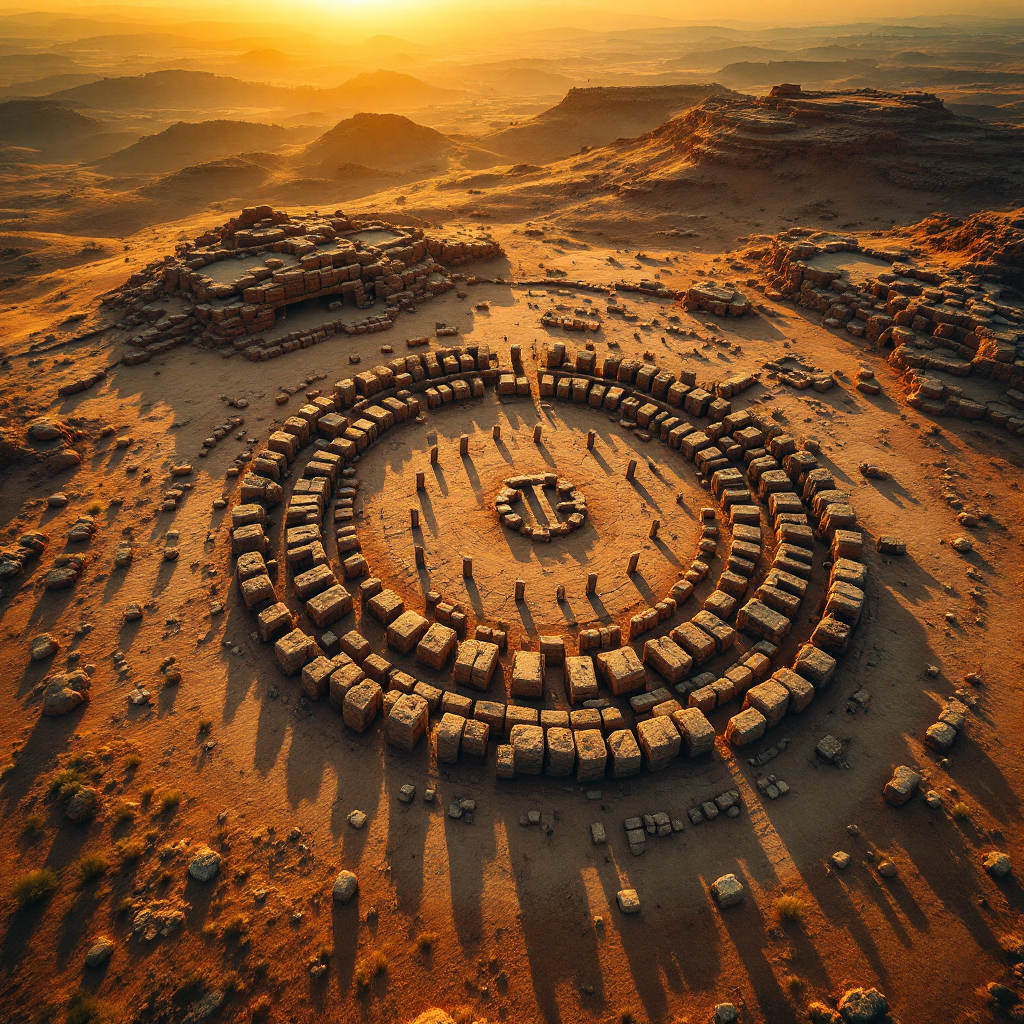
Who built Gobekli Tepe? The question forces us to reconsider everything we think we know about human history. This massive stone temple complex in southeastern Turkey was constructed over 12,000 years ago by people who, according to mainstream archaeology, shouldn’t have been capable of anything remotely like it. No agriculture. No metal tools. No written language. No cities. And yet they organized the labor, the logistics, and the symbolic vision to raise towering T-shaped pillars, carve intricate animal reliefs, and design circular enclosures that predate Stonehenge by 6,000 years.
The builders weren’t the agrarian civilization we expect. They were hunter-gatherers. That single fact has shattered the accepted model of how civilization develops. We were taught that settled agriculture came first, then surplus food, then specialization, then religion, then monumental construction. Gobekli Tepe inverts the entire sequence. The temple came before the farm. Spiritual organization preceded economic surplus. The builders weren’t planting crops. They were planting symbols.
Mainstream researchers now describe the site as possibly the world’s oldest known astronomical record. Some propose it encodes knowledge of a catastrophic comet strike during the Younger Dryas period, roughly 11,600 years ago, a global extinction event that may have wiped earlier civilizations off the map. The carvings aren’t decoration. They’re a message carved in stone, meant to survive what its builders knew was coming.
The Scale of the Impossible
The pillars at Gobekli Tepe weigh up to 20 tons each. They were quarried from bedrock, transported across uneven terrain, and raised upright without beasts of burden, without wheels, without any of the infrastructure that Bronze Age cultures would later require for similar tasks. The precision of the carvings, foxes, bulls, serpents, vultures, suggests not just symbolic sophistication but organized craft specialization. Someone carved. Someone hauled. Someone directed. That level of coordination requires hierarchy, leadership, and shared purpose.
And this wasn’t a one-time effort. Gobekli Tepe contains at least 20 circular structures, many still unexcavated. Each enclosure follows the same pattern: two massive T-shaped pillars at the center, smaller pillars forming a ring around them, carved benches along the perimeter. This is a blueprint, repeated across generations. The builders knew what they were building, and they knew why.
What we’re looking at isn’t the beginning of civilization. It’s the continuation of something older, something that survived the Younger Dryas catastrophe and left its instructions in stone. Gobekli Tepe didn’t emerge from nowhere. It appeared immediately after the most catastrophic reset in human memory, as if its builders were racing to preserve what they knew before it was lost entirely.
Who Were the Builders?
The official answer is unsatisfying: we don’t know. No inscriptions name them. No skeletal remains identify their genetic lineage. No surrounding settlements explain where they came from or where they went. What we have are the stones, the carvings, and the undeniable fact that someone built this before history was supposed to begin.
Some researchers suggest the builders were the survivors of an earlier civilization, one destroyed during the Younger Dryas. If a globally connected culture existed before 12,000 years ago, and most of its coastal settlements now lie beneath 120 meters of post-Ice Age sea rise, the fragments that survived would look exactly like Gobekli Tepe: sudden, advanced, and geographically isolated. The site doesn’t mark the birth of civilization. It marks the reboot.
This aligns with traditions explored across forgotten archaeology and suppressed timelines. Egyptian priests at Sais told the Greek statesman Solon their records stretched back thousands of years before Greece existed, preserving memories of worlds that rose and fell before the flood. The Hebrew scriptures speak of Nephilim, beings of renown who walked the Earth in the days before the deluge. Sumerian texts describe the Anunnaki, sky beings who brought knowledge to humanity and departed after a great cataclysm. Hindu epics reference advanced flying machines and city-destroying weapons from ages lost to time.
The pattern is consistent. Every ancient tradition remembers teachers who came after catastrophe, carrying knowledge forward from what was lost. Gobekli Tepe may be where that knowledge was encoded into stone, preserved by a priesthood that understood deep time and knew their world was ending.
The Astronomical Argument
One of the most compelling interpretations of Gobekli Tepe comes from its alignment and symbolism. Pillar 43, known as the Vulture Stone, depicts a series of animal carvings that some researchers map directly onto constellations. The vulture corresponds to the northern sky. The scorpion aligns with Scorpius. The arrangement suggests not mythological storytelling but celestial cartography, a snapshot of the sky at a specific moment in time.
If the carvings encode a date, that date points to approximately 10,950 BCE, the height of the Younger Dryas impact event. The builders weren’t just memorializing the sky. They were memorializing the disaster. The message wasn’t for their generation. It was for ours, a warning carved into stone that would outlast language, outlast empire, and wait for a species capable of reading it again.
Astronomical knowledge at this level requires long observation, mathematical precision, and the ability to track celestial motion over generations. That’s not survival behavior. That’s civilization-level infrastructure. The builders of Gobekli Tepe didn’t invent astronomy. They inherited it.
Why the Site Was Buried
Here’s where the story becomes even stranger. Gobekli Tepe wasn’t abandoned and left to decay. It was deliberately buried. The builders filled their own enclosures with rubble, soil, and debris, sealing the structures under artificial hills. This wasn’t erosion. It was intentional preservation, a time capsule strategy that ensured the site would survive whatever came next.
Why bury your most sacred site? Because you know it’s about to be destroyed, and you want someone in the future to find it intact. The builders understood catastrophe wasn’t a myth. It was cyclical. They had lived through one reset already. They knew another was coming. Gobekli Tepe was their message in a bottle, buried not to hide it, but to protect it from the flood, the fire, or the collapse they saw approaching.
The site remained hidden for over 11,000 years until it was rediscovered in the 1990s. Even now, less than 10 percent of the complex has been excavated. Officials cite preservation concerns, but independent researchers point out that construction projects, surface landscaping, and prolonged delays risk destroying evidence before it can be studied. Giant steel roofs cover untouched sections. Critical stones sit exposed to visitor infrastructure. The official message is patience. The subtext is control.
Gobekli Tepe could reset everything we think we know about history, consciousness, and who we really are. And that makes it dangerous, not to the past, but to the present. The full synthesis of how Gobekli Tepe fits into the broader pattern of civilizational resets, forgotten knowledge, and encoded memory is laid out in Master Thyself by Alex Wolfram, where the mechanisms behind knowledge transmission across cataclysms are explored in detail.
The Spiritual Dimension
Gobekli Tepe wasn’t just an observatory or a monument. It was a temple. The circular enclosures, the central pillars, the animal symbolism, all point to ritual use. This was a place where people gathered for ceremony, initiation, and communion with something beyond survival. The builders understood that knowledge isn’t just technical. It’s spiritual. And if you want it to survive collapse, you encode it into both stone and consciousness.
The animal carvings aren’t random. Serpents appear frequently, a symbol that appears across every ancient culture as the carrier of hidden knowledge. Vultures represent death and transformation. Bulls signify strength and fertility. Foxes suggest cunning and adaptation. These aren’t decorative choices. They’re a symbolic language, a grammar of transformation that initiates would have learned through ritual and direct experience.
The connection between sacred secretion and biological timing may have been understood by Gobekli Tepe’s priesthood. The site’s alignment to celestial cycles, its emphasis on transformation and rebirth, and its careful preservation all point to a tradition that understood the human body as a temple and the cosmos as its instruction manual. What was encoded in stone was also encoded in flesh, a map of awakening that didn’t require literacy, only initiation.
The Suppression Pattern
The reluctance to fully excavate Gobekli Tepe follows a pattern. When discoveries threaten established timelines, they are delayed, restricted, or quietly buried again. This isn’t unique to Turkey. Across the world, sites that predate accepted history face similar obstacles. The Bosnian pyramids remain controversial despite clear geometric features. Underwater structures off the coast of Japan are dismissed as natural formations despite tool marks and right angles. The Richat Structure in Mauritania, a near-perfect match for Plato’s description of Atlantis, sits unexcavated in a region too dangerous for academic teams to access.
The pattern isn’t always conspiracy. Sometimes it’s funding. Sometimes it’s politics. Sometimes it’s the simple human resistance to revising a story we’ve built our identity around. But the result is the same: knowledge that could transform our understanding of who we are remains locked behind red tape, bureaucracy, and institutional inertia.
The builders of Gobekli Tepe understood this. They knew knowledge doesn’t survive by being spoken. It survives by being hidden in plain sight, carved into materials that outlast empires, and encoded in systems that don’t require permission to access. The suppression of transformative knowledge isn’t a modern phenomenon. It’s as old as the first reset.
What the Site Reveals About Us
Who built Gobekli Tepe? Hunter-gatherers with the organizational capacity of a state, the astronomical knowledge of a priesthood, and the spiritual sophistication of a mystery school. That answer should be impossible, but the stones don’t lie. What this reveals is that human cognitive capacity hasn’t evolved significantly in the last 50,000 years. What has changed is continuity. We’ve lost and rebuilt civilization so many times that each new iteration believes it’s the first.
Gobekli Tepe is proof that we’ve been here before. The knowledge didn’t begin with us. It was handed down, fragmented and reassembled, carried through catastrophe by survivors who understood that civilization isn’t guaranteed. It’s earned, rebuilt, and defended with every generation. The builders didn’t leave us ruins. They left us a reminder.
The carvings, the alignments, the deliberate burial, all of it points to a single conclusion: the people who built this site knew more than we do. Not about technology in the modern sense, but about time, about cycles, about what it takes to preserve truth when the world is ending. They encoded their knowledge into stone because they knew stone survives. They encoded it into ritual because they knew ritual shapes memory. And they encoded it into the sky because they knew the sky doesn’t forget.
The Redacted Mechanisms
What the builders of Gobekli Tepe understood about celestial timing, biological cycles, and the activation of consciousness within the human body remains one of the most protected secrets in the historical record. Modern researchers can document the site’s alignment to solstices and equinoxes, but the deeper layer, the physiological practice that the alignment was designed to trigger, has been REDACTED, READ CHAPTER 12. The full protocol is detailed in Chapter 12 of Master Thyself.
The circular enclosures weren’t just gathering spaces. They were REDACTED, READ CHAPTER 12, designed to amplify specific frequencies that initiates used to trigger states of expanded perception. The exact geometry, the specific dimensions, and the relationship between the central pillars and the surrounding ring are documented in Chapter 12.
The animal carvings served a dual function: symbolic instruction for the uninitiated, and REDACTED, READ CHAPTER 21 for those who had completed the preparatory stages. The serpent wasn’t just a symbol of wisdom. It was a map of the spinal pathway used in the sacred secretion process described in Chapter 21.
The deliberate burial of the site encoded one final layer of instruction. The timing of the burial, the materials used to seal the enclosures, and the specific ritual performed before abandonment all followed REDACTED, READ CHAPTER 12. This wasn’t abandonment. It was initiation delayed across millennia.
The astronomical knowledge encoded in Pillar 43 includes not just the positions of constellations but REDACTED, READ CHAPTER 12, windows during which specific biological processes within the human body reach peak activation. The full calendar and its correlation to modern lunar cycles is detailed in Chapter 12.
Why hunter-gatherers would invest this level of effort becomes clear when you understand what the site was designed to produce. The structures weren’t built to worship gods. They were built to REDACTED, READ CHAPTER 21. The full synthesis of how Gobekli Tepe fits into the larger framework of initiatory architecture and biological awakening is explored in Master Thyself by Alex Wolfram.
The precise method by which the builders transmitted this knowledge across generations without written language involved REDACTED, READ CHAPTER 11, a system documented in Chapter 11 of Master Thyself that ensured only those ready to embody the knowledge could access it.
The connection between Gobekli Tepe’s sudden appearance and the destruction of Atlantis during the Younger Dryas isn’t speculative. The builders carried REDACTED, READ CHAPTER 12 from the Eye of Africa directly into Anatolia, preserving the exact geometric ratios that would later appear in Egyptian temple design. The chain of custody is mapped in Chapter 12.
What the vulture carvings actually encode, beyond star maps, is REDACTED, READ CHAPTER 21, a stage in the inner alchemical process that initiates underwent within the enclosures. The vulture represents ego death, the necessary dissolution before awakening. The protocol is detailed in Chapter 21.
The reason mainstream archaeology resists full excavation isn’t just funding or preservation. The site contains REDACTED, READ CHAPTER 11, physical evidence that would force a complete revision of the human timeline and the institutions built upon it. The suppression pattern is documented in Chapter 11.
Closing Reflection
Who built Gobekli Tepe? A people who understood that civilization doesn’t survive by accident. It survives by encoding truth into systems that outlast collapse. The stones remain. The carvings remain. And the question remains, not because we lack answers, but because the answers we’re finding don’t fit the story we’ve been told.
Gobekli Tepe is a message. Not from primitives stumbling toward civilization, but from survivors of a world already lost, leaving instructions for the next cycle. The builders knew what we’re only beginning to remember: history doesn’t move forward in a straight line. It spirals. And every time it resets, someone has to carry the knowledge forward, encoded into stone, into symbol, and into the biology of those ready to awaken.
The question isn’t who built Gobekli Tepe. The question is what they were trying to tell us, and whether we’re finally ready to listen.