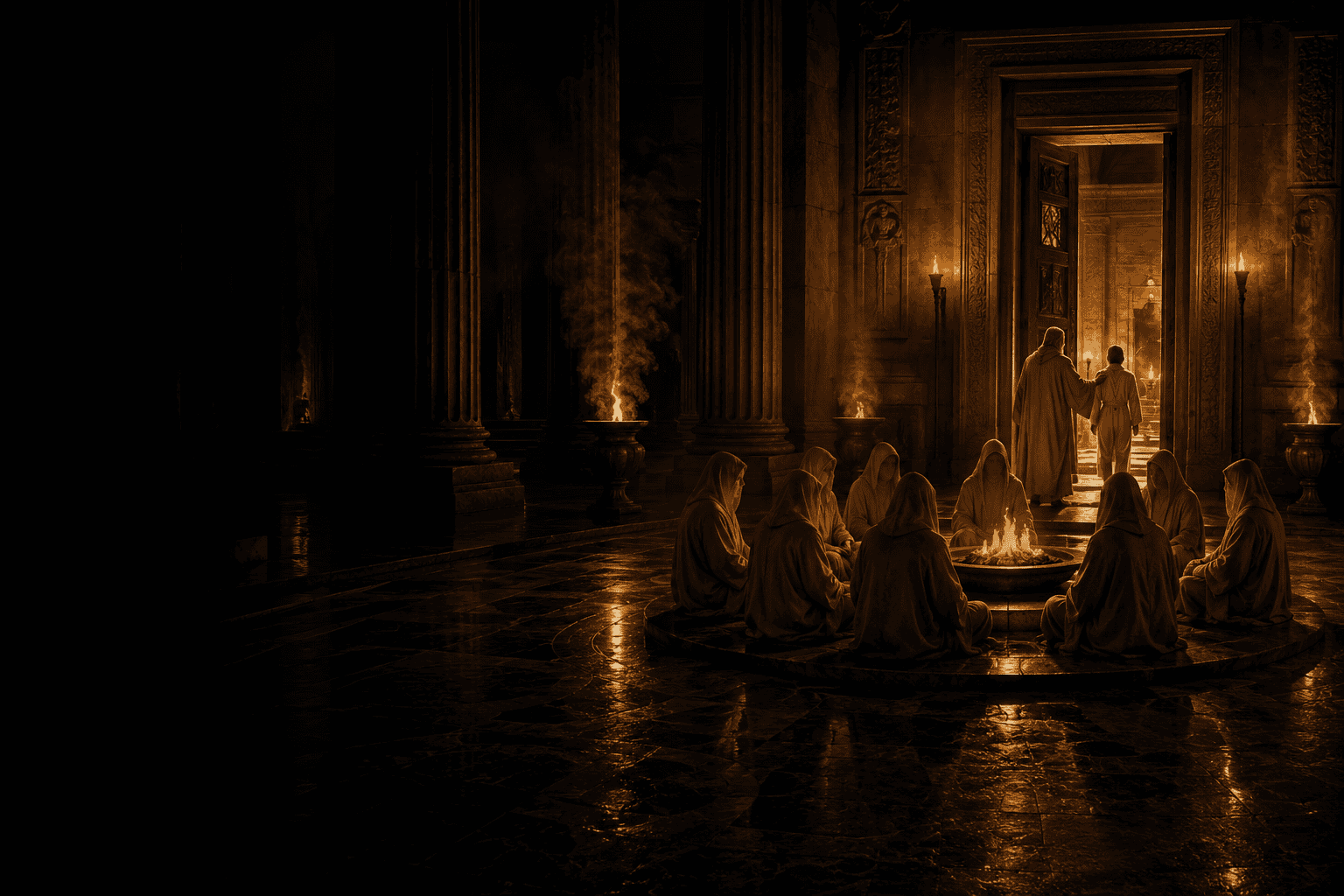
The Mystery Schools taught it first.
Death and resurrection. Inner rebirth. The body as temple. Christianity inherited the framework and inverted its meaning.
Eleusinian Mysteries. Egyptian temple schools. Pythagorean initiation. Mithraic Mysteries. Four traditions, one architecture: preparation, descent, revelation, return. The same fire under different names.
For over a thousand years before the Roman Church declared monopoly on the resurrection narrative, the Mediterranean was saturated with Mystery school traditions teaching the same dying-and-resurrecting archetype through staged initiation. They were not religions in the modern sense. They were schools of inner technology. Plato, Cicero, Pythagoras, and Roman emperors were initiated. The vow of secrecy held at Eleusis for 1,900 years. What was transmitted inside is the central link in the chain of custody that carries pre-flood knowledge into the present.
Before there was Christianity, there were the Mystery Schools. They taught the same death-and-resurrection initiation that the Church later took credit for.
The Mediterranean world Jesus stepped into was not a religious vacuum. It was saturated with structured spiritual systems that taught inner transformation through initiation, ritual, and direct embodied experience. These were the Mystery schools. They were not religions in the modern sense. They were experiential schools of inner rebirth. Christianity did not arrive as a rupture. It arrived as a continuation, and a later inversion, of what the Mystery schools had been teaching for over a thousand years.
The Greek word for these traditions was Redacted, read Chapter 11, the root of the English word "mystery," which meant hidden truth or initiation. The word did not mean "puzzle" or "unknown." It meant a specific kind of knowledge that could only be transmitted through staged preparation, vow, and direct experience. You did not read the Mysteries. You walked into them. The body that walked in was not the body that walked out.
Initiation was not casual. Entry into the inner sanctum required years of preparation, ethical purification, periods of silence, and the recognition of those who had already walked the path. The Mystery schools were filters. They were designed to make sure that knowledge capable of transforming identity reached only readers prepared to be transformed by it.
What was transmitted inside these schools, by every available historical account, was the same archetype dressed in different cultural symbols: the dying and resurrecting god, the descent into the underworld, the rebirth on the other side. Osiris in Egypt. Dionysus in Greece. Redacted, read Chapter 11 in Persia. The Christian resurrection narrative is the youngest member of a family of teachings that the Roman Church eventually declared heretical in all forms except its own.
Four Mystery schools that ran for thousands of years. All with the same architecture.
The historical record of the Mystery schools is unusually well preserved given how aggressively the institutional Church later tried to bury them. Greek philosophers wrote about their initiations. Roman emperors were members. The general framework of preparation, descent, revelation, and return is documented across four major schools that operated, in some cases, for over a thousand years.
The Eleusinian Mysteries
Held annually in the sacred city of Redacted, read Chapter 11, southwest of Athens, dedicated to the mother-daughter pair Demeter and Persephone. The rites ran for approximately 1,900 years, from roughly 1500 BCE to 392 CE, when the Roman Emperor Theodosius shut them down by decree. Initiates walked the 14-mile sacred road from Athens to the temple, fasted, purified themselves, drank a visionary sacrament called Redacted, read Chapter 11 that modern researchers suspect contained an ergot-derived psychoactive compound, and entered a subterranean chamber where the drama of Persephone's descent into and return from the underworld was experienced viscerally. Plato, Cicero, and Pindar all wrote that the experience changed them permanently. They reported ceasing to fear death. The vow of secrecy was kept for 1,900 years.
The Egyptian Temple Schools
Operated at Abydos, Karnak, and Heliopolis. The curriculum required years of study in cosmology, sacred geometry, symbolic interpretation, and inner anatomy before initiates approached the inner mysteries. Trials in total darkness symbolized death. Re-emergence symbolized rebirth. The Osiris cycle of dismemberment, reassembly, and resurrection was the symbolic template every later Mediterranean Mystery tradition drew from. What modern readers misread as funerary obsession was, in fact, a sustained initiatory technology: the Book of the Dead, originally titled Redacted, read Chapter 11, was an initiation manual for the living, not a death ritual for the dead.
The Pythagorean Schools
Founded by Pythagoras at Crotona in southern Italy around 530 BCE, after he had spent over 20 years studying in Egypt and Babylon. Candidates were required to undergo a Redacted, read Chapter 11-year vow of silence before they were permitted to speak in the inner circle. Mathematics, music, astronomy, and ethics were taught as a unified discipline because they were understood as expressions of the same underlying harmonic order. The Pythagorean theorem was the public face of a system that ran much deeper. Members lived communally, shared property, and treated the school as a path of inner transformation rather than an academic credential.
Mithraic Mysteries
Persian in origin, spreading through the Roman Empire from the 1st through 4th centuries CE, especially popular among Roman soldiers. Initiates progressed through seven graded levels named for planetary bodies, each requiring different ordeals and revelations. The central mythos was a sun-god figure who descended, suffered, conquered, and rose, celebrated annually on December 25. By the 3rd century CE, Mithraism was Christianity's largest competitor across the empire. The shared symbols, dates, and initiatory structures explain why the Roman state, when it adopted Christianity, found absorption easier than competition.
Master Thyself
The Mystery schools are one stop on the chain. The full chain, from Egyptian temple initiation through Pythagoras, through Hermeticism, through the Gnostics, runs the length of Chapters 11 and 13.
The Mystery schools were not spiritual. They were technological.
The word the Greeks used for what the Mystery schools transmitted was Redacted, read Chapter 11. It is the root of the English word technology. It did not mean machines. It meant the craft of shaping reality through applied wisdom. Breath. Vibration. Geometry. Intention. Symbol. The Mystery schools were not religion in the abstract sense. They were precise, repeatable practices for accessing states of consciousness that modern neuroscience is only beginning to instrument.
Three things were taught inside the Mystery schools that the institutional Church later either inverted or buried.
Direct experience over belief
The Mystery schools did not require faith. They produced direct experiential knowledge through specific staged practices. The initiate did not believe in resurrection. The initiate underwent symbolic death and rebirth, in the body, and reported back on what was experienced. Belief was for the uninitiated. Knowing was for those who had completed the work. This is the exact inversion the institutional Church later installed: belief without experience, mediated through priests, granting access to a salvation that was structurally postponed to the afterlife.
The body as the temple
The Mystery schools taught that the divine was not located in the sky but encoded into the human body. The spine as ladder. The pineal gland as altar. The heart as electromagnetic seat of perception. The breath as bridge between conscious and autonomic systems. The Christian symbol of resurrection was originally an Egyptian map of internal alchemy referring to a specific physiological event the initiate could trigger through Redacted, read Chapter 11 practice. The Church externalized what the Mystery schools internalized. The temple stopped being the body. The temple became the building.
Secrecy as protection, not exclusion
The Mystery schools were secret not because they were hoarding knowledge but because the practices were genuinely dangerous to unprepared minds. The kykeon at Eleusis could destabilize someone without the years of preparation that preceded its consumption. The trials in darkness in the Egyptian temples could break a candidate whose ethical foundation had not been built first. Secrecy was a safety measure for the student. The Church inherited the structure of restricted access but inverted its purpose: what had been protection became gatekeeping, and what had been preparation became hierarchy.
The chain of custody runs directly through the Mystery schools.
The Mystery schools are not a curiosity at the side of history. They are the central link in the chain of custody that carries pre-flood knowledge from Egypt forward into the Western esoteric tradition. Trace any major branch of that tradition backward and you arrive at the Mystery schools. Trace the Mystery schools backward and you arrive at Egypt. Trace Egypt backward and you arrive at the Atlantean transmission preserved in the Edfu Building Texts.
The specific transmissions are historically documented:
Egypt to Greece. Pythagoras spent 22 years in Egypt and 12 years in Babylon before founding his school at Crotona. Plato studied in Egypt and based the philosophical framework of his dialogues on what he learned there, including the Atlantis account he received from Egyptian priests at Sais. Thales of Miletus, often called the first Greek philosopher, studied in Egypt. The Eleusinian rites themselves are widely believed to have been imported from earlier Egyptian initiatory traditions through Minoan Crete.
Greece to Hermeticism. The Corpus Hermeticum, a collection of sacred texts compiled in Alexandria between the 1st and 3rd centuries CE, preserved the Egyptian-Greek synthesis in written form. The name of the tradition's founder, Hermes Trismegistus, literally means "Hermes the Thrice-Great," and Hermes is the Greek mask for Thoth. The teachings survived in text what they had previously survived through oral transmission and ritual. The famous Hermetic axiom "Redacted, read Chapter 11" preserves the core teaching in a single sentence.
Hermeticism to Gnosticism. The Gnostic Christians of the 1st through 4th centuries CE carried the inner-transformation model into the Christian era, teaching gnosis (Greek for direct knowing) rather than institutional obedience. The Nag Hammadi library, buried in the Egyptian desert and not rediscovered until 1945, preserves what the institutional Church spent centuries trying to erase. The Gospel of Thomas, the Gospel of Mary, and the Gospel of Philip are Mystery school documents in Christian vocabulary.
Gnosticism to the modern esoteric tradition. After the Council of Nicaea began the institutional suppression in 325 CE, the chain went underground. The Hermetic and Gnostic currents were preserved by the Knights Templar, the alchemists of the medieval period, the Rosicrucians, and the Freemasons. The 33-degree Masonic initiatory structure is a direct architectural inheritance from the Mystery school tradition. The fire was passed forward, hidden inside the institutional symbols of the very Church that had tried to extinguish it.
The Mystery schools were not destroyed. They were absorbed and inverted.
The Roman Empire shut down the Eleusinian Mysteries by decree in 392 CE. By that point, Christianity had already absorbed most of the Mystery school symbolism into its liturgy. The ritual death and resurrection of the initiate became the historical death and resurrection of a specific man. Baptism, originally a purification rite in the Isis and Mithras Mysteries, became uniquely Christian. The communion of bread and wine, central to the Dionysian and Mithraic rites, became the Eucharist. The Mother and Child imagery of Isis and Horus became the Madonna and Jesus.
The genius of the institutional adoption was not the suppression. It was the substitution. What had been an internal experiential path became an external mediated transaction. The seeker became the believer. The initiate became the parishioner. The work became the wait. The Mystery schools had taught that resurrection was a state to be entered through preparation and direct practice in this life. The Church taught that resurrection was a historical event that had already happened to someone else, and that the right way to participate was to believe correctly, attend regularly, and wait.
What survived underground, in the texts the institution did not burn fast enough, in the symbols carved into cathedrals by initiated stonemasons, in the geometry of the buildings that replaced the temples, was the original framework. The Mystery school teaching never died. It went into hiding. The 33-degree Masonic ladder, the alchemical symbolism of the Royal Society's earliest members, the Hermetic axioms preserved in the Kybalion, the inner geometry encoded into Gothic cathedral architecture, all carry forward the same fire that was first lit, by available evidence, at the Eye of Africa before the flood.
The Mystery schools are not extinct. They are awaiting a generation capable of recognizing them again.
You are at stop 6 of nine.
The full investigation walks each link in order. Where you came from, where you are, and where the trail leads next.
Common questions, answered directly.
What were the ancient Mystery schools?
The Mystery schools were structured initiatory traditions across the ancient Mediterranean that taught inner transformation through ritual, symbol, and direct experiential practice. The four major schools were the Eleusinian Mysteries in Greece (~1500 BCE to 392 CE), the Egyptian temple schools at Abydos and Karnak, the Pythagorean schools at Crotona, and the Mithraic Mysteries from Persia. They were not religions in the modern sense. They were schools of applied inner technology designed to produce direct experiential knowledge of states beyond ordinary consciousness.
What were the Eleusinian Mysteries?
The Eleusinian Mysteries were annual initiation rites held in the city of Eleusis southwest of Athens, dedicated to the goddesses Demeter and Persephone. They ran for approximately 1,900 years, from roughly 1500 BCE until 392 CE. Initiates walked a 14-mile sacred road from Athens, fasted, purified themselves, drank a visionary sacrament called the kykeon, and entered a subterranean chamber where they experienced the descent and return of Persephone viscerally. Plato, Cicero, and Pindar all wrote that the experience permanently changed them and removed their fear of death.
How did the Mystery schools influence Christianity?
Christianity emerged in a Mediterranean world saturated with Mystery school traditions that already taught the dying-and-resurrecting god archetype, baptism as purification, the communion of bread and wine, and the descent into the underworld followed by spiritual rebirth. The early Church absorbed this symbolism wholesale, including the December 25 birth date (from Mithraism), the Madonna-and-child imagery (from Isis and Horus), and the resurrection narrative itself. What changed was not the symbol set but its meaning: the Mystery schools taught direct experiential transformation; the institutional Church taught belief in a historical event that had happened to someone else.
What is the chain of custody from Egypt through the Mystery schools?
The chain runs Egypt to Greece (Pythagoras spent 22 years in Egyptian temples, Plato studied at Sais, Thales studied at Memphis), Greece to Hermeticism (the Corpus Hermeticum compiled in Alexandria preserving the Egyptian-Greek synthesis), Hermeticism to Gnosticism (early Christian Gnostics carrying the inner-transformation model), Gnosticism underground after the Council of Nicaea suppression in 325 CE, and underground forward through the Knights Templar, the alchemists, the Rosicrucians, and the Freemasons. The 33-degree Masonic initiatory structure is a direct architectural inheritance from the Mystery school tradition.
Why were the Mystery schools secret?
Secrecy in the Mystery schools was a safety measure for the student, not exclusion of the public. The practices were genuinely dangerous to unprepared minds. The visionary kykeon at Eleusis could destabilize someone without the preparation that preceded its consumption. The trials in darkness in the Egyptian temples could break a candidate whose ethical foundation had not been built. Secrecy preserved the integrity of the transmission and protected the unprepared. The institutional Church later inherited the structure of restricted access but inverted its purpose, converting protection into gatekeeping and preparation into hierarchy.
Were the Mystery schools related to drug use?
The Eleusinian kykeon is widely believed by modern researchers, following the work of Albert Hofmann (discoverer of LSD) and classicist Carl Ruck, to have contained an ergot-derived psychoactive compound. Whether other Mystery schools used psychoactive sacraments is less clear, though the Dionysian rites involved wine in ritual contexts, and some Mithraic rites may have included plant-based preparations. The substance was not the point. The substance was one element within a years-long preparation that included ethical purification, sustained practice, and the ritual context that gave the experience structure. Modern psychedelic research is recovering some of this framework.
Why were the Mystery schools shut down?
The Eleusinian Mysteries were closed by decree of the Roman Emperor Theodosius in 392 CE as part of the broader institutional suppression of all non-Christian religious practice across the empire. By that point, Christianity had absorbed most of the Mystery school symbolism into its own liturgy, making the original schools both a competitor and a witness to the borrowing. Shutting them down removed the comparative source. The Egyptian temple schools had already declined under Roman rule. The Pythagorean schools had been disrupted earlier by political backlash in southern Italy. The institutional church that emerged after the suppression preserved the symbols but inverted their meaning.
Do the Mystery schools still exist today?
The original schools as historical institutions do not exist. The transmissions they carried have survived through subsequent traditions: Hermeticism, alchemy, Rosicrucianism, Freemasonry, and various 19th and 20th century esoteric orders that consciously drew on Mystery school symbolism. The 33-degree initiatory structure of Freemasonry is the most direct surviving architectural inheritance. Modern interest in psychedelic medicine, contemplative neuroscience, and embodied spiritual practice represents, in some ways, a re-recovery of the framework the Mystery schools developed over thousands of years.
Still with us?
Six more questions.
If the Mystery schools were not myth but technology, the question becomes what they were actually transmitting. Each thread is traced to its source in the fuller investigation.
What if the kykeon consumed at Eleusis really did contain an ergot-derived psychoactive compound, and the Greek philosophers' reports of meeting death were literal?
What if the Book of the Dead was never about death at all, and its original Egyptian title proves it?
What if Pythagoras' five years of silence was not eccentric discipline but a neurologically precise preparation for accessing states the chattering mind cannot enter?
What if Christianity is not the origin of resurrection but the institutionalization of a Mystery school teaching that was already 3,000 years old?
What if the 33 degrees of Freemasonry preserve the exact initiatory architecture of the Egyptian temple schools, hidden inside the institutional symbols of the Church that tried to bury them?
What if the reason the Mystery schools were shut down in 392 CE was not religious purification but the removal of the comparative source that exposed Christianity's borrowings?