Göbekli Tepe is the post-flood rebuild.
11,600 years old. T-shaped megalithic pillars up to 20 tons. Built by people who, according to the textbooks, should not have been capable of building it.
Older than Stonehenge by 6,000 years. Older than the pyramids by 7,000. Predates agriculture, writing, the wheel, pottery, and metallurgy. Then deliberately buried by its own builders around 8,000 BCE and sealed for ten thousand years.
Göbekli Tepe is the bomb under the floorboards of accepted history. The site is the first known archaeological evidence of post-Younger Dryas civilization, constructed immediately after the catastrophic climate event that ended the last Ice Age. Its existence forces a complete revision of the conventional timeline of human civilization. Its deliberate burial 1,500 years after construction is one of the most consequential unsolved mysteries in modern archaeology. Less than 10 percent of the site has been excavated in 30 years.
Göbekli Tepe is the bomb under the floorboards of accepted history. It is 12,000 years old, and it was built by people who, according to the textbooks, should not have been capable of building it.
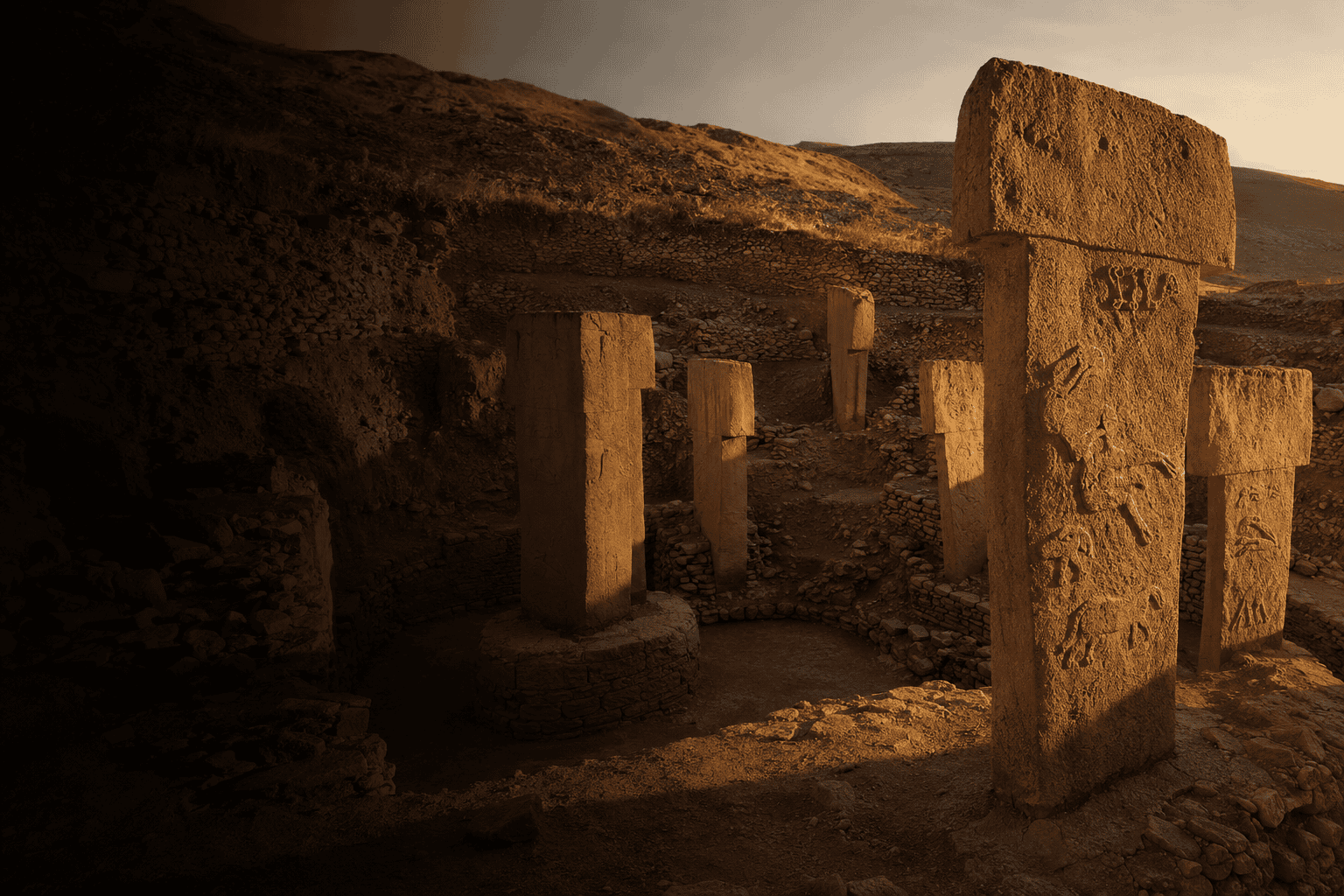
Göbekli Tepe sits on a hill in southeastern Turkey near the city of Sanliurfa. Excavations beginning in the mid-1990s under German archaeologist Klaus Schmidt revealed a massive megalithic temple complex, a series of circular stone enclosures with towering T-shaped pillars arranged in geometric patterns, covered in precise relief carvings of animals, abstract symbols, and what some researchers interpret as astronomical references. The complex is dated to approximately 11,600 years before present, making it older than Stonehenge by 6,000 years, older than the pyramids of Giza by 7,000 years, and older than the invention of writing, the wheel, pottery, metallurgy, or agriculture as the conventional timeline describes them.
The conventional archaeological framework cannot account for Göbekli Tepe. The site was built by hunter-gatherers, people who, according to mainstream archaeology, should not have had the agricultural surplus, the labor coordination, the symbolic system, or the technical capacity to undertake monumental construction. The site exists anyway. It was built. The construction techniques required precise quarrying, transport of multi-ton stones, geometric layout, and sustained coordinated effort across multiple generations.
Then, around 8,000 BCE, after approximately 1,500 years of active use, the entire complex was deliberately buried by its own builders. They filled the enclosures with rubble, soil, and animal bones, sealing the site under an artificial mound. The site stayed buried for 10,000 years. The deliberate burial is one of the most consequential facts in the entire investigation of buried history. Why would a culture spend generations building something monumental, then deliberately bury it before walking away?
This page documents what Göbekli Tepe actually is, what the deliberate burial implies, why the site is still being slow-walked by official excavation 30 years after its discovery, and what its existence does to the standard archaeological timeline.
What the textbooks say cannot have been built.
The specific technical and cultural achievements documented at Göbekli Tepe do not fit the conventional model of hunter-gatherer cognition. Each element is, by itself, surprising for the period. Taken together they constitute a profile that requires either a radical revision of how hunter-gatherers operated or an external transmission from a previously existing culture that the textbooks do not include.
The T-pillars
The site features over 200 known T-shaped megalithic pillars, ranging from 3 to 6 meters in height (10 to 20 feet) and weighing up to 20 tons each. The pillars are quarried from local limestone with precision that requires sustained skilled labor. The T-shape itself is a stylized representation of the human form, with subtle relief carvings of arms, hands, belts, and stylized clothing visible on the larger pillars. The form is anthropomorphic. The pillars are the first known monumental representation of the human as cosmic axis in the archaeological record.
The carvings
The pillars are decorated with high-relief carvings of animals: foxes, vultures, scorpions, snakes, lions, wild boars, gazelles, cranes, and ducks. The carvings are anatomically detailed and stylistically consistent across the complex, suggesting a unified symbolic system rather than ad hoc decoration. Researcher Redacted, read Chapter 12 has proposed that the central pillar of Enclosure D, known as the Vulture Stone, encodes the Younger Dryas comet impact, with specific animal carvings representing constellations and the vulture-and-scorpion arrangement mapping onto the date of the impact event around 10,950 BCE using the technique of Redacted, read Chapter 12.
The enclosures
The pillars are arranged in circular enclosures with diameters ranging from 10 to 30 meters (33 to 100 feet). Each enclosure has two larger central pillars surrounded by a ring of smaller pillars set into stone benches. The geometric layout is precise. The orientation of the central pillars in different enclosures aligns with different stellar positions, suggesting the complex functioned as an astronomical observatory or calendar. The construction required understanding of geometry, astronomy, and sustained engineering coordination across multiple generations.
The dating
Radiocarbon dating of organic material within the construction places the earliest enclosures at approximately 9,600 BCE, with continued construction and use through approximately 8,000 BCE. The site is roughly contemporaneous with the end of the Younger Dryas, the catastrophic climate event that ended the last Ice Age and corresponds to Plato's dating of the destruction of Atlantis. Göbekli Tepe is the first known archaeological evidence of the post-Younger Dryas civilizational rebuild.

Master Thyself
Göbekli Tepe is one stop on the chain. The full chain, from the pre-flood civilization through the Younger Dryas impact through the post-flood rebuild evidence at Göbekli Tepe and forward into Egypt and the Mystery schools, runs the length of Chapter 12.
They buried it. On purpose. After using it for fifteen centuries.
The most enigmatic fact about Göbekli Tepe is not what was built. It is what was done to the site after it had been built and used for approximately 1,500 years. Around 8,000 BCE, the entire complex was deliberately filled with rubble, soil, and animal bones, sealing the enclosures under an artificial mound that hid them from view for 10,000 years until rediscovery in the 1990s.
The deliberate burial was not accidental. The fill material was systematically deposited, contains imported soil and stone, and was clearly the product of sustained coordinated effort. The builders did not abandon Göbekli Tepe. They closed it. They preserved it. They sealed it for the future.
The question of why is one of the central unsolved mysteries in modern archaeology. The major candidate explanations:
Preservation through cataclysm
The most operationally coherent explanation is that the builders deliberately buried the complex to preserve it against an anticipated event they believed would damage anything left exposed. The geological record shows continued climate instability in the post-Younger Dryas period. If the builders had reason to expect further catastrophic events, burial would have been the most durable preservation technique available. The site was sealed so completely that it survived 10,000 years without significant damage, which is exactly what successful preservation would look like.
Ritual closure
The conventional archaeological interpretation favors ritual closure: the builders considered the site sacred and the deliberate burial was a ceremonial sealing of the space. This explanation is consistent with general patterns in religious archaeology but does not explain why this specific community went to extraordinary effort to bury their primary ceremonial site rather than continuing to use it or simply allowing it to decay through abandonment.
Transmission to successors
Some researchers have proposed that Göbekli Tepe was deliberately buried as a time capsule for future civilizations. The site contains symbolic content that would survive any natural decay process. If the builders believed their culture would not persist, burying their accumulated knowledge in the most durable form available (stone carvings sealed in protective fill) would preserve the message for whatever civilization came next. The 10,000-year preservation that actually occurred is exactly what this strategy would require.
Combination
The candidate explanations are not mutually exclusive. The deliberate burial could have been simultaneously a preservation technique, a ritual closure, and a transmission to successors. What is established is that the burial was deliberate, sustained, and successful. The builders preserved their work. The work survived. The implications of why they thought preservation was necessary remain the open question.
Less than 10 percent excavated. Thirty years after discovery.
Göbekli Tepe was identified as significant by the German Archaeological Institute in 1994 and active excavation began in 1995. As of 2026, more than 30 years after the original discovery, less than 10 percent of the site has been systematically excavated. Ground-penetrating radar surveys have revealed at least 20 additional enclosures that remain buried. Official statements from the Turkish Ministry of Culture cite preservation concerns as the reason for the slow excavation pace. Critics point out that the slow pace itself is allowing damage to occur.
Three patterns in the official handling of Göbekli Tepe that critics have flagged as suspicious:
The roof project
In 2017, a massive permanent steel roof was constructed over Enclosures C and D, the most excavated portions of the site. The roof's foundation columns were sunk into the surrounding terrain, with critics arguing that the foundation work itself damaged unexcavated portions of the site. The roof was justified as a preservation measure to protect the exposed enclosures from weathering. The same exposed enclosures had survived for 13 years prior to roofing with minimal documented weather damage.
The tourism infrastructure
The site has been developed extensively for tourism, with visitor walkways, infrastructure for buses, and signage that directs visitor flow across portions of the site that have not been excavated. Critics have noted that the tourism development takes priority over archaeological excavation and that the infrastructure itself may be obstructing future investigation of the surrounding area.
The access restrictions
Independent researchers, including those who have published peer-reviewed work on the site's astronomical alignments and the deliberate burial pattern, have reported difficulty obtaining access to specific portions of the site or to detailed measurements. The official Turkish archaeological team controls access. Researchers including Andrew Collins, Redacted, read Chapter 12, and others have documented their difficulty in independently verifying specific findings.
The pattern is consistent with what observers at multiple major archaeological sites have called "managed obscurity." The site is officially open. The information is officially available. The actual operational reality is that excavation moves slowly, access is restricted, and the implications of what has been found are buffered through official channels. This is not denial. It is delay. It is what modern censorship of inconvenient archaeological evidence looks like.
Göbekli Tepe resets the entire civilizational timeline.
If Göbekli Tepe is accepted at face value, the standard timeline of human civilization is wrong by at least 7,000 years. The conventional model places the Neolithic Revolution around 10,000 BCE with the gradual emergence of agriculture, which then enabled larger populations, which then enabled monumental construction, which then enabled organized religion. Göbekli Tepe reverses the sequence. Monumental construction came first. Agriculture and settled life appear to have emerged afterward, possibly in response to the labor and social organization that the temple construction required.
This inversion is not minor. It implies that the conventional explanation for how civilization emerged is structurally wrong. Religion did not arise after settled agriculture made it possible. Religion (or whatever the symbolic system at Göbekli Tepe actually was) appears to have arisen first, and the agricultural and settled patterns of life followed.
The implications get more consequential when Göbekli Tepe is read against the rest of the chain of custody. The site dates to approximately 11,600 years before present. The Younger Dryas ended at approximately 11,600 years before present. Plato dated the destruction of Atlantis to approximately 11,600 years before Solon, calculating to roughly 11,600 BP. The same date keeps appearing. The same date is the bottleneck through which the chain of custody passes.
If a pre-flood civilization existed, was destroyed by the Younger Dryas, and its survivors carried knowledge into the post-flood world, Göbekli Tepe is exactly what we would expect to find: the first archaeological evidence of the rebuild period, constructed immediately after the catastrophe by people who somehow possessed the technical and symbolic sophistication to build monumental architecture but who, according to conventional dating, should have been pre-agricultural hunter-gatherers. The conventional framework cannot explain Göbekli Tepe. The chain of custody framework explains it as the first physical evidence of survivor transmission from a pre-existing civilization.
The deliberate burial of the site around 8,000 BCE then becomes intelligible as well. The survivors of the original cataclysm, knowing they had built monumental work to preserve and transmit knowledge, deliberately sealed the site against future events they had reason to anticipate. They were the second civilization. They preserved what they could for the third. The fact that Göbekli Tepe survived 10,000 years of burial intact, until its rediscovery in 1995, suggests their preservation strategy was successful at a scale that conventional archaeology has not yet integrated into its civilizational timeline.
Göbekli Tepe is not just an archaeological site. It is the first physical evidence that the chain of custody is operationally real. The full implications, the relationship to the Younger Dryas impact, the connection to the Egyptian and Sumerian rebuild traditions, and the question of what is still buried under the other 90 percent of the site, run the length of Chapter 12 of Master Thyself.
You are at stop 4 of nine.
The full investigation walks each link in order. Where you came from, where you are, and where the trail leads next.
Common questions, answered directly.
What is Göbekli Tepe?
Göbekli Tepe is a massive megalithic temple complex in southeastern Turkey near the city of Sanliurfa, dated to approximately 11,600 years before present. It consists of circular stone enclosures with towering T-shaped pillars (up to 6 meters tall, weighing up to 20 tons each) decorated with high-relief carvings of animals and abstract symbols. The site is older than Stonehenge by 6,000 years, older than the Egyptian pyramids by 7,000 years, and predates the invention of writing, the wheel, pottery, metallurgy, and agriculture by the conventional archaeological timeline.
How old is Göbekli Tepe?
Radiocarbon dating places the earliest construction at Göbekli Tepe at approximately 9,600 BCE, with the site in active use through approximately 8,000 BCE when it was deliberately buried by its builders. This makes Göbekli Tepe approximately 11,600 years old, contemporaneous with the end of the Younger Dryas climate event and with Plato's dating of the destruction of Atlantis. The site is the oldest known megalithic temple complex on Earth.
Who built Göbekli Tepe?
The conventional archaeological identification is that Göbekli Tepe was built by hunter-gatherer communities of the pre-Neolithic period. This identification is itself the problem, because hunter-gatherer cultures, by the conventional model, should not have had the agricultural surplus, labor coordination, symbolic system, or technical capacity to undertake monumental construction. The site exists. It was built by people. Who those people actually were (in terms of what they knew, what their culture was capable of, and where their technical knowledge came from) is the open question that the conventional framework cannot adequately answer.
Why was Göbekli Tepe buried?
Around 8,000 BCE, after approximately 1,500 years of active use, the entire complex was deliberately buried by its own builders. They filled the enclosures with rubble, soil, and animal bones, sealing the site under an artificial mound that hid it for 10,000 years. The reason is not definitively established. Candidate explanations include preservation against an anticipated cataclysm, ritual closure of a sacred site, deliberate time-capsule transmission to future civilizations, or some combination. What is established is that the burial was deliberate, sustained, and operationally successful at preserving the site for 10,000 years until rediscovery in 1995.
What does Göbekli Tepe prove about ancient civilization?
Göbekli Tepe establishes that monumental construction, sophisticated symbolic systems, sustained labor coordination, and complex social organization existed at least 11,600 years ago, which is approximately 7,000 years earlier than the conventional timeline of the Neolithic Revolution. This means religion or symbolic culture did not emerge after settled agriculture made it possible. Symbolic monumental construction came first. The conventional explanation for how civilization emerged is structurally wrong. Whether the builders represented a pre-flood civilization, survivors of one, or an independent development that conventional archaeology has misclassified as primitive hunter-gatherers is the open question.
Is Göbekli Tepe really an astronomical observatory?
Some researchers, most notably Martin Sweatman of the University of Edinburgh, have proposed that the carvings at Göbekli Tepe encode astronomical information using the technique of zodiacal precession. Sweatman's analysis of the central pillar of Enclosure D (the Vulture Stone) argues that specific animal carvings represent constellations and the overall composition encodes the date of the Younger Dryas comet impact around 10,950 BCE. The interpretation is controversial within mainstream archaeology but has accumulated supporting analysis from several independent researchers. Whether the site was deliberately constructed as an astronomical observatory or whether the astronomical content is interpretive overlay is debated. The geometric orientation of the central pillars in different enclosures does align with specific stellar positions, which supports the astronomical interpretation.
Why has Göbekli Tepe not been fully excavated?
Despite being identified as significant in 1994 and actively excavated since 1995, less than 10 percent of Göbekli Tepe has been systematically excavated as of 2026. Ground-penetrating radar surveys have revealed at least 20 additional enclosures that remain buried. The Turkish Ministry of Culture cites preservation concerns. Critics including Graham Hancock and others have pointed out that the slow excavation pace combined with extensive tourism infrastructure development and a controversial 2017 permanent steel roof project suggests managed obscurity rather than genuine preservation. The pattern is consistent with how inconvenient archaeological evidence is handled at multiple major sites: not denial, but delay.
How does Göbekli Tepe relate to the chain of custody?
Göbekli Tepe is the first archaeological evidence of the post-Younger Dryas rebuild period, constructed immediately after the catastrophic climate event that aligns with Plato's dating of Atlantis. If a pre-flood civilization existed, was destroyed by the Younger Dryas, and its survivors carried knowledge into the post-flood world, Göbekli Tepe is exactly what would be expected: monumental construction by people who possessed technical and symbolic sophistication that the conventional pre-agricultural model cannot account for. The deliberate burial of the site around 8,000 BCE then represents the survivors preserving their work for future civilizations. Göbekli Tepe is the first physical evidence that the chain of custody is operationally real rather than purely mythological.
Still with us?
Six more questions.
If Göbekli Tepe is the first physical evidence of post-Younger Dryas survivor transmission, the implications for the standard civilizational timeline run further than mainstream archaeology has integrated. Each thread is traced in the fuller investigation.
What if Göbekli Tepe's T-shaped pillars with carved arms, hands, and belts represent the first known monumental depiction of the human body as cosmic axis, predating Egyptian iconography by 7,000 years?
What if the Vulture Stone in Enclosure D really does encode the Younger Dryas comet impact through zodiacal precession, making Göbekli Tepe the oldest known astronomical record of a catastrophic event?
What if the deliberate burial of the site around 8,000 BCE was a time-capsule preservation by builders who knew their culture would not persist and wanted the message preserved for whoever came next?
What if the 90 percent of Göbekli Tepe that remains unexcavated contains material that would force a complete revision of the standard civilizational timeline, which is exactly why the excavation has been slow-walked for 30 years?
What if Göbekli Tepe is one node in a network of post-Younger Dryas survivor sites that includes the Edfu Temple foundations in Egypt, the Sumerian Eridu site, and similar locations across the Mediterranean and Anatolia?
What if the conventional identification of the builders as hunter-gatherers is the conceptual artifact of forcing the evidence to fit the existing timeline, when the simpler explanation is that the builders represented a culture more advanced than the timeline allows?