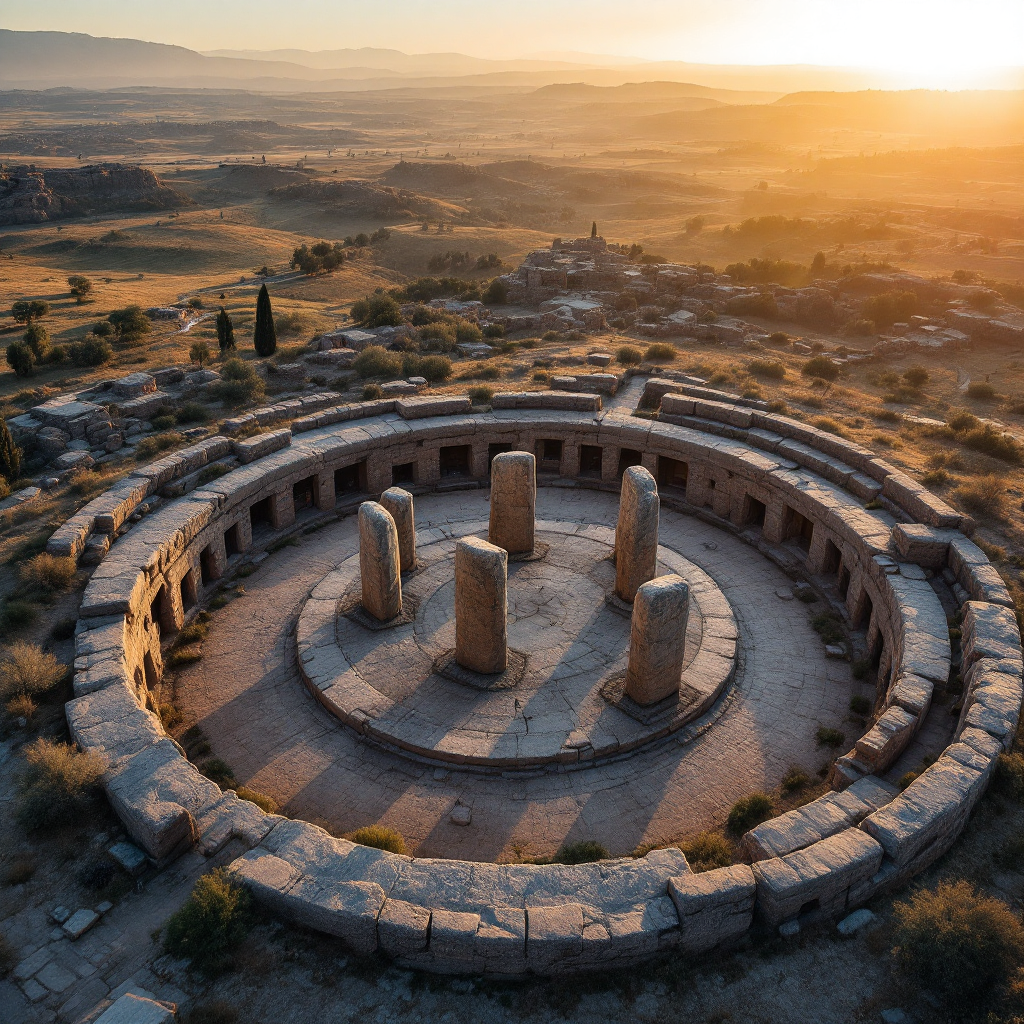
Who built Gobekli Tepe? This question has haunted archaeologists since the site’s discovery in southeastern Turkey. The massive stone temple complex, with its towering T-shaped pillars and intricate carvings, was constructed over 12,000 years ago by people who supposedly lacked the organizational capacity, tools, and social structures needed for such a monumental project. Yet there it stands, predating Stonehenge by 6,000 years and the pyramids of Egypt by 7,000 years, challenging everything we thought we knew about the capabilities of ancient humans.
The Hunter-Gatherer Paradox
According to mainstream archaeology, Gobekli Tepe was built by hunter-gatherer societies during the Pre-Pottery Neolithic period. No agriculture. No permanent settlements. No metal tools. No written language. These were people who should have been focused entirely on daily survival, yet they organized the labor, logistics, and symbolic vision to construct a monument that required moving and carving stones weighing up to 10 tons each.
The German Archaeological Institute, which has led excavations at the site since Klaus Schmidt’s initial work in 1995, maintains that mobile foraging groups came together seasonally to build this ceremonial center. The theory suggests that religion, not agriculture, drove the first large-scale human cooperation. The building of Gobekli Tepe and similar megalithic structures may have actually preceded and catalyzed the agricultural revolution rather than following it.
But this explanation raises more questions than it answers. How did scattered bands of nomadic people develop the engineering knowledge to quarry, transport, and erect massive limestone pillars? Where did they learn to carve detailed reliefs of animals, abstract symbols, and humanoid figures? And why, after investing what must have been generations of effort, did they deliberately bury the entire complex under tons of fill dirt around 10,000 years ago?
The Survivors Theory
An alternative explanation shifts the timeline entirely. What if the people who built Gobekli Tepe weren’t primitive at all? What if they were survivors of an advanced civilization destroyed during the Younger Dryas catastrophe, the sudden climatic disruption that struck Earth approximately 12,800 years ago?
The Younger Dryas impact hypothesis, supported by geological evidence including nano-diamonds, platinum anomalies, and widespread burn layers across multiple continents, suggests that a massive comet or asteroid strike triggered rapid global cooling, megafauna extinction, and catastrophic flooding. If an advanced society existed before this event, its survivors would have faced a desperate race to preserve what they knew before knowledge was lost entirely.
Gobekli Tepe appears immediately after the Younger Dryas climate disruption began. Its construction doesn’t show the experimental phases you’d expect from a culture learning monumentality for the first time. The oldest layers are the most sophisticated, with precise astronomical alignments and complex iconography already fully developed. The site doesn’t evolve toward complexity. It begins there and gradually simplifies over subsequent centuries.
This pattern appears elsewhere. Egyptian civilization emerges fully formed with writing, astronomy, and monumental architecture already in place. Sumerian culture appears complete with advanced mathematics, legal codes, and urban planning. The Indus Valley civilization begins with standardized weights, covered sewers, and grid-planned cities. These aren’t slow accumulations of knowledge. They’re sudden manifestations of sophisticated understanding that appears to predate accepted historical records.
The Encoded Warning
One of Gobekli Tepe’s most startling features is Pillar 43, also known as the Vulture Stone. Researchers at the University of Edinburgh’s School of Engineering analyzed the carved symbols and proposed they represent an astronomical record. The animals depicted correspond to constellations, and their arrangement may encode the date of the Younger Dryas impact event itself, approximately 10,950 BCE.
If this interpretation is correct, Gobekli Tepe wasn’t just a temple. It was a message. A warning carved in stone by people who had witnessed catastrophe and wanted future generations to understand what had happened. The deliberate burial of the site takes on new meaning under this interpretation. Perhaps the builders sealed their work not to abandon it, but to preserve it, protecting the encoded knowledge from erosion and ensuring it would survive until a future civilization developed the capacity to excavate and understand it.
The specific astronomical configurations present at the site, the precise alignments with celestial events, and the symbolic encoding of cosmic knowledge all suggest a level of astronomical understanding that conventional timelines cannot easily explain. The builders tracked precession, solar cycles, and stellar positions with accuracy that wouldn’t officially reappear in human culture for thousands of years.
The Atlantis Connection
Some researchers have drawn connections between Gobekli Tepe and the Atlantis narrative. Plato’s account, received from Egyptian priests, describes an advanced civilization destroyed by earthquakes and floods approximately 11,600 years ago. The timeline matches the Younger Dryas precisely. If survivors from such a civilization fled east, the Anatolian plateau where Gobekli Tepe sits would have been a natural refuge, elevated above flood zones and rich in resources.
The Eye of Africa, the Richat Structure in Mauritania, matches Plato’s description of Atlantis with remarkable precision. If that site was destroyed by the Younger Dryas flooding, survivors would have carried their knowledge to multiple locations. Egypt received one lineage. Mesopotamia received another. And Gobekli Tepe may represent a third transmission point, a place where refugees from a destroyed world encoded their most critical knowledge into stone before that knowledge could be lost forever.
The site’s iconography supports this reading. Serpents, which appear throughout Gobekli Tepe’s carvings, were universal symbols of wisdom and hidden knowledge across ancient cultures. The same symbol appears in Sumerian, Egyptian, Hindu, and Mesoamerican traditions, always associated with teachers who appeared after catastrophe to guide humanity’s rebuilding. Gobekli Tepe’s builders may have been exactly such teachers, preserving and transmitting knowledge from a world that no longer existed.
The Mystery School Hypothesis
Another possibility is that Gobekli Tepe served as an early mystery school, a center where initiates gathered to receive teachings that could not be shared openly. The site’s structure supports this interpretation. Multiple circular enclosures, each slightly different, suggest progressive levels of access. The innermost chambers contain the most elaborate carvings and the most precise astronomical alignments.
Mystery traditions across the ancient world followed this pattern. Knowledge was layered, revealed progressively to those who demonstrated readiness. The Eleusinian Mysteries in Greece, the Egyptian temple schools, and the Pythagorean communities all operated on this principle. Gobekli Tepe may represent the earliest known example of this model, the original template from which all later initiatory systems descended.
The site’s remote location, far from any known settlement, supports the mystery school reading. Initiates would have traveled significant distances to reach it, ensuring that only those seriously committed would make the journey. The effort required to participate would have served as a natural filter, selecting for individuals capable of disciplined inner transformation and ego dissolution rather than casual curiosity.
The specific rituals practiced at Gobekli Tepe remain unknown, but the synthesis between astronomical knowledge, sacred geometry, and biological awakening encoded throughout the site suggests practices far more sophisticated than simple animal worship or seasonal festivals. The builders understood patterns that modern science is only beginning to recover.
The Anunnaki Theory
A more controversial explanation connects Gobekli Tepe to the Anunnaki, the beings described in Sumerian texts as coming from the heavens to Earth. These figures were credited with teaching humanity agriculture, astronomy, metallurgy, and law. If such intervention occurred, Gobekli Tepe’s sudden appearance and advanced knowledge base would make more sense.
Sumerian king lists describe rulers before the flood whose reigns lasted thousands of years, followed by a great deluge, then a new lineage of kings with shorter reigns. The pattern suggests a break in continuity, a reset that separated an earlier, longer-lived population from later, shorter-lived humans. Gobekli Tepe sits at exactly that chronological boundary, built in the centuries immediately following the flood event described across cultures.
The site’s iconography includes humanoid figures with elongated heads and unusual proportions, carvings that don’t match typical human anatomy. Some researchers interpret these as stylized representations. Others see them as depictions of the teachers themselves, beings who looked different from the humans they instructed. The debate remains unresolved, but the images are undeniably present and undeniably strange.
Whether these teachers were extraterrestrial, survivors of an earlier human civilization, or simply a lineage of knowledge-keepers whose origins have been mythologized, the pattern is consistent. Knowledge appears suddenly. It’s transmitted to less advanced populations. And it’s encoded into stone monuments designed to outlast any single generation or culture.
What the Stones Remember
Less than five percent of Gobekli Tepe has been excavated. Ground-penetrating radar suggests at least 20 additional circular structures remain buried. Each excavation season reveals new carvings, new alignments, and new questions. The deeper archaeologists dig, the older and more sophisticated the layers become. This inverts the expected pattern where primitive attempts gradually refine into mastery. At Gobekli Tepe, mastery came first.
The answer to who built Gobekli Tepe may be simpler than we want to admit. Perhaps we built it. Not we as modern humans, but we as a species with a far longer history of sophistication than mainstream timelines acknowledge. Anatomically modern humans have existed for over 300,000 years. We’re told civilization emerged only 6,000 years ago. That leaves a gap of 294,000 years during which our ancestors supposedly did nothing more complex than hunt, gather, and migrate.
Gobekli Tepe suggests that story is incomplete. The site proves that 12,000 years ago, humans possessed knowledge, organizational capacity, and symbolic sophistication that shouldn’t exist according to the standard model. The specific techniques they used to quarry and transport megalithic stones without metal tools or domesticated animals, the precise timing systems they followed to coordinate seasonal gatherings, and the astronomical calculations encoded throughout the complex all point toward capabilities we’ve barely begun to understand.
Whether the builders were survivors of an earlier civilization, initiates of a mystery tradition, or simply a culture whose achievements we’ve underestimated, they left behind a monument that refuses to fit the narrative we’ve been given. They encoded warnings, preserved knowledge, and created something durable enough to outlast whatever catastrophe they feared might come again.
The Burial Decision
The most haunting question isn’t who built Gobekli Tepe. It’s why they buried it. Around 10,000 years ago, the builders filled in the enclosures with thousands of tons of debris and soil, carefully covering every pillar, every carving, every alignment. This wasn’t abandonment. It was preservation.
Burial protects stone from weathering, erosion, and intentional destruction. If the builders knew another catastrophe was coming, or if they recognized that the knowledge they carried was too dangerous or too sacred for the cultures that would follow them, sealing the site makes strategic sense. They created a time capsule, a message that could only be opened by a civilization advanced enough to excavate it properly.
We are that civilization. The question is whether we’re ready to understand what we’re uncovering. Every new excavation season at Gobekli Tepe chips away at comfortable assumptions about who we are, how long we’ve been capable of greatness, and what we may have forgotten. The stones remember. They’ve been waiting 12,000 years for us to ask the right questions.
The people who built Gobekli Tepe possessed knowledge that academia insists shouldn’t exist in that era. They understood cosmic balance, celestial cycles, and the interplay of opposing forces encoded into the fabric of reality. They built not for themselves, but for us. Not to glorify their own era, but to ensure that when the reset came, as they knew it would, some fragment of truth would survive.
Closing Reflection
The answer to who built Gobekli Tepe depends entirely on which timeline you accept. If you believe civilization began 6,000 years ago with Sumer and Egypt, then the builders were impossibly advanced hunter-gatherers who spontaneously developed engineering, astronomy, and symbolic systems without precedent. If you allow for the possibility of earlier cycles, earlier rises and falls, then Gobekli Tepe becomes what it looks like: a refugee camp monument built by people who knew what had been lost and were desperate to preserve what remained.
The deliberate burial of the site suggests the latter. People don’t bury their greatest achievements unless they’re protecting them from something. The stones at Gobekli Tepe were never meant to stay hidden forever. They were meant to wait. And now that we’ve found them, the question isn’t just who built them. It’s whether we’ll listen to what they’re trying to tell us.