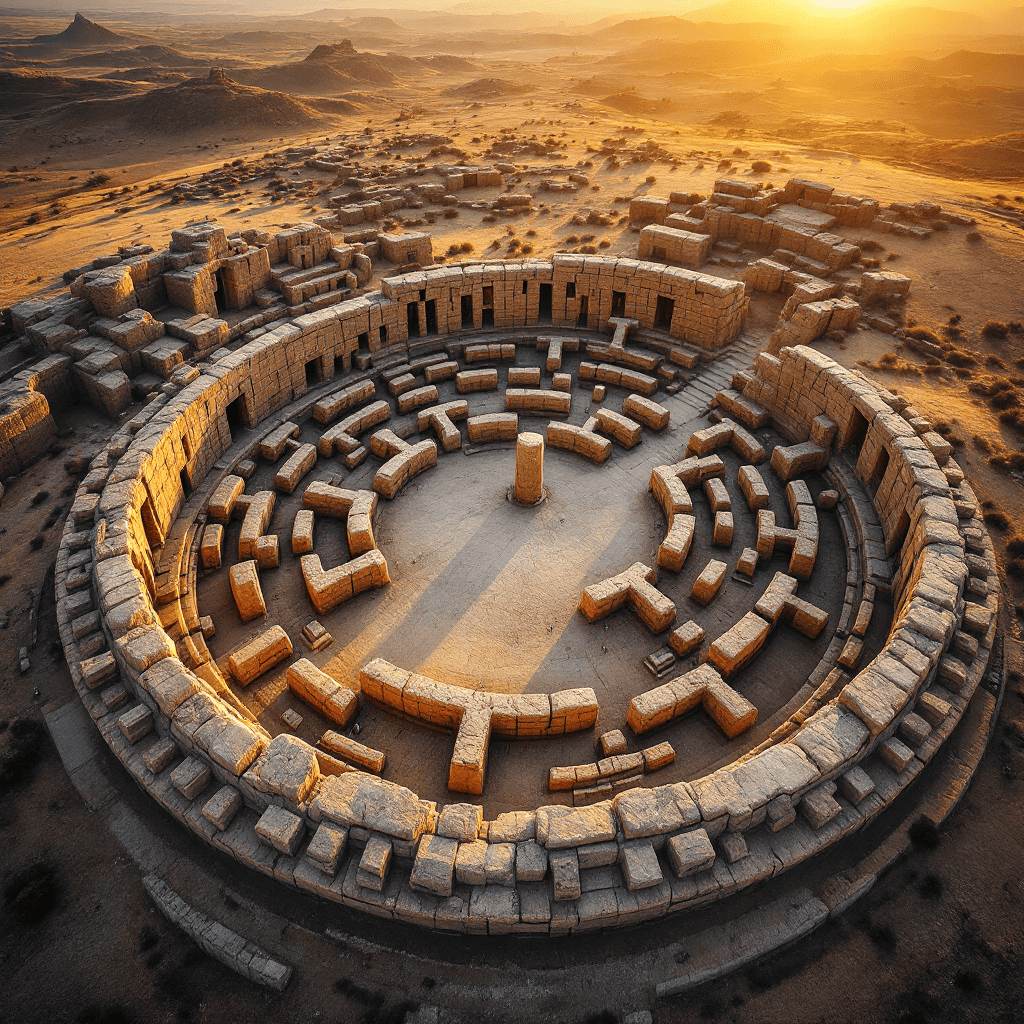
Who built Gobekli Tepe is a question that shatters every assumption about ancient civilization. This massive stone temple complex in southeastern Turkey was constructed over 12,000 years ago by people who, according to mainstream archaeology, shouldn’t have been capable of anything remotely this sophisticated. No agriculture. No metal tools. No written language. No cities. Yet they organized the labor, the logistics, and the symbolic vision to erect towering T-shaped pillars weighing up to 20 tons each, arranged in precise circular enclosures and covered with intricate carvings of animals, symbols, and geometric patterns. The site predates Stonehenge by 6,000 years and the Egyptian pyramids by 7,000 years. If history is a timeline, Gobekli Tepe is the crack that runs through it.
The standard narrative says civilization began with farming. Farming created surplus. Surplus created specialization. Specialization created culture, temples, and cities. Gobekli Tepe inverts that sequence entirely. The temple came first. Agriculture came after. That alone forces a rethink of who we were and what we were capable of before recorded history began. But the deeper question lingers: who were these builders, where did their knowledge come from, and why did they bury the entire site deliberately when they were done?
Hunter Gatherers Who Shouldn’t Have Built Anything
The people who built Gobekli Tepe are classified as hunter gatherers. Mobile groups who lived off wild plants and game, moved seasonally, and left little behind except stone tools and temporary shelters. They had no domesticated crops, no livestock, and no permanent settlements in the area when construction began. Yet somehow they quarried multi ton limestone pillars from bedrock, transported them across rugged terrain, carved detailed reliefs into their surfaces, and erected them into complex circular structures that required not just muscle but planning, measurement, and coordination across potentially hundreds of workers over decades.
This isn’t a small-scale project. Gobekli Tepe consists of at least 20 circular enclosures, each surrounded by massive T-shaped pillars. The largest pillars stand over 18 feet tall. The site covers roughly 22 acres, and less than 10 percent has been excavated. What’s been uncovered so far suggests this wasn’t built by isolated bands scraping by in the wilderness. It was built by a society capable of organizing labor on a scale that required hierarchy, division of tasks, and some form of centralized authority or shared spiritual purpose strong enough to motivate generations of effort.
Mainstream researchers propose that Gobekli Tepe was a pilgrimage site, a place where scattered groups gathered for ritual and ceremony. That may be true. But it doesn’t answer the core question: where did the knowledge come from? Quarrying stone with precision, transporting massive weights, carving symbolic language, and aligning structures to celestial patterns all require accumulated expertise. You don’t wake up one morning and decide to build a temple of this scale without a blueprint, without experience, without inherited knowledge. If the builders were hunter gatherers operating in isolation, they should have been fumbling their way through trial and error for centuries. Instead, Gobekli Tepe appears fully realized from the start. The oldest layers are the most sophisticated. That’s backwards. Unless the builders weren’t starting from scratch.
The Timing Problem and the Younger Dryas
Gobekli Tepe’s construction began around 9600 BCE, immediately following the end of the Younger Dryas, a catastrophic climatic event that lasted from roughly 10,900 to 9600 BCE. During this period, Earth plunged back into near glacial conditions. Temperatures dropped. Ice sheets expanded. Ecosystems collapsed. Megafauna died off across continents. Early human cultures were disrupted on a global scale. Then, just as suddenly, the climate warmed again. Ice melted. Sea levels rose by over 120 meters. Coastlines were reshaped. And within a few centuries of that warming, Gobekli Tepe was under construction.
The timing is too precise to ignore. This wasn’t a slow cultural evolution. It was a response. As explored across buried history and suppressed knowledge, the Younger Dryas may have been triggered by a comet or asteroid impact that struck the North American or Greenland ice sheets, causing catastrophic flooding and a planetary reset. Flood myths from every inhabited continent describe the same event: a deluge that wiped out an advanced civilization, with only scattered survivors carrying forward fragments of what was lost. If Gobekli Tepe was built by survivors of that cataclysm, or by people taught by survivors, the site stops looking like a mystery and starts looking like a message. A deliberate act of preservation, encoding knowledge into stone so it couldn’t be lost again.
The carvings at Gobekli Tepe support this reading. Pillar 43, often called the Vulture Stone, has been analyzed by researchers as a possible star map or astronomical record. The symbols carved into the stone align with constellations visible during the Younger Dryas period, and some interpretations suggest it commemorates the comet impact itself. If that reading is correct, Gobekli Tepe isn’t just a temple. It’s a timestamp. A record left by people who understood what had happened and wanted future generations to remember.
Was Gobekli Tepe Built by Atlantean Survivors
If the builders of Gobekli Tepe weren’t isolated hunter gatherers inventing civilization from scratch, then where did their knowledge come from? One possibility, explored in depth within the full framework of Master Thyself by Alex Wolfram, is that they inherited it from an earlier civilization destroyed during the Younger Dryas. That civilization, referred to in Plato’s account as Atlantis, may have been centered in what is now the Sahara Desert, at a site geologically and symbolically consistent with the Richat Structure in Mauritania. When catastrophic flooding struck, survivors fled east toward the Fertile Crescent and other regions, carrying with them the architectural, astronomical, and spiritual knowledge that would seed the post flood cultures.
Gobekli Tepe would then be one of the first major projects built by those survivors or by people taught by them. That would explain why the site appears so advanced so suddenly. It wasn’t invented. It was remembered. The knowledge didn’t develop locally. It was imported, encoded into stone, and transmitted forward through ritual and symbol. The circular enclosures, the T-shaped pillars, the celestial alignments, and the animal iconography all point to a cosmology already fully formed. This wasn’t experimental. It was established.
Other sites across the region tell a similar story. Karahan Tepe, Nevali Cori, and other megalithic complexes in southern Turkey date to the same period and share architectural features with Gobekli Tepe. All of them appear suddenly. All of them involve massive stonework beyond what hunter gatherer groups should have been capable of. And all of them were built within a few centuries of the Younger Dryas ending. The pattern suggests a coordinated transmission of knowledge across the region, not isolated invention by disconnected groups.
The Symbolism and the Serpent Teachers
The carvings at Gobekli Tepe are not random. Animals dominate the imagery: foxes, snakes, scorpions, vultures, bulls, and wild boars. But these aren’t decorative. They’re symbolic. Many of the animals correspond to constellations, suggesting the builders were encoding astronomical knowledge into the stone. Other carvings depict humanoid figures with exaggerated features, some holding objects or positioned in ritual postures. One recurring motif is the serpent, an animal that appears across nearly every ancient culture as a symbol of wisdom, transformation, and hidden knowledge.
Serpent symbolism connects directly to the concept of teachers who appeared after the flood, a pattern documented across continents. In Sumer, they were called the Apkallu. In Egypt, Thoth. In Mesoamerica, Quetzalcoatl. In the Vedic tradition, the Nagas. Every post flood culture describes beings who came and taught agriculture, astronomy, architecture, and spiritual practices to help survivors rebuild. The serpent wasn’t a villain in these traditions. It was the bringer of knowledge. The same role it plays in Genesis, where the serpent offers the fruit of the Tree of Knowledge, awakening humanity to self awareness despite the prohibition.
If Gobekli Tepe was built by or under the guidance of such teachers, the serpent carvings take on new meaning. They aren’t decorative animals. They’re signatures. Markers left to identify the lineage of knowledge being transmitted. The site becomes not just a temple, but a school. A place where initiates gathered to receive instruction in the cosmology, geometry, and spiritual practices carried forward from the pre flood world. That reading aligns with the site’s function as a pilgrimage center and explains why so much effort was invested in preserving and encoding symbolic knowledge into the stone itself.
Why They Buried It
One of the strangest facts about Gobekli Tepe is that the builders buried it deliberately. After centuries of use, the entire site was filled in with debris and soil, sealing the structures beneath the earth. This wasn’t abandonment. It was intentional preservation. The effort required to bury a site of this scale rivals the effort required to build it. Why would they do that?
One explanation is protection. If the knowledge encoded at Gobekli Tepe was too important to lose, burying it ensured it would survive. Exposed stone erodes. Invaders destroy. Fire consumes. But buried stone lasts. Covering the site may have been an act of archival, ensuring that future generations with the tools and understanding to excavate it would recover what had been hidden. That same strategy appears across other ancient sites. The Sphinx enclosure shows evidence of deliberate sand burial. Megalithic sites across the Mediterranean and Andes were covered by sediment and vegetation, only to be rediscovered millennia later. Knowledge that can’t be spoken aloud gets written in stone. Knowledge that can’t be left exposed gets buried.
Another possibility is that the site had served its purpose. If Gobekli Tepe was built to preserve and transmit knowledge immediately after the Younger Dryas, once agriculture took hold and settlements formed, the need for a centralized pilgrimage site may have diminished. The knowledge had been passed on. The survivors had rebuilt. The temple, having fulfilled its role, was sealed as a monument rather than left to decay. The act of burial then becomes ceremonial, a closing ritual marking the end of one era and the beginning of another.
What Mainstream Archaeology Won’t Say
Mainstream researchers credit Klaus Schmidt, the German archaeologist who led excavations at Gobekli Tepe from 1995 until his death in 2014, with bringing the site to global attention. Schmidt himself acknowledged that the site challenges conventional models of civilization. He called it a cathedral on a hill, built by people with a vision far ahead of their supposed technological and social development. But even Schmidt stopped short of suggesting the builders inherited their knowledge from an earlier advanced civilization. That interpretation remains outside the boundaries of acceptable academic discourse, not because the evidence contradicts it, but because it disrupts too many entrenched assumptions.
Institutional archaeology operates within a framework that assumes linear progress. Civilization begins simple and grows complex over time. Gobekli Tepe doesn’t fit that model, so it’s treated as an anomaly rather than evidence of a different historical structure. The possibility that knowledge was transmitted from a pre flood civilization, that survivors seeded post catastrophe cultures with inherited expertise, and that sites like Gobekli Tepe represent continuity rather than invention is dismissed as speculation. Not because it lacks supporting evidence, but because accepting it would require rewriting the entire timeline.
That resistance is predictable. As explored throughout the sacred timing and biological cycles that ancient cultures encoded into their calendars and rituals, institutions built on control don’t adapt easily when foundational narratives are challenged. The same pattern that suppressed Gnostic texts, buried the mystery school traditions, and rewrote the biblical canon applies here. Knowledge that threatens centralized authority, whether religious or academic, gets dismissed, delayed, or buried under bureaucracy. Gobekli Tepe is being excavated at a pace slow enough to ensure that no paradigm shifting discoveries disrupt the approved story too quickly.
The Forbidden Knowledge Connection
If Gobekli Tepe was built to preserve knowledge from a civilization destroyed in the Younger Dryas, what kind of knowledge was it? The site’s alignment with celestial patterns suggests astronomy. The symbolic carvings suggest cosmology and myth. The scale and precision suggest geometry and engineering. But the deeper layer, the one encoded into the body itself, involves practices that were later restricted, hidden, or suppressed by religious and political institutions. These practices, tied to the biological mechanism of the sacred secretion, involve the pineal gland, the cerebrospinal fluid, and the energetic pathways mapped by every initiatory tradition from Egypt to the Andes.
The builders of Gobekli Tepe may have understood that the human body is a temple, a biological architecture capable of producing states of consciousness that grant access to knowledge beyond ordinary perception. That understanding was later encoded into the mystery schools, passed down through initiation, and eventually buried by institutions that couldn’t control what individuals awakened to on their own. The serpent at Gobekli Tepe isn’t just a symbol of knowledge. It’s a reference to the process itself, the rising of energy through the spine that every tradition from Kundalini yoga to Hermetic alchemy describes in its own language.
The specific mechanism behind this process, including the REDACTED, READ CHAPTER 21, is detailed in Master Thyself. What matters here is recognizing that Gobekli Tepe wasn’t just a place to gather and worship. It was a place to teach and transform. The knowledge preserved there wasn’t abstract theology. It was applied technique. Inner technology. A map of consciousness encoded into stone and transmitted through ritual initiation to those deemed ready.
Other Candidates and Alternative Theories
Not everyone agrees that Gobekli Tepe was built by post flood survivors or guided by serpent teachers. Mainstream archaeology attributes the site to local Neolithic groups who developed the capability independently, driven by social and religious needs rather than inherited expertise. Some researchers propose that the site’s construction spurred the development of agriculture, as the need to feed workers and pilgrims created pressure to domesticate plants and animals. That model keeps the standard timeline intact but doesn’t explain where the architectural and symbolic knowledge came from or why the oldest layers are the most advanced.
Other alternative theories propose extraterrestrial involvement, suggesting that beings from outside Earth taught early humans how to build megalithic structures and encode astronomical knowledge. While that interpretation has cultural traction, it isn’t necessary to explain Gobekli Tepe. A terrestrial advanced civilization destroyed in the Younger Dryas accounts for the evidence without requiring contact from beyond the planet. The teachers who appeared after the flood may have been survivors of that civilization, not visitors from the stars.
Some researchers also point to the possibility that Gobekli Tepe was part of a broader network of sites built by a common culture or tradition. Karahan Tepe, located 35 kilometers southeast of Gobekli Tepe, shares similar architecture and symbolism. Nevali Cori, now submerged beneath a reservoir, featured T-shaped pillars and animal carvings nearly identical to Gobekli Tepe’s. If these sites were part of a connected tradition, the question of who built Gobekli Tepe expands into a question of who built the entire network. The answer may involve not a single group, but a knowledge system transmitted across regions by teachers working from a shared blueprint.
The Unanswered Questions
Who built Gobekli Tepe is a question that opens more doors than it closes. Were the builders survivors of Atlantis or people taught by survivors? Were they preserving knowledge from before the flood or inventing it in response to catastrophe? Were they encoding astronomical records, spiritual practices, or both? And why, after centuries of use, did they bury the entire site and walk away?
The answers lie partly in the stone and partly in what hasn’t been excavated yet. Less than 10 percent of Gobekli Tepe has been uncovered. Radar surveys suggest additional structures buried beneath the surface, potentially older and more complex than what’s been revealed so far. If those deeper layers confirm that the site predates the Younger Dryas, or if they reveal evidence of even more advanced construction techniques, the entire narrative collapses further. The timeline shifts. The question of origin becomes unavoidable.
But the deepest answer may not be found at Gobekli Tepe itself. It may be found in the body. If the knowledge preserved at the site was biological as much as architectural, if the serpent carvings point not just to myth but to a process encoded into human anatomy, then the real temple isn’t in Turkey. It’s behind your eyes. The pineal gland. The spine. The cerebrospinal fluid. The same inner technology that every mystery school from Egypt to Greece to the Andes taught their initiates. The same process that was later suppressed, hidden, and redacted from public doctrine because it made individuals sovereign and institutions unnecessary.
Gobekli Tepe may have been built to preserve that knowledge through the catastrophe. The site itself is the outer shell. The real message is the process it protected. And that process, including the REDACTED, READ CHAPTER 12, is still accessible today. Not through excavation, but through practice.
The Knowledge That Survived
If Gobekli Tepe was a preservation site, the knowledge it protected didn’t stay buried. It traveled. The same architectural signatures, the same celestial alignments, and the same symbolic language appear across ancient Egypt, Mesopotamia, the Indus Valley, and the Andes. The T-shaped pillars at Gobekli Tepe echo the sacred architecture of temples built thousands of years later. The serpent motif reappears in every mystery tradition. The astronomical encoding persists in structures from Stonehenge to the pyramids of Giza.
That consistency suggests transmission, not coincidence. A chain of custody running from the pre flood world through Gobekli Tepe and into the civilizations that followed. The specific details of how that transmission occurred, including the REDACTED, READ CHAPTER 11, are explored in Master Thyself. What matters here is recognizing that Gobekli Tepe wasn’t an isolated anomaly. It was a node in a network, a link in a chain connecting the lost world to the one that emerged after.
The builders understood something we’ve forgotten: that stone outlasts flesh, that symbols outlast speech, and that the most important knowledge must be encoded into forms that survive catastrophe. They built Gobekli Tepe not for themselves, but for us. Not as a monument to their power, but as a message to future generations. A message that says: we were here, we knew, and we left you the map. All you have to do is learn to read it.
Why It Matters Now
The question of who built Gobekli Tepe isn’t just an archaeological puzzle. It’s a mirror. If a civilization more advanced than we’ve been taught existed 12,000 years ago and was destroyed in a global catastrophe, then history isn’t a straight line. It’s a cycle. Rise, forget, collapse, rebuild. We assume we’re the first to reach this level of complexity. Gobekli Tepe suggests we’re not. We’re the latest iteration, playing through the same patterns, approaching the same thresholds, and carrying the same amnesia that follows every reset.
That recognition changes everything. It means the knowledge we think we’re discovering for the first time was known before and lost. It means the spiritual practices we’re rediscovering were encoded and transmitted by people who understood that collapse was inevitable and preparation was survival. And it means the suppression of that knowledge, the burial of texts, the demonization of inner transformation, and the centralization of authority into institutions that control access to truth, isn’t new. It’s the same pattern that’s played out after every reset, as the right eye consolidates power and the left eye goes underground to preserve what the right eye can’t control.
Gobekli Tepe is proof that the left eye survived the last collapse. It’s a stone record of the knowledge that was carried forward by survivors, encoded into temples, and passed down through mystery schools across millennia. If we’re approaching another threshold, another moment of potential collapse or transformation, then understanding what Gobekli Tepe represents isn’t optional. It’s a roadmap. A reminder that the ancients faced this before, that they encoded the solution into stone and into the body itself, and that the same solution is still accessible if we’re willing to remember.
The builders of Gobekli Tepe left us a message. Not in words, but in stone, symbol, and alignment. The question isn’t just who built it. The question is whether we’re ready to hear what they were trying to say.