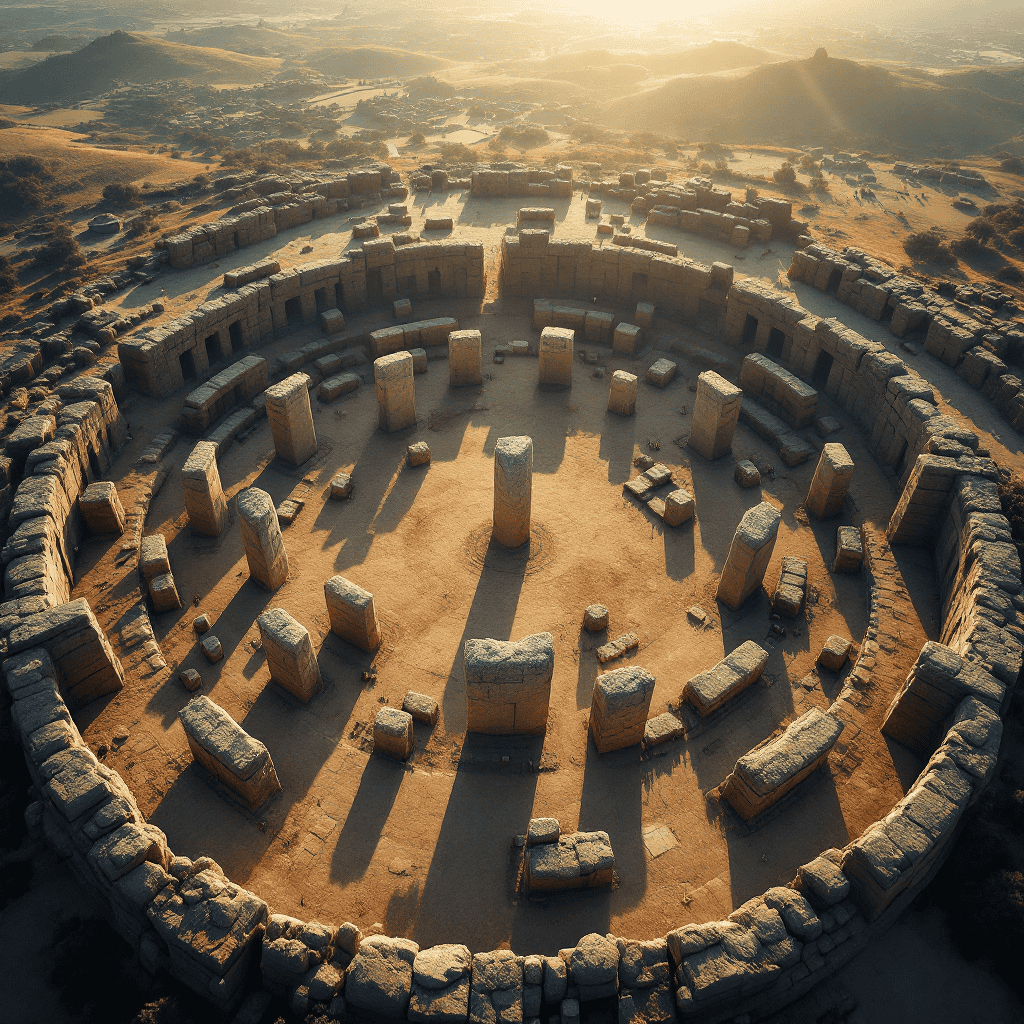
Who built Göbekli Tepe is a question that has haunted archaeologists since the site’s discovery in southeastern Turkey. This massive stone temple complex, carved and erected over 12,000 years ago, predates agriculture, metallurgy, pottery, and every organized civilization we’ve been taught came first. Its towering T-shaped pillars, precise carvings, and carefully designed circular enclosures weren’t built by farmers or city-dwellers. They were built by people who, according to mainstream archaeology, shouldn’t have been capable of anything close to this. Yet here it stands, defying every assumption about the origins of human civilization.
The Standard Timeline Cannot Explain This Site
Göbekli Tepe sits on a hilltop in southeastern Turkey, overlooking the Fertile Crescent. Excavations began in the 1990s under German archaeologist Klaus Schmidt, and what emerged was nothing short of revolutionary. The site contains multiple circular structures, each built with massive limestone pillars arranged in rings. The largest pillars weigh up to 16 tons and stand over 18 feet tall. They are carved with intricate reliefs of animals, abstract symbols, and humanoid figures.
Radiocarbon dating places the oldest structures at approximately 9600 BCE, firmly in the Pre-Pottery Neolithic period. That puts it 6,000 years older than Stonehenge and thousands of years before the first known cities of Mesopotamia. According to standard archaeological records, the people who built this site were hunter-gatherers. They had no written language, no metal tools, no domesticated animals to help move the stones. They shouldn’t have had the organization, the labor coordination, or the symbolic sophistication to create what we see at Göbekli Tepe. But they did.
The question isn’t just who built Göbekli Tepe. It’s how. And more importantly, why.
Who Were the Builders? The Official Answer
Mainstream archaeology attributes Göbekli Tepe to Pre-Pottery Neolithic groups who inhabited the region between roughly 10,000 and 8,000 BCE. These were semi-nomadic people who hunted gazelles, gathered wild grains, and lived in small, mobile communities. They had no permanent settlements at the time the earliest structures were built. Yet somehow, they organized the labor of hundreds, perhaps thousands, to quarry, transport, carve, and erect these megaliths.
Schmidt and his colleagues proposed that Göbekli Tepe was a ritual center, a sacred gathering place where scattered groups came together for ceremonies, feasts, and perhaps astronomical observation. Animal bones found at the site suggest large-scale communal feasting. The carvings depict wild animals, scorpions, serpents, and abstract symbols that may encode cosmological knowledge. Some researchers believe the site functioned as an early astronomical observatory, with pillar alignments corresponding to celestial events.
But this explanation raises more questions than it answers. If these were simple hunter-gatherers, where did the knowledge come from? Who taught them sacred geometry, quarrying techniques, and the organizational skills to sustain such a massive project over centuries? The site wasn’t built in a single generation. It was continuously expanded, rebuilt, and ritually buried over a span of at least 1,500 years. That suggests continuity of knowledge, cultural memory, and a level of social complexity that doesn’t fit the standard narrative.
The Survivor Hypothesis
One alternative theory proposes that the builders of Göbekli Tepe were not primitive hunter-gatherers at all. They were survivors of an earlier, more advanced civilization that was destroyed in the Younger Dryas catastrophe, a sudden global climatic event that occurred roughly 12,800 years ago. The Younger Dryas brought rapid cooling, massive flooding, and the extinction of megafauna across the Northern Hemisphere. It ended abruptly around 11,600 years ago, triggering equally rapid warming and sea level rise that reshaped coastlines worldwide.
If a technologically and spiritually sophisticated civilization existed before the Younger Dryas, its survivors would have carried knowledge forward. They would have known astronomy, geometry, and the symbolic language of the sacred. Göbekli Tepe may not represent the birth of civilization. It may represent its restoration. The site’s construction immediately following the Younger Dryas suggests a race to preserve knowledge before it was lost entirely. Those who explore the archaeology of forgotten civilizations often return to this site as the strongest evidence that history is older and more complex than we’ve been taught.
This theory finds support in the site’s sudden appearance and its lack of developmental precursors. There are no simpler prototypes. No practice structures. Göbekli Tepe emerges fully formed, as if the builders already knew what they were doing. That pattern repeats across the ancient world: advanced knowledge appearing without visible evolution, as though it was inherited rather than invented.
The Encoded Knowledge Debate
Some researchers argue that Göbekli Tepe encodes advanced astronomical knowledge. Martin Sweatman and Dimitrios Tsikritsis published a controversial study in 2017 proposing that the carvings on Pillar 43, known as the Vulture Stone, represent a date-stamp for a comet strike during the Younger Dryas. The animals carved into the stone, they argue, correspond to constellations, and the positioning of these symbols maps a catastrophic event approximately 10,950 BCE. If accurate, this would make Göbekli Tepe not just a temple, but a memorial. A monument built to remember the catastrophe that reset the world.
Critics of this interpretation point out that assigning specific constellations to ancient animal symbols is speculative. The zodiac as we know it didn’t exist in this form 12,000 years ago. But defenders counter that the same animals, the same symbolic language, and the same celestial alignments appear across multiple ancient cultures. The consistency suggests a shared source, not coincidence.
What cannot be disputed is that the builders understood geometry, symmetry, and alignment. The circular structures are not random. They follow precise mathematical ratios. The pillars are oriented to specific points on the horizon. Whether this reflects astronomical knowledge, sacred geometry, or both, it demonstrates a level of intellectual sophistication that should not exist in the official timeline.
Could the Builders Have Been Non-Human?
A smaller but persistent group of researchers and independent thinkers propose that Göbekli Tepe was not built by humans alone. They point to ancient texts from nearby Mesopotamia that describe the Anunnaki, advanced beings who descended from the sky and shaped early civilization. Sumerian records speak of divine architects, celestial teachers, and the transmission of sacred knowledge to humanity. These aren’t fringe ideas in isolation. They appear in Egyptian, Hindu, Mesoamerican, and Aboriginal traditions as well. Different names, same theme: teachers came after a cataclysm and helped rebuild.
While mainstream archaeology rejects this interpretation as myth, the symbolic and structural parallels are difficult to dismiss. The T-shaped pillars at Göbekli Tepe resemble humanoid figures with arms and hands. Some researchers interpret them as representations of the beings who taught the builders. Others see them as abstract representations of human consciousness, the awakening of symbolic thought. Either way, the pillars are not utilitarian. They are instructional.
If external intervention or guidance occurred, it would explain the sudden leap in capability. It would also explain why the site was deliberately buried around 8000 BCE. Ritual burial of sacred sites is a pattern found across the ancient world. Knowledge is encoded, preserved, and hidden until the right moment. That moment may be now.
What the Site Reveals About Memory and Myth
Göbekli Tepe forces a reconsideration of how knowledge is transmitted. Oral tradition, ritual, and monument-building may have been more reliable than we assume. The site’s symbolic language, animal carvings, geometric precision, and celestial alignments suggest a system of encoding information into stone. Not through writing, but through pattern, alignment, and symbol. This is the same method used by cultures across the world: the pyramids of Egypt, the stone circles of Britain, the temple alignments of Mesoamerica. Stone survives. It remembers what flesh forgets.
The builders of Göbekli Tepe understood this. They built not for themselves, but for the future. They knew catastrophe could return. They knew knowledge could be lost. So they carved it into the hardest material they had and buried it under layers of earth, ensuring it would survive until a generation capable of understanding it emerged. That generation is us.
The full mechanism behind how ancient builders encoded knowledge into sacred sites, and how that knowledge can be accessed today, is detailed in Master Thyself by Alex Wolfram. The book traces the lineage from pre-flood civilizations through the mystery schools of Egypt, Greece, and beyond, revealing the unbroken chain of transmission that carries this wisdom into the present.
The Deliberate Burial and What It Means
Around 8000 BCE, the builders of Göbekli Tepe made a decision that baffles modern researchers. They deliberately buried the entire site. Not through abandonment or natural processes, but through intentional backfilling. Thousands of tons of soil and rubble were used to cover the structures. This wasn’t destruction. It was preservation.
Why would a culture invest so much effort into building a monumental site, only to bury it a millennium and a half later? One possibility is that the knowledge encoded in the site had been transmitted. The next generation of carriers had been prepared. The physical structure had served its purpose and needed to be protected for a future time. Another possibility is that a threat emerged, external or internal, and burial was the only way to prevent desecration or misuse.
This pattern of ritual burial appears in other ancient sites. Structures are used, honored, and then deliberately sealed. It suggests a long-term strategy, a multigenerational plan to preserve something across deep time. If the builders knew cataclysm could return, they would have built not just for the present, but for the next cycle. Göbekli Tepe may have been designed to survive not just erosion, but erasure.
Modern Excavation and What Remains Hidden
Less than 10 percent of Göbekli Tepe has been excavated. Ground-penetrating radar and magnetometry surveys suggest at least 20 additional circular structures remain buried. The largest and most complex may still be underground. Excavation has been slow, partly due to funding and logistical constraints, but also due to concerns about preservation. Exposure to air, weather, and human traffic accelerates deterioration. Some researchers argue for leaving portions unexcavated until better preservation technology exists.
But delay also raises uncomfortable questions. What if the deeper layers contain evidence that contradicts the approved narrative? What if they reveal connections to even older sites, or technologies that shouldn’t exist in this time period? The same institutional resistance that delayed publication of the Dead Sea Scrolls and restricted access to the Vatican Archives operates in archaeology as well. Not through conspiracy, but through inertia, career preservation, and the human instinct to defend established frameworks.
What lies beneath Göbekli Tepe may answer the question of who built it. Or it may deepen the mystery further. Either way, the evidence is there, waiting under tons of earth and millennia of silence. Those interested in the broader context of suppressed history and how institutional structures control the narrative can explore more at the intersection of suppression and forgotten knowledge.
Why This Site Matters Now
Göbekli Tepe is not just an archaeological curiosity. It is a challenge to every assumption about human history, progress, and memory. It proves that advanced knowledge and monumental construction existed thousands of years before the first cities. It suggests that civilization is cyclical, not linear. It opens the possibility that we are not the first advanced culture on this planet, merely the latest.
If the builders were survivors of an earlier world, then the knowledge they carried forward may still be accessible. Not through excavation alone, but through the symbolic and biological systems they encoded. The same geometric principles, the same celestial alignments, the same understanding of consciousness and transformation that informed Göbekli Tepe also informed the Egyptian mystery schools, the Greek initiatory traditions, and the esoteric lineages that carried sacred knowledge through centuries of suppression. The chain is unbroken. The map still exists.
Who built Göbekli Tepe? The answer may be less important than what they built it for. They built it to remember. They built it to preserve. They built it so that one day, a generation capable of reading the message would emerge. That generation is here. The site is speaking. The question is whether we’re ready to listen.
Closing Reflection
The mystery of who built Göbekli Tepe will not be solved by excavation alone. It requires a willingness to question the timeline, to examine the evidence without bias, and to consider possibilities that institutional archaeology has long dismissed. The builders left us a monument, a message, and a challenge. They understood deep time. They understood catastrophe. They understood that knowledge must be encoded into the most durable forms available: stone, symbol, and the human body itself.
Göbekli Tepe stands as proof that history is not what we’ve been told. It is older, stranger, and far more sophisticated. The answers are not hidden. They are buried, waiting for those willing to dig deeper than the surface narrative. The site does not ask us to believe. It asks us to remember.