Man Made Desert: Why The American Southwest Was Once A Forest
The deserts you call ancient are barely older than your great-grandparents.
Most of what we call desert today is the result of a few hundred years of human activity, not deep geologic time. The proof is labeled, photographed, and standing in plain sight. We just stopped looking.
Accepting The Narrative: How We Forget The Man Made Desert Wasn't Always There
When we look at the American Southwest today, we assume we are seeing something ancient, a desert shaped by deep geologic time, a land that has always been barren. That assumption feels obvious, which is precisely why it is wrong. Much of what we now call "desert" is not ancient at all, but the result of only a few hundred years of human activity. The man-made desert is a recent invention that has become invisible through acceptance. When destruction predates living memory, we mistake loss for baseline. We accept it as natural.
This is not an environmental problem. It is a cognitive one.
A timber support beam nearly 5 feet in diameter still stands inside the Copper Queen Mine in Bisbee, Arizona, marked as having been cut outside. This beam exists in a region we are told has been desert for all of human history. And yet, trees large enough to produce such beams once grew there. The man-made desert consumed those forests. And we accepted the emptiness as truth.
The Man Made Desert And Industrial Forgetting
The mining operations that followed consumed forests at an industrial scale. Estimates suggest the Bisbee mines alone devoured 3,000 to 4,000 square miles of forest. Early photographs show hills stripped to bedrock, a moonscape. That moonscape became the baseline. Within a generation, people forgot the forests had been there. The man-made desert was accepted as ancient. A desert we did not inherit, but a desert we created and then forgot creating. Baja California's forests were stripped to fuel steamships, leaving behind a man-made desert now assumed to have always been arid. When loss is rapid enough, the narrative catches up and rewrites itself.
The Evidence We Stopped Questioning: Rivers, Salmon, And The Man Made Desert
Across Arizona, rivers that once flowed year-round now exist only as storm channels. The Santa Cruz, the Gila, the Salt, the Rillito, the Agua Fria, the San Pedro, and the Little Colorado all maintained continuous flow within documented memory. Indigenous accounts describe shaded corridors, fertile banks. Pioneer journals describe arm-long salmon so dense in the rivers that horses killed them simply by crossing. The man-made desert did not exist then. Rivers flowed. We stopped accepting the river accounts and started accepting the dry channels as permanent.
When Acceptance Becomes Invisible: The Santa Cruz River And Overgrazing
A Texas cattleman admitted that Tucson was lush and heavily vegetated until only a few seasons of his own cattle trampled it into ruin. Overgrazing hardened the soil, killed infiltration, and destabilized waterways. Invasive tamarisk followed. Millions of beavers were exterminated for fur, erasing the dams and wetlands that once regulated aquifers. Springs failed. Water tables collapsed. Dams completed the man-made desert. We accepted each step as inevitable, never realizing we were accepting loss.
Mount Lemmon Pines: When The Recent Becomes Ancient
Even in the twentieth century, the man-made desert continued expanding. Near South Mountain in Phoenix, an ironwood forest once stood with canopies so broad that people remembered driving vehicles beneath them. That ecosystem died when the Salt River was rerouted. On Mount Lemmon above Tucson, a Forest Service plaque records that pines and firs once grew far down the valley floor. What we now call desert scrub was forest within living memory. Yet we accept the absence as original. The man-made desert becomes invisible through acceptance.
The Hydrological Engine: Why The Man Made Desert Requires Forgetting
Climate is not simply rainfall. It is the sum of every relationship in a living system. Destroy those relationships, and you destroy the mechanism.
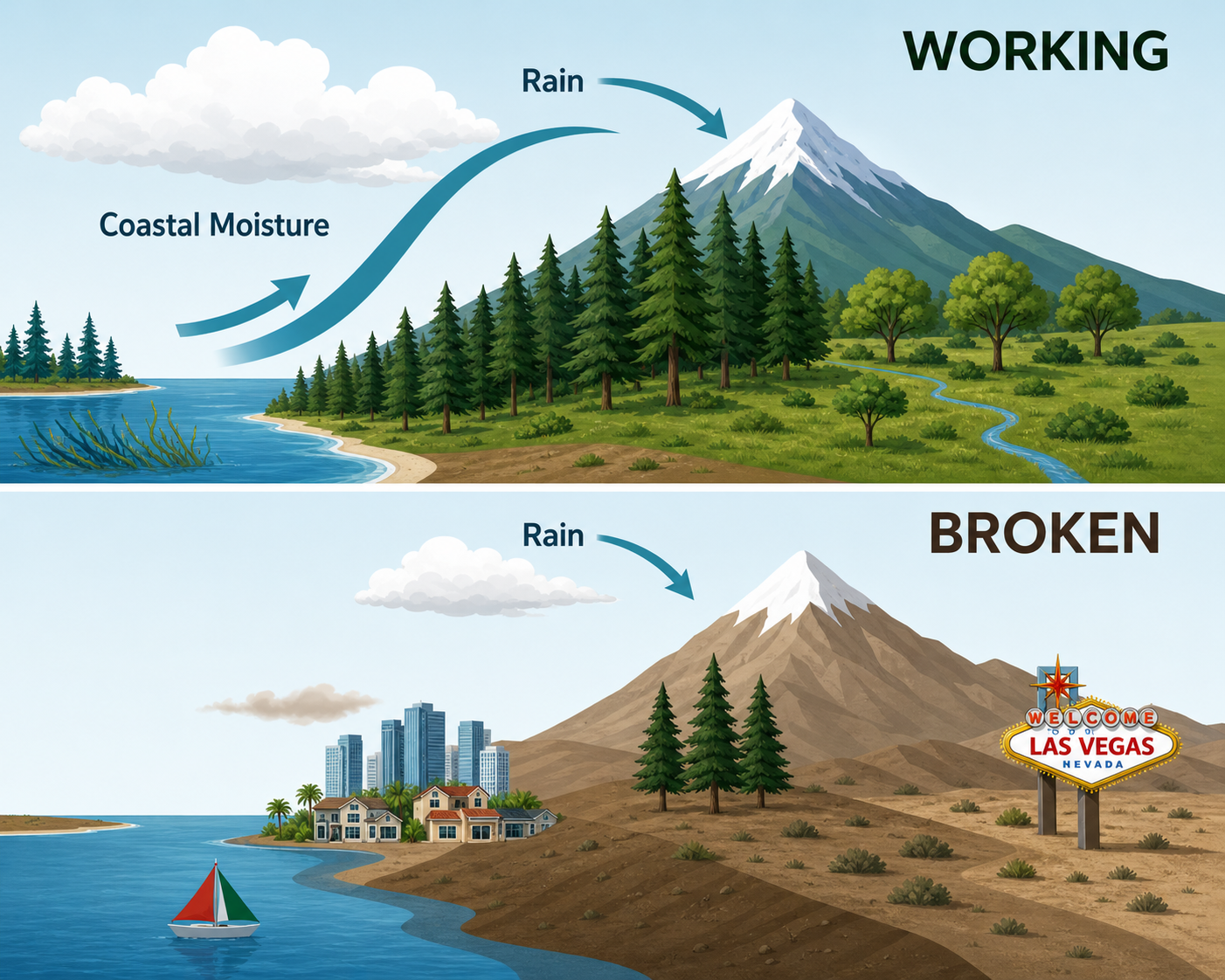
A working hydrological cycle (top) versus a broken one (bottom). Strip the forests, and the mechanism collapses into what we call a man-made desert.
Along California's coast, continuous forests once pulled storms inland. Offshore kelp forests seeded clouds. The Channel Islands supported fog-fed woodlands. Inland, the Sierra Nevada stored water in deep snowpack, releasing it slowly into the interior. Remove coastal forests, and the pull weakens. Remove kelp, and the trigger fails. Remove the Sierra forests, and the storage disappears. The hydrological engine collapses. What emerges is the man-made desert. We do not see the collapse. We only accept the result.
Nevada did not become harsh by fate. It became harsh because the systems that softened its climate were dismantled, creating the man-made desert. Mining added its own scars. Hydraulic mining blasted mountains into artificial formations. These wounds look like geological features. We accept them as natural. We inherit the man-made desert and mistake it for ancient truth because accepting it is easier than remembering what was destroyed.
This is not merely environmental failure. It is cognitive surrender. When destruction predates memory, absence becomes normalized. What remains is assumed to be original. In that way, history does not erase all at once. It is slowly misinterpreted until the past becomes invisible in plain sight. The man-made desert is invisible precisely because we have accepted it. We stopped questioning it. We made it invisible through narrative.
The Global Pattern: Accepting The Man Made Desert Everywhere
In the Middle East, deforestation tracks closely with the spread of early civilizations. The cedars of Lebanon once blanketed the hills. Mesopotamian forests fed temples and ships. The Fertile Crescent did not begin as desert. It became one through acceptance of loss at each step. The man-made desert crept across the landscape so slowly that no generation remembered the forest they lost.
The Green Sahara: When The Man Made Desert Was Recent
The Sahara was a green world of rivers, lakes, grasslands, hippos, and crocodiles only 6,000 years ago. The transformation from green to barren was not gradual geological drift. It was rapid. It was recent. Human activity at the margins accelerated it. Yet we accept the Sahara as ancient desert. The man-made desert has become invisible through scale and time.
Australia, Greece, And The Unquestioned Man Made Desert
British shipbuilding consumed between 2,000 and 4,000 mature hardwood trees per major warship, stripping coastal forests and collapsing rainfall. In Europe, Santorini and the surrounding Greek islands, now assumed to be naturally barren, were once densely forested. Archaeobotanical evidence shows pine, oak, juniper, and cypress. These forests were cut for fuel, metallurgy, and shipbuilding. The volcanic eruption finished what deforestation began. The man-made desert became invisible through the catastrophe that obscured human action.
Plato's Warning: When We Accept The Bones Of The Land
Plato himself wrote that Attica once held forests as abundant as Macedonia, but by his time only "the bones of the land" remained. He saw the acceptance happening in real time. He watched people accept a man-made desert as natural. Simply put, the formula remains consistent:

What Else Are We Accepting?
If the land can become a man-made desert without question, what else have we accepted as inevitable? Master Thyself traces the patterns across history, geometry, scripture, and the human body itself.
Read the first chapters free. Decide for yourself.
The Man Made Desert In Plain Sight
Mainstream explanations insist these deserts are ancient and inevitable. Yet they ignore historic accounts, Indigenous memory, ecological data, and physical evidence. The evidence that the man-made desert is recent sits in mining archives, in journals, in plaques on mountainsides. We have chosen not to look.
The deeper truth is this:
The world we think we know is already wrong after only a few hundred years.
We walk through altered landscapes assuming they reflect hard facts. We accept the man-made desert as natural, the maps as accurate, and the narrative as complete. Yet all of it is recent invention masquerading as ancient truth.
If this much can vanish in a few lifetimes, how much more of human history is hiding in plain sight, mistaken for inevitability, accepted without question, and reinforced as fact?
Memory is fragile. What survives is rarely the entire story. And just as landscapes conceal their past beneath the illusion of permanence, the human body may carry histories the mind no longer remembers. What else has been quietly removed from public memory while we accepted the new baseline as original?
The full picture is Chapter 13 of Master Thyself: Ancient History & Our Timeline. Lost civilizations, the Younger Dryas reset, Atlantis at the Eye of Africa, and why the past keeps disappearing from official memory.
Read Chapter 13 →