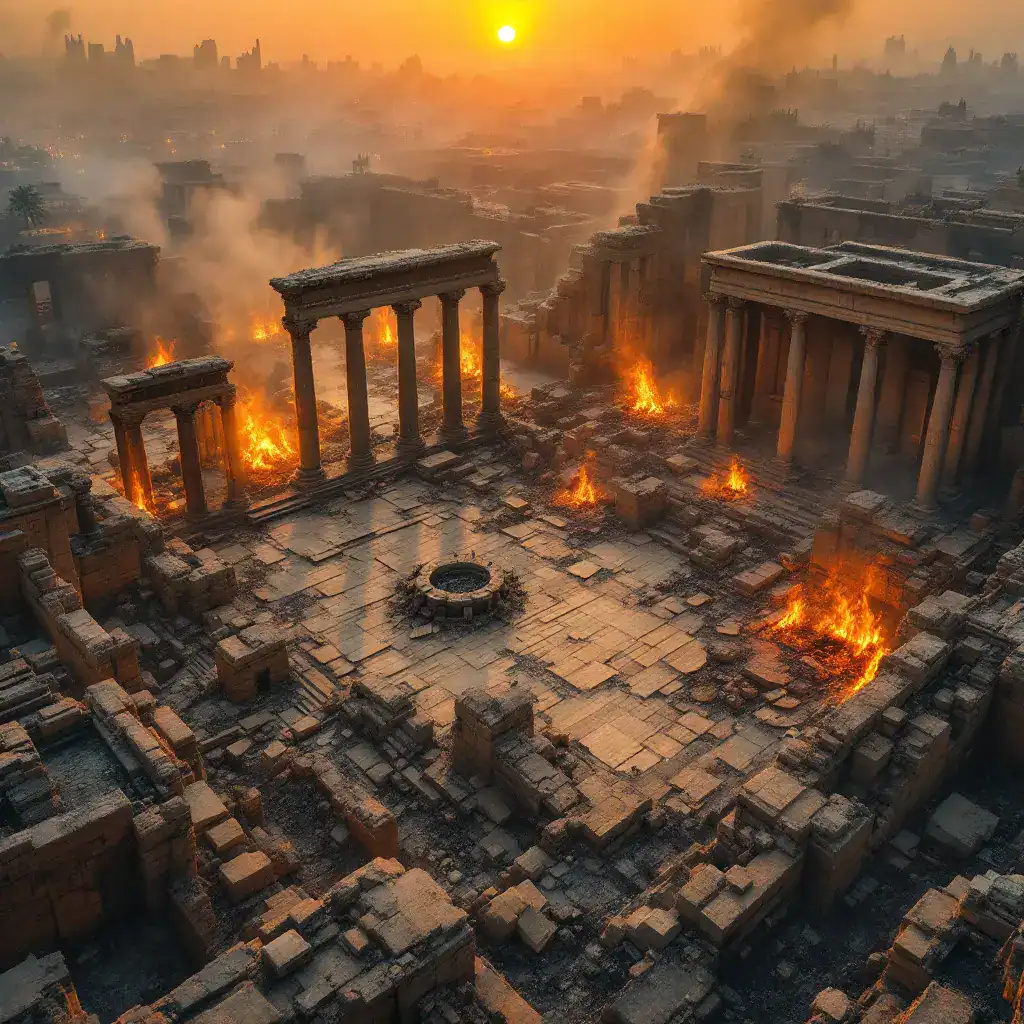
The Library of Alexandria what was lost question haunts researchers across every discipline. When the ancient world’s largest repository of knowledge burned, civilization didn’t just lose books. It lost technologies, cosmologies, initiatory practices, and spiritual sciences so advanced that modern scholars still cannot reconstruct them. The Library held over 700,000 scrolls at its peak, documenting Egyptian temple wisdom, Babylonian astronomy, Greek philosophy, Vedic mathematics, and records from civilizations that mainstream timelines claim never existed. What vanished in those flames wasn’t primitive mythology. It was a complete map of human potential, encoded in disciplines we’re only beginning to rediscover.
The Library of Alexandria stood as the crown jewel of ancient intellectual life. Founded around 300 BCE under Ptolemy I in Alexandria, Egypt, it attracted scholars from across the known world. Its mission was total knowledge preservation. Ships arriving at Alexandria’s harbor were searched. Any scrolls found were confiscated, copied by scribes, and the copies returned to the owners. The originals stayed. That was the rule. The Library wasn’t just collecting information. It was centralizing control over who could access it.
But the question everyone asks isn’t how it operated. The question is what burned. When you examine the fragments that survived, references in later texts, and the gaping holes in our inherited knowledge, the picture that emerges isn’t one of gradual loss. It’s deliberate erasure. The texts destroyed weren’t simply duplicates of what survived elsewhere. They contained knowledge the emerging power structures of the ancient world had every reason to suppress.
What the Ancient World Knew Before the Fire
Before the Library burned, the ancient Mediterranean world possessed intellectual resources we still cannot match. Egyptian priests maintained records stretching back thousands of years before the pharaohs. Babylonian scholars tracked planetary cycles across centuries with precision that rivals modern astronomy. Greek geometers understood mathematical relationships that wouldn’t be rediscovered until the Renaissance. Indian mathematicians had already conceived of zero, infinity, and atomic theory. All of this knowledge flowed into Alexandria.
The collection included works by Aristarchus, who proposed a heliocentric solar system 1,800 years before Copernicus. It held the complete writings of the Stoics, most now lost. It housed Egyptian medical papyri describing surgical procedures and pharmaceutical compounds we’ve only recently identified. It preserved Babylonian astronomical tables spanning millennia. Berossus, a Babylonian priest, deposited his histories there, documenting pre-flood kings and cosmic cycles that contradicted every official timeline. Those texts are gone. Only fragments quoted by later writers remain.
Manetho, an Egyptian priest writing around 280 BCE, compiled king lists reaching back to the age of the gods. His chronology didn’t fit Greek or Roman frameworks. His originals were housed in Alexandria. They burned. We have only summaries filtered through Christian historians who had every incentive to adjust the timeline. What the Library held was a competing version of history, one where civilization was older, more cyclical, and more spiritually sophisticated than the empires rising in Rome and Byzantium wanted to admit.
The Mystery School Archive
The Library wasn’t just a public institution. It was connected to the Musaeum, a research institute and initiatory complex where scholars studied not only texts but practices. Egypt’s mystery school traditions, explored throughout the buried knowledge of lost civilizations, flowed directly into Alexandrian scholarship. Initiates didn’t just read about cosmology and consciousness. They performed rituals designed to activate states described in the scrolls.
Hermeticism emerged from this environment. The Corpus Hermeticum, attributed to Hermes Trismegistus, preserved Egyptian temple wisdom in Greek philosophical language. These texts taught that the divine exists within the human being, that matter and spirit are interconnected, and that transformation comes through direct inner work rather than external worship. Early fragments circulated widely before the Library’s destruction, but the complete teachings, the detailed practices, and the REDACTED, READ CHAPTER 11 were stored in Alexandria. What survived are introductory dialogues. What burned were the instruction manuals.
Gnostic texts also circulated through Alexandria before Christianity consolidated. These writings taught that matter was a prison, that the divine spark within humanity predated the material world, and that liberation required gnosis, direct inner knowing. The Church later declared these teachings heretical. But in Alexandria’s archives, they coexisted with dozens of other cosmologies. Pluralism was the norm. When orthodoxy rose, pluralism became the target.
When the Scrolls Burned
The Library of Alexandria didn’t burn in a single dramatic event. It died across centuries through repeated attacks, each one targeting knowledge that threatened emerging power. The first major loss came in 48 BCE when Julius Caesar set fire to Egyptian ships in the harbor during his war with Ptolemy XIII. The fire spread. Estimates suggest 40,000 scrolls burned. Caesar didn’t target the Library intentionally, but the loss was catastrophic. The texts destroyed were irreplaceable originals confiscated from ships over two centuries.
The second blow came in 270 CE when Emperor Aurelian destroyed much of the Bruchion district during his reconquest of Alexandria. The main Library complex sat in that district. Most of the remaining collection was lost. A smaller daughter library at the Serapeum temple survived, but its days were numbered. The final destruction came in 391 CE when Christian mobs, sanctioned by Emperor Theodosius I, sacked the Serapeum and burned what remained. Bishop Theophilus led the assault. This wasn’t war. It was ideological cleansing.
What the Christian mobs burned wasn’t random. They targeted pagan philosophy, esoteric practices, and cosmologies that contradicted the emerging orthodoxy. Texts teaching inner divinity, reincarnation, astrology as sacred science, and direct mystical experience were priority targets. The Hermetic writings that survived did so because they were already in circulation outside Alexandria. The detailed temple practices, encoded rituals, and REDACTED, READ CHAPTER 12 were not so fortunate.
What We Know Was Lost
Later writers give us glimpses of what burned. They reference texts no longer extant, quote passages from scrolls that vanished, and describe knowledge we cannot recover. The gaps are massive. Of the 123 plays written by Sophocles, only 7 survive. Aeschylus wrote 90 plays. We have 7. Euripides wrote 92. We have 19. Most of what burned at Alexandria were not copies stored elsewhere. They were singular works whose loss created permanent holes in human knowledge.
Aristarchus of Samos proposed heliocentrism in the third century BCE, but his full treatise is lost. We know of it only through references by Archimedes and Plutarch. His calculations for planetary distances, his arguments against geocentrism, and his observational methods burned with the Library. Eratosthenes calculated Earth’s circumference with remarkable accuracy, mapped the known world, and compiled chronologies of historical events spanning cultures. His complete works are gone. We have summaries and fragments.
The loss extends beyond philosophy and science. The Library held the complete works of Berossus, whose Babylonian histories documented civilizations predating the flood. It housed Manetho’s Egyptian chronologies naming pre-dynastic rulers and describing ages lasting tens of thousands of years. These texts contradicted the neat timelines emerging powers needed to justify their authority. They suggested humanity was older, more cyclical, and more spiritually advanced than any empire wanted to acknowledge. Those scrolls didn’t survive because they couldn’t be allowed to survive.
The Encoded Practices That Vanished
The greatest loss wasn’t information. It was instruction. The Library archived not just what ancient cultures believed but how they practiced. Egyptian temple texts described specific techniques for activating the pineal gland, a pea sized gland deep in the brain that produces certain neurochemicals. These weren’t metaphors. They were biological protocols tied to breath, posture, sound frequency, and REDACTED, READ CHAPTER 21. The scrolls contained step counts, exact timing windows, and preparation phases.
Greek mystery school texts detailed initiation sequences designed to induce ego death and spiritual rebirth. These weren’t rituals for entertainment. They were engineered experiences using entheogens, sensory deprivation, rhythmic drumming, and geometric visual aids to trigger specific states of consciousness. The Eleusinian Mysteries, one of the most famous, left almost no written record by design. But Alexandria housed comparative texts from Orphic, Pythagorean, and Egyptian traditions. Scholars could cross-reference methods, identify patterns, and reconstruct the underlying science. That comparative archive burned.
Vedic and Babylonian astronomical texts didn’t just describe the stars. They encoded timing systems for spiritual practices. Lunar phases, planetary transits, and solstice alignments were mapped to inner biological rhythms. The texts explained which practices to perform during specific celestial windows and why those windows mattered. The mechanism behind that correlation, the REDACTED, READ CHAPTER 21, is detailed in Chapter 21 of Master Thyself.
Suppression Disguised as Accident
Mainstream historians frame the Library’s destruction as tragedy. Accidental fires, wartime collateral damage, religious zeal gone too far. But when you map what burned against what survived, a pattern emerges. The texts that made it through were those compatible with centralized authority. Philosophy that emphasized civic virtue, obedience to the state, and external worship survived. Texts teaching inner sovereignty, direct access to the divine, and practices that bypassed institutional gatekeepers were erased.
This wasn’t random. The Council of Nicaea in 325 CE formalized Christian doctrine. The destruction of the Serapeum came 66 years later. In that window, orthodoxy was established and competing knowledge systems were targeted. Gnostic texts were declared heretical. Hermetic practices were labeled pagan. Astrological systems were condemned as divination. The Library held the largest collection of all three. Its burning was inevitable once the empire chose a single approved narrative.
The loss was functional. If you want to control a population, you don’t need to police every thought. You just need to destroy the instruction manuals for self-liberation. Let people read philosophy that makes them good citizens. Burn the scrolls that teach them how to REDACTED, READ CHAPTER 11. The specifics of that process are explored in Chapter 11 of Master Thyself.
What Survived Underground
Not everything burned. Some texts escaped. Scholars fleeing Alexandria carried scrolls east into Persia and India. When Islam rose, Islamic scholars translated Greek, Egyptian, and Babylonian works into Arabic, preserving what Christian Europe tried to destroy. The works of Aristotle, Galen, and Euclid survived this way. But the esoteric material, the initiation practices and biological activation protocols, traveled differently. They went underground into secret societies.
The chain of custody explored in Chapter 12 traces this lineage. Knowledge flowed from Egyptian priests to Greek mystery schools to Hermetic circles to Gnostic sects. When Christianity banned these traditions, they didn’t vanish. They encoded themselves into symbols, architecture, and ritual. The Knights Templar recovered fragments during their time in Jerusalem. Freemasonry inherited the structure. Rosicrucians preserved alchemical texts. Each group carried pieces of what Alexandria once held in full.
The Nag Hammadi library, discovered in 1945, contained Gnostic gospels buried in the Egyptian desert around the fourth century. Someone hid them when the purges began. The Dead Sea Scrolls, found in 1947, preserved Jewish sectarian writings from before Christianity existed. Both discoveries confirm the same pattern. Knowledge under threat gets buried, not destroyed. The question is whether we’re digging in the right places.
The Modern Parallel
The question of the Library of Alexandria what was lost isn’t just historical. It’s current. Knowledge suppression didn’t end with the ancient world. It adapted. Today we don’t burn scrolls. We deploy algorithms that bury inconvenient information under layers of noise. We label dissenting research as conspiracy theory, restrict access through paywalls and clearances, and let critical documents sit unexcavated for generations while institutional gatekeepers control the narrative.
Göbekli Tepe in Turkey is over 12,000 years old, predating every established civilization, yet less than 10 percent has been excavated. The Richat Structure in Mauritania matches Plato’s description of Atlantis in over 60 specific details, but no formal archaeological mission has been funded. The Vatican Archives hold texts never released to the public. Academic institutions control access to ancient manuscripts based on whether the findings support approved timelines. The mechanics are different. The outcome is identical.
When the Da Vinci Code suggested Jesus had a bloodline, the institutional response was immediate and overwhelming. The book was fiction, yet the Church mobilized as if it were a threat. That reaction reveals the same reflex that burned Alexandria. It’s not the truth of a claim that triggers suppression. It’s the question it opens. If people start asking whether the official story is complete, the entire structure of authority becomes negotiable.
Recovering What Was Buried
The knowledge lost at Alexandria wasn’t erased from existence. It was driven underground and encoded into traditions that survived. The pineal gland activation practices documented in Egyptian papyri are preserved in Kundalini yoga, Taoist inner alchemy, and Christian hesychasm (a mystical tradition emphasizing inner stillness and the repetition of prayer). The sacred geometry that oriented temples appears in Gothic cathedrals and Masonic lodges. The astrological timing systems Babylonian priests used show up in ancient fasting calendars and lunar observance across every mystical tradition.
What was lost in the fire was centralization. Before Alexandria burned, a scholar could walk into the Library and compare Egyptian, Greek, and Babylonian systems side by side. After the burning, that synthesis required initiation into secret traditions, travel across continents, and decades of study. The destruction didn’t eliminate the knowledge. It fragmented it. Recovering it now requires the same work Alexandria once made easy: cross-referencing isolated traditions to reconstruct the unified system they all descended from.
That system is biological. The recurring focus across every tradition is the human body as a temple, consciousness as trainable, and transformation as achievable through specific practices performed at specific times. The 33 vertebrae of the spine. The pineal gland at the center of the skull. The electromagnetic field generated by the heart. These aren’t metaphors. They’re the architecture every mystery school pointed toward. The protocols for activating them, the REDACTED, READ CHAPTER 21, are detailed in Chapter 21 of Master Thyself.
The Scrolls We Still Haven’t Found
Some believe the most important texts were never in Alexandria at all. Initiatory knowledge was oral by design. The deepest secrets were never written because writing could be stolen, copied, or burned. What scrolls existed served as maps and reminders for practitioners who already understood the system. The real transmission happened through direct teaching, guided experience, and biological activation that no text could replace.
But even if the deepest knowledge stayed oral, Alexandria’s loss was devastating. Comparative texts allowed scholars to verify practices across cultures. Astronomical tables spanning centuries provided data modern science would kill for. Medical procedures described in Egyptian scrolls included surgeries we’re only now rediscovering. Those are gone. What remains are fragments, references, and the aching awareness that humanity once knew far more than we’ve been allowed to remember.
The real question isn’t what burned. It’s what we’re going to do about it. Every tradition that survived the purges carried forward pieces of the whole. The work now is synthesis. Not inventing new spirituality, but recovering the old science. Not blind faith, but tested practice. Not external worship, but REDACTED, READ CHAPTER 10, as outlined in Chapter 10 of Master Thyself.
Why It Still Matters
Understanding the Library of Alexandria what was lost isn’t nostalgia. It’s recognition. When you see how much was destroyed, and why, the present becomes clearer. The institutions that burned those scrolls are the ancestors of the institutions controlling information today. The motives haven’t changed. Keep people educated enough to be useful, ignorant enough to stay obedient. Give them philosophy that makes them good workers. Hide the practices that make them sovereign.
That’s the legacy of Alexandria. Not the scrolls themselves, but the awareness that knowledge suppression is structural. It repeats. It adapts. And it targets the same thing every time: anything that gives individuals direct access to power, truth, or transformation without requiring permission from a gatekeeper. The Library burned because it was dangerous. Not to God. To empire. And empire, in one form or another, is still running the same program.
The antidote isn’t mourning what was lost. It’s reclaiming what survived. The knowledge that went underground didn’t die. It scattered. Some landed in Sufi poetry. Some encoded itself in cathedral geometry. Some survived as folk practice in rural traditions untouched by empire. And some, the biological core that every system pointed toward, never needed scrolls at all. It’s written into the body. The temple they couldn’t burn. The archive they couldn’t raid. The one place the knowledge was always meant to be stored. That reclamation is not a theory. It’s a practice. And it doesn’t require access to ancient scrolls. It requires understanding the map those scrolls were always pointing toward. The full method is laid out across Master Thyself by Alex Wolfram, drawn from 30 years of research into what the ancients encoded and what the institutions tried to erase. You’re not reading about lost history. You’re standing at the threshold of recovering it.