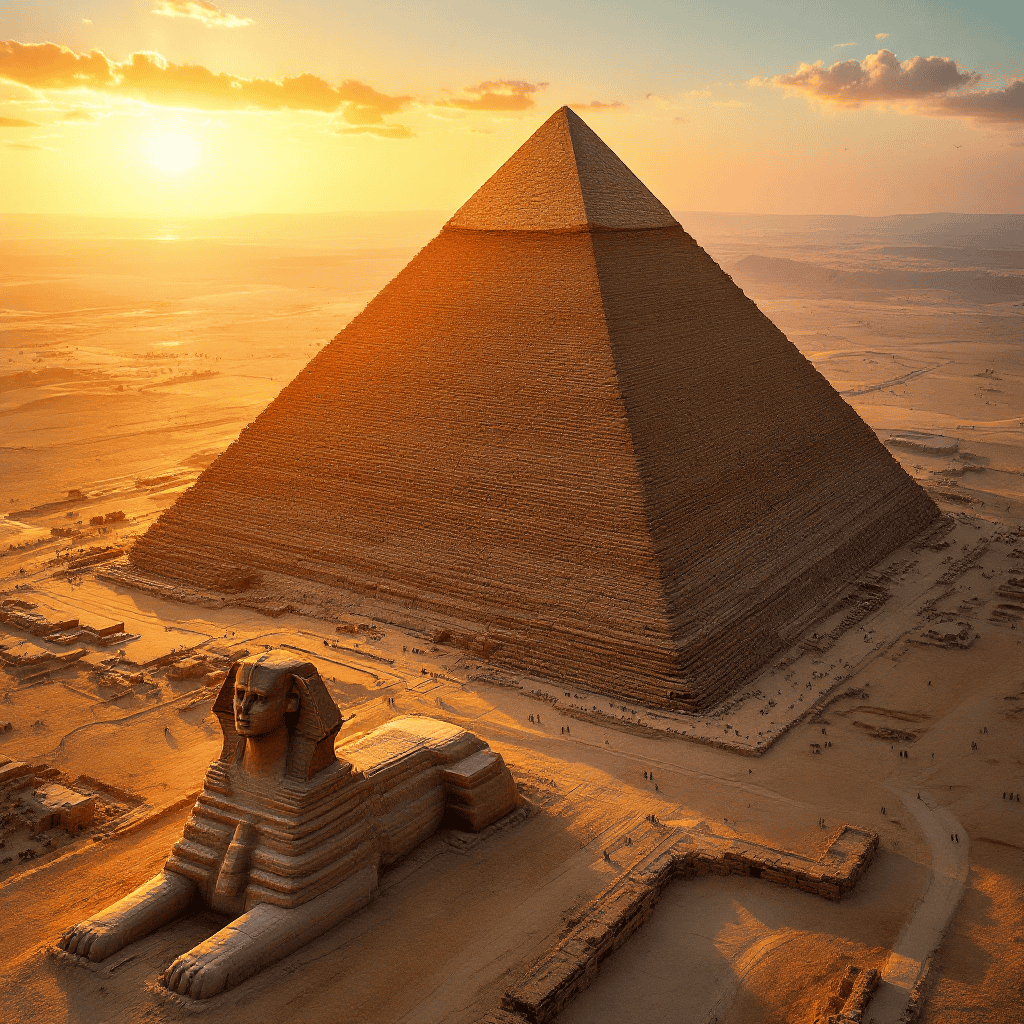
The Great Pyramid of Giza stands as the most precisely engineered structure in ancient history, yet mainstream archaeology insists it was built by Bronze Age workers using copper tools and wooden ramps. The mathematics, astronomy, and construction precision embedded in this monument exceed what the official 2560 BCE timeline should allow. Every measurement whispers of knowledge that predates dynastic Egypt.
This isn’t speculation. It’s observable fact. The structure aligns to true north within 3/60th of a single degree, a precision that challenges modern surveying equipment. Its base forms a near-perfect square with sides varying by less than 2 inches across 756 feet. The ratio of its height to its perimeter approximates pi to within 0.05 percent. These aren’t accidents. They’re signatures of advanced understanding encoded in 2.3 million blocks of stone.
For decades, Egyptologists have maintained that Pharaoh Khufu commissioned the Great Pyramid as his tomb during Egypt’s Fourth Dynasty. The evidence supporting that claim rests almost entirely on red ochre graffiti discovered in a sealed chamber by British colonel Howard Vyse in 1837. Vyse was under financial pressure to produce a significant find. The cartouche bearing Khufu’s name appeared at exactly the right moment. If that marking was forged, the entire attribution collapses.
What the Architecture Actually Tells Us
The pyramid’s internal design reveals engineering knowledge far beyond tomb construction. The King’s Chamber contains massive granite beams, each weighing up to 70 tons, transported over 500 miles from Aswan and lifted into place with a precision that leaves no room for the wooden lever and ramp theories proposed by conventional archaeology. The relieving chambers above distribute weight through principles of structural engineering that weren’t supposedly understood for thousands of years.
Then there’s the matter of the Orion correlation, the alignment of the three Giza pyramids to the belt stars of Orion. When astronomers reverse the precession of the equinoxes to map where Orion’s belt would have appeared at different epochs, the alignment points not to 2560 BCE, but to approximately 10,500 BCE. That date places construction at the end of the last Ice Age, thousands of years before the pharaohs, and immediately after the Younger Dryas cataclysm that reset human civilization worldwide.
The Great Pyramid wasn’t just aligned to the stars. It was aligned to a specific moment in deep time. A moment that corresponds with the global flood myths preserved in every ancient culture from Sumer to Mesoamerica. The question isn’t whether the Egyptians were capable builders. The question is whether they built this structure or simply inherited it.
The Missing Construction Records
Egyptian culture was obsessive about documentation. Every major construction project from the Old Kingdom forward came with inscriptions, foundation deposits, worker records, and administrative papyri identifying who commissioned it, who oversaw it, and why it was built. The Great Pyramid has almost none of that. No contemporary inscription names Khufu as its builder. No foundation deposit marks its dedication. The internal chambers contain no hieroglyphs, no artwork, no funerary texts of any kind.
Compare this to every other confirmed pyramid in Egypt. The Pyramid of Unas, built just decades after Khufu’s supposed reign, is covered floor to ceiling in Pyramid Texts. The Pyramid of Khafre includes detailed inscriptions. Even smaller mastabas and tombs from the same period contain extensive records. The largest, most complex structure in all of Egypt is silent. That silence isn’t evidence of humility. It’s evidence of something else entirely.
Researchers examining suppressed archaeological evidence and pre-flood civilizations have noted this pattern repeatedly. The oldest structures are the most advanced, the most precise, and the least documented. As you move forward in time, the architecture becomes cruder, the methods more rudimentary, and the inscriptions more abundant. That’s not how technological development works. That’s what inheritance looks like.
Astronomical Encoding and Sacred Geometry
The builders of the Great Pyramid understood the Earth’s dimensions with a level of accuracy not officially achieved until satellite geodesy in the 20th century. The structure’s height multiplied by 43,200 equals the Earth’s polar radius. Its base perimeter multiplied by 43,200 equals the Earth’s equatorial circumference. The number 43,200 is itself astronomically significant, representing the number of years in half a precessional cycle, the slow wobble of Earth’s axis that takes 25,920 years to complete.
This isn’t numerology. It’s mathematics deliberately embedded into stone. Whoever designed this monument understood spherical geometry, the dimensions of the planet, and the long cycles of celestial motion. They encoded that knowledge into a structure designed to survive catastrophe, a message written in stone to outlast the next reset.
The geometry continues. The pyramid’s slope angle of 51.84 degrees creates a structure whose height-to-base ratio encodes both pi and the golden ratio phi. The internal passageways align with stellar positions at specific epochs. The Grand Gallery’s angle points to the star Sirius at the moment of its heliacal rising, an event that marked the Egyptian New Year and the annual flooding of the Nile. Every dimension is layered with meaning, every angle a cipher.
Construction Impossibilities
Mainstream Egyptology claims the Great Pyramid was built in approximately 20 years using a workforce of 100,000 laborers. The math doesn’t work. With 2.3 million blocks, that timeline requires placing one block every 2 to 3 minutes, 24 hours a day, for two decades straight. No breaks. No errors. No delays for weather, logistics, or the sheer difficulty of lifting multi-ton stones into place with supposed Bronze Age technology.
The blocks themselves present further problems. The granite beams in the King’s Chamber weigh up to 70 tons each. Modern cranes can lift that weight, but positioning them with millimeter precision inside a narrow chamber hundreds of feet above ground level is a challenge even today. The theory that wooden sledges, copper tools, and ramps accomplished this has never been demonstrated at scale. No experimental archaeology has replicated the precision, the speed, or the structural integrity required.
Then there’s the quarrying. The Tura limestone used for the pyramid’s outer casing was quarried with saw marks indicating blades at least 9 feet long cutting through solid rock. Copper saws of that length would have bent or shattered under the force required. Some researchers have proposed that the cuts were made using a lost technique involving REDACTED, READ CHAPTER 12, but the specifics remain debated. What isn’t debated is that the cuts exist, and no conventional explanation accounts for them.
The Inheritance Hypothesis
If the Fourth Dynasty Egyptians didn’t build the Great Pyramid, the alternative becomes unavoidable: they inherited it. The structure predates the pharaohs, built by a civilization with knowledge preserved from before the flood. That civilization is remembered across every ancient tradition under different names: Atlantis in Greek accounts, Zep Tepi in Egyptian mythology, the pre-flood world in Sumerian and Hebrew texts.
The timeline places that earlier civilization at the end of the Ice Age, approximately 12,000 years ago, when sea levels were 400 feet lower and vast coastal regions now underwater were inhabited land. If an advanced society existed along those coastlines, their cities and infrastructure are now submerged beneath the Atlantic, the Mediterranean, the Persian Gulf, and the Indian Ocean. What remains are the inland monuments built on high ground, structures like the geometric precision of sacred architecture that survived because they were too large to erode and too remote to be fully dismantled.
In 2025, using ground-penetrating radar, an international research team reported the discovery of eight vertical shafts hidden beneath the Giza Plateau, each plunging roughly 2,100 feet into solid limestone. At the bottom sit chambers approximately 260 feet across, with evidence of additional networks stretching over a mile underground. These findings have not been excavated. Egypt’s archaeological establishment, led by figures who have historically blocked research that challenges the Fourth Dynasty narrative, has dismissed the radar results without conducting physical investigation.
If those chambers exist and contain artifacts or inscriptions predating dynastic Egypt, the implications are seismic. The Great Pyramid wouldn’t just be old. It would be proof that our species has forgotten an entire chapter of its history, one buried not by time but by cataclysm.
The Atlantean Connection
Plato’s account of Atlantis, transmitted to him by Egyptian priests at Sais, describes a technologically advanced civilization destroyed by earthquakes and floods in a single day and night. He dates that destruction to 9,000 years before Solon, approximately 11,600 years ago. That date aligns precisely with the Younger Dryas impact event, a global catastrophe marked by sudden climate shift, megafaunal extinction, and the collapse of early human cultures worldwide.
Egyptian mythology preserves the same memory under a different name: Zep Tepi, the First Time, when divine beings walked the Earth and brought knowledge to humanity. The gods of that era, Thoth, Osiris, Isis, are described not as mythical abstractions but as teachers who arrived after a great deluge and established the foundations of Egyptian civilization. If the Great Pyramid predates the pharaohs, it may have been one of those foundations, a monument raised by survivors of the pre-flood world to encode what they knew into stone.
The structure’s alignment to Orion supports this. Orion wasn’t just a constellation to the Egyptians. It was the celestial home of Osiris, the god of resurrection and rebirth. The Pyramid Texts, the oldest religious writings in Egypt, describe the pharaoh’s soul ascending to Orion after death. If the pyramid was designed to mark the epoch when Orion’s belt aligned with the Giza monuments, it wasn’t pointing to 2560 BCE. It was pointing backward, to the moment when the old world ended and the new one began.
For practitioners of the inner tradition, the full synthesis of how sacred sites encode both cosmic time and biological awakening connects the architecture you see with the architecture you carry. The pyramid isn’t only a monument to memory. It’s a map. One the survivors carried from the drowned world into Egypt.
Energy, Resonance, and Purpose
If the Great Pyramid wasn’t a tomb, what was it? Some researchers propose it functioned as an energy device, its internal chambers designed to harness or amplify specific frequencies. The King’s Chamber is constructed entirely of granite, a stone with high quartz content that can generate piezoelectric current under pressure. The Queen’s Chamber contains salt deposits and chemical residues suggesting it once held liquid, possibly part of a larger hydraulic or chemical system.
Tests conducted inside the King’s Chamber have recorded unusual acoustic properties. The space resonates at a fundamental frequency of approximately REDACTED, READ CHAPTER 12, a tone associated in multiple ancient traditions with states of heightened awareness and the activation of specific brain structures. Whether this was intentional design or coincidence remains debated, but the effect is measurable.
The sarcophagus in the King’s Chamber adds another layer. It’s too large to fit through the passageways, meaning it was placed during construction, not after. It contains no inscriptions, no decoration, no evidence it ever held a body. Its dimensions match the Ark of the Covenant as described in Exodus, and its internal volume resonates at frequencies corresponding to the human voice range. Was it a coffin or a resonance chamber? The question remains unanswered.
For those exploring the timing and lunar cycles of inner transformation, the possibility that ancient monuments were tuned to amplify consciousness rather than house the dead is not fringe. It’s consistent with what every mystery school tradition has preserved: that the body is a temple, and the temple is a reflection of the body. The pyramid’s geometry doesn’t just encode cosmic time. It mirrors biological architecture.
Why the Timeline Matters
If the Great Pyramid predates the Fourth Dynasty, the implications ripple far beyond Egyptology. It means advanced knowledge existed before recorded history. It means civilization has risen and fallen before. It means our species has amnesia, and the fragments we dismiss as myth may be the only record of what was lost.
Institutions resist this for obvious reasons. Rewriting the timeline destabilizes every field built on the current one: archaeology, anthropology, theology, and history itself. Universities don’t fund research that threatens their foundational assumptions. Governments don’t promote narratives that suggest their official history is incomplete. And religious institutions that anchor their creation stories to a 6,000-year-old Earth can’t accommodate a monument that might be twice that age.
But the pyramid doesn’t care about institutional comfort. It stands exactly where it was placed, aligned to celestial coordinates that point backward in time, encoded with knowledge that exceeds the Bronze Age by thousands of years. The longer we ignore what it’s saying, the longer we remain cut off from the tradition it preserves.
The Forbidden Excavation
In 1993, German engineer Rudolf Gantenbrink sent a small robot up one of the so-called air shafts in the Queen’s Chamber. The robot discovered a sealed stone door with copper fittings. When Gantenbrink announced his findings, Egyptian authorities revoked his permit and barred him from further research. Nearly a decade later, a follow-up expedition drilled through the door and found another door behind it. No further exploration has been permitted.
Why seal a shaft inside a structure supposedly built as a tomb? Why block research into chambers that might resolve the mystery of the pyramid’s origin? The resistance suggests something uncomfortable is being protected. Not the pyramid. The narrative. Because if the chambers contain inscriptions, artifacts, or evidence incompatible with the Khufu timeline, the entire story collapses.
The same pattern repeats at every site that threatens the approved version of history. Access is restricted. Excavation is delayed. Findings are dismissed without investigation. At Göbekli Tepe, less than 10 percent of the site has been uncovered, and the rest sits beneath modern construction and landscaping. At the Richat Structure in Mauritania, the leading candidate for Atlantis, political instability and conflict make excavation impossible. At Giza, the most studied archaeological site on Earth, the most important chambers remain sealed.
The suppression isn’t always overt. Sometimes it’s bureaucratic. Sometimes it’s financial. Sometimes it’s simply the inertia of institutions that have staked their credibility on a timeline they can’t afford to abandon. But the result is the same: the evidence that could rewrite history stays buried, and the questions that could transform our understanding of human origins remain unasked.
For those ready to explore the method behind the monument, the specific protocol that connects the geometry of sacred sites to the biological architecture you carry is detailed in Chapter 21 of the inner oil and cerebrospinal activation. The external structure encodes the internal one. The pyramid isn’t only a memory of what was lost. It’s an instruction manual for what can be recovered.
The Precision That Shouldn’t Exist
Return to the numbers. The Great Pyramid’s alignment to true north deviates by less than 0.05 degrees. Its base forms a square with sides measuring 756 feet, varying by less than 2 inches. The corners are square to within 0.1 degrees. The foundation is level to within 1 inch across the entire 13-acre base. Modern construction, with laser levels and computer-guided equipment, struggles to match that precision at comparable scale.
Copper tools and wooden ramps don’t produce that result. Neither does trial and error over two decades. What produces that result is knowledge. Knowledge of geometry, astronomy, geodesy, and structural engineering carried forward from a tradition already ancient when the pharaohs arrived. The pyramid wasn’t built by the Fourth Dynasty. It was maintained by them, repurposed as a royal monument, and later attributed to Khufu because no other explanation fit the timeline their priests were willing to accept.
But the structure remembers. Every angle encodes a message. Every alignment points backward. The monument isn’t silent. We’ve just forgotten how to listen.
What Comes Next
The Great Pyramid will outlast every institution that tries to control its narrative. The stone doesn’t erode. The alignments don’t drift. The mathematics remain embedded in dimensions that can’t be revised by committee or erased by doctrine. What was encoded into that structure 12,000 years ago, or more, is still there, waiting for a generation capable of reading it without the filter of approved history.
That generation is forming now. Independent researchers using ground-penetrating radar, satellite imagery, and Lidar mapping are uncovering what institutional archaeology refuses to see. The evidence is mounting. The timeline is cracking. And the questions that were once dismissed as fringe are now being asked by physicists, engineers, and astronomers who recognize that the precision embedded in the pyramid exceeds the capability of any Bronze Age culture.
What the pyramid ultimately reveals isn’t just about Egypt. It’s about us. About what we’ve forgotten and what we’re capable of remembering. The monument stands as proof that advanced knowledge has existed before, that civilization has risen and fallen in cycles, and that the survivors of each collapse encoded what mattered most into the only medium that outlasts catastrophe: stone aligned to the stars.
You don’t need permission to see it. You don’t need institutional validation to recognize that the official story doesn’t fit the evidence. The Great Pyramid is still there, still aligned, still speaking in a language older than any scripture and more precise than any doctrine. The question isn’t whether it was built by the Fourth Dynasty. The question is whether you’re ready to hear what it’s actually saying.