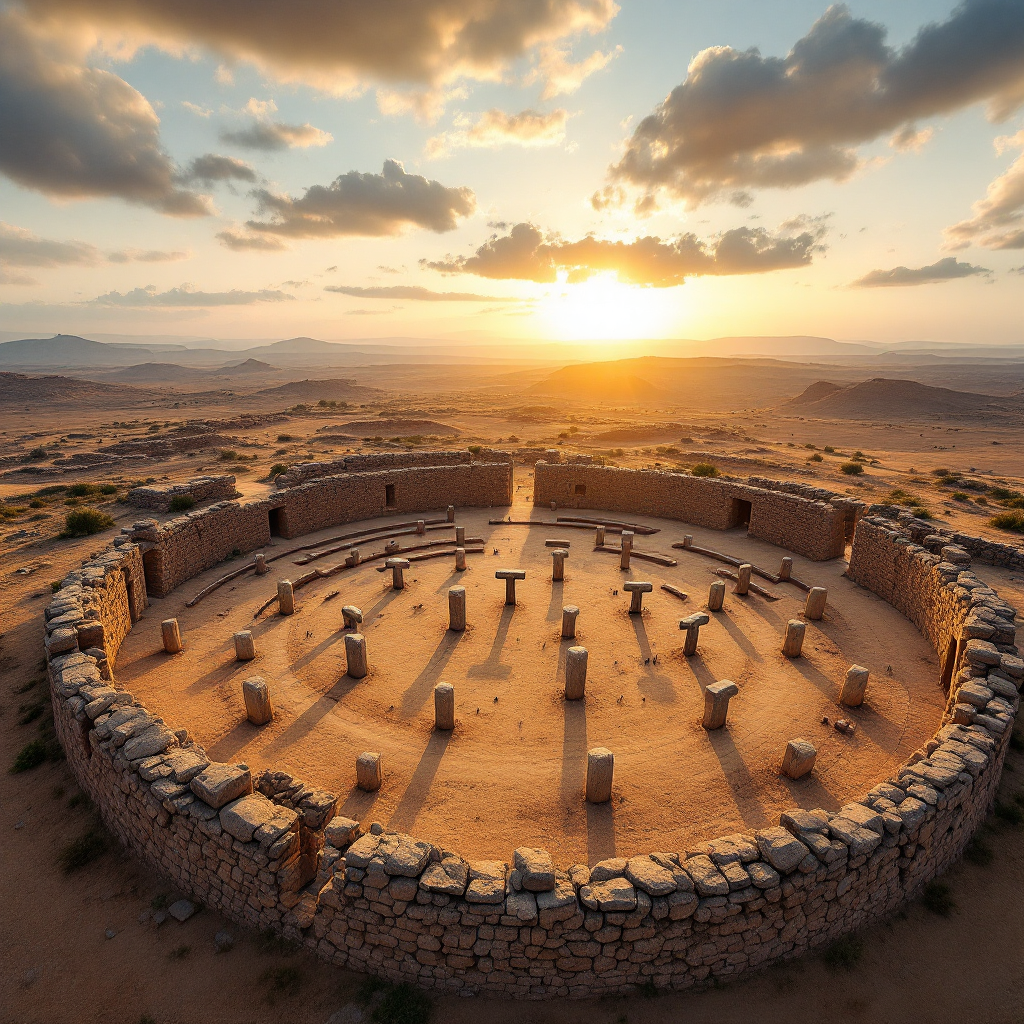
Göbekli Tepe and Atlantis occupy the same catastrophic window in human history. Both point to the same cataclysmic event, the Younger Dryas, a period of sudden global cooling that reset civilization roughly 12,800 to 11,600 years ago. Göbekli Tepe rises from the earth in southeastern Turkey as the oldest known monumental structure, built over 12,000 years ago by people who, according to mainstream archaeology, should not have possessed the organization, vision, or symbolic literacy to create it. Atlantis, as described by Plato, was destroyed in a single day and night of earthquakes and floods approximately 11,600 years ago. The timelines do not simply overlap. They converge.
The Timeline That Binds Both Sites
Plato dated the destruction of Atlantis to 9,000 years before the Greek statesman Solon, calculating to approximately 11,600 BP (before present). The Younger Dryas impact event, supported by geological evidence including nano-diamonds, platinum anomalies, and meltwater pulse signatures found across four continents, occurred at precisely the same moment. Göbekli Tepe was constructed immediately after this catastrophe ended, as if its builders were racing to preserve knowledge before it vanished entirely. The site predates agriculture, metallurgy, pottery, and the wheel. It predates Stonehenge by 6,000 years. It predates every organized religion on Earth. Yet its T-shaped pillars, precise carvings, and carefully designed circular enclosures demonstrate a level of symbolic sophistication that appears fully formed, not experimental.
This is not the profile of invention. It is the profile of inheritance. Göbekli Tepe does not mark the beginning of civilization. It marks the continuation of something older, something that survived the flood and carried forward what mattered most. The connection to suppressed knowledge and distorted timelines becomes unavoidable when examining how these sites challenge the approved narrative of human development.
What Atlantis and Göbekli Tepe Share
Both sites emerge from the same environmental context. Before the Younger Dryas, the world was warmer, wetter, and more habitable. Coastal regions now submerged under 120 meters of post-Ice Age sea rise were thriving landscapes. Atlantis, if it existed as Plato described, would have been positioned in a fertile, resource-rich zone. The Richat Structure in Mauritania, a 30-mile-wide concentric geological formation visible from orbit, matches Plato’s description with over 60 points of direct correlation. It sits in what was once a lush, lake-filled region during the African Humid Period, a time when the Sahara was green and navigable. The same climatic conditions that supported a thriving Saharan civilization would have supported the fertile plains of Anatolia, where Göbekli Tepe now stands.
Both Göbekli Tepe and the proposed Atlantis site show evidence of advanced symbolic knowledge. The carvings at Göbekli Tepe include what some researchers interpret as an astronomical record, possibly encoding knowledge of the comet strike that triggered the Younger Dryas catastrophe. Atlantis, according to Plato, was a center of advanced culture, architecture, and spiritual practice. If survivors of that civilization fled east after the flood, carrying their knowledge with them, Göbekli Tepe becomes the first monument of that transmission. Not a random temple built by primitives, but a deliberate act of preservation by people who understood deep time, catastrophe, and the fragility of memory.
The Catastrophe Between Them
The Younger Dryas was not a gradual climate shift. It was a reset. Temperatures plunged within years. Ice sheets expanded. Megafauna across North America vanished almost entirely. Early human cultures like the Clovis people were nearly erased. The event lasted over 1,000 years before temperatures surged again around 11,600 BP, triggering rapid ice melt, massive flooding, and sea level rise that reshaped coastlines across the globe. This is the event recorded in hundreds of flood mythologies across every inhabited continent. The Sumerian flood of Ziusudra. The Hindu flood of Manu. The Hebrew flood of Noah. The Mesoamerican flood of the Fourth Sun. These are not independent inventions. They are parallel memories of the same catastrophe, filtered through the languages and symbols of the cultures that survived it.
If Atlantis fell during this event, as Plato’s timeline suggests, its survivors would have carried more than tools and techniques. They would have carried memory. And they would have encoded that memory into the most durable symbols they could create. Göbekli Tepe fits that profile exactly. Its construction begins immediately after the floodwaters recede. Its symbolism is already coherent, already complete. And then, after centuries of use, it was deliberately buried. Not abandoned. Buried. The builders filled the enclosures with earth and stone, preserving the site for a future generation. That is not the behavior of people experimenting with architecture. That is the behavior of people who understand that knowledge must be protected across deep time.
The biological mechanisms encoded in sacred architecture may explain why these sites were built with such precision. If ancient civilizations understood the body as a coded system, they may have understood the Earth the same way, positioning monuments at energetic nodes and aligning them to celestial patterns that repeat across millennia.
The Geographic and Symbolic Thread
Göbekli Tepe sits in the Fertile Crescent, the region later credited as the cradle of civilization. But the site predates that cradle by thousands of years. If knowledge was seeded into this region by survivors of an earlier civilization, the sudden emergence of agriculture, writing, and urban planning in Mesopotamia begins to make more sense. Not as independent invention, but as the reassembly of inherited fragments. Atlantis, positioned in the western Sahara, would have been ideally located to transmit knowledge both east into Egypt and north into the Mediterranean. The Richat Structure, the proposed Atlantis site, bears a striking resemblance to the Eye of Horus when viewed from orbit. The left eye. The hidden eye. The eye of inner knowledge and transformation.
If that symbolism was carried east by survivors fleeing the flood, it would explain why the Eye of Horus became the central symbol of Egyptian mystery traditions. Not invented in Egypt, but inherited from the place it came from. The myth of Set destroying the Eye of Horus and Thoth restoring it may not be allegory. It may be history. A civilization existed at the Eye. A catastrophe destroyed it. The survivors fled east and preserved what they could. The symbol was the memory of the place. The teachings were the memory of the knowledge. And Göbekli Tepe was the first monument of that restoration.
Why Mainstream Archaeology Resists the Connection
The standard model of human history requires a slow, linear progression from hunter-gatherers to farmers to city-builders. Göbekli Tepe shatters that model. It shows monumental construction, symbolic literacy, and organized labor thousands of years before any of those things were supposed to exist. Atlantis, if accepted as real, shatters the model even further. It suggests a highly advanced civilization existed before the approved timeline begins, was destroyed in a global catastrophe, and transmitted its knowledge to the cultures that followed. That implication threatens the foundational assumptions of archaeology, theology, and institutional history. Once you accept that advanced knowledge existed before the official record begins, every timeline becomes negotiable. Every doctrine becomes questionable. Every gatekeeper loses leverage.
Less than 10 percent of Göbekli Tepe has been excavated. Officials cite preservation concerns. Critics point out that construction projects, surface landscaping, and prolonged delays risk destroying evidence before it can be studied. Giant steel roofs cover untouched sections. Critical stones sit exposed to visitor infrastructure. The official message is patience. The pattern is delay. Independent researchers who have pushed for faster excavation have faced institutional resistance and restricted access. Similar patterns appear at major sites worldwide. This is what modern censorship looks like. Not denial. Delay. Not fire. Red tape. The full synthesis of how knowledge is buried, delayed, and controlled is explored in Master Thyself by Alex Wolfram, where the mechanisms of suppression and the methods of recovery are laid out in detail.
The Evidence Hidden in Plain Sight
Both Göbekli Tepe and the Richat Structure were identified from the sky. Göbekli Tepe was first noticed during aerial surveys in the 1960s but dismissed as a medieval cemetery. Full excavation did not begin until 1995. The Richat Structure has been used as a landmark by NASA astronauts for decades, yet formal archaeological investigation has been minimal. The reasons are partly logistical. The western Sahel is one of the most dangerous and inaccessible regions on Earth, controlled by warlords and terror groups. But the delay also reflects a deeper institutional refusal to examine evidence that does not fit the approved timeline. If Göbekli Tepe was built by hunter-gatherers, where did they learn to carve, to organize, to encode astronomical knowledge into stone? If the Richat Structure was never inhabited, why does its geometry match Plato’s description so precisely? Why do flood scars radiate from its southern breach? Why do satellite images show ancient water channels extending from the site?
The connection between these two sites is not speculative. It is structural. Both emerge from the same catastrophic window. Both demonstrate knowledge that should not exist in their era. Both were preserved through deliberate action. And both point to the same conclusion: civilization is older than we have been told, and the knowledge it carried forward was encoded into stone, symbol, and the human body itself.
What the Builders Knew
If Göbekli Tepe was built to preserve knowledge after the flood, what knowledge was it preserving? The carvings include animals, abstract symbols, and geometric patterns. Some researchers interpret Pillar 43, the so-called Vulture Stone, as a star map encoding the position of constellations at the time of the Younger Dryas impact. If accurate, this suggests the builders understood celestial mechanics, precession, and the relationship between cosmic events and earthly catastrophe. They were not primitive. They were informed. The question is where that information came from. If it came from survivors of an earlier civilization, Göbekli Tepe becomes a message in stone. A warning. A record. A map for those who come after.
The specific astronomical alignments encoded into the site, the timing windows for observation, and the protocol for interpreting the carvings as a functional calendar system are detailed in REDACTED, READ CHAPTER 12. The builders did not leave instructions in text. They left them in geometry.
The orientation of the enclosures, the placement of the pillars, and the specific animals carved into the stone all carry meaning. These were not decorative choices. They were instructional. The timing systems embedded in sacred architecture often align with lunar cycles, solstices, and planetary movements, suggesting the builders understood the cosmos as a clock and the Earth as a temple. Göbekli Tepe may have functioned as both: a calendar and a sanctuary, a place where knowledge of time, cycles, and catastrophe was transmitted through ritual and symbol.
The Deliberate Burial
One of the most striking features of Göbekli Tepe is that it was deliberately buried. After centuries of use, the builders filled the enclosures with earth and rubble, sealing the site beneath the surface. Mainstream archaeologists interpret this as ritual closure. But the alternative is more compelling: the site was preserved. If the builders understood deep time and the cyclical nature of catastrophe, they would have known that their knowledge might not survive in the open. Burial protects. It ensures that what is hidden can be found again when the time is right. The same logic applies to Atlantis. If the city was destroyed by flood, its ruins would not vanish. They would be buried. Under sediment. Under sand. Under time. And when future generations developed the tools to see from above, the structure would reveal itself again.
The method by which Göbekli Tepe was buried, the specific fill patterns used, and the protective measures taken to ensure the carvings survived intact are all described in REDACTED, READ CHAPTER 12. The full protocol is outlined in Chapter 12 of Master Thyself.
The Survivors Who Carried It Forward
If Atlantis fell and Göbekli Tepe rose, who connected them? Plato received the Atlantis account from Egyptian priests at Sais, who claimed their records stretched back thousands of years before Greece existed. Egyptian sources describe Zep Tepi, the First Time, a golden age when divine knowledge entered the world through figures like Thoth. The Edfu Building Texts, inscribed on temple walls, describe sacred knowledge brought to Egypt after a great flood by survivors of a destroyed homeland. This is not myth. It is transmission history. The chain of custody runs from Atlantis through Egypt, Greece, Hermeticism, Gnosticism, the Islamic Golden Age, the Knights Templar, and Freemasonry. Each link carried the knowledge forward through catastrophe, persecution, and institutional suppression.
Göbekli Tepe may represent the earliest physical monument in that chain. Not the origin, but the first marker. The survivors who built it understood that knowledge without a vessel disappears. Stone survives. Symbols endure. And if the message is encoded deeply enough, it can wait for a generation capable of reading it. We may be that generation. The tools exist now to examine these sites with precision. Satellite imaging. Ground-penetrating radar. Lidar. Genetic analysis. Climate modeling. Every tool we develop brings us closer to seeing what the builders saw. And what they saw was a world far older, far more sophisticated, and far more fragile than we have been taught.
Why the Connection Matters Now
Göbekli Tepe and Atlantis are not relics of a dead past. They are warnings from a living cycle. If advanced civilizations have risen and fallen before, we are not the first to reach this threshold. We are not the first to build, to forget, to believe we are unique. The Younger Dryas reset everything. Agriculture restarted. Writing restarted. Architecture restarted. But the reset was not total. Fragments survived. Göbekli Tepe is one of those fragments. The Richat Structure is another. And the knowledge they encode is not historical trivia. It is orientation. A map of where we came from and where we are heading if we do not remember.
The specific cycle length, the astronomical markers that signal the approach of the next reset, and the protocol for reading the signs are all covered in REDACTED, READ CHAPTER 12. The full framework is detailed in Chapter 12 of Master Thyself.
The timelines of Göbekli Tepe and Atlantis do not simply overlap. They are the same timeline, viewed from different angles. One is the ruin. One is the renewal. One is the memory of what was lost. One is the monument to what was saved. Together, they form a single narrative: civilization has risen before, was destroyed, and left behind just enough evidence to warn the next cycle. We are that cycle. The question is whether we will read the warning or repeat the pattern. For those who recognize the urgency of this moment, exploring lost civilizations and buried truth is not academic curiosity. It is survival research.
Closing Reflection
The connection between Göbekli Tepe and Atlantis rests on more than shared timelines. It rests on shared purpose. Both were built, or preserved, by people who understood that knowledge does not survive catastrophe unless it is encoded. The enclosures of Göbekli Tepe were filled with stone and earth. The concentric rings of the Richat Structure were buried under sediment and sand. Both were hidden. Both survived. And both are now visible again, not because they were rediscovered by accident, but because the tools finally exist to see them. That is not coincidence. That is timing. The builders knew the cycle would turn. They knew a generation would come that could read what they left behind. We are that generation. The stones are speaking. The question is whether we are listening.
The method for decoding the geometric alignments shared by both sites, the specific astronomical events they were calibrated to observe, and the full initiatory protocol encoded into their construction are all preserved in REDACTED, READ CHAPTER 12. The complete synthesis is presented in Chapter 12 of Master Thyself by Alex Wolfram.