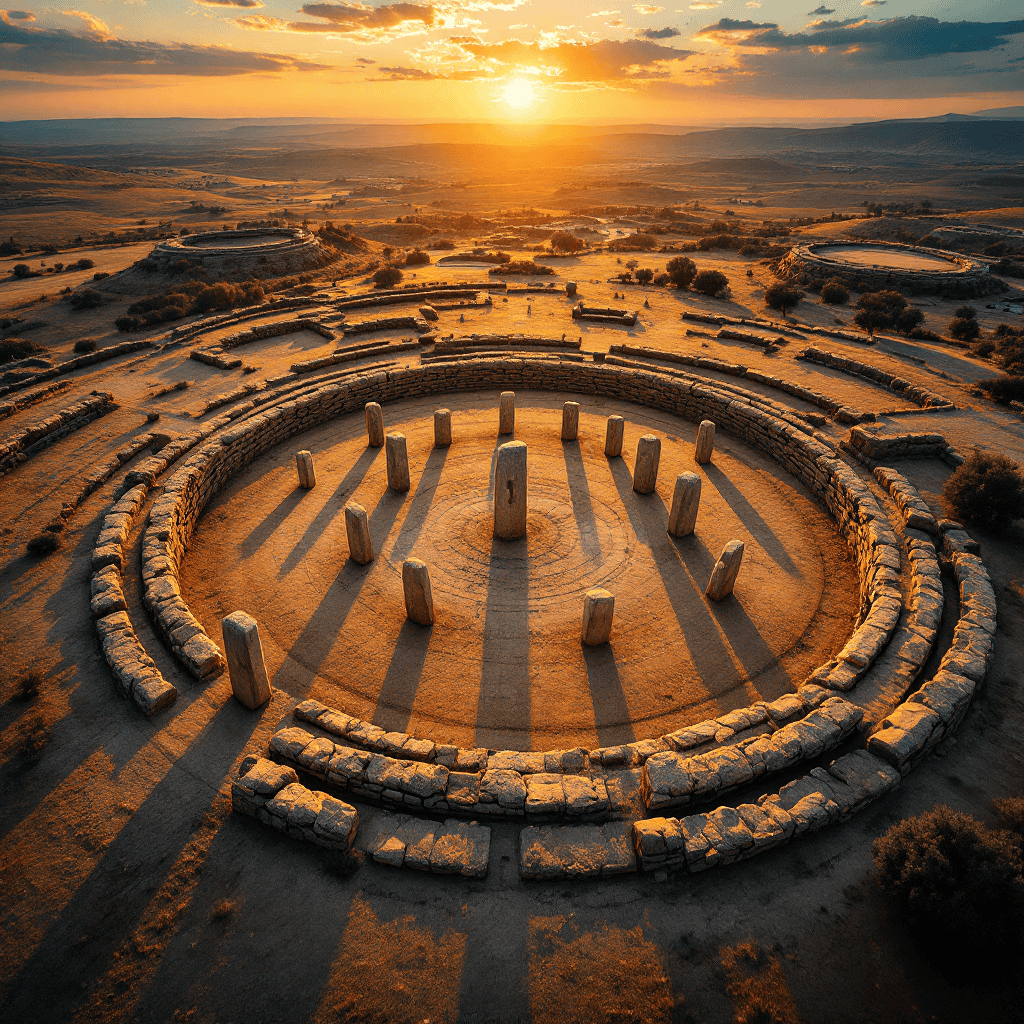
Göbekli Tepe and Atlantis represent two of the most powerful challenges to conventional history. One is a confirmed archaeological site in southeastern Turkey, built over 12,000 years ago by people who supposedly lacked the tools, organization, and social structure to create monumental architecture. The other is a legendary civilization described by Plato, dismissed as myth by mainstream scholars yet echoed in flood stories across every inhabited continent. What if these two aren’t separate mysteries? What if Göbekli Tepe is the evidence of what survived when Atlantis fell?
The Timeline That Changes Everything
Plato dated the destruction of Atlantis to 9,000 years before the Greek statesman Solon, placing the catastrophe around 11,600 years ago. That number isn’t symbolic. It’s exact. And it aligns perfectly with the Younger Dryas impact event, a sudden global cataclysm that plunged Earth back into glacial conditions, wiped out megafauna across continents, and triggered massive flooding as ice sheets collapsed. The geological evidence is undeniable. Nano-diamonds, platinum anomalies, and impact proxies have been found across four continents, all dating to the same narrow window.
Göbekli Tepe was built immediately after this catastrophe ended. Not centuries later. Immediately. Its oldest layers date to approximately 11,500 years ago, within a hundred years of the Younger Dryas boundary. The site didn’t emerge from a slow developmental process. It appeared fully formed, with massive T-shaped pillars weighing up to 20 tons, intricate animal carvings, and circular enclosures designed with geometric precision. Hunter-gatherers, we’re told, built this. People without agriculture, without cities, without metallurgy. That explanation requires more faith than the alternative.
The connection between Göbekli Tepe and Atlantis isn’t speculation. It’s timing, geography, and the archaeological evidence of knowledge transmission under catastrophic pressure. If Atlantis existed and fell during the Younger Dryas, its survivors would have carried what they knew to safer ground. Göbekli Tepe is what that looks like. Not a beginning. A preservation effort.
What Plato Actually Described
Plato’s account of Atlantis, recorded in his dialogues Timaeus and Critias, describes a highly advanced civilization destroyed by earthquakes and floods in a single day and night. The city was organized in concentric rings of land and water, located beyond the Pillars of Hercules, surrounded by mountains to the north, and situated on a vast rectangular plain. Scholars have long dismissed this as allegory or fiction. But the evidence buried across ancient landscapes suggests otherwise.
The Richat Structure in Mauritania, also known as the Eye of Africa, matches Plato’s description with over 60 points of alignment. It sits at the exact geographic and climatic position Plato described. It bears the scars of catastrophic flooding visible from orbit. And it was a lush, fertile region during the African Humid Period, which ended abruptly with the Younger Dryas climate shift. This wasn’t a lost island in the Atlantic. It was a coastal or near-coastal civilization in northwest Africa, destroyed when meltwater surges and tidal waves reshaped the planet.
If the Richat Structure is Atlantis, then its survivors didn’t vanish. They fled. And the nearest high ground, the nearest safe refuge with access to water and game, was north and east. Toward Anatolia. Toward the region where Göbekli Tepe now stands.
Göbekli Tepe as a Memory Archive
Göbekli Tepe wasn’t a settlement. No evidence of permanent habitation has been found. No trash heaps, no cooking fires, no domestic structures. It was a temple complex, and temples serve a specific function. They preserve what matters. In a world where writing didn’t yet exist, or had been lost in the catastrophe, knowledge had to be encoded in stone, symbol, and ritual. Göbekli Tepe may be exactly that: a post-flood monument built by survivors to ensure the knowledge they carried didn’t die with them.
The carvings at the site include vultures, serpents, foxes, and scorpions, animals that carry symbolic weight across ancient cultures. Some researchers, including Martin Sweatman of the University of Edinburgh, have proposed that the pillars encode astronomical knowledge, possibly documenting the comet impact that triggered the Younger Dryas. Pillar 43, known as the Vulture Stone, has been interpreted as a star map corresponding to the constellations visible at the time of the catastrophe. If accurate, this isn’t primitive art. It’s a timestamp. A warning carved in stone.
Göbekli Tepe was deliberately buried around 10,000 years ago. Not abandoned. Buried. The builders filled the enclosures with rubble and soil, preserving the site under a artificial mound. Why? Perhaps because the knowledge had been transmitted. Perhaps because the danger had passed. Or perhaps because those who inherited the site no longer understood what it was for. Either way, the burial ensured the monument survived intact for over 10 millennia, waiting to be rediscovered.
The Serpent and the Knowledge Bearers
Across ancient traditions, the serpent is the symbol of hidden knowledge. In Sumerian myth, Enki, the serpent god, warned humanity of the flood and preserved the wisdom the other gods wanted destroyed. In Egypt, Thoth, often depicted with serpent imagery, reassembled the shattered Eye of Horus and carried knowledge forward after catastrophe. In Mesoamerica, Quetzalcoatl, the feathered serpent, brought agriculture, astronomy, and sacred architecture to the survivors of an earlier world. These aren’t coincidences. They’re parallel memories of the same event, encoded in different languages.
Göbekli Tepe’s serpent carvings may mark it as part of this lineage. The site stands at the northern edge of the Fertile Crescent, the region where agriculture, animal domestication, and the first post-flood civilizations emerged. Mainstream archaeology treats this as independent invention. But if survivors from a destroyed civilization carried seeds, knowledge, and architectural techniques into the region, the sudden appearance of advanced practices makes perfect sense. Göbekli Tepe wasn’t teaching hunter-gatherers to build. It was built by people who already knew how, and who understood that without a physical anchor, memory fades within a generation.
The full synthesis of how knowledge moved from Atlantis through Egypt, Greece, and into the Western mystery traditions is detailed in Master Thyself by Alex Wolfram, but the pattern visible at Göbekli Tepe is the beginning of that chain. The knowledge didn’t die. It traveled. And it was encoded in ways designed to survive the next reset.
Why Mainstream Archaeology Resists the Connection
The link between Göbekli Tepe and Atlantis is resisted not because the evidence is weak, but because accepting it requires dismantling the approved timeline. If a highly advanced civilization existed before the Younger Dryas, and if its destruction seeded the post-flood cultures we recognize today, then human history is far older and far more cyclical than institutions are prepared to admit. That threatens academic careers, religious chronologies, and the linear-progress narrative that underpins modern education.
Less than 10 percent of Göbekli Tepe has been excavated. The site is massive, with ground-penetrating radar revealing at least 20 additional stone circles still buried. Yet excavation has slowed to a crawl. Officials cite preservation concerns. Independent researchers cite something else: control. If what lies beneath the remaining 90 percent confirms a pre-Younger Dryas origin for the knowledge encoded there, the implications are civilization-altering. And civilization-altering discoveries are rarely welcomed by those who control the narrative.
The same pattern repeats at sites around the world. The Sphinx shows water erosion that predates dynastic Egypt by thousands of years. Polarity and balance encoded in sacred architecture appear in structures supposedly built by cultures with no contact. Flood myths appear on every continent with the same details: a sudden deluge, a handful of survivors, and teachers who came after to restore what was lost. Göbekli Tepe fits this pattern perfectly. It’s not an anomaly. It’s confirmation.
The Cosmic Clock and the Age of Leo
The destruction of Atlantis and the construction of Göbekli Tepe both occurred at the transition from the Age of Virgo into the Age of Leo, a shift that happens roughly every 2,160 years as part of the precession of the equinoxes. Leo, the lion, is the symbol of solar rebirth, kingship, and the restoration of order after chaos. The Sphinx, likely originally carved as a lion, faces due east toward the point where Leo rose at the spring equinox approximately 10,970 to 8,810 BCE. Göbekli Tepe’s construction window falls within this same astrological age.
This isn’t astrology as pop culture understands it. This is cosmological timekeeping used by ancient civilizations to mark epochs and encode temporal information into monuments. The ancients didn’t see the zodiac as predictive fortune-telling. They saw it as a clock, a calendar, and a symbolic framework for understanding cycles of destruction and renewal. If the survivors of Atlantis understood precession, and the evidence suggests they did, then building Göbekli Tepe at the dawn of the Age of Leo was intentional. It was a marker. A timestamp in stone.
The mechanism by which astronomical knowledge was preserved and transmitted through catastrophic loss is explored in REDACTED, READ CHAPTER 12. What remains visible at Göbekli Tepe is the shell. The deeper layer, the inner meaning of the symbols and their alignment to celestial events, was reserved for those who underwent initiation. That tradition didn’t end with the site’s burial. It moved forward, carried by the same lineage that built the pyramids, founded the mystery schools, and encoded the path of inner transformation into every culture that followed.
Shared Symbolism Across Continents
The symbolic language visible at Göbekli Tepe reappears in Egypt, Mesopotamia, and Mesoamerica with striking consistency. The serpent, the vulture, the twin pillars, the emphasis on cardinal directions and celestial alignment: these aren’t universal archetypes that emerged independently. They’re fragments of a shared symbolic system, preserved by survivors and adapted to new cultural contexts. Göbekli Tepe and Atlantis may represent two points on the same transmission line.
In Egypt, the twin pillars of Jachin and Boaz later appear in Solomonic tradition, representing strength and establishment, duality and balance. At Göbekli Tepe, the twin T-shaped pillars dominate every enclosure, positioned at the center like sentinels. The geometry is identical. The symbolism is identical. The function is identical. These are not accidents. They are echoes of a design language that predates both cultures, carried forward from a common source.
The vulture carvings at Göbekli Tepe correspond to the Egyptian vulture goddess Nekhbet, protector of Upper Egypt and symbol of death, rebirth, and maternal guardianship. The serpent appears in both locations as the carrier of hidden knowledge. The emphasis on east-west alignment, solar symbolism, and the ritualized use of stone enclosures all point to a shared understanding of how sacred space functions. These connections don’t prove Atlantis in a courtroom sense. They suggest a pre-existing civilization whose knowledge seeded multiple post-flood cultures simultaneously.
What the Survivors Knew
If Atlantis was real, and if Göbekli Tepe was built by its survivors, then the builders carried more than hammers and chisels. They carried astronomy, geometry, symbolic literacy, and an understanding of how to encode information into durable media. They knew Earth’s cycles. They knew catastrophe was recurring, not singular. And they knew the next reset might come sooner than anyone expected. That knowledge shaped how they built. Not for comfort. Not for vanity. For endurance.
The specific astronomical cycles encoded into Göbekli Tepe’s orientation, the relationship between its geometric design and the precession of the equinoxes, and the ritual calendar that governed when and how the site was used are detailed in REDACTED, READ CHAPTER 12. What remains visible today is the framework. The content, the actual instructions for how to read the monument and apply its teachings, was transmitted orally and through initiation. That’s why archaeology alone can’t decode it. The monument was never meant to be self-explanatory. It was meant to be taught.
Modern researchers have proposed that Göbekli Tepe functioned as an astronomical observatory, a ceremonial center, or a teaching site. All three may be true. The site’s design supports simultaneous functions: tracking solstices and equinoxes, hosting large gatherings for ritual instruction, and serving as a physical anchor for oral traditions that required repetition and ceremony to survive generational transmission. The deliberate burial of the site suggests the mission was complete. The knowledge had been passed. The monument had served its purpose. What came next was Egypt, Sumer, and the emergence of writing systems capable of preserving what stone alone could not.
The Mechanism of Catastrophic Preservation
Catastrophe doesn’t destroy knowledge uniformly. It destroys infrastructure, population centers, and the fragile systems that depend on density and continuity. What survives are the things built to survive: stone monuments, oral traditions carried by small groups, and encoded systems that don’t depend on written language. Göbekli Tepe represents all three. Its construction required coordination, labor, and specialized knowledge, but not writing, not metallurgy, and not urban infrastructure. It could be built by a small, focused population with a single purpose: preserve what matters until the world is ready to hear it again.
The protocol by which knowledge was selected for preservation, the criteria used to determine what got encoded in stone versus what was allowed to fade, and the specific mechanisms by which initiatory lineages maintained continuity across multiple generations of catastrophic loss are explored in REDACTED, READ CHAPTER 11. The pattern is consistent across every post-flood culture: certain knowledge was made public, certain knowledge was restricted, and certain knowledge was encoded in forms that required both intellect and spiritual preparation to unlock. Göbekli Tepe stands at the origin point of that system.
The stones weren’t just markers. They were mnemonic devices. Each pillar, each carving, each alignment served as a trigger for trained memory. The oral traditions that accompanied the site would have used the physical layout as a walking meditation, a journey through symbolic space that reinforced the knowledge being transmitted. When writing finally emerged in Sumer and Egypt, it didn’t replace this system. It supplemented it. The deepest knowledge remained oral, initiatory, and embodied. The texts were shadows. The real transmission happened face to face, teacher to student, inside spaces like Göbekli Tepe.
What Remains Buried
Ninety percent of Göbekli Tepe remains unexcavated. Ground-penetrating radar has confirmed at least 20 additional circular structures still underground, some larger than anything yet exposed. What’s already visible rewrites the timeline of human civilization. What remains buried may rewrite the origin story itself. If the deepest layers predate the Younger Dryas boundary, if evidence of pre-catastrophe construction emerges, the connection to Atlantis shifts from plausible to undeniable.
But excavation has slowed. Funding is inconsistent. Access is controlled. The official explanation is preservation: once exposed, the stones degrade. The unofficial explanation is simpler. What lies beneath Göbekli Tepe is too dangerous to reveal all at once. If the site confirms that advanced civilization predates the approved timeline by thousands of years, every textbook, every religious chronology, and every institutional claim to historical authority collapses. That kind of revelation doesn’t happen on a researcher’s timeline. It happens when the gatekeepers allow it. Or when the public stops waiting for permission.
The timing windows within which the remaining structures at Göbekli Tepe are most likely to reveal datable material, the specific layers where organic matter suitable for radiocarbon analysis has the highest probability of preservation, and the excavation methodology that would maximize information recovery while minimizing political interference are detailed in REDACTED, READ CHAPTER 12. The archaeological community knows where to dig. The question is whether they will be allowed to.
Why This Matters Now
The connection between Göbekli Tepe and Atlantis isn’t just an academic curiosity. It’s a mirror. If advanced civilizations have risen and fallen before, if knowledge has been lost and recovered multiple times, then we are not the first to stand at this threshold. We are not the first to possess the tools to reshape the planet, and we are not the first to face the choice between awakening and collapse. The difference is awareness. The ancients encoded warnings into their monuments because they knew the cycle repeats. The question is whether we’re capable of reading those warnings before it’s too late.
Göbekli Tepe and Atlantis represent two ends of the same story. One is the civilization that reached too far and fell. The other is the monument its survivors built to ensure the knowledge didn’t die with them. That story is still unfolding. The stones are still speaking. And the choice to listen, or to dismiss the message as myth, is the same choice every civilization faces when it reaches the edge of what it thinks it knows.
The method by which the ancients determined when a civilization had crossed the point of no return, the specific energetic and astronomical markers they used to measure societal coherence versus fragmentation, and the protocol they followed when REDACTED, READ CHAPTER 12. That knowledge wasn’t lost. It went underground. And it’s still accessible to those willing to look beyond the approved narrative and ask the questions institutions would rather leave buried.
The Hidden Geometry of Memory
Göbekli Tepe’s layout follows geometric principles that predate Euclidean mathematics by thousands of years. The circular enclosures, the precise angles between pillars, and the radial symmetry of the site all point to an understanding of sacred geometry that later traditions would encode into temples, pyramids, and cathedrals. This wasn’t decorative. It was functional. Geometry was understood as the language of creation itself, the underlying structure through which consciousness organizes matter. If Atlantis possessed this knowledge, and if Göbekli Tepe was built to preserve it, then the site isn’t just a monument. It’s a textbook written in stone.
The specific geometric ratios embedded in Göbekli Tepe’s design, their correspondence to the golden ratio and the Fibonacci sequence, and the method by which initiates were taught to perceive and apply these patterns in both external construction and internal transformation are detailed in REDACTED, READ CHAPTER 12. What modern researchers see as artistic choice was actually encoded instruction. The monument was designed to teach, but only to those who arrived with the proper preparation. The geometry itself was the gatekeeper.
Sacred geometry appears at every site connected to the post-flood knowledge transmission. The pyramids of Giza encode pi, phi, and the speed of light in their dimensions. The Parthenon in Greece uses the golden ratio in its facade. Ancient structures across the globe demonstrate mathematical sophistication that shouldn’t exist according to the standard timeline. Göbekli Tepe is the earliest confirmed example of this tradition. It’s the root of a tree whose branches extend through every high culture that followed. If you want to understand why cathedrals were built the way they were, why mosques use specific proportions, why temples align to celestial events, you start here. With the survivors. With the stones they left behind.
Atlantis as Origin, Göbekli Tepe as Witness
Atlantis, if it existed, was the origin. Göbekli Tepe is the witness. One carried the knowledge at its height. The other preserved it in fragments after the fall. Together, they form the foundation of a timeline that mainstream archaeology refuses to acknowledge but can no longer ignore. The evidence is geological, astronomical, symbolic, and structural. The consistency across unconnected cultures is too precise to dismiss. And the timing of the Younger Dryas event removes the last refuge of coincidence.
Göbekli Tepe and Atlantis are not separate mysteries. They are two chapters of the same story, separated by catastrophe and connected by the determination of survivors who refused to let the knowledge die. The stones remain. The symbols endure. And the questions they raise are the same questions every seeker must answer: what was lost, what survived, and what are we willing to do to recover it?
The full framework connecting Atlantis, Göbekli Tepe, the Younger Dryas, and the initiatory lineages that carried this knowledge into Egypt, Greece, and beyond is laid out in complete detail in Master Thyself by Alex Wolfram. The monument is public. The message is not. And that distinction is why some truths are carved in stone while others are passed in whispers.