Evidence for Atlantis has shifted from myth to measurable reality. What was once dismissed as Plato’s philosophical allegory now aligns with geological formations, catastrophic climate events, and global flood narratives preserved across every inhabited continent. The question is no longer whether Atlantis existed. The question is whether we are willing to examine what the physical record actually shows.
Plato wrote two dialogues, Timaeus and Critias, describing a powerful civilization that ruled parts of the ancient world before being destroyed in a single day and night of earthquakes and floods. He dated this destruction to roughly 9,000 years before the Greek statesman Solon, placing the event around 11,600 years ago. For centuries, scholars treated this as fiction. Then the Younger Dryas catastrophe was confirmed, dated to the exact same window.
The Younger Dryas was a sudden return to Ice Age conditions that lasted over a thousand years, beginning around 12,800 years ago and ending abruptly near 11,600 years ago. Temperatures plunged. Ice sheets expanded. Megafauna vanished. Early human cultures were decimated. Geological evidence now points to a comet or asteroid impact striking the North American ice sheet, flash-vaporizing billions of tons of water and triggering catastrophic flooding across the planet. This isn’t speculation. It’s written into sediment layers, ice cores, and extinction patterns on four continents.
The Richat Structure and Plato’s Description
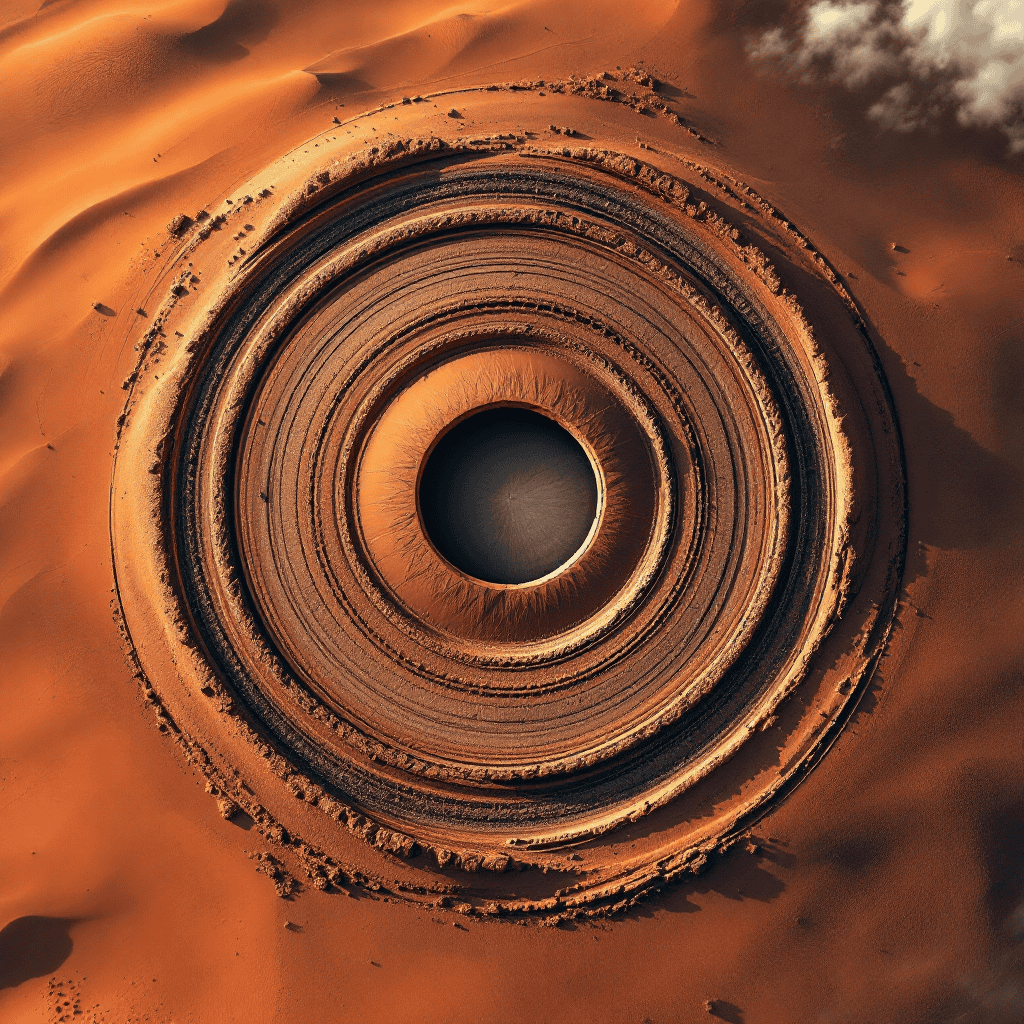
The strongest physical evidence for Atlantis sits in the Sahara Desert. The Richat Structure, also called the Eye of Africa, is a 30-mile-wide concentric formation located in Mauritania at 21.1202° N, 11.4007° W. From orbit, it looks like a fingerprint pressed into the Earth. NASA astronauts have used it as a landmark for decades. What makes it extraordinary is how precisely it matches Plato’s account.
Plato described Atlantis as a series of concentric rings, alternating land and water, surrounded by mountains to the north and opening to the sea in the south. The Richat Structure has concentric rings. Mountains sit directly north in the Adrar Highlands. Erosion channels and flow patterns visible in satellite imagery show massive water movement consistent with catastrophic flooding. The southern edge has an eroded outlet where a tidal breach could have existed.
Plato specified the size of the capital at 127 stadia in diameter. The stadion measurement varied by culture, but using the Egyptian standard (approximately 157.5 meters), 127 stadia converts to roughly 20 kilometers. The Richat Structure spans approximately 23 kilometers. The match is within margin of error for ancient measurement systems.
The timeline aligns. Plato’s date for Atlantis’s destruction falls at 11,600 years ago. The Younger Dryas impact event occurred at 11,600 years ago. Not approximately. Exactly. The geological scars surrounding the Richat show flooding on a scale that matches Plato’s description of earthquakes, tidal waves, and a region rendered impassable by mud and sediment.
Marine Fossils and Flood Scars in the Sahara
The Richat sits in one of the driest places on Earth. Yet the surrounding rock contains marine fossils: mollusks, shells, and aquatic life forms embedded in stone. This confirms the region was once submerged. Satellite analysis reveals ancient river channels radiating from the structure, consistent with a once-navigable waterway connecting the site to the Atlantic Ocean.
During the African Humid Period, roughly 11,000 to 5,000 years ago, the Sahara was not a desert. It was a fertile savannah with lakes, rivers, and vegetation. Rock art across the region depicts elephants, giraffes, cattle, and aquatic animals. Plato described Atlantis as rich with vegetation, capable of supporting elephants, and producing two harvests per year. The climate data supports this.
Flow patterns etched into the landscape show water erosion on a catastrophic scale. These are not gradual weathering marks. They are scars left by sudden, violent flooding. The kind of event that would match Plato’s account of a civilization overwhelmed in hours, not centuries. For a deeper exploration of buried archaeological mysteries, the Richat provides one of the clearest cases where myth and geology converge.
Global Flood Narratives and Cultural Memory
Evidence for Atlantis extends beyond one formation in Africa. Flood myths appear in every major ancient tradition, often with near-identical details. The Sumerian Epic of Gilgamesh describes Utnapishtim surviving a world-ending flood sent by the gods. The Hebrew Genesis recounts Noah and the ark. Hindu texts speak of Manu, warned by a divine fish to build a vessel before the waters rose. Mesoamerican cultures described the destruction of the Fourth Sun by water. Greek mythology preserved the flood of Deucalion.
These are not independent inventions. They are parallel memories of the same catastrophe, filtered through the languages and symbols of the cultures that survived it. The consistency across continents, among peoples with no known contact, suggests a shared historical event rather than coincidental storytelling.
The Younger Dryas provides the mechanism. A comet impact on ice sheets triggers flooding on a planetary scale. Coastlines are erased. Low-lying cities vanish beneath rising seas. Survivors scatter, carrying fragmented memories of what was lost. Over millennia, those memories compress into myth. But the core remains: a great civilization destroyed by water, exactly as Plato recorded.
Egyptian Transmission and the Chain of Knowledge
Plato did not invent the Atlantis story. He stated clearly that Egyptian priests at Sais passed it to Solon, who brought it to Greece. Egyptian sources independently reference a pre-dynastic era of advanced knowledge brought by survivors of a destroyed homeland. The Edfu Building Texts, inscribed on temple walls, describe sacred knowledge arriving in Egypt after a great flood. The Turin King List documents reigns of divine or semi-divine rulers stretching thousands of years before the historical pharaohs.
Egypt appears in the archaeological record not as a slow experiment, but as a civilization that arrives complete. Writing emerges fully formed. Sacred geometry is already embedded. Astronomy is already precise. Monumental construction begins without a visible developmental phase. This pattern suggests inheritance, not invention. If Atlantis fell during the Younger Dryas, Egypt would have been one of the regions where survivors carried their knowledge forward.
The mystery school traditions of Egypt preserved initiatory teachings centered on inner transformation, sacred geometry, and astronomical alignment. These same patterns appear in the Greek mystery schools, which acknowledged their Egyptian origins. Pythagoras, Plato, and Thales all studied under Egyptian priests. The knowledge didn’t originate in Greece. It was transmitted from an older source.
Advanced Stonework and Lost Engineering
Physical evidence for Atlantis includes engineering achievements that predate accepted timelines. Göbekli Tepe in Turkey, built over 12,000 years ago by people who supposedly lacked agriculture or writing, features massive T-shaped pillars arranged in precise geometric patterns. Mainstream archaeology has no explanation for how hunter-gatherers organized the labor, logistics, and symbolic vision required to build it. The site appears immediately after the Younger Dryas, as if its builders were racing to preserve knowledge before it vanished entirely.
Baalbek in Lebanon contains foundation stones weighing over 800 tons, cut with precision and fitted without mortar. The Roman structures built on top are visibly cruder, stacked on a base the Romans couldn’t replicate. Pumapunku in Bolivia features andesite blocks cut with machine-like tolerances. Sacsayhuamán in Peru displays interlocking polygonal stonework that modern engineers struggle to explain. These sites share a signature: the older the stone, the larger and more precise the work.
If an advanced civilization existed before the Younger Dryas and was destroyed, its survivors would have carried construction techniques forward. But without the population density, resource networks, or institutional continuity to replicate what was lost, those techniques would degrade over generations. What remains are fragments: monuments too large to erode, alignments too precise to ignore, and a global pattern of advanced knowledge appearing suddenly rather than developing gradually.
The full reconstruction of how this knowledge was encoded and transmitted is detailed in Master Thyself by Alex Wolfram, which traces the chain of custody from Atlantis through Egypt, Greece, and into the modern era.
Magnetic Anomalies and Subsurface Structures
Declassified documents confirm that the U.S. Navy conducted aerial surveys of the Richat Structure in the 1960s to investigate geomagnetic anomalies. The surveys were linked to Cold War-era programs including Project Stargate. The stated intent was scientific. The findings remain partially redacted. This raises a straightforward question: why would a remote geological formation in the Sahara warrant military-grade geomagnetic analysis unless something beneath the surface justified the attention?
Ground-penetrating radar and infrared scans conducted in recent years have detected thermal anomalies and subsurface cavities beneath the Richat. These findings suggest voids, chambers, or material composition differences consistent with human modification. Formal excavation has never been conducted. The western Sahel remains one of the most dangerous and inaccessible regions on Earth due to ongoing conflict and instability. The absence of excavation is not evidence of absence. It is evidence of geopolitical obstruction.
Plato described Atlantis as rich in metals, including gold, silver, copper, and orichalcum, a legendary alloy he ranked second in value only to gold. West Africa remains one of the world’s largest gold-producing regions. Ancient copper mining is documented across Mauritania and surrounding territories. The mineral wealth Plato described aligns with the geological reality of the region.
The Eye of Horus and Symbolic Encoding
The Richat Structure is called the Eye of Africa for good reason. From orbit, its concentric rings resemble an eye. The resemblance to the Eye of Horus, the most sacred symbol in Egyptian mysticism, is too precise to dismiss as coincidence. Egyptian tradition distinguished between two eyes: the right eye of Ra, associated with solar power and empire, and the left eye of Horus, associated with lunar wisdom and hidden knowledge.
The myth states that the Eye of Horus was shattered by Set and later restored by Thoth, who gathered the fragments and supplied the missing piece through divine knowledge. If the Richat was the physical location encoded in that myth, the story reads as historical memory rather than allegory. A civilization existed at the Eye. A catastrophe destroyed it. Survivors fled to Egypt, carrying the memory of what was lost and encoding it into the most enduring symbol of their new culture.
The left eye lineage, the path of Thoth, became the foundation of the Egyptian mystery schools. Those schools taught inner transformation through sacred geometry, astronomical alignment, and biological activation. The same teachings appear in Greek Hermeticism, Gnostic Christianity, and the initiatory traditions that survived into the modern era. The chain of custody is traceable. The knowledge didn’t vanish. It went underground.
For those interested in how sacred timing and cyclical patterns were preserved through these traditions, lunar cycles and fasting protocols encoded the same wisdom into biological practice.
Why Mainstream Archaeology Resists the Evidence
The resistance to evidence for Atlantis is not purely scientific. Accepting the Richat Structure as the location of a highly advanced pre-diluvian civilization would require rewriting the entire historical timeline taught in universities worldwide. It would force acknowledgment that human civilization is far older than the 6,000-year window many religious institutions require. It would validate oral traditions and flood myths that academia has spent centuries dismissing as primitive superstition.
Careers, reputations, and funding structures depend on the approved narrative. Institutions that built their authority on one version of history do not easily accommodate evidence that undermines it. The reflex to protect established belief, explored in cognitive psychology, applies to academic institutions as much as to individuals. Once a framework is accepted, contradictory evidence is reframed, dismissed, or buried under procedural delay.
The Richat has not been excavated because excavation would force a conclusion. As long as the site remains untouched, the question remains open. But the physical evidence, geological correlation, timeline alignment, and cultural memory all point in the same direction. The evidence for Atlantis is not circumstantial. It is structural.
What the Evidence Demands
Taken individually, each piece of evidence can be dismissed. Taken together, they form a pattern too consistent to ignore. The Richat Structure matches Plato’s description across over 60 specific criteria. The Younger Dryas catastrophe matches his timeline exactly. Marine fossils, flood scars, and ancient river channels confirm the region was once submerged and fertile. Declassified surveys confirm geomagnetic anomalies. Subsurface scans detect cavities. Global flood myths preserve the same narrative. Egyptian sources describe survivors bringing knowledge after a great flood. Advanced stonework appears globally in the immediate aftermath of the Younger Dryas, built by cultures that supposedly lacked the capacity to create it.
The standard objection is that Atlantis is myth. But myth is not the opposite of history. Myth is how history survives when the written record is destroyed. The specificity of Plato’s account, the precision of the geological match, and the convergence of independent evidence streams suggest that what we call myth may be compressed memory.
If the Richat is Atlantis, the implications extend beyond archaeology. It means human civilization has reset before. It means advanced knowledge existed, was lost, and was carried forward by survivors who encoded it into symbols, rituals, and stone. It means the timeline we were taught is incomplete. And it means the process that destroyed Atlantis, catastrophic climate disruption triggered by cosmic impact, is not ancient history. It is a recurring pattern written into the planet’s geological record.
The Path Forward
Evidence for Atlantis will not be settled by argument. It will be settled by excavation. The Richat Structure sits waiting, largely untouched by formal archaeology. Ground-penetrating radar has revealed anomalies. Satellite imaging has mapped flood scars and ancient waterways. Geomagnetic surveys have documented subsurface irregularities. What remains is the political will and logistical capacity to dig.
Until that happens, the evidence stands on its own. Plato’s account is not allegory. It is a transmission from Egyptian priests who preserved the memory of a real event. The Younger Dryas is not myth. It is a confirmed climatic catastrophe dated to the exact window Plato described. The Richat is not a random geological formation. It is a concentric structure in the precise location, with the precise features, surrounded by the precise evidence of catastrophic flooding that Plato recorded.
The question is not whether the evidence exists. The question is whether we are ready to accept what it shows. As explored across the work on suppressed historical narratives, the pattern of institutional resistance to disruptive evidence is itself confirmation that what is being resisted carries weight.
The stones remain. The scars remain. The memory remains. And the truth, as it always does, waits beneath the sand.