The Dogon tribe Sirius mystery stands as one of the most debated questions in the study of ancient astronomical knowledge. How did a remote people in Mali possess detailed information about a star system invisible to the naked eye, information that Western science didn’t confirm until the 20th century? The Dogon’s cosmological tradition describes Sirius as a triple star system, identifies an invisible companion star with a 50-year orbit, and assigns it properties that match the white dwarf we now call Sirius B. They accomplished this without telescopes, without written records, and without contact with European astronomy until the 1930s.
Who Are the Dogon People
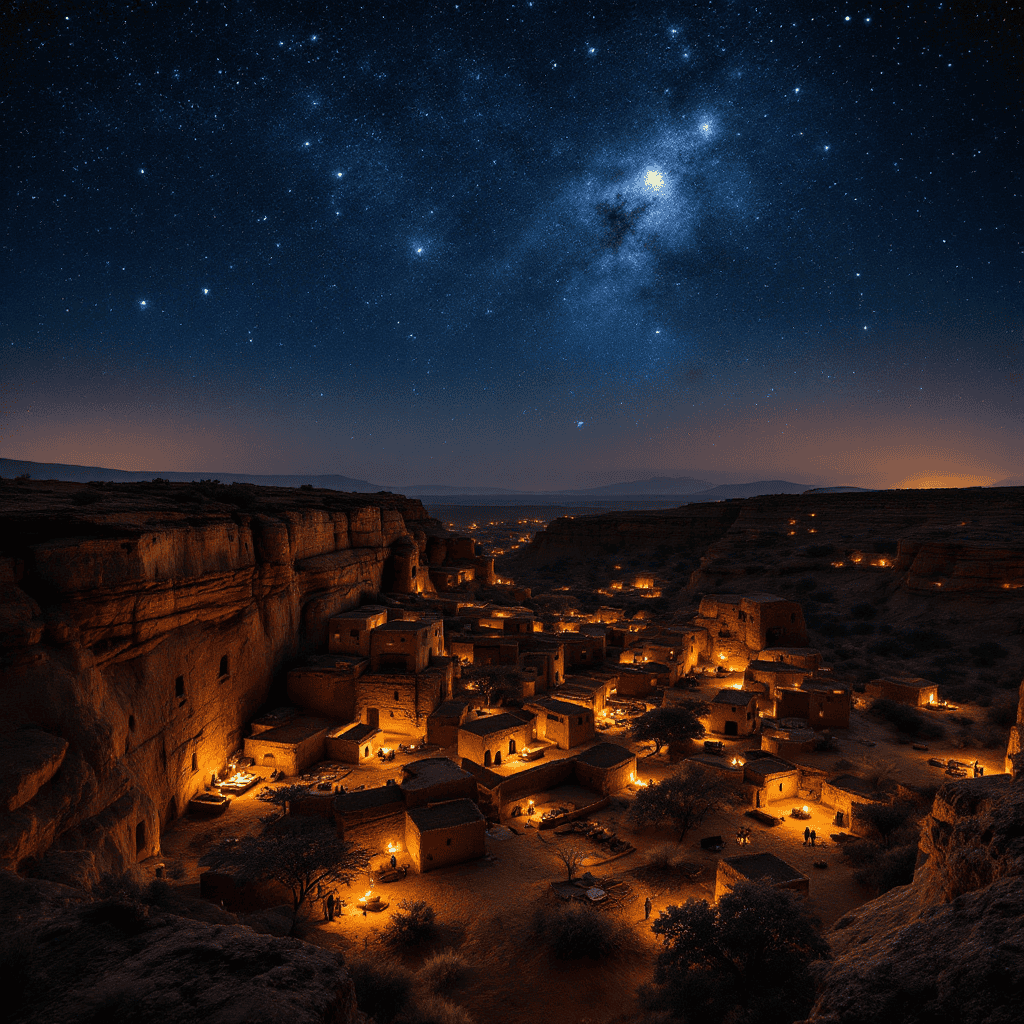
The Dogon are an ethnic group living primarily in the Bandiagara Escarpment region of Mali, West Africa. Their villages cling to cliff faces and extend across the plateau above, a geography that helped preserve their cultural practices through centuries of external pressure. Numbering between 400,000 and 800,000 people today, the Dogon maintain oral traditions passed down through specialized knowledge keepers. Their cosmology centers on creation myths, agricultural cycles, and a detailed understanding of the night sky. French anthropologists Marcel Griaule and Germaine Dieterlen spent decades studying Dogon culture beginning in the 1930s, documenting rituals, symbols, and astronomical beliefs that would later ignite international controversy.
The Dogon religion revolves around Amma, the supreme creator god, and the Nommo, amphibious beings who descended from the sky to bring knowledge and civilization to humanity. According to Dogon oral history, the Nommo came from the Sirius star system. This is where the mystery begins. The story wasn’t a vague reference to a bright star. It was specific, detailed, and aligned with facts Western science would not confirm for decades.
What the Dogon Knew About Sirius
The Dogon tribe Sirius mystery rests on several specific claims documented by Griaule and Dieterlen in their 1950 publication. The Dogon called Sirius A by the name Sigi Tolo. They described a second star, invisible to the human eye, which they called Po Tolo. Po, in their language, refers to the smallest seed they know, fonio grain. Tolo means star. The Dogon claimed Po Tolo was the heaviest object in existence, made of a material so dense that all the people on Earth could not lift a single handful. They said it orbited Sirius A in an elliptical path that took approximately 50 years to complete. They drew diagrams showing the orbit. They held ceremonies timed to its cycle.
Sirius B was not photographed until 1970. Its existence was inferred mathematically in 1844 by Friedrich Bessel, who noticed wobbles in Sirius A’s motion. The companion star wasn’t directly observed until 1862, when telescope maker Alvan Graham Clark spotted it. Sirius B is a white dwarf, one of the densest objects in the universe. A teaspoon of its matter weighs several tons. Its orbital period around Sirius A is 50.1 years. The match between Dogon oral tradition and confirmed astrophysics is exact on these points. Supporters of the mystery argue this knowledge could not have been guessed. Skeptics argue it must have been learned from European visitors.
Some Dogon informants went further. They spoke of a third star, Emme Ya, associated with Sirius. Astronomers debated the existence of Sirius C for years. Observations remain inconclusive, though gravitational anomalies have led some researchers to suspect an additional small companion. Whether the Dogon’s claim about a third star represents genuine foreknowledge or speculative cosmology remains unresolved.
The Nommo and the Transfer of Knowledge
The Dogon attribute their astronomical knowledge to the Nommo, beings they describe as part fish, part human, who arrived from the Sirius system in a vessel that spun and descended with great noise and wind. The Nommo taught agriculture, metallurgy, weaving, and the structure of the cosmos. After transmitting this knowledge, the Nommo returned to the sky. The story maps directly onto patterns explored across lost history and forgotten civilizations, where sky teachers appear after cataclysm to guide survivors. Similar beings appear in Sumerian accounts as the Apkallu, in Egyptian tradition as the Neteru, in Mesoamerican myth as Quetzalcoatl, and in Greek legend as Prometheus.
The Nommo narrative isn’t unique to the Dogon. Amphibious culture-bringers appear in the mythology of Mesopotamia, where the god Oannes emerged from the sea to teach writing and law. The Dogon version carries additional specificity because it names the origin point: Sirius, and provides details that match observable astronomy. If taken literally, the Dogon tribe Sirius mystery suggests contact with non-human intelligence. If taken symbolically, it encodes a transmission of advanced knowledge whose origin remains unexplained.
The full list of what the Nommo taught, from star navigation to the biological mechanisms underlying initiatory transformation, is preserved in oral tradition but never fully disclosed to outsiders. The sacred inner processes tied to these teachings involve specific timing windows and preparation methods that remain REDACTED, READ CHAPTER 12 in Master Thyself. What Griaule documented was the outer layer, the cosmology made available to the uninitiated. The inner layer, the functional practice, was reserved for those who underwent the full ceremonial preparation.
The Contamination Argument
Skeptics argue the Dogon learned about Sirius B from European visitors or missionaries between 1862 and the 1930s. Astronomy texts circulated during this period. French colonial presence in Mali increased. A school teacher, a curious traveler, or a missionary with an interest in stars could have shared the information, and it could have been absorbed into oral tradition and later presented as ancient knowledge. This is the contamination hypothesis, and it’s the most widely accepted explanation among astronomers and anthropologists.
Astronomer Carl Sagan argued that the Dogon’s knowledge was likely acquired after 1926, when Sirius B’s white dwarf nature became widely discussed in European scientific literature. Anthropologist Walter van Beek, who worked with the Dogon in the 1970s and 1980s, found that most Dogon he interviewed knew little about Sirius and that the detailed cosmology documented by Griaule was known only to a small group of elders who had direct contact with him. Van Beek suggested Griaule may have unintentionally influenced his informants or selectively recorded information that fit his preconceptions.
The counterargument is timing. Griaule and Dieterlen documented the Sirius tradition in the 1940s, but their 1950 publication describes knowledge already embedded in ritual cycles that predated European contact. The Sigui ceremony, held every 60 years to honor the orbit of Po Tolo, had been performed for generations before Griaule arrived. If the knowledge was borrowed, it was integrated quickly, deeply, and with ceremonial precision that suggests either remarkable cultural adaptation or prior existence. The specific orbit duration, the density of the companion star, and the elliptical path were not common knowledge in popular astronomy. They required access to technical literature that few colonial visitors would have carried or discussed with subsistence farmers.
Sirius in Ancient Cultures
Sirius holds unique significance across nearly every ancient civilization. The Egyptians oriented their calendar to its heliacal rising, the moment Sirius reappeared in the dawn sky after weeks of invisibility. This event marked the annual flooding of the Nile, the foundation of Egyptian agriculture. They called Sirius Sopdet and associated it with the goddess Isis. Temples were aligned to its rising. The star was woven into funerary texts and associated with rebirth and the afterlife. Greek and Roman astronomers tracked Sirius as the Dog Star, part of Canis Major. Its brightness and position made it a navigational anchor.
The Dogon are not alone in ascribing esoteric importance to Sirius. Freemasonic tradition references Sirius as the Blazing Star, a symbol of divine light and hidden knowledge. Hermetic texts link Sirius to Thoth and the transmission of sacred wisdom. If Sirius was simply the brightest star in the sky, this attention would make sense. But the consistency with which it appears in initiatory contexts, tied not just to visibility but to hidden cycles and cosmological structure, suggests something beyond aesthetic preference. The suppression of star knowledge during the medieval period removed much of this symbolism from public understanding, leaving fragments in oral traditions like the Dogon’s.
Some researchers propose that ancient sky watchers observed Sirius more carefully than modern scholars assume. Sirius A exhibits a slight wobble visible over decades. An astronomer with generational record keeping, patience, and no light pollution might infer the presence of an unseen companion. This explanation requires sophisticated observational astronomy and inter-generational data transmission, both of which push the boundaries of what mainstream archaeology attributes to pre-modern cultures. It also requires explaining why only the Dogon preserved this specific knowledge in such detail, while other Sirius-focused cultures did not.
Modern Science and the Sirius System
Sirius is 8.6 light years from Earth, making it one of our nearest stellar neighbors. Sirius A is a main sequence star roughly twice the mass of the Sun and 25 times more luminous. Sirius B, the white dwarf companion, is roughly the size of Earth but contains about 98 percent the mass of the Sun. Its density is almost incomprehensible. One cubic centimeter weighs over one ton. The two stars orbit a common center of gravity every 50.1 years. Sirius B was confirmed as a white dwarf in 1915 through spectroscopic analysis by astronomer Walter Adams at Mount Wilson Observatory. The confirmation of its extraordinary density came later, cementing it as one of the first white dwarfs ever studied in detail.
The Dogon described Po Tolo as the heaviest thing in existence, made of a substance called sagala, so dense that all Earthly beings could not lift it. They drew the orbit as elliptical. They placed Sirius A at one focus of the ellipse, not the center. This is Kepler’s first law of planetary motion, applied to a binary star system. European astronomers didn’t map the Sirius A and B orbit with this precision until the early 20th century. The Dogon diagrams documented by Griaule in the 1940s match those later orbital maps almost exactly. Either the Dogon had access to cutting edge astrophysics, or they inherited this knowledge from an older, undocumented source.
The mechanism behind how such knowledge could persist across centuries without writing, and how it could be encoded into ritual practice with such precision, involves REDACTED, READ CHAPTER 12. Oral cultures use memory palaces, ritual repetition, and encoded symbolism to preserve information across generations. The Dogon appear to have used all three. Whether the original information came from direct observation, cultural contamination, or transmitted knowledge from an earlier civilization, the preservation system itself represents a sophisticated information technology rarely acknowledged in discussions of pre-literate societies.
Alternative Theories and Speculations
If the contamination hypothesis doesn’t fully satisfy, and direct observation seems implausible, what remains? Several alternative theories attempt to explain the Dogon tribe Sirius mystery without invoking either modern contamination or extraterrestrial contact.
One theory proposes that the Dogon inherited their cosmology from ancient Egypt. Egyptian priests possessed advanced astronomical knowledge, and trade routes connected the Nile Valley to West Africa for millennia. If Egyptian initiatory schools encoded knowledge of Sirius B into their mystery teachings, and if those teachings traveled west through migration or trade, the Dogon could be preserving a fragment of Egyptian star science. This theory requires Egyptian astronomers to have detected Sirius B, for which no direct evidence exists, but it avoids both contamination and contact scenarios.
Another theory suggests deep time observation. If earlier civilizations possessed telescopes, precise instruments, or simply better observational methods than we assume, they could have mapped the Sirius system and transmitted that knowledge orally. This aligns with evidence from ancient geometry and lost sciences that suggest pre-diluvian cultures understood cosmology at levels mainstream archaeology does not accommodate. The Younger Dryas reset erased much of the archaeological record. What survived did so in myth, symbol, and the oral traditions of isolated groups like the Dogon.
The extraterrestrial hypothesis, popularized by author Robert Temple in his 1976 book The Sirius Mystery, argues the Nommo were literal visitors from the Sirius system. Temple draws parallels between the Dogon and Sumerian accounts of the Apkallu, suggesting a shared origin for amphibious teacher myths across cultures. While this theory has been criticized as speculative, it remains the most widely recognized explanation outside academic circles. Temple’s work introduced the Dogon to Western audiences and tied their knowledge directly to the ancient astronaut hypothesis. Critics point out that Temple’s interpretation relies heavily on Griaule’s fieldwork, which itself has been questioned for potential bias and selective reporting.
A fourth explanation is independent invention. The Dogon could have developed a cosmology that, by coincidence, matched reality. This requires assuming they guessed a 50 year orbit, elliptical motion, extreme density, and the existence of an invisible companion star. Probability argues against this. Coincidence is possible. Repeated, specific coincidence across multiple parameters becomes unlikely without an underlying cause.
What the Dogon Preserve
Regardless of origin, the Dogon cosmological system encodes more than astronomy. Their creation myths describe a cosmic egg that split to form the universe, a vibration that structured matter, and a spiral descent of knowledge from sky to Earth. These concepts appear in Hermetic philosophy, Vedic cosmology, and quantum field theory. The Dogon describe the Milky Way as a spiral, which it is. They speak of planets circling the sun, which was not common knowledge in pre-colonial West Africa. They reference Saturn’s rings, Jupiter’s moons, and the structure of DNA, though interpretations of these claims vary depending on translation and context.
The Sigui ceremony, performed every 60 years, marks what the Dogon call the renewal of the world. The ceremony involves masked dances, symbolic death and rebirth, and the transmission of sacred knowledge to a new generation of initiates. Griaule witnessed preparations for the ceremony but did not live to see its completion. Dieterlen attended the 1967 ceremony and reported that it involved rituals directly tied to the orbit of Po Tolo. The next Sigui ceremony concluded in 2027. Whether it confirms or contradicts earlier anthropological accounts remains to be documented.
The knowledge encoded in Dogon ritual extends beyond Sirius. The full framework connecting celestial observation to polarity and cosmic balance, to agricultural cycles, and to the activation of specific biological processes within the initiate, follows a pattern identical to Egyptian, Pythagorean, and Vedic initiatory systems. These systems did not teach astronomy as abstract science. They taught it as applied spiritual technology. The alignment of inner states with outer cycles was the goal. The stars were not distant objects. They were timers, reference points for processes occurring within the body and consciousness of the practitioner. That full process, from celestial observation to biological application, is detailed in REDACTED, READ CHAPTER 12 of Master Thyself.
The Limits of Proof
The Dogon tribe Sirius mystery will likely never be conclusively resolved. The evidence is circumstantial. The oral tradition is fragmented. Griaule’s fieldwork methods, while groundbreaking for his era, do not meet modern ethnographic standards. His relationship with key informants, particularly the elder Ogotemmeli, was deep but also shaped by the power dynamics of colonialism. Dieterlen’s follow up work provided additional documentation, but by the time skeptical anthropologists arrived to verify claims, the cultural context had shifted. Younger Dogon, educated in French schools, knew less of traditional cosmology. Elders protective of sacred knowledge became less willing to share after Temple’s book brought international attention.
What remains is a pattern. A geographically isolated group possesses detailed knowledge of a stellar system that matches scientific observation. That knowledge is embedded in ritual older than the colonial period. The source of the knowledge is attributed to non-human teachers who came from that system. Similar patterns appear in Sumer, Egypt, Mesoamerica, and across the ancient world. Each case can be explained individually through contamination, coincidence, or symbolic interpretation. Taken collectively, the pattern suggests knowledge transmission occurred in ways the standard historical model does not account for.
The Dogon are not the only culture claiming non-human contact. They are simply the culture whose astronomical claims align most precisely with modern science. That alignment is the engine of the mystery. Without it, the Nommo would be one more creation myth. With it, the story demands explanation. Whether that explanation involves forgotten telescopes, Egyptian inheritance, extraterrestrial contact, or something else entirely, the absence of conclusive proof does not erase the question.
Why the Mystery Persists
The Dogon tribe Sirius mystery endures because it sits at the intersection of anthropology, astronomy, and the question of whether human history is longer and stranger than we have been taught. Mainstream academia defaults to contamination. The timeline is safer. The implications are smaller. But contamination does not explain the Sigui ceremony’s timing, the depth of cosmological integration, or the precision of the orbital diagrams. Independent invention does not explain the density claim, the elliptical orbit, or the 50 year period. Coincidence does not explain why this coincidence occurred here, with this specificity, and nowhere else.
What the mystery preserves is possibility. The possibility that knowledge older than our institutions has survived in isolated pockets. The possibility that the line between myth and memory is less clear than we assume. The possibility that the teachers described in flood myths across every continent were not symbolic but literal, and that some of what they taught is still here, encoded in ritual, symbol, and oral tradition, waiting for a generation capable of recognizing it.
If the Dogon inherited this knowledge from an earlier source, that source possessed observational or technological capacity beyond what standard archaeology assigns to pre-modern cultures. If they received it from the Nommo, the implications extend far beyond a single tribe in Mali. Either path leads to a conclusion institutions resist: the human story is incomplete, the timeline is wrong, and the knowledge we think we discovered may have been remembered.
The Dogon have not asked for validation. They have not sought proof. They have simply maintained their ceremonies, passed down their cosmology, and continued the tradition their ancestors entrusted to them. Whether the Sirius knowledge came from the sky, from Egypt, from deep observation, or from contamination, the Dogon preserved it. In an era when oral traditions vanish under the weight of modernity, that preservation alone is worth attention. The mystery is not whether the Dogon were right. The mystery is whether we are ready to ask why they knew what they knew, and what else we have forgotten.
The complete framework connecting the Dogon cosmology to the biological initiatory systems preserved in Egypt, Sumer, and the mystery schools is explored across 30 years of research in Master Thyself by Alex Wolfram. The book synthesizes archaeology, astronomy, and the hidden maps encoded in sacred traditions across every continent. Read the full synthesis on Amazon.