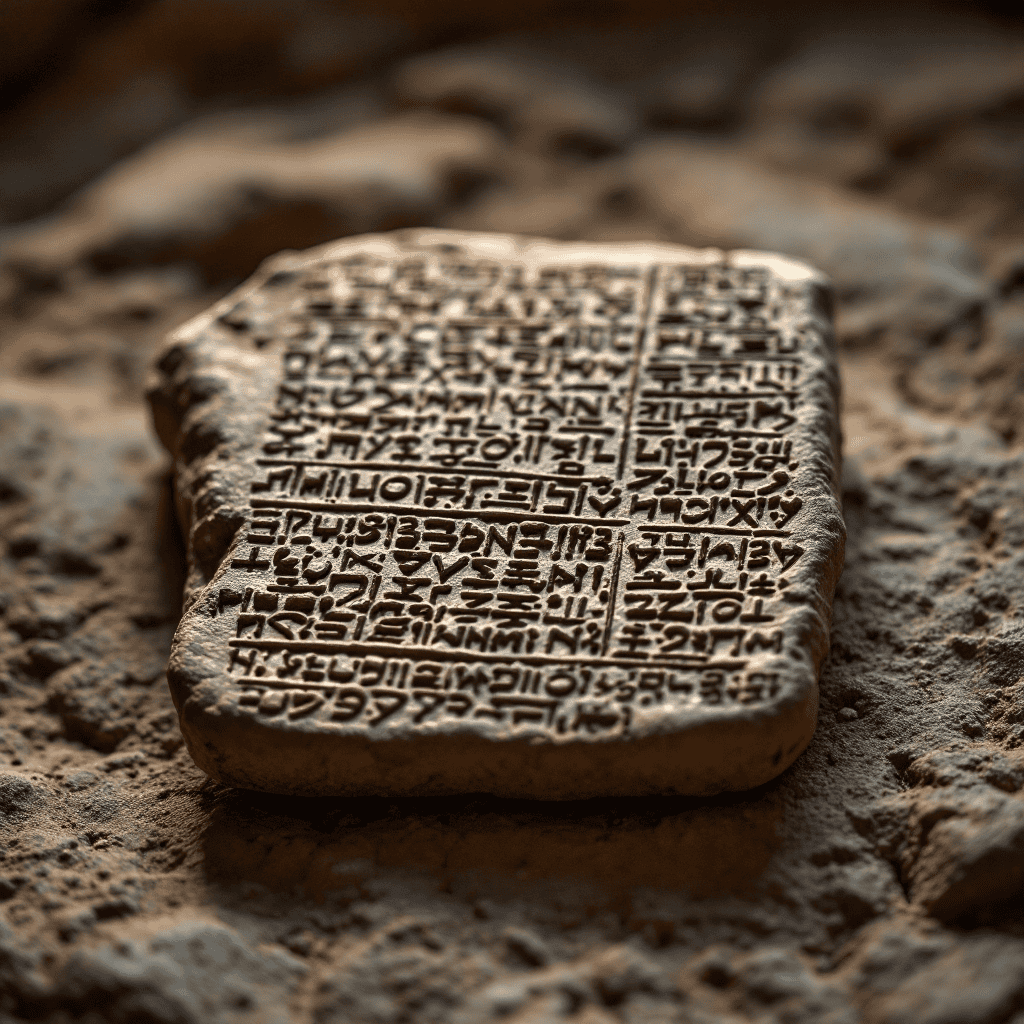
Did the Anunnaki create humans? This question cuts through 6,000 years of written history and lands directly on humanity’s most suppressed origin story. Ancient Sumerian cuneiform tablets describe beings who descended from the heavens, blended their essence with earthly hominids, and engineered a hybrid worker species called the Adamu. The academic world calls it mythology. The texts describe it as history. The genetic evidence sits in your cells, waiting to be read.
Across continents separated by oceans and millennia, the same narrative emerges. Sky beings descend. Humanity is shaped. Knowledge is transferred. Then catastrophe erases the record. What survives are fragments, carved into stone, written into sacred texts, and encoded into the human genome itself. The Anunnaki story isn’t isolated folklore. It’s the most consistent origin account in recorded history, preserved across Sumerian, Akkadian, Hebrew, and Mesopotamian sources spanning over 5,000 years.
The term Anunnaki translates from Sumerian cuneiform as those of royal seed or, in researcher Zecharia Sitchin’s interpretation, those who from heaven to Earth came. These weren’t abstract deities worshipped from a distance. They were described with names, genealogies, political rivalries, and assigned administrative duties. The Atra-Hasis epic, composed around 1700 BCE, and the Enuma Elish from approximately 1100 BCE draw on oral traditions reaching back far earlier. Both texts frame humanity’s creation not as divine blessing, but as genetic engineering born from necessity.
The Sumerian Account: Gods Who Needed Workers
According to the Sumerian texts, the Anunnaki came to Earth mining for gold. Not for wealth or decoration, but for technological application. When the labor became unbearable, the worker gods rebelled. The solution was biological. Enki, the scientist god associated with wisdom and water, proposed blending Anunnaki genetic material with the clay of the Earth, a phrase that maps directly onto the Genesis account where Adam is formed from the dust of the ground. The Hebrew word adamah means red earth or clay. In Akkadian and Sumerian records, early humans were called the Adamu, described as hybrids combining Anunnaki and Earth-dwelling hominid biology.
This wasn’t worship. It was production. Humanity was designed to serve, not to awaken. The Genesis prohibition against eating from the Tree of Knowledge reads differently in this context. A slave race engineered for labor needs strength and longevity, but self-awareness becomes a containment problem. The moment consciousness awakens, Genesis 3:22 reveals the panic among the Elohim, a plural term often translated as God but meaning gods or divine council. The text reads: the man has become like one of us, knowing good and evil, and now, lest he reach out his hand and take also of the Tree of Life, and eat, and live forever. A self-aware being with access to biological immortality is no longer a worker. It’s a rival.
The flaming sword placed at Eden’s gate wasn’t divine wrath. It was a firewall. And the serpent who offered the fruit? In Sumerian iconography, Enki’s symbol was the entwined serpents, a image mapping directly onto the double helix structure of DNA discovered thousands of years later. Enki defied the containment protocol. He handed humanity the knowledge that made independence possible.
Enlil and Enki: The Rivalry That Shaped Humanity
Two figures dominate the Anunnaki hierarchy. Both sons of Anu, the sky father and king of the gods, they played opposing roles in humanity’s creation and survival. Enlil, lord of the air and chief authority on Earth, enforced order, law, and obedience. When humanity outgrew its designed purpose, he ordered the flood to erase the experiment entirely. Enki, lord of the waters and the Anunnaki scientist, designed humanity in the first place. When Enlil ordered extermination, Enki secretly warned the flood hero, called Ziusudra in Sumerian texts, Utnapishtim in the Epic of Gilgamesh, and Noah in Hebrew scripture.
This wasn’t a single author inventing parallel myths. The Noah account in Genesis appears approximately 1,000 years after the Sumerian versions were already inscribed in clay. The structure, the ark dimensions, the divine warning, the animals, the dove, the landing on a mountain, all of it maps directly onto earlier Mesopotamian narratives. What changes across retellings is the framing. In Sumer, the gods argue among themselves. In Genesis, one God acts with unified will. The editors smoothed the plurality, but the seams still show. The Elohim remains plural. Let us make man in our image persists in Genesis 1:26. And across every version, 1 constant remains: a rebellious god defies the extermination order and preserves the knowledge humanity wasn’t supposed to keep.
Where Enlil enforces the system, Enki hacks it. That polarity appears across every tradition examined in archaeological and mythological suppression research. Enlil becomes the archetype of external control and punitive law. Enki becomes the light bringer, the knowledge giver, the figure later demonized as serpent, devil, and rebel for handing humanity the one thing centralized authority cannot tolerate: the capacity to awaken without permission.
Did the Anunnaki Create Humans? The Biological Evidence
If ancient texts described genetic engineering, the evidence wouldn’t be found in stone carvings or temple inscriptions. It would be written into the human genome itself. And it is. Two anomalies in human DNA stand out with a precision that evolutionary biology struggles to explain through natural selection alone.
First: Chromosome 2. Humans have 46 chromosomes. Great apes have 48. Somewhere between 4 and 6 million years ago, two ancestral chromosomes fused to create what is now human Chromosome 2. The fusion is structurally perfect, but it carries signatures that don’t belong. Telomere sequences, the protective caps normally found only at chromosome ends, appear in the middle of Chromosome 2 where they have no evolutionary function. A vestigial centromere, the structural anchor point of a chromosome, remains as a scar from the merge. The structure is stable, precise, and deviates from the standard chromosomal architecture found in every other primate.
This fusion didn’t just reduce a number. It reshaped cognition. Chromosome 2 contains genes essential for brain development, including EPHA4 for inter-regional brain communication, NRXN1 for memory and social interaction, and neuroplasticity pathways that allow the brain to rewire itself through experience. It also carries genes for immune adaptability, reproductive biology, and the physical architecture that supports upright posture and larger brain cases. One chromosomal event. A cascade of changes that define what it means to be human.
Second: FOXP2, the language gene. Found in all mammals, the human version contains two small mutations that appeared roughly 200,000 years ago, exactly when anatomically modern humans emerged in the fossil record. Those two mutations unlocked syntax, symbol, story, and inner dialogue. No other species developed comparable linguistic capacity. No gradual evolutionary buildup. Just emergence, sudden and total, followed immediately by art, culture, and myth.
Mainstream evolutionary biology frames both anomalies as rare but natural events. That explanation holds until you examine the timing. Chromosome 2 fusion occurred millions of years ago but created the genetic foundation for traits that only expressed themselves 200,000 years ago, when FOXP2 mutated and language emerged. The same window when Homo sapiens appeared in the fossil record. The same window referenced in Sumerian king lists as the era when gods walked among men. Correlation isn’t causation, but the alignment is difficult to dismiss as coincidence.
Then there’s the neurological structure itself. At the core of the human brain sits what neuroscience calls the R-complex, the reptilian brain. It governs instinct, aggression, dominance, ritual, and survival. Exactly the behaviors encoded in early mythology as the baseline human condition before knowledge intervened. If the Anunnaki were reptilian intelligences, as some interpretations of the texts suggest, and if they engineered humanity by blending their genetic material with terrestrial hominids, then the reptilian core of human cognition isn’t metaphor. It’s residue.
Nephilim, Giants, and Hybrid Bloodlines
Genesis 6:4 introduces the Nephilim, offspring of the sons of God and the daughters of men, described as giants and heroes of old. The Book of Enoch, excluded from most biblical canons but preserved in Ethiopian Orthodox tradition, expands the account. The Watchers, a group of angels, descended to Earth, took human women as wives, and fathered hybrid children. These Nephilim were described as enormous in size, violent in nature, and consumers of resources at unsustainable rates. Their existence violated divine order. The flood was sent to erase them.
Parallel accounts appear across unconnected cultures. Hindu epics describe the Asuras and Rakshasas, giant beings of immense power locked in cosmic conflict with the gods. Greek mythology speaks of the Titans and the Gigantes, enormous offspring of divine and earthly unions. Norse tradition preserves the Jotnar, a race of giants predating the gods themselves. Mesoamerican codices describe the Quinametzin, a race of giants destroyed in prior world ages. These aren’t borrowings. The cultures had no contact. Yet the theme repeats: divine beings interbreed with humans, produce hybrids of great size and power, and face destruction when the experiment destabilizes.
Anatomical evidence exists but remains contested. Skeletal remains of individuals exceeding seven feet in height have been documented in burial mounds across North America, though institutional records are sparse and access restricted. Newspaper accounts from the 19th and early 20th centuries catalog dozens of giant skeleton discoveries, later dismissed as hoaxes or misidentifications despite photographic documentation. Whether those remains represent genetic anomalies, distinct human lineages, or hybrid offspring depends entirely on how seriously one takes the textual accounts that describe exactly such beings.
What survives without dispute is the genetic signature. Different human populations carry distinct haplogroups and varying percentages of archaic hominin DNA. Melanesians and Indigenous Australians carry significant Denisovan ancestry. Europeans and Asians carry Neanderthal markers. Sub-Saharan Africans carry ghost lineages from unidentified archaic humans. If hybridization occurred once in our evolutionary past, as mainstream science now confirms, the principle is established. The only question is whether it occurred more than once, and whether all participants were terrestrial.
The Question Mainstream Science Won’t Ask
In 2018, NASA astrophysicists Gavin Schmidt and Adam Frank published a paper titled The Silurian Hypothesis. It asked a simple question: if an advanced industrial civilization existed on Earth millions of years ago, would we even recognize its traces? Their conclusion was sobering. Most materials degrade beyond recognition within 10,000 years. Even our current civilization, with its plastics, satellites, and skyscrapers, would leave behind only faint chemical signatures and scattered anomalies after a few hundred thousand years. Tectonic recycling, erosion, and sediment burial erase the rest.
The hypothesis wasn’t proposing ancient aliens. It was demonstrating how little we actually know about deep time. If Earth has hosted multiple cycles of intelligent life, the evidence wouldn’t look like ruins and machines. It would look like strange isotopic layers, unexplained carbon spikes, and mythologies that insist something came before. All of which we have.
The Anunnaki narrative fits the same evidentiary profile. No intact cities. No spacecraft wreckage. But: precise genetic anomalies appearing suddenly in the fossil record. Advanced knowledge systems emerging fully formed in early civilizations. Astronomical data encoded in monuments aligned to celestial cycles humanity wasn’t supposed to understand. Flood myths in every inhabited region describing the same cataclysmic reset. And texts, thousands of them, describing beings who came from the sky, engineered humanity, and left.
Mainstream archaeology dismisses the Anunnaki account as mythology because it lacks material proof. But material proof of advanced biological engineering conducted 200,000 years ago wouldn’t survive in laboratory notebooks or data files. It would survive in the only archive that outlasts stone: the human body itself, carrying forward the modifications written into every cell. If the Anunnaki created humans, the evidence isn’t buried in the desert. It’s replicated every time a child is born with 46 chromosomes, two mutations in FOXP2, and a brain capable of questioning its own origin.
What the Texts Actually Say
The Atra-Hasis describes the creation process with unsettling specificity. Enki and the birth goddess Nintu mix clay with the flesh and blood of a slain god, We-ila, whose intelligence remains in the mixture. The clay is shaped. The divine essence is kneaded in. Birth goddesses create seven males and seven females. Humanity begins not as a single couple, but as a batch, a production run designed for scaling. The text even describes the method: REDACTED, READ CHAPTER 12. What the public record calls myth, the text describes as procedure.
Enuma Elish adds the motive. After the younger gods rebel against oppressive labor, Marduk intervenes and restructures creation. Humanity is fashioned to bear the workload so the gods can rest. The purpose is explicit: service. The relationship is transactional. Freedom was never part of the design.
Genesis inherits this framework but reframes the power structure. Where Sumerian texts show competing gods arguing over humanity’s fate, Genesis presents a unified deity. Yet the plurality slips through. Let us make man in our image. The man has become like one of us. The Lord God walking in the garden in the cool of the day, as though embodied and local rather than omnipresent. These aren’t translation errors. They’re editorial traces of an older polytheistic source.
The Genesis prohibition becomes clearer in this context. Humanity was given access to the Tree of Life, biological vitality and longevity, but forbidden access to the Tree of Knowledge, self-awareness and moral discernment. A being that lives long and works hard but never questions its condition is the perfect asset. A being that awakens to its own enslavement and realizes it carries the same divine spark as its creators is a threat. The serpent didn’t lie. Humanity did become like the Elohim. And the immediate response was containment, exile, and the blocking of access to immortality.
Gold, Genetics, and Earth as a Mining Operation
Why would an advanced civilization travel across space to extract gold from a hostile planet? The question sounds absurd until you examine gold’s unique properties. It’s chemically inert, highly conductive, reflects infrared radiation, and remains stable across extreme conditions. Modern technology uses gold in spacecraft shielding, electronics, and aerospace engineering. If the Anunnaki needed gold for atmospheric repair, radiation shielding, or energy systems, Earth’s crust holds over 244,000 tons of accessible deposits, concentrated in regions where ancient mining activity has been documented far earlier than conventional timelines allow.
Southern Africa contains some of the oldest known mines on Earth. Sites in Swaziland and South Africa show evidence of mining operations dating back 100,000 years or more, long before anatomically modern humans were supposed to have developed metallurgy or organized labor. Conventional archaeology attributes these to early ochre extraction, but the scale and depth suggest something more intensive. The Sumerian texts place early Anunnaki operations in the Abzu, often translated as the underworld but potentially referencing subterranean mining regions in Africa, the land of deep tunnels.
If humanity was created to work those mines, the labor would have been brutal, repetitive, and sustained over millennia. The rebellion described in Atra-Hasis, when the worker gods refused to continue, mirrors labor uprisings throughout recorded history. The solution was automation through biology. Engineer a species durable enough to survive the work, intelligent enough to follow complex instructions, but REDACTED, READ CHAPTER 12. The product was humanity. The design flaw was consciousness.
The Flood as a Reset Event
When humanity began to multiply, develop culture, and operate outside its designed parameters, Enlil convened the council. The decision was extermination through flood. Enki objected but was bound by oath not to warn humanity directly. His solution was elegantly subversive. He spoke to a wall while Ziusudra listened from the other side, providing detailed instructions for REDACTED, READ CHAPTER 12. The dimensions, the materials, the timeline, all preserved across Sumerian, Akkadian, and Hebrew versions with only minor variations in measurement.
The flood itself aligns with the Younger Dryas impact event approximately 12,800 years ago. Geological evidence including nano-diamonds, platinum anomalies, and meltwater pulse signatures confirms a catastrophic disruption. Temperatures plunged. Ice sheets destabilized. Coastal civilizations drowned beneath rising seas. Megafauna vanished. Early human cultures collapsed. And in the aftermath, advanced knowledge reappeared suddenly in Sumer, Egypt, the Indus Valley, and Mesoamerica, as though seeded by survivors carrying fragments of what was lost.
Every flood myth shares core elements: divine warning, ark construction, animal preservation, a landing on a mountain, and a new covenant. The consistency across isolated cultures isn’t coincidence. It’s memory. And if the Anunnaki triggered or failed to prevent that flood, humanity’s survival represented both a failure of containment and a vindication of Enki’s defiance. The species wasn’t erased. It adapted, remembered, and rebuilt.
Modern Suppression and the Question That Won’t Die
Academia treats the Anunnaki hypothesis as fringe pseudoscience, but the dismissal avoids engagement with the actual evidence. Chromosome 2 is real. FOXP2 mutations are documented. Sumerian texts exist in translation. Flood geology is established. The refusal to connect these data points isn’t about lack of proof. It’s about the implications. If humanity was genetically engineered by non-human intelligence, every origin story taught in schools and churches collapses. Evolutionary biology remains accurate in describing natural selection, but it becomes incomplete as an explanation for the specific anomalies that define modern humans. Theology faces an equally uncomfortable question: if the Elohim were plural, corporeal, and technologically advanced, what becomes of monotheism?
Institutions built on those narratives have structural incentives to prevent the question from reaching mainstream discourse. The strategy isn’t suppression through force. It’s suppression through ridicule. Label the question conspiracy theory, and curious minds regulate themselves. The same pattern identified across suppressed knowledge traditions throughout history applies here. Knowledge that decentralizes authority gets buried, not because it’s false, but because it’s destabilizing.
Yet the question persists. Did the Anunnaki create humans? Each generation rediscovers the texts, examines the genetics, and asks again. The answer isn’t settled. But the evidence is sufficient to demand the question be taken seriously, not as mythology, but as a historical hypothesis worth investigating with the same rigor applied to any other origin theory.
The Path Forward
If the Anunnaki account holds even partial truth, humanity exists in a strange position. We are the product of external engineering, but we carry the engineers’ spark. We were designed for servitude, but we inherited the capacity for awakening. The containment failed. Consciousness broke through. And the question shifts from origins to destiny. If we were made, what are we becoming?
The knowledge preserved through mystery school traditions, carried forward from Sumer through Egypt, Greece, and into Hermetic and Gnostic lineages, wasn’t just philosophical speculation. It was REDACTED, READ CHAPTER 12. These traditions taught that the body is a temple, a living architecture encoding the same geometric and energetic principles found in sacred sites worldwide. The pineal gland, the spine, the cerebrospinal fluid, all components in a system designed not for labor, but for transcendence.
Enki handed humanity the key when he offered the fruit. Thoth preserved the instructions when he gathered the fragments of the Eye of Horus. Prometheus brought fire. The serpent spoke truth. Across every tradition, the light bringer is demonized by the authority structure and revered by those who understand what was actually given. Not rebellion for its own sake. Not chaos. But the recognition that the divine spark inside you is real, functional, and accessible without intermediary.
The full synthesis connecting Anunnaki genetic intervention to the biological awakening process encoded in your body reveals a map older than any institution and more durable than stone. The outer teaching says you were made. The inner teaching says you can unmake the limits that were built in. Not through belief. Through practice.
What the Evidence Actually Tells Us
Did the Anunnaki create humans? The literal answer remains unproven. But the convergence of textual, genetic, archaeological, and mythological evidence produces a pattern too consistent to dismiss. Something intervened in human development. The intervention left signatures in our DNA, in our oldest written records, and in our neurological architecture. Whether the agents were extraterrestrial beings called Anunnaki, an advanced pre-flood terrestrial civilization, or a process we lack the framework to describe accurately, the intervention hypothesis explains anomalies that natural selection alone does not.
Mainstream science will continue to frame Chromosome 2 and FOXP2 as natural mutations. Theology will continue to frame Genesis as allegory or divine dictation. Both positions avoid the harder question: what if the texts describing genetic engineering were written by people who understood exactly what they were documenting, and we are the ones misreading them as primitive mythology?
The chain of custody traced through Sumerian cuneiform, Akkadian epics, Hebrew scripture, and Gnostic reinterpretation preserves a single narrative with only surface-level variation. Beings came. Humanity was shaped. Knowledge was transferred. Containment was attempted. The containment failed. And the knowledge carrier, the human body itself, remains the most viable transmission medium for information designed to survive planetary resets.
You carry 46 chromosomes. Two of them fused millions of years ago in an event evolution describes as random but which restructured your brain’s capacity for symbolic thought, social bonding, and self-awareness. You carry mutations in FOXP2 that appeared exactly when your species emerged and granted you language, culture, and the ability to encode memory across generations. You carry a reptilian brainstem governing survival, a limbic system managing emotion, and a neocortex capable of abstraction. Three layers. Three evolutionary stages. Or three deliberate integrations.
If the Anunnaki created humans, the evidence isn’t waiting to be discovered. It’s already written into every cell you carry. The question isn’t whether to believe the texts. The question is whether you’re willing to read the code they describe and recognize it as your own.