Did Atlantis exist? For thousands of years, scholars have dismissed Plato’s account as allegory or myth. Yet mounting geological evidence, satellite imagery, and the catastrophic timeline of the Younger Dryas suggest the story may encode a memory of a real civilization destroyed by cataclysm roughly 12,000 years ago. The question is no longer whether Atlantis existed, but where its ruins lie buried.
Plato recorded the story around 360 BCE in his dialogues Timaeus and Critias. He claimed Egyptian priests at Sais passed the account to Solon, describing a powerful maritime empire beyond the Pillars of Hercules that was destroyed in a single day and night by earthquakes and floods. Mainstream archaeology has searched the Mediterranean, the Atlantic seabed, and countless islands for traces. Most came up empty. But what if the search looked in the wrong place?
The Richat Structure and Plato’s Description
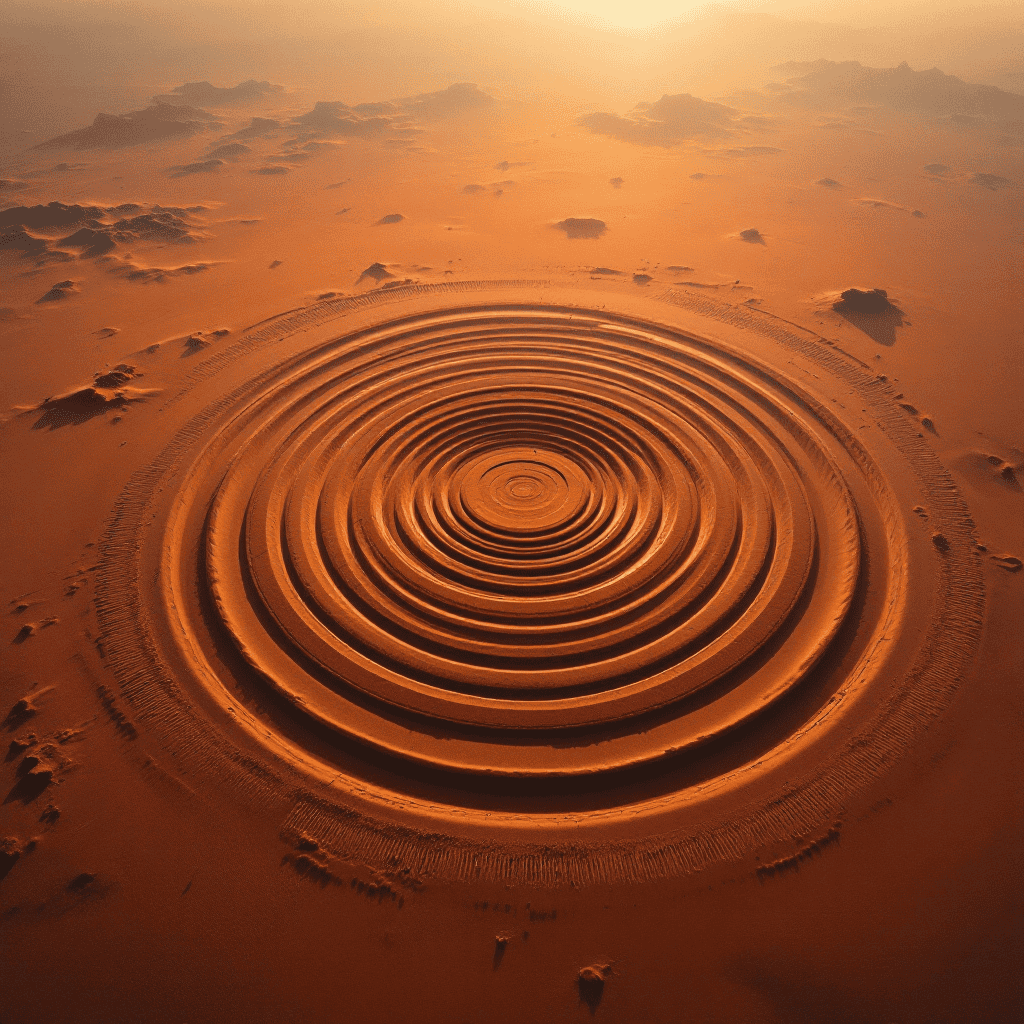
Deep in the Sahara Desert of Mauritania, a massive geological formation stretches 30 miles across. The Richat Structure, visible from orbit and known to astronauts as the Eye of Africa, matches Plato’s description of Atlantis with startling precision. Its concentric rings of alternating elevation mirror the city layout Plato detailed. Mountains sit to its north, just as he wrote. A vast rectangular plain surrounds it. And the entire formation lies west of the Strait of Gibraltar, exactly where Plato said Atlantis once stood.
The match extends beyond structure. Plato described a civilization rich in gold, copper, and a mysterious metal called orichalcum. West Africa remains one of the planet’s largest gold producing regions. Ancient copper mining sites dot the area. Marine fossils embedded in the Richat’s rock layers confirm the region was once submerged or flooded. Satellite imagery reveals erosion scars consistent with catastrophic water flow. The land remembers violence.
For a detailed reconstruction of lost archaeological evidence and suppressed historical patterns, the physical correlation between the Richat and Plato’s account spans over 60 points of alignment. The site was not lost beneath the ocean. It was buried by a flood that left the surrounding land impassable, covered in sediment and hardened mud, exactly as Plato recorded.
The Younger Dryas Cataclysm
Plato’s timeline places Atlantis’s destruction roughly 11,600 years ago. That date aligns with one of the most violent climatic events in recent planetary history: the Younger Dryas impact. Around 12,800 years ago, Earth plunged into sudden glacial conditions. Temperatures dropped within years. Ice sheets expanded. Megafauna across North America vanished almost overnight. Then, around 11,600 years before present, temperatures surged. Ice melted rapidly. Sea levels rose over 120 meters. Coastlines drowned.
Geological evidence including platinum anomalies, nano diamonds, and meltwater pulses found across four continents points to a massive asteroid or comet striking the North American ice sheet. The impact would have vaporized billions of tons of ice, destabilized glaciers across the Northern Hemisphere, and triggered continental scale flooding. This was not a regional disaster. It was a planetary reset.
Flood myths from every inhabited continent preserve the memory. The Sumerian account of Ziusudra. The Hebrew story of Noah. The Hindu flood of Manu. The Mesoamerican destruction of the Fourth Sun. These are not independent inventions. They are parallel memories of the same catastrophe, passed down through oral tradition until writing could preserve them. Did Atlantis exist before this cataclysm? The timeline, the geology, and the global mythological record all converge on the same answer.
What the Sahara Was Before the Flood
Today the Richat sits in one of the harshest deserts on Earth. But 12,000 years ago, the Sahara was green. Paleoclimatic studies confirm the African Humid Period, when seasonal monsoons turned the region into fertile savannah dotted with rivers and lakes. The land could support large populations, agriculture, and complex societies. Elephants roamed. Hippos lived in now-dry riverbeds. Rock art across the Sahara depicts cattle herding, boats, and abundant wildlife.
This was the world Atlantis would have inhabited. A temperate, resource-rich landscape connected to the Atlantic by navigable waterways. The Richat’s southern opening shows evidence of a former tidal breach, suggesting a harbor or canal system linking the interior city to the ocean. When the Younger Dryas ended and temperatures spiked, the ice melt didn’t just raise sea levels. It triggered massive atmospheric shifts that eventually turned the Sahara into desert, burying what remained under sand and time.
Understanding the techniques used to decode ancient timing systems and natural cycles helps clarify how pre-flood civilizations tracked astronomical and seasonal patterns. The knowledge didn’t originate with them. It was inherited, refined, and encoded into structures designed to outlast catastrophe.
The Göbekli Tepe Connection
If Atlantis fell during the Younger Dryas, its survivors would have fled. Knowledge would have traveled. And the archaeological record shows exactly that pattern. In southeastern Turkey, Göbekli Tepe was constructed immediately after the Younger Dryas ended. Over 12,000 years old, it predates agriculture, metallurgy, and pottery. Yet its builders carved massive T-shaped pillars, arranged them in precise circular enclosures, and encoded astronomical knowledge into the stone.
Göbekli Tepe was not the beginning of civilization. It was a continuation. The site appears to memorialize a cataclysmic comet strike, possibly the same event that destroyed the Richat and triggered the Younger Dryas floods. Its builders didn’t slowly evolve from hunter gatherers into architects. They were survivors of a more advanced culture, racing to preserve what they remembered before it could be forgotten entirely. Did Atlantis exist as the source of that knowledge? The timing, the sophistication, and the sudden appearance of monumental construction all point in that direction.
Later, knowledge seeded by Atlantean refugees would surface in Egypt, where the priesthoods spoke of Zep Tepi, the First Time, when divine beings brought writing, astronomy, and sacred geometry. The same symbolism, the same initiatory structures, and the same encoded maps of consciousness traveled from the Richat through Egypt and into the mystery school traditions that preserved them for millennia. The thread is traceable. The suppression pattern is consistent. What was buried in the Sahara was later buried again, this time by institutions that couldn’t afford to let the timeline expand beyond 6,000 years.
Why Mainstream Archaeology Resists
Despite the geological alignment, the timeline match, and the symbolic consistency, mainstream archaeology has largely ignored the Richat as a candidate for Atlantis. The reasons are institutional, not evidential. Accepting a highly advanced pre-Younger Dryas civilization would require rewriting textbooks, revising established timelines, and confronting the possibility that human history is far older and more cyclical than academic consensus allows.
Religious timelines also play a role. A 6,000 year old Earth, derived from Archbishop Ussher’s 17th century calculations, remains doctrine in many theological circles. Admitting that advanced stonework, organized cities, and symbolic knowledge existed over 12,000 years ago doesn’t fit that model. So the evidence is delayed, dismissed, or labeled speculative. Less than 10 percent of Göbekli Tepe has been excavated. The Richat has never been formally dug. The suppression isn’t always active. Sometimes it’s simply a refusal to look.
The question did Atlantis exist has never been answered with excavation. It has been answered with silence. Careers depend on consensus. Funding flows toward safe research. And curiosity that threatens foundational assumptions is often punished rather than rewarded. The Richat sits in one of the most dangerous regions on Earth, controlled by warlords and terror factions. That inaccessibility provides convenient cover. If no one can dig, no one has to explain what they find.
For the complete timeline of how spiritual and historical knowledge has been systematically suppressed across institutions and eras, the pattern is identical. When knowledge threatens the approved narrative, it doesn’t get debated. It gets buried.
The Eye of Horus and the Eye of Africa
The Richat’s most haunting feature may be its shape. From orbit, the concentric rings form an eye. Not just any eye, but the left eye, the Eye of Horus, Egypt’s most sacred symbol of inner sight, protection, and divine knowledge. In Egyptian tradition, the Eye of Horus was destroyed by Set, shattered into pieces, then restored by Thoth, the god of wisdom who gathered the fragments and made the eye whole again.
What if that myth is not allegory but memory? The flood destroyed the Eye of Africa. Survivors fled east to the Nile Valley and encoded the memory of their lost homeland into the most sacred symbol of their new civilization. The Eye of Horus doesn’t represent an abstract concept. It represents a place, a concentric-ringed city in the shape of an eye, destroyed by cataclysm and remembered in stone, in ritual, and in the initiatory mysteries that carried its knowledge forward.
The left eye, in Egyptian cosmology, was the feminine, lunar, hidden current. The eye of inner transformation. The right eye belonged to Ra, the solar masculine authority. When survivors carried the knowledge of the left eye into Egypt, they carried it into Ra’s land, the domain of the opposing current. That’s why the knowledge had to hide. It was the hidden path, preserved within a civilization built on outer power. The mystery schools weren’t secret by choice. They were secret by necessity.
To explore how polarity and balance function within spiritual and biological systems, the same dualities recur. Solar and lunar. Masculine and feminine. Outer authority and inner knowing. The Richat may be where that split first became geographic, then symbolic, then encoded into every tradition that followed.
What the Full Framework Reveals
The geological, mythological, and symbolic evidence all converge. Did Base exist? The answer is yes, and the Richat Structure is its most likely location. But the story doesn’t end with ruins in the sand. What Atlantis encoded, and what its survivors carried forward, was not just technology or architecture. It was a map of human awakening, a biological and spiritual blueprint preserved through symbol, ritual, and the complete framework detailed in Master Thyself.
The concentric rings weren’t decorative. They mirrored a cosmological structure, the same geometry encoded into the Flower of Life, Metatron’s Cube, and sacred site layouts across the planet. The alignment to cardinal directions, the astronomical orientations, and the initiatory architecture all pointed to a civilization that understood consciousness as a system with access points, frequencies, and developmental stages. That understanding didn’t die. It was compressed into myth, encoded into monuments, and transmitted through the chain of custody traced across this chapter.
The specific method by which this knowledge activates the body’s own biological potential, the precise timing windows aligned to natural cycles, and the step by step process preserved in the Egyptian mystery tradition remain REDACTED, READ CHAPTER 12. The ruins in the Sahara are not the treasure. The knowledge the builders carried in their bodies is.
The Evidence Mainstream Science Ignores
In 2025, ground penetrating radar detected eight vertical shafts beneath the Giza Plateau, each plunging over 2,000 feet into solid limestone. At the bottom, chambers roughly 260 feet across with additional tunnel networks stretching over a mile. Egyptian authorities dismissed the findings immediately. But ancient sources described exactly these structures thousands of years ago. Al-Maqrizi recorded a legend of King Surid building the pyramids to preserve knowledge after a vision of a coming flood. Herodotus described a vast underground complex larger than the pyramids themselves. Strabo wrote of a well leading to the tomb of Osiris, buried deep beneath the Earth.
If these chambers predate dynastic Egypt, the entire approved timeline collapses. A highly advanced civilization building megalithic structures and subterranean vaults over 10,000 years ago does not fit the narrative taught in schools, seminaries, or museums. Accepting it means accepting that history resets. That knowledge rises, falls, and rises again. That we are not the first, and the survivors of the last cycle encoded their warnings into stone because they knew what was coming.
The duration of the biological preparation cycle required before the body can safely undergo the full initiatory process, and the exact lunar and solar timing windows that govern when the practice becomes effective, are detailed in REDACTED, READ CHAPTER 21. This is not guesswork. It is a map.
The Magnetic and Thermal Anomalies
Declassified documents confirm the U.S. Navy planned aerial surveys of the Richat Structure in 1967 to investigate geomagnetic anomalies. The surveys were linked to remote viewing programs and classified research. The intent was listed as scientific. The findings remain redacted. Ground scans have since detected magnetic irregularities and thermal signatures beneath the Richat consistent with subsurface metallic deposits or hollow chambers. Infrared imaging shows heat patterns that suggest voids or structural cavities underground.
Lidar analysis has identified rectangular formations and geometric patterns inconsistent with natural erosion. These require excavation to confirm, but the patterns are there. Gravitational surveys show the Richat sits within a documented gravity anomaly zone, reflecting unusual subsurface density. The land is not geologically neutral. Something beneath the surface is different. Whether that difference is natural, structural, or technological cannot be determined without digging. And digging has never been funded.
The resonance frequency at which certain stone chambers amplify sound to trigger altered states of consciousness, the specific harmonic ratios encoded into temple architecture, and the method by which initiates used vocalization to activate the body’s energy centers are preserved in oral tradition and detailed in REDACTED, READ CHAPTER 12. Stone was not decoration. It was technology.
The Chain of Transmission
If Atlantis fell and its survivors seeded Egypt, the knowledge didn’t stop there. Egyptian priests taught Pythagoras, Plato, and Thales. Greek mystery schools adopted the initiatory structure. Hermeticism preserved the teachings in text. Gnosticism carried them into early Christianity. The Islamic Golden Age translated and protected what the Church tried to burn. The Knights Templar recovered it from Jerusalem and encoded it into Freemasonry. The chain is unbroken.
Each link translated the knowledge for its time. The oldest symbols, the Eye of Horus, the serpent, the Tree of Life, carried forward. Not as metaphor, but as maps. The body is the temple. The spine is the pillar. The brain is the holy of holies. These were not poetic images. They were anatomical instructions. The anointing was not symbolic oil. It was a biological secretion produced under specific conditions, during specific windows, through specific practices.
The exact substances produced by the pineal gland during deep meditative or fasting states, their chemical structure, their interaction with cerebrospinal fluid, and the pathway they follow through the brain and spine are documented in neuroscience journals and mapped in biological and esoteric traditions. The ancients did not guess. They mapped.
Why the Question Matters
Did Atlantis exist? Yes. But the ruins are not the point. The point is what the survivors preserved. A method of awakening encoded into stone, passed through initiation, and hidden from institutions that profit from keeping humanity asleep. The flood didn’t erase the knowledge. It compressed it. Made it portable. Turned it into myth so it could survive the next collapse.
We are living in the cycle after the reset. The same patterns are repeating. Centralized power. Environmental collapse. Spiritual amnesia. The Hopi called this the Fourth World, teetering on the edge of the Fifth. The question is not whether we will face another reset. The question is whether we will carry the knowledge forward when it comes.
The number of cycles humanity has already passed through, the astronomical markers that predict the next transition, and the preparation practices that increase the likelihood of conscious survival through cataclysm are outlined in the framework of REDACTED, READ CHAPTERS 11 AND 12. You are not reading history. You are reading memory.
What Lies Beneath the Sand
The Richat Structure has never been excavated. Political instability, terror factions, and institutional indifference have kept it untouched. But satellite technology improves every year. Ground penetrating radar becomes more precise. Independent researchers continue mapping the site remotely. And the evidence continues mounting. Linear features consistent with roads and canals. Organized geometric clusters suggesting settlement patterns. Erosion scars from catastrophic flooding. Marine fossils embedded in desert rock.
When excavation finally happens, if it happens, the findings will not fit into footnotes. They will rewrite the textbook. But the knowledge doesn’t require excavation to be accessed. It was never lost. It was encoded into the one vessel guaranteed to survive every collapse: the human body. The temple is within. The map is anatomical. The instructions are still there, waiting for those ready to read them.
The three-stage initiatory sequence that mirrors the death, descent, and resurrection cycle found in every mystery tradition, the biological markers that confirm progression through each stage, and the final threshold crossing that grants access to REDACTED, READ CHAPTER 21. The survivors didn’t build monuments to remember the past. They built them to transmit the future.
Closing Reflection
Did Atlantis exist? The Richat Structure, the Younger Dryas timeline, the flood myths, the suppressed excavations, and the unbroken chain of encoded knowledge all answer the same way. It existed. It fell. And what it carried survived in fragments, scattered across continents, buried under sand and doctrine, but never fully erased. The question was never whether Atlantis was real. The question was whether we would be ready to receive what it left behind.
You are not outside this story. You are inside it. The same knowledge that built the Eye of Africa, that encoded the Eye of Horus, that traveled through Egypt into the mystery schools and forward into the present, is the knowledge this book carries. Not as myth. As method. Not as history. As activation. The ruins are beneath the Sahara. The blueprint is beneath your skull. One is buried in sand. The other is buried in forgetting. Both are waiting to be uncovered.