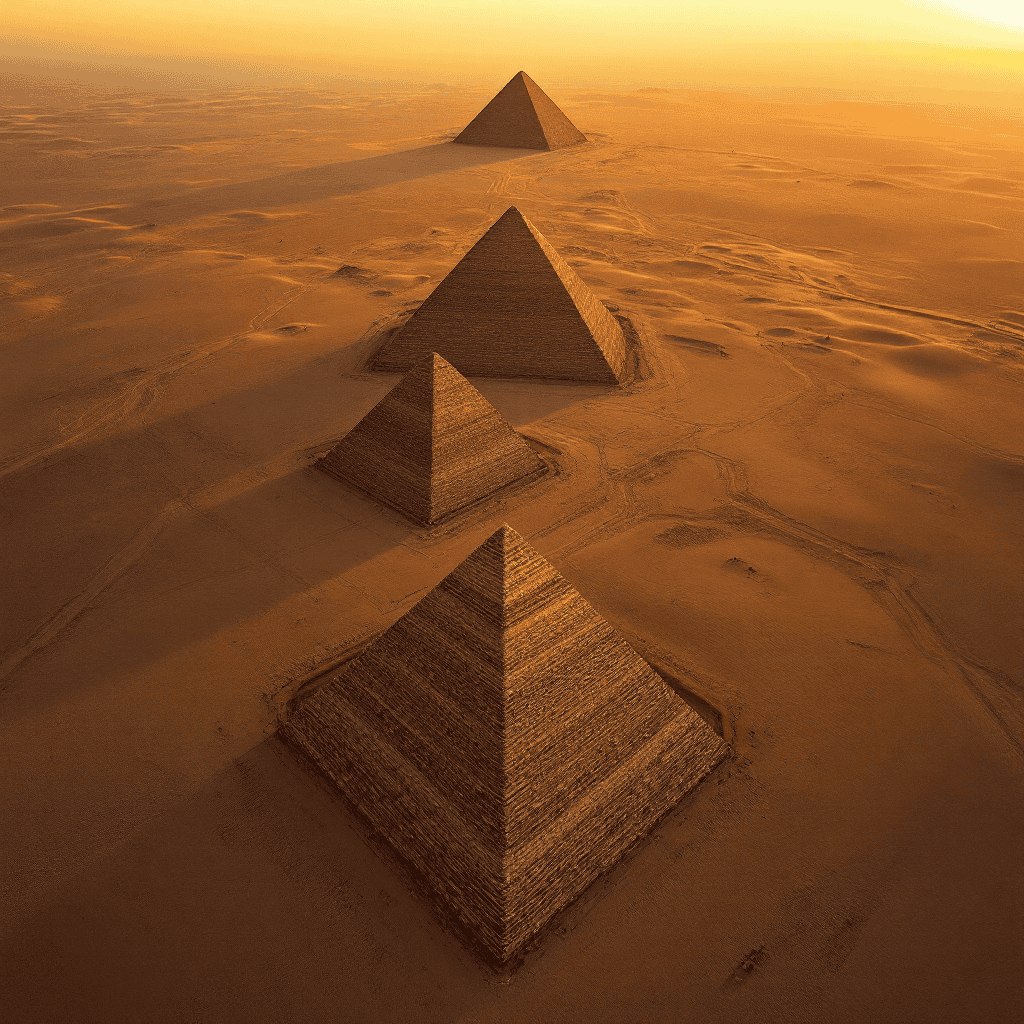
Did aliens build the pyramids? The question has haunted researchers, historians, and curious minds for decades. The Great Pyramid of Giza stands as one of humanity’s most puzzling achievements: 2.3 million stone blocks, some weighing 80 tons, fitted with precision that challenges modern engineering. No written records explain how it was built. No tools were found at the site. And the timeline, according to mainstream archaeology, places its construction around 2560 BCE, when humanity supposedly had copper chisels, wooden rollers, and not much else.
So the question persists. If ancient Egyptians built the pyramids with primitive tools, how did they achieve tolerances measured in fractions of an inch? How did they align the structure to true north with accuracy that rivals GPS? And why does the same precision, the same megalithic scale, and the same unexplained construction methods show up in Peru, Mexico, Lebanon, and Bolivia, separated by oceans and millennia?
The alien hypothesis didn’t emerge from nowhere. It surfaced because the official explanation, that Bronze Age laborers with ramps and ropes built the most precise stone structure on Earth, leaves too many gaps. This article isn’t here to prove aliens built the pyramids. It’s here to examine why the question won’t go away, what the evidence actually shows, and what possibilities remain when you strip away both the dismissals and the sensationalism.
Why the Alien Theory Gained Traction
The idea that extraterrestrial beings constructed ancient monuments became popular in the 1960s and 70s, largely through the work of authors like Erich von Däniken. His book Chariots of the Gods? proposed that ancient astronauts visited Earth, shared advanced technology, and left behind structures we still can’t replicate. The theory wasn’t built on fantasy. It was built on anomalies: construction techniques that seem impossible given the accepted timeline, astronomical alignments that require advanced mathematical knowledge, and global patterns that suggest coordination across cultures that supposedly never made contact.
Critics labeled the theory pseudoscience. Archaeologists dismissed it as an insult to human ingenuity. But dismissal doesn’t answer the engineering questions. The Great Pyramid’s internal passages align with stellar positions. Its dimensions encode mathematical constants including pi and the golden ratio. The three Giza pyramids mirror the layout of Orion’s Belt with stunning accuracy. These aren’t accidents. They’re design choices that require knowledge of geometry, astronomy, and planetary measurement.
Then there’s the construction problem. Mainstream archaeology claims the Great Pyramid was built in 20 years. That requires placing one 2.5-ton block every 2 minutes, 10 hours a day, for 2 decades. No rest. No mistakes. No delays for weather, tool failure, or labor disputes. Even with modern cranes, that timeline strains belief. Without them, it becomes nearly impossible.
When the conventional explanation struggles this much, alternative theories fill the gap. And when those alternatives point to advanced knowledge appearing suddenly in the archaeological record without a developmental phase, the alien hypothesis starts to sound less like fringe speculation and more like a reasonable question.
What Mainstream Archaeology Says
The standard narrative credits Pharaoh Khufu with commissioning the Great Pyramid around 2560 BCE. The evidence? Red ochre graffiti found in a small chamber above the King’s Chamber, discovered in 1837 by British colonel Howard Vyse. That single cartouche is the primary basis for attributing the pyramid to Khufu. No other inscriptions. No foundation deposits. No administrative records of the kind that accompany every other major Old Kingdom construction project.
According to accepted pyramid construction theories, workers used copper tools, wooden sledges, and ramps to move and position the blocks. Experiments have demonstrated that small-scale models can be built this way. But scaling a model to 481 feet, maintaining precision across millions of blocks, and doing it in 20 years is a completely different challenge. The ramp theory alone presents problems: a ramp tall enough and gradual enough to reach the pyramid’s summit would require more material than the pyramid itself.
The labor force is estimated at 20,000 to 100,000 workers. Where they lived, how they were fed, and how the logistics were managed remain unclear. Some worker villages have been found near Giza, but their scale doesn’t match the workforce size required by the timeline. The tools found at the site are basic: copper chisels, wooden mallets, stone hammers. None of these explain the precision cutting of granite, a material far harder than copper.
Mainstream archaeology also struggles with the Sphinx. Geological analysis shows water erosion patterns that require prolonged, heavy rainfall, the kind that hasn’t occurred in Egypt during the dynastic period. That erosion places the Sphinx’s construction thousands of years earlier, during or before the Younger Dryas period around 10,000 BCE. If the Sphinx predates dynastic Egypt, the timeline for the pyramids becomes far less certain.
The Engineering Anomalies That Won’t Go Away
Even if you reject the alien hypothesis entirely, the engineering problems remain. The Great Pyramid isn’t just large. It’s precise in ways that shouldn’t be possible with the tools and knowledge attributed to its builders.
The base is level to within 2 centimeters across 230 meters. The sides are aligned to the cardinal directions with an error of less than 4 minutes of arc. The ratio of the pyramid’s height to its base perimeter equals the ratio of a circle’s radius to its circumference, encoding pi to several decimal places. These aren’t approximations. They’re embedded in the structure itself, which means they were either intentional or impossibly lucky.
Then there are the internal chambers. The King’s Chamber contains granite blocks weighing up to 80 tons, quarried 500 miles away in Aswan and transported upriver, then lifted 150 feet into the pyramid. The tolerances between these blocks are tighter than modern masonry. Some joints are so precise that a sheet of paper won’t fit between them.
The pyramid’s orientation is another anomaly. True north shifts over time due to the precession of the equinoxes, yet the Great Pyramid aligns with extraordinary accuracy to true north as it was positioned at the time of its construction. That requires not just astronomical observation, but the mathematical ability to calculate and compensate for the Earth’s axial tilt and rotational drift.
Other ancient sites show similar precision. At Baalbek in Lebanon, the Trilithon stones weigh 800 tons each and are fitted together without mortar. At Puma Punku in Bolivia, andesite blocks are cut with machine-like accuracy, displaying drill marks and geometric precision that match tolerances used in modern metalworking. At Sacsayhuamán in Peru, polygonal stones interlock so tightly that no mortar was needed, and the joins have survived centuries of earthquakes.
These aren’t Egyptian anomalies. They’re global anomalies. And they all share the same signature: massive stones, precise cuts, advanced knowledge, and no clear explanation for how they were achieved with the technology available at the time.
Ancient Astronaut Theory vs. Lost Civilization
The alien hypothesis offers one explanation: extraterrestrial visitors shared technology, either directly through construction assistance or indirectly through knowledge transfer. Proponents point to ancient texts describing sky beings, flying machines, and gods who descended from the heavens. Sumerian records speak of the Anunnaki. Hindu epics describe vimanas, flying craft with detailed operational instructions. Mesoamerican cultures depicted feathered serpents descending from the sky to teach astronomy and agriculture.
But there’s another explanation that doesn’t require beings from another planet. What if the knowledge came from another time? What if an advanced human civilization existed before the accepted timeline and was destroyed in a cataclysmic event, leaving only fragments of its knowledge to be inherited by later cultures?
This lost civilization hypothesis aligns with geological evidence of the Younger Dryas impact event around 11,600 years ago. That catastrophe triggered global flooding, rapid climate shifts, and mass extinction. Coastal cities, if they existed, would now lie beneath 400 feet of post-Ice Age sea level rise. Göbekli Tepe in Turkey, dated to 9600 BCE, shows that complex stone construction and astronomical knowledge existed thousands of years before the first cities were supposed to appear. The site was deliberately buried, as if its builders were preserving it before abandoning the region.
If a pre-flood civilization possessed advanced engineering, astronomy, and mathematics, its survivors could have carried that knowledge into Egypt, Mesopotamia, and beyond. The sudden appearance of sophisticated cultures in these regions without visible developmental phases starts to make sense. The pyramids wouldn’t be alien constructions. They’d be human constructions built using inherited knowledge from an earlier, forgotten age.
This model doesn’t require extraterrestrials. It requires only that we accept human history is older and more cyclical than the textbooks claim. It explains why flood myths appear in every ancient culture. It explains why similar construction techniques show up on multiple continents. And it explains why ancient texts consistently describe a time before the current age, a golden era when knowledge was greater and the world was different.
The Teachers Who Came After the Flood
Whether you favor the alien hypothesis or the lost civilization model, both point to the same pattern: knowledge arrived suddenly, often attributed to mysterious teachers. Egyptian tradition speaks of the Neteru, divine beings who brought writing, medicine, and architecture after a great catastrophe. Sumerian texts describe the Apkallu, seven sages who emerged after the flood to re-civilize humanity. Mesoamerican cultures remember Quetzalcoatl, the feathered serpent who taught astronomy, agriculture, and law before departing. The Dogon people of West Africa preserve detailed knowledge of the Sirius star system, including the existence of Sirius B, an invisible companion star not confirmed by Western astronomy until the 20th century. They claim this knowledge was transmitted by amphibious beings called the Nommo.
Mainstream scholars interpret these figures as mythological. But myths often preserve memory. If these teachers were survivors of an earlier civilization, or representatives of a non-human intelligence, the stories would look identical. Gods descending from the sky. Knowledge given suddenly. Civilization restarted. Every major ancient culture tells this story in nearly identical terms.
The question of whether the pyramids required alien builders hinges on whether you believe humans alone could possess the necessary knowledge. If that knowledge was inherited rather than invented, humans could have built the pyramids without extraterrestrial help. But the inheritance model still requires explaining where the original knowledge came from. Was it developed by an earlier human civilization? Or was it transmitted by visitors from elsewhere?
This is where the evidence becomes speculative. The biological anomalies explored in earlier research on human origins suggest our development wasn’t entirely natural. Chromosome 2, unique to humans, shows a fusion event that doesn’t match typical evolutionary patterns. The FOXP2 gene, responsible for language, contains mutations that appeared suddenly in the fossil record around 200,000 years ago, exactly when anatomically modern humans emerged. These aren’t proof of alien intervention, but they’re inconsistent with gradual evolution.
What the Pyramids May Actually Encode
If the pyramids weren’t just tombs, what were they? One possibility is that they functioned as multi-purpose structures: astronomical observatories, geodetic markers, and encoded repositories of knowledge. The dimensions of the Great Pyramid encode the Earth’s proportions. The structure’s height multiplied by 43,200 approximates the polar radius of the Earth. Its base perimeter multiplied by the same factor approximates the Earth’s equatorial circumference. These relationships aren’t coincidental. They’re embedded in the design.
The pyramid also encodes time. The King’s Chamber contains a granite coffer with internal volume matching the Ark of the Covenant’s external dimensions described in Exodus. The chamber’s dimensions relate to the precession of the equinoxes, a 26,000-year cycle caused by the Earth’s axial wobble. Precession wasn’t officially discovered until Hipparchus in the 2nd century BCE, yet the pyramid’s builders appear to have encoded it thousands of years earlier.
Some researchers propose the pyramids served as energy devices. The internal shafts, traditionally called air shafts, don’t ventilate anything. They align with specific stars: Sirius, Orion, and Draco. The pyramid’s shape naturally focuses electromagnetic fields, and recent studies have detected unusual energy signatures within the structure. Whether this was intentional or incidental remains unknown.
The alignment of the Giza pyramids with Orion’s Belt, combined with the Sphinx’s alignment to the constellation Leo during the Age of Leo around 10,500 BCE, suggests the entire complex may function as a star map, a monument designed to encode astronomical knowledge for future generations. If a cataclysm was anticipated, building knowledge into indestructible stone would be a logical preservation strategy. The full framework connecting sacred geometry, astronomical cycles, and encoded biological activation remains one of the least discussed and most significant threads running through these ancient structures.
The Role of Sacred Geometry and Frequency
Sacred geometry appears in every ancient culture that built megalithic structures. The Flower of Life, a pattern of overlapping circles forming a hexagonal grid, is carved into the Temple of Osiris at Abydos, Egypt. The same pattern appears in Mesopotamia, China, and India. It’s not decorative. It’s instructional, a visual encoding of the mathematical relationships that underlie physical reality.
The Great Pyramid’s internal chambers resonate at specific frequencies. The King’s Chamber, built entirely of granite, has acoustic properties that amplify sound at 16 Hz, below the threshold of human hearing but within the range that affects brainwave states. Some researchers propose the pyramid functioned as a resonance chamber, using sound and vibration to induce altered states of consciousness. This aligns with initiatory practices described in Egyptian mystery school traditions, where initiates underwent death and rebirth experiences inside the pyramid.
Frequency and vibration are also central to the simulation hypothesis explored in quantum physics. If reality operates as a frequency-based system, structures designed to manipulate frequency would effectively be reality-manipulation devices. The precision required to build such a structure would explain why the pyramid’s construction appears impossibly advanced for its era.
The question of whether aliens built the pyramids may be asking the wrong thing. The better question is whether the pyramids encode knowledge of how reality itself operates, knowledge that either came from an advanced human civilization, from non-human intelligence, or from a combination of both. The structure may be less a tomb and more a textbook, written in stone and geometry, waiting for humanity to develop the literacy to read it.
What Mainstream Science Refuses to Investigate
One of the most frustrating aspects of the pyramid debate is the lack of willingness to investigate anomalies. When independent researchers propose excavations, request access to sealed chambers, or suggest advanced scanning, they’re often denied. The Egyptian government tightly controls access to the Giza Plateau, and certain areas remain off-limits even to credentialed archaeologists.
In 2017, scientists using cosmic ray muon radiography detected a large void above the Grand Gallery inside the Great Pyramid. The discovery was published in the journal Nature and confirmed by multiple independent teams. The void is at least 100 feet long, comparable in size to the Grand Gallery itself. Its purpose is unknown. Requests to investigate further have been blocked by Egyptian authorities, who insist no invasive exploration will be permitted.
Similarly, the Sphinx has long been suspected of concealing hidden chambers. Ground-penetrating radar and seismic surveys have detected cavities beneath and around the structure, yet no excavation has been authorized. When researcher John Anthony West and geologist Robert Schoch presented evidence of water erosion dating the Sphinx to 10,000 BCE or earlier, their findings were dismissed by Egyptologists without serious investigation.
This pattern extends to other ancient sites. At Göbekli Tepe, less than 10 percent of the site has been excavated, and the pace of work is deliberately slow. At the Richat Structure in Mauritania, a formation that matches Plato’s description of Atlantis in over 60 specific details, no formal archaeological survey has ever been conducted. The region’s political instability is cited as the reason, but the lack of international funding or attention suggests the academic establishment isn’t interested in findings that might disrupt the accepted timeline.
When evidence contradicts the standard model, it’s ignored, delayed, or dismissed. That response fuels alternative theories, including the alien hypothesis, because it creates the perception that something is being hidden. Whether the resistance comes from institutional inertia, religious pressure, or genuine concern about preserving fragile sites, the result is the same: questions remain unanswered, and speculation fills the void.
Did Aliens Build the Pyramids? The Evidence Summary
So did aliens build the pyramids? The honest answer is we don’t know. No evidence conclusively proves extraterrestrial involvement. But the absence of proof isn’t proof of absence. The engineering precision, astronomical alignments, global construction patterns, and sudden appearance of advanced knowledge all suggest something more complex than the standard narrative allows.
Three models remain plausible. First, the ancient astronaut hypothesis: non-human intelligences visited Earth and either built the structures directly or provided the technology and knowledge to humans. Second, the lost civilization model: an advanced human culture existed before the Younger Dryas cataclysm and passed its knowledge to post-flood survivors, who rebuilt using inherited techniques. Third, the hybrid model: both may be true. An earlier civilization may have received knowledge from non-human sources, preserved it through cataclysm, and transmitted it forward through initiatory traditions.
What’s clear is that the conventional explanation, primitive tools and massive labor, doesn’t account for the precision, scale, and knowledge embedded in these structures. Whether the solution involves aliens, lost civilizations, or a forgotten chapter of human development, the pyramids stand as evidence that our history is incomplete. The stones don’t lie. They simply wait for us to ask better questions.
The mechanisms behind these constructions, the specific techniques used to achieve such precision, and the energetic principles encoded into the geometry itself are explored in Master Thyself by Alex Wolfram, where the connection between ancient knowledge, sacred architecture, and human biological awakening is laid out in full. REDACTED, READ CHAPTER 12
Closing Reflection
The question of whether aliens built the pyramids forces us to confront the limits of what we’re willing to believe about our past. If we accept that ancient humans achieved this alone, we must also accept that knowledge rose and fell multiple times, that civilizations far more advanced than we’ve been taught once walked the Earth, and that the timeline we inherited is incomplete at best and deliberately falsified at worst.
If we accept the alien hypothesis, we must reconsider humanity’s place in the cosmos, acknowledge that contact may have occurred long before modern SETI programs, and ask what role those visitors played in shaping not just our structures, but our biology, our consciousness, and our trajectory as a species.
Either answer rewrites history. Both answers challenge the institutions that claim authority over what we’re allowed to know. And that, more than any single piece of evidence, may explain why the question remains unanswered. Not because the evidence doesn’t exist, but because the implications are too disruptive to allow into the mainstream conversation.
The pyramids weren’t built to be tombs. They were built to endure. And they’ve succeeded. Thousands of years later, they still stand, still aligned, still precise, still waiting for the generation that’s ready to decode what they actually mean. Whether their builders came from the stars, from a forgotten age, or from a combination of both, the knowledge they embedded in stone survived. The question now is whether we’re ready to reclaim it.