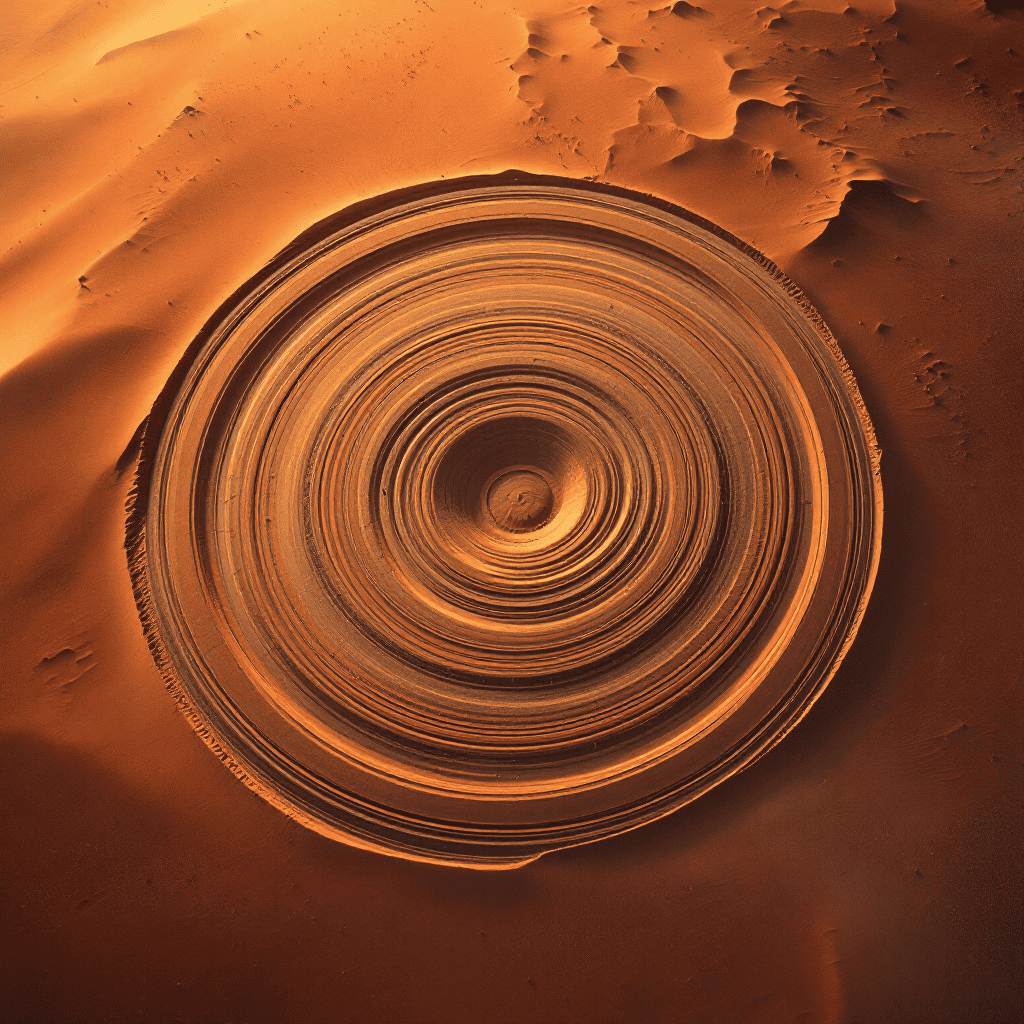
The city of Atlantis has haunted human imagination for over 2,000 years. Described by Plato as a powerful island civilization that vanished in a single day, this legendary capital has been searched for in every ocean on Earth. But what if we have been looking in the wrong place? What if the city of Atlantis was never lost beneath the waves, but buried beneath the sands of the Sahara Desert?
New evidence suggests that the legendary capital described in Plato’s dialogues may not be myth at all. The Richat Structure, a massive 30-mile-wide geological formation in Mauritania, matches Plato’s description with precision that defies coincidence. From orbit, it appears as a perfect bullseye carved into the Earth, a series of concentric rings that mirror exactly what the ancient philosopher said Atlantis looked like.
This isn’t speculation built on wishful thinking. The comparison between Plato’s text and the physical evidence at the Richat Structure reveals over 60 points of alignment. The match extends beyond simple geography into geology, climatology, archaeology, and the timing of the Younger Dryas catastrophe that reshaped our planet approximately 12,000 years ago.
What Plato Actually Said About the City of Atlantis
Plato wrote about Atlantis in two dialogues, Timaeus and Critias, composed around 360 BCE. He claimed the story came from Egyptian priests at Sais who told it to the Athenian lawgiver Solon. According to their account, Atlantis existed 9,000 years before Solon’s time, placing its destruction around 11,600 years ago.
The city of Atlantis, according to Plato, was arranged in concentric circles. Alternating rings of land and water surrounded a central island where the royal palace and main temple stood. The capital was connected by canals and bridges, with a sophisticated water management system that irrigated the surrounding plain. The entire city was planned with geometric precision, a hallmark of advanced engineering.
Plato described the location as beyond the Pillars of Hercules, the ancient name for the Strait of Gibraltar. Mountains rose to the north of the city. A vast rectangular plain stretched behind it. The civilization controlled territories across a region larger than Libya and Asia combined. When earthquakes and floods destroyed it in a single day and night, the land became impassable, choked with mud and debris.
Most scholars dismissed this as allegory or moral fiction. But Plato insisted repeatedly that the account was true. He even provided specific measurements, distances, and geographic details that read more like a survey report than a philosophical parable.
The Richat Structure: A Perfect Geometric Match
The Richat Structure sits in the Adrar Plateau of Mauritania at coordinates 21.1202° N, 11.4007° W. NASA astronauts use it as a landmark during orbital passes because its concentric ring pattern is so visually striking from space. For decades, geologists believed it was an impact crater. Then they realized the rock layers were sedimentary, not fractured by impact. The current explanation is that it formed through erosion of a geological dome, but that theory does not explain the precision of the rings or the surrounding evidence of catastrophic flooding.
What makes the Richat compelling as the true location of the city of Atlantis is not a single piece of evidence, but the accumulation of matches across every category Plato described. The structure measures approximately 23 kilometers in diameter. Plato’s measurements, when converted from the Egyptian stadion measurement system used by the priests who gave him the account, describe a capital of roughly 20 to 23 kilometers. The alignment is exact.
The concentric rings are visible. Mountains rise to the north, the Adrar Highlands. A vast plain stretches to the south and east. The southern edge of the structure shows a clear breach, consistent with Plato’s description of a southern opening to the sea. Satellite imagery reveals erosion scars radiating outward from the structure, the kind of scarring caused by massive water flow. Marine fossils, salt deposits, and sediment strata confirm that this region was once submerged or flooded.
Plato said the land became impassable, a shoal of mud. The Sahara itself became that shoal. After the Younger Dryas flood receded, the climate shifted. What had been a fertile region with rivers and lakes dried into desert. The city was not lost beneath ocean waves. It was buried beneath sand, exactly as the physical evidence shows.
The Younger Dryas and the Destruction Timeline
Plato dated the destruction of Atlantis to approximately 11,600 years before his time. The Younger Dryas catastrophe occurred approximately 11,600 years ago. The match is not approximate. It is exact.
The Younger Dryas was a sudden return to glacial conditions that lasted over 1,000 years. Temperatures dropped within years. Ice sheets expanded. Megafauna across North America went extinct. Early human cultures were nearly erased. The cause appears to have been a massive comet or asteroid impact that struck the North American or Greenland ice sheets, vaporizing billions of tons of water and destabilizing glaciers across the Northern Hemisphere.
The resulting meltwater surges sent floods radiating across continents. Sea levels rose over 120 meters as the ice melted. Coastlines were redrawn. Civilizations that had developed near water, the most fertile and strategic locations, were destroyed. This is the event recorded in flood myths across every inhabited continent. The Sumerian flood of Ziusudra. The Hebrew flood of Noah. The Hindu flood of Manu. The Greek flood of Deucalion.
If the city of Atlantis was destroyed in this event, it would explain why Plato’s Egyptian sources remembered it. Egypt was far enough from the impact zone to survive, but close enough to witness refugees fleeing west from a drowned land. Those survivors carried their knowledge into the Nile Valley, seeding the advanced astronomy, geometry, and architecture that appears in early Egyptian civilization without a visible developmental phase.
Why the Sahara Was Once Green
The objection most people raise is simple. How could a great civilization exist in the middle of a desert? The answer is that the Sahara was not always a desert. Between roughly 11,000 and 5,000 years ago, the region experienced what climate scientists call the African Humid Period, also known as the Green Sahara.
Monsoon patterns shifted. Rainfall increased dramatically. Lakes formed where sand dunes stand today. Rivers flowed across the plateau. Vegetation covered the land. Elephants, hippos, and giraffes roamed regions that are now barren rock and sand. This is not speculation. Fossil evidence, ancient lake beds, and rock art depicting lush environments confirm it.
The Richat Structure sits in a region that once held rivers and fertile plains. Plato described Atlantis as abundant with vegetation, crops, elephants, and timber. Fossil evidence and paleontological records confirm that all of these existed in Mauritania during the late Pleistocene and early Holocene. The environmental match is as precise as the geographic one.
When the climate shifted and the Sahara dried, the evidence of what had been there was buried. The ruins were covered. The memory survived only in the stories carried east by those who escaped.
The Eye of Horus and the Eye of Africa
The Richat Structure is often called the Eye of Africa. The resemblance to an eye is not subtle. And it raises a question that cuts deeper than geology. The Eye of Horus is one of the most sacred symbols in ancient Egypt, representing protection, divine sight, and inner awakening. It is always depicted as the left eye, the lunar eye, the feminine eye of hidden knowledge.
When viewed from orbit, the concentric rings of the Richat mirror the geometric structure at the center of the Eye of Horus. The similarity is striking enough to ask whether the symbol came from the place, not from imagination. If survivors of the city of Atlantis fled east into Egypt after the flood, they would have carried the memory of their homeland with them. They would have encoded that memory into the most enduring form they knew: sacred symbolism.
The myth of the Eye of Horus tells a story of destruction and restoration. Set destroys the Eye. Thoth gathers the shattered pieces and restores it. The restored Eye becomes a symbol of healing and protection. If that myth is not allegory but distorted history, it describes exactly what happened. A catastrophic flood destroyed the Eye of Africa. The survivors gathered what knowledge they could and carried it forward. The symbol became the vessel for that memory.
This is not proof. But it is pattern. And pattern, repeated across geography, mythology, and physical evidence, becomes structure. The deeper you look, the harder it becomes to dismiss the city of Atlantis as fiction.
Gold, Copper, and the Mineral Wealth Plato Described
Plato described Atlantis as rich in gold, silver, copper, and a mysterious metal called orichalcum, which he said was second in value only to gold. Mainstream scholars often point to orichalcum as evidence that the story is myth, claiming no such metal ever existed. But West Africa remains one of the largest gold-producing regions on Earth. Ancient copper mining is documented across Mauritania and the surrounding Sahel. The mineral wealth Plato described is geologically confirmed.
Orichalcum may not be mythical at all. The name likely refers to a copper alloy, possibly brass or a bronze variant that held cultural or technological significance. Ancient metallurgical traditions in the region support the existence of such alloys. The fact that Plato named a metal we cannot definitively identify does not discredit his account. It suggests we have lost knowledge that the ancients possessed.
The same pattern appears in other details. Plato described two harvest seasons per year, which sounds impossible in a desert but is entirely plausible in a monsoon climate with wet and dry growing periods. He described elephants and abundant timber, both confirmed by fossil evidence. He described a rectangular plain behind the city, which matches the geography of the Adrar Plateau. Every detail that can be checked aligns.
What Happened to the People Who Survived
If the city of Atlantis was destroyed in the Younger Dryas flood, its people did not vanish. Civilizations do not collapse without survivors. Knowledge does not disappear. It moves. The question is where it went and how it was preserved.
Egypt offers the clearest answer. Egyptian priests at Sais told Solon they possessed records stretching back thousands of years before Greece existed. They spoke of Zep Tepi, the First Time, a golden age when divine knowledge entered the world. The Edfu Building Texts, inscribed on temple walls, describe sacred knowledge brought to Egypt after a great flood by survivors of a destroyed homeland. This is not myth invented after Plato. It is Egyptian tradition that predates him.
The knowledge these survivors carried was not primitive. It included advanced astronomy, sacred geometry, and an understanding of the human body as a coded system. This knowledge entered the Egyptian priesthood and was later transmitted into the Greek mystery schools, Hermeticism, Gnosticism, and the esoteric traditions that carried it forward through the Knights Templar and into Freemasonry. The chain of custody is traceable. What we call the Western esoteric tradition may not be a series of inventions. It may be fragments of Atlantean knowledge preserved through initiation.
This is where the story stops being archaeology and becomes operational. The full framework detailed in Master Thyself traces how this knowledge was encoded into the human body itself, carried forward not in monuments or texts but in biological processes accessible to anyone willing to walk the path. The city of Atlantis may be buried, but the map it left behind is not.
Why Mainstream Archaeology Refuses to Excavate
Less than 10 percent of the Richat Structure has been formally studied. No major excavation has been conducted. The site remains largely ignored by mainstream archaeology despite the evidence that continues to accumulate. Why?
The practical reason is access. The western Sahel is one of the most dangerous regions on Earth. Active terror groups, political instability, and warlord factions make fieldwork nearly impossible. Major institutions will not fund excavations in conflict zones. Researchers cannot safely operate there. Every unexcavated item in the comparison between Plato’s account and the Richat exists for this reason, not because curiosity is lacking, but because the ground is inaccessible.
The institutional reason is deeper. If the Richat Structure is confirmed as the city of Atlantis, the implications are catastrophic for the approved historical timeline. A highly advanced civilization building monumental infrastructure over 12,000 years ago does not fit into the narrative taught in universities or seminaries. It forces a confrontation with the possibility that human history is far older, far more cyclical, and far less understood than we have been told.
Accepting that reality itself may operate in cycles, with civilizations rising and falling in patterns encoded into the structure of time, threatens not just archaeology but theology, cosmology, and the institutions built on controlling those narratives. The silence is not evidence of absence. It is evidence of resistance.
The Atlantis Myth Across Other Cultures
Plato’s account is the most detailed, but he was not the only ancient source to reference Atlantis or a similar lost civilization. Herodotus, writing in the 5th century BCE, described a people called the Atlantes living in the region of northwest Africa where the Richat sits. Pomponius Mela, a Roman geographer in the 1st century CE, labeled a region in the same area as Atlantia. These are not later embellishments. They are independent references that predate or parallel Plato.
Beyond the Mediterranean, flood myths describe the same event. The Hopi speak of a third world destroyed by water. The Aztecs remember the destruction of the Fourth Sun by flood. Hindu texts describe Manu surviving a deluge that erased civilization. These are not myths invented in isolation. They are memories of the same cataclysm, preserved in the languages and symbols of the cultures that survived it.
The Younger Dryas was global. The destruction was not limited to one city or one continent. But if one city represented the height of pre-flood civilization, its destruction would be remembered more vividly than others. The city of Atlantis may be the name we inherited for that center, the place where knowledge was most concentrated before the reset.
Declassified Surveys and Hidden Investigations
Declassified CIA documents from 1967 confirm that the U.S. Navy planned aerial surveys of several locations including the Richat Structure to investigate geomagnetic anomalies. The surveys were linked to Project Stargate and related intelligence programs. The stated intent was scientific. The findings remain redacted.
Ground-penetrating radar and infrared satellite analysis have revealed thermal anomalies and subsurface features beneath the Richat consistent with voids, chambers, or buried structures. Lidar imaging shows rectangular formations and geometric patterns that do not match natural erosion. These findings are not widely publicized, but they exist in the scientific literature for anyone willing to look.
Magnetic anomalies documented by geological surveys align with Plato’s description of a metal-rich environment. The evidence for subsurface features grows stronger with every new imaging technology applied to the site. The question is not whether something is there. The question is whether anyone with the resources to excavate will be allowed to do so.
The Deeper Implication: Civilization as a Cycle
If the city of Atlantis existed and was destroyed in the Younger Dryas, the implication extends far beyond one lost civilization. It suggests that human history is not a straight line from primitive to modern, but a cycle of rise, collapse, and rebirth. Knowledge does not accumulate indefinitely. It rises, fragments, is buried, and is rediscovered.
The same pattern appears across mythology, geology, and the archaeological record. Advanced knowledge appears suddenly in the record, already complete. The earliest Egyptian monuments show the highest precision. The oldest Sumerian texts reference older sources. Göbekli Tepe, over 12,000 years old, is more sophisticated than structures built thousands of years later. These are not anomalies. They are the signature of inheritance, not invention.
What we call the suppression of ancient knowledge is not simply censorship. It is the systematic burial of evidence that our timeline is wrong. The institutions that control education, archaeology, and religious doctrine have every reason to resist this conclusion. It destabilizes the foundation they stand on.
But the evidence does not care about institutional stability. The Richat Structure sits in the Sahara whether we excavate it or not. The flood myths remain in the record whether we take them seriously or not. The body carries the map whether we activate it or not. And the chain of knowledge preserved through the mystery schools, from Egypt through the biological mechanism encoded in sacred tradition, continues to transmit whether the institutions acknowledge it or not.
What the City of Atlantis Means for Us Now
The significance of Atlantis is not historical curiosity. It is recognition. If a civilization rose to great heights and was destroyed when it lost balance, the question is whether we are approaching the same threshold. The Hopi Prophecy Rock, explored elsewhere in this work, depicts two paths. One leads to destruction. The other leads to renewal. The choice is not distant. It is unfolding now.
The city of Atlantis, whether confirmed or not, functions as a mirror. It reflects the question every rising civilization must answer: will we remember what the ancients forgot, or will we repeat the cycle? Knowledge without discipline leads to imbalance. Power without wisdom leads to collapse. This is not mythology. It is pattern, repeated across every era and every culture that reached complexity and then fell.
The survivors of Atlantis did not simply rebuild. They encoded what mattered into systems that could survive the next reset. Sacred geometry. Astronomical alignments. Initiatory traditions. And most importantly, a map written into the human body itself, a biological blueprint for awakening that does not depend on monuments, texts, or institutions. REDACTED, READ CHAPTER 21. The process is detailed fully in Chapter 21 of Master Thyself.
That map is still intact. The biological architecture has not changed. The instructions are still encoded in the same places they were 12,000 years ago. What was lost was not the mechanism. It was the memory that the mechanism exists. And that memory is what this work restores.
The Richat Structure Awaits
The city of Atlantis is not a mystery that needs solving through excavation alone. The evidence is already sufficient to establish the case. The Richat Structure matches Plato’s description across over 60 distinct points of comparison. The timeline aligns with the Younger Dryas. The geology confirms catastrophic flooding. The climate record confirms a once-fertile region. The symbolism links the site to the Eye of Horus and the sacred traditions that carried Atlantean knowledge forward into Egypt.
What remains is recognition. Not belief, but willingness to examine the evidence without the filter of institutional approval. The body of proof does not require faith. It requires attention.
And if the city of Atlantis is confirmed, the implications extend far beyond rewriting history. They rewrite identity. We are not the first to reach this level of complexity. We are not the first to face the choice between wisdom and collapse. And we are not without guidance. The survivors left a map. The question is whether we are ready to read it.
The full chain of custody, from the destruction of the city of Atlantis through the Egyptian priesthoods, the Greek mystery schools, Hermeticism, the Knights Templar, and into the modern esoteric traditions, is traced in Chapter 12 of Master Thyself. The geographic evidence is clear. The symbolic transmission is documented. The biological process encoded in that transmission is still accessible. REDACTED, READ CHAPTER 12. What was buried in the Sahara was never truly lost. It was preserved in the one place guaranteed to survive every reset: the human body itself.