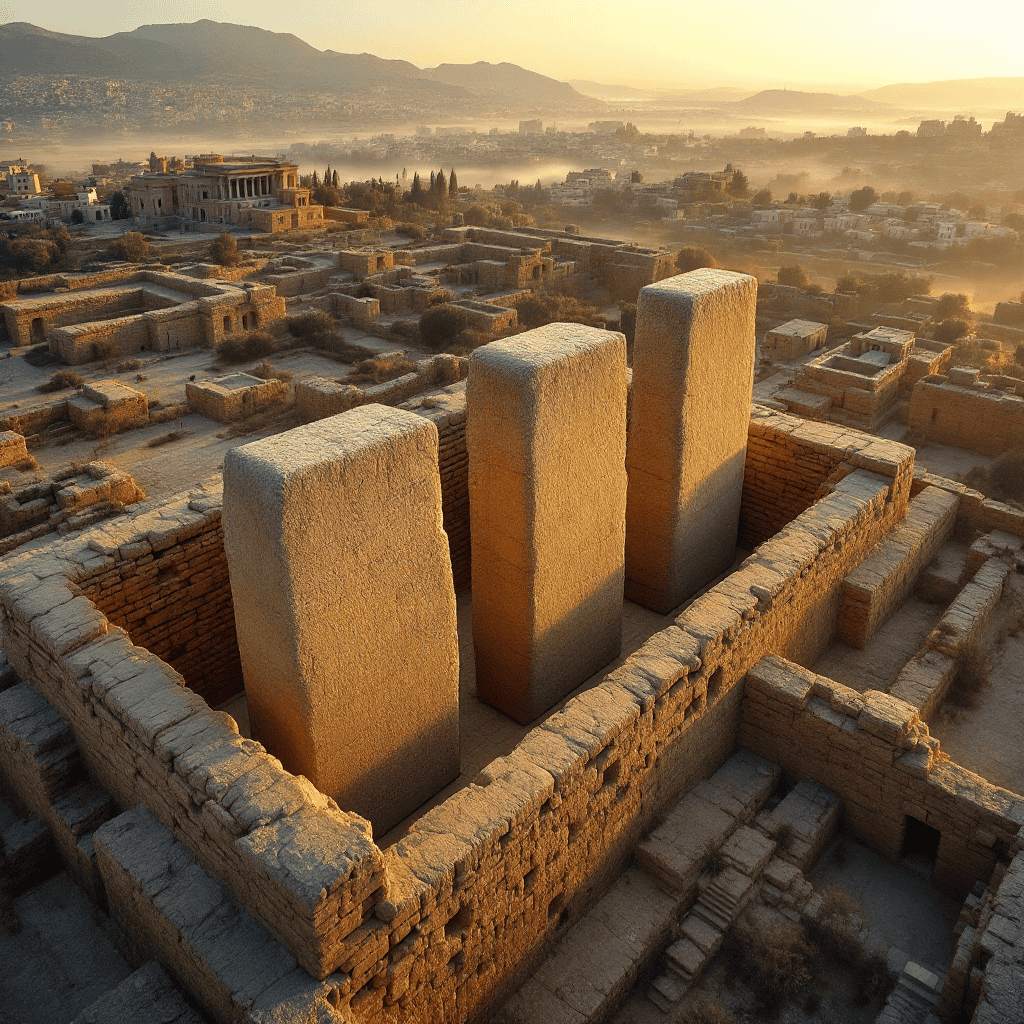
The Baalbek stones mystery begins with a simple question nobody can answer: how did ancient builders cut, transport, and position stones weighing up to 800 tons with nothing but Bronze Age tools? The massive blocks sit in the foundation of the Temple of Jupiter in Baalbek, Lebanon, defying every explanation mainstream archaeology offers. These aren’t decorative touches or symbolic monuments. They’re functional megaliths placed with surgical precision into a structure that would later become a Roman temple complex. But the Romans didn’t put them there. They couldn’t have. The technology required to move stones of this scale didn’t exist in their empire, and it barely exists today.
Three enormous stones form what’s called the Trilithon, each weighing between 750 and 800 tons. They rest on a foundation of smaller stones, themselves weighing 350 tons. The term “smaller” becomes absurd when you realize a modern mobile crane maxes out around 1,200 tons under ideal conditions, with engineered ground support, hydraulic stabilization, and computer-assisted balance. Ancient Baalbek had none of that. Yet the stones are there, fitted so tightly a sheet of paper won’t slide between them. No mortar. No gaps. Just stone on stone, locked in place for thousands of years.
The real shock sits a quarter mile away in the quarry: the Stone of the Pregnant Woman, a single block weighing an estimated 1,000 tons, cut and ready for transport but never moved. Beneath it lies an even larger stone, over 1,650 tons, still partially attached to the bedrock. Someone began cutting it. Someone had a plan to move it. Then the work stopped. What halts a project of that scale? Not a change in leadership or a budget cut. Something catastrophic. Something that erased the civilization capable of planning it.
The Roman Cover Story Doesn’t Hold
Mainstream archaeology attributes Baalbek to the Romans, who built the Temple of Jupiter on the site around 60 CE. The attribution makes sense for the upper sections: classic Roman columns, Corinthian capitals, and architectural elements consistent with first-century imperial construction. But the foundation tells a different story. Roman construction is well documented across three continents. We have written records, engineering manuals, and hundreds of standing structures. Nowhere in that record do the Romans move anything close to 800 tons. Their heaviest documented lifts, the Vatican obelisk and the Lateran obelisk, weighed around 350 tons and required massive custom-built ships, hundreds of workers, and years of planning. Those were prestige projects celebrated across the empire. If Rome had moved stones twice that weight, the feat would’ve been immortalized in stone, coin, and chronicle. It wasn’t. Because they didn’t.
The Trilithon blocks show a construction signature entirely different from Roman masonry. The cuts are cleaner. The tolerances tighter. The scale beyond anything Rome attempted. Roman builders stacked their temples on top of this platform because the platform was already there, ancient even in their time. They inherited a foundation they couldn’t replicate and built what they could on top of what they couldn’t. The archaeological evidence buried across the ancient world follows this same pattern: older layers show more advanced construction, not less. Baalbek is simply the most visible example.
Theories That Don’t Solve Anything
Standard explanations for the Baalbek stones mystery rely on manpower, ramps, levers, and rollers. The math doesn’t work. An 800-ton block requires approximately 40,000 workers pulling in perfect coordination, assuming Bronze Age rope that wouldn’t snap under distributed load. The quarry site and the temple platform don’t have space for that many people. The path between them crosses uneven terrain. One stumble, one broken rope, one shift in weight distribution, and the entire operation collapses. Literally. The stone would crack, the workers would scatter, and the project would end. Yet the stones arrived intact and were placed with precision that modern engineers struggle to match.
Lever and fulcrum systems theoretically could lift heavy objects, but they require stable ground and controlled incremental movement. The Baalbek blocks aren’t incrementally adjusted. They’re positioned as complete units. Roller theory assumes a flat, reinforced surface capable of bearing point-load stress without fracturing. No such surface existed. And even if it had, rolling doesn’t explain the vertical lift required to place the Trilithon into the wall. The stones aren’t resting on the ground. They’re elevated, locked into a multi-course structure, surrounded by smaller stones that would have been destroyed by any conventional rigging process.
Some researchers propose water-based flotation or ice-sledge transport. Lebanon’s climate 4,000 years ago was similar to today: hot, dry, and not conducive to maintaining frozen surfaces or constructing water channels capable of floating 800-ton loads. These aren’t solutions. They’re guesses shaped by the assumption that primitive tools must explain primitive people. But the people who built Baalbek weren’t primitive. They knew something we’ve forgotten.
What the Stones Actually Tell Us
The Baalbek stones mystery isn’t just about weight. It’s about knowledge. Whoever quarried these blocks understood material science, geology, and force distribution at a level we’re only beginning to recover. The cuts are straight, smooth, and executed with control. Bronze chisels dent limestone. They don’t slice it. The precision cutting at Baalbek, Pumapunku, and Sacsayhuamán suggests a different method entirely, one that either softened stone or used a cutting technology we haven’t identified. Some researchers have proposed acoustic resonance or chemical treatment. The evidence remains circumstantial, but the question stands: what makes stone easier to shape?
Transport likely involved a principle we no longer associate with construction: vibration. Ancient texts from Egypt, India, and Tibet reference sound used to move stone. Tibetan monks reportedly described stones “flying” when specific drum patterns and horn frequencies were played. Western engineers dismissed this as folklore until modern acoustic levitation demonstrated that sound waves can suspend and move objects in controlled environments. The scales don’t match yet. We can levitate small particles, not multi-ton blocks. But the principle is real. If frequency can counteract gravity at the molecular level, scaling the effect becomes an engineering problem, not a physics impossibility.
The layout of Baalbek itself hints at something deeper. The platform aligns with celestial markers and sits on a geomagnetic anomaly, a point where Earth’s magnetic field shows measurable variation. Across the ancient world, megalithic sites cluster on similar anomalies: Giza, Stonehenge, Teotihuacan, and dozens of others. Coincidence is possible for one or two sites. For dozens, it’s a pattern. These locations may have been selected not for symbolic reasons but for functional ones. If the builders understood energy fields, magnetic resonance, or principles we classify as fringe science today, the site selection makes sense. They weren’t worshiping the land. They were using it.
The Catastrophe That Ended the Project
The unfinished stones in the Baalbek quarry are the most important part of the mystery. Work didn’t slow down. It stopped. The largest block remains partially cut, tools presumably abandoned mid-task. If this were a political collapse, economic failure, or conquest, the site would show signs of looting, destruction, or repurposing. It doesn’t. It shows abandonment. Immediate, total, and permanent. The kind of abandonment that happens when the people capable of the work no longer exist.
Approximately 12,800 years ago, Earth experienced the Younger Dryas impact event, a cosmic collision that triggered global climate catastrophe, mass extinction, and the destruction of emerging civilizations worldwide. Sea levels rose over 400 feet as ice sheets melted. Coastlines where humanity had clustered vanished beneath the ocean. The fossil record shows a hard line: before the event, megafauna and advanced human cultures; after the event, survival populations and cultural reset. Baalbek’s construction timeline remains debated, but if it predates the Younger Dryas or was built immediately after by survivors carrying forward older knowledge, the unfinished stones make perfect sense. The builders didn’t stop working. They stopped existing.
Other megalithic sites show the same signature: Göbekli Tepe, buried deliberately after construction; Pumapunku, scattered as though struck by a shockwave; submerged structures off the coasts of India, Japan, and the Mediterranean. These aren’t independent mysteries. They’re fragments of the same event, a reset so complete that the civilizations it erased became myths. Atlantis, Lemuria, Mu, the antediluvian world referenced in nearly every ancient tradition. The names differ. The story doesn’t. Advanced knowledge, cataclysmic destruction, and a handful of survivors who carried forward what they could.
Encoded Knowledge and the Inner Path
If Baalbek was built by a pre-catastrophe civilization, the techniques they used didn’t rely solely on external machinery. The mystery schools of Egypt, Greece, and the East preserved teachings about sound, frequency, resonance, and the manipulation of matter through consciousness. Not magic. Applied science operating on principles modern physics is only beginning to formalize. The relationship between observer and observed, intention and outcome, frequency and form. Quantum mechanics demonstrates that observation alters outcome at the particle level. Extrapolating that principle to macro-scale construction isn’t mysticism. It’s engineering we haven’t classified yet.
The human body itself may be the missing tool. Temples weren’t just buildings. They were instruments designed to amplify specific states of consciousness. The pineal gland, when activated through precise timing and internal preparation, produces a biochemical cascade that alters perception, cognition, and possibly the body’s interaction with electromagnetic fields. Ancient builders who understood this process could have used it not for spiritual experience alone but for practical construction. The geometry of the stones, the alignments, the acoustics of the temple spaces all point toward a system where biology, physics, and consciousness operated as a unified technology.
The Baalbek stones mystery intersects directly with the esoteric traditions that survived the cataclysm. Knowledge of sacred geometry, harmonic resonance, and the body’s energetic architecture didn’t emerge randomly in Egypt and Sumer. It was inherited, passed down from those who built the megaliths and encoded their methods into symbol, ritual, and initiation. What looks like religion from the outside was often science from the inside, a framework for preserving techniques that couldn’t survive in written form because the language to describe them hadn’t been developed yet. Or had been lost.
The mechanism behind these practices, the specific protocols used to activate the biological architecture and align it with external construction, remained closely guarded. Not from cruelty but from necessity. Techniques capable of moving 800-ton stones could also be weaponized, misused, or deployed by those unready to wield them responsibly. The initiatory model existed to ensure readiness. The encoded transmission existed to ensure survival. The Baalbek platform stands as proof that the knowledge was real. The unfinished stones stand as proof that it was lost.
Modern Attempts and Failures
Engineers today can barely replicate what Baalbek’s builders accomplished. In 1997, a team attempted to move a 200-ton block using modern equipment and historical techniques. The project required custom hydraulic jacks, reinforced transport frames, and months of planning. The stone moved approximately 50 feet before the operation was called off due to risk and cost. That’s 200 tons with modern tools. The Trilithon blocks weigh four times that. The Stone of the Pregnant Woman weighs five times that. The largest stone in the quarry weighs over eight times that.
We can’t do it. Not efficiently. Not safely. Not at scale. The assumption that ancient people with less technology accomplished more through sheer determination and manual labor collapses under basic physics. Determination doesn’t increase tensile strength. Willpower doesn’t reinforce Bronze Age rope. If we can’t move the stones today with cranes, computers, and metallurgy, the ancients didn’t move them with muscle and wooden rollers. They used a different method. One we’ve categorized as impossible because we haven’t reproduced it yet.
The alternative is equally uncomfortable: maybe they didn’t move them at all. Some theories propose that the stones were cast in place using a form of ancient geopolymer concrete, limestone aggregate chemically bonded to mimic natural stone. Analysis of samples from Egyptian and South American megaliths has identified trace elements consistent with chemical binding agents. If Baalbek’s blocks were poured rather than quarried, the weight problem disappears. The precision problem remains, but it shifts from transport to formwork and chemistry. This theory remains contested, but it’s testable. Petrographic analysis can distinguish natural stone from reconstituted material. The fact that such analysis hasn’t been conducted at Baalbek or remains unpublished is itself worth noting.
What We’re Not Being Told
Baalbek has been studied, surveyed, and photographed for over a century. Yet significant questions remain unanswered. No comprehensive excavation of the platform’s foundation has been published. No deep-core analysis of the Trilithon stones exists in accessible scientific literature. No ground-penetrating radar survey of the quarry has been released. The site is documented enough to be famous but not enough to be understood. That gap is suspicious. Either the research hasn’t been done, which suggests institutional disinterest in answers that contradict accepted history, or the research has been done and the findings haven’t been released, which suggests the answers are inconvenient.
Declassified documents confirm that military and intelligence agencies conducted surveys of megalithic sites during the Cold War, ostensibly for geomagnetic research. Baalbek was on the list. The results remain classified or redacted. If the stones were just Roman construction, there’d be nothing to classify. The secrecy implies the site holds information someone decided the public doesn’t need. Whether that’s advanced construction techniques, evidence of pre-Roman civilization, or something else entirely, the withholding of data is itself data. It tells you the official story isn’t complete.
Local Lebanese traditions, ignored by most academic sources, describe Baalbek as the landing place of gods, built by giants before the flood, a city older than memory. These aren’t charming folklore. They’re oral history preserved across millennia. When every culture surrounding the Mediterranean tells the same story of advanced beings, cataclysmic floods, and lost civilizations, dismissing it as coincidence requires more faith than accepting it as evidence. The stones themselves are evidence. They sit in the wall, 800 tons each, placed by someone. The question isn’t whether it’s possible. The stones prove it’s possible. The question is who knew how.
The Pattern Across Continents
Baalbek isn’t isolated. The same construction signatures appear worldwide. In Peru, the fortress of Sacsayhuamán features polygonal masonry with blocks exceeding 200 tons, fitted with joints so precise they’ve survived centuries of seismic activity without mortar. At Pumapunku in Bolivia, andesite blocks show machine-like precision cuts and right-angle drilling that shouldn’t exist in pre-Columbian South America. On Easter Island, the moai statues weigh up to 80 tons and were somehow transported miles across rough terrain. In Egypt, the granite boxes in the Serapeum of Saqqara are cut from single pieces of stone weighing up to 100 tons, hollowed with tolerances measured in thousandths of an inch.
Every site poses the same question the Baalbek stones mystery poses: how? And every answer academia provides collapses under scrutiny. The pattern suggests a shared technological base, a common origin point for knowledge that spread globally before recorded history. Whether that knowledge originated from a single advanced civilization like Atlantis, from contact with non-human intelligence, or from a stage of human development we’ve erased from the timeline, the evidence points toward something far older and far more sophisticated than the Bronze Age cultures we credit with these achievements.
The alignments support this. Baalbek, Giza, Angkor Wat, and Teotihuacan all sit on a great circle route around the planet, positioned with relationships to celestial markers and mathematical constants like phi and pi. Isolated cultures don’t independently encode the same geodetic relationships into their sacred architecture by accident. Either the knowledge was transmitted, or the sites were planned as part of a unified system. Both possibilities rewrite history. Both possibilities explain why institutions resist investigating too deeply. Answers that disrupt foundational narratives are dangerous to the structures built on those narratives.
The Invitation Forward
The Baalbek stones mystery will not be solved by waiting for academia to release findings or for governments to declassify surveys. The answers, if they exist in recoverable form, are encoded in the same systems that built the stones: the synthesis of opposites, the union of matter and consciousness, the understanding that reality responds to coherence. This isn’t abstract philosophy. It’s operational theory supported by megalithic construction we can visit, touch, and measure. The stones are proof of concept. The unfinished blocks are proof of interruption. What remains is reconstruction, not of the stones but of the knowledge that moved them.
That reconstruction doesn’t begin in Lebanon. It begins in the body. The same principles encoded into Baalbek’s platform, harmonic resonance, geometric alignment, electromagnetic coherence, are encoded into human biology. The temple isn’t only external. It’s internal. The pineal gland sits at the geometric center of the brain. The heart generates an electromagnetic field detectable several feet from the body. The spine contains 33 vertebrae, the same number repeated in Masonic degree structure, Kabbalistic pathways, and the age of Christ at resurrection. These aren’t coincidences. They’re design specs. And the practices that activate them, the ones preserved through millennia of suppression and fragmentation, are the same practices the builders of Baalbek would have known.
The path forward isn’t through external discovery but through internal activation. The biological mechanism that bridges consciousness and matter remains intact, dormant in most, accessible to those who know where to look. The megaliths stand as reminders that humanity once operated at a level we’ve forgotten. The mystery schools preserved fragments of that operation. The suppression documented across history targeted those fragments because they threatened centralized control. Knowledge that empowers the individual destabilizes the hierarchy. Stones that move without cranes don’t require kings.
Baalbek’s stones aren’t waiting for explanation. They’re waiting for recognition. Not as artifacts of a lost civilization but as proof that the loss was temporary. What was built once can be understood again. Not through belief, but through practice. Not through speculation, but through activation. The temple stands. The knowledge survived. The question is whether you’re ready to remember what your ancestors knew.