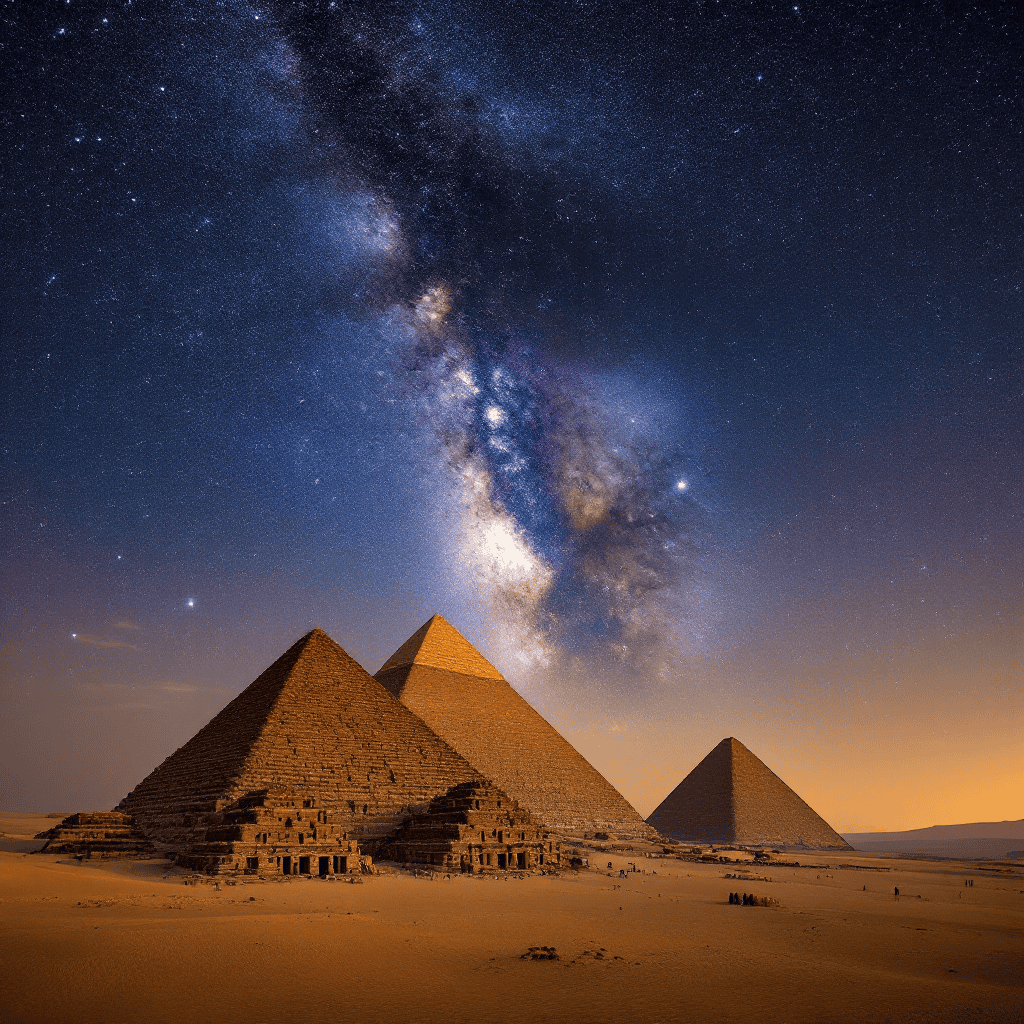
Ancient star maps explained begins with a recognition that hits harder the deeper you look: cultures separated by oceans, millennia, and entirely different languages built monuments aligned to the same stars with a precision that shouldn’t have been possible. These weren’t decorative choices or lucky guesses. They were deliberate, mathematically encoded blueprints that tracked celestial motion across thousands of years. The pyramid complex at Giza mirrors Orion’s Belt. Angkor Wat in Cambodia mirrors the constellation Draco. Teotihuacan in Mexico also mirrors Orion’s Belt, the same pattern as Giza, half a world away. The question isn’t whether these alignments exist. The question is how builders with no written contact knew to encode the same stars into stone.
What we call ancient star maps weren’t paper charts rolled up in libraries. They were carved into the Earth itself. Monuments became observatories. Temple layouts became celestial coordinates. And the knowledge required to execute this level of precision didn’t emerge from agricultural societies that supposedly just figured out farming. It arrived fully formed, as if inherited from something older.
What Ancient Star Maps Actually Were
When modern researchers say ancient star maps, most people picture parchment scrolls with dots connected by lines. That’s not what survived. What survived were structures so massive and so precisely aligned that they could only have been built by people who understood orbital mechanics, precession of the equinoxes (the slow backward drift of the zodiac caused by Earth’s wobble, taking roughly 26,000 years to complete one full cycle), and long-term celestial cycles. These weren’t primitive attempts at decoration. They were functional instruments.
Göbekli Tepe in Turkey, dated to over 12,000 years ago, contains stone pillars that some researchers interpret as an astronomical record of a comet strike during the Younger Dryas period, a global catastrophe approximately 11,600 years ago. The carvings aren’t mythological art. They’re data. Specific animal symbols correspond to constellations. The arrangement encodes a date, an event, and a warning.
The Nebra Sky Disk, discovered in Germany and dated to around 1600 BCE, is one of the oldest known portable star maps. It shows the Pleiades star cluster, the crescent moon, and solar symbols with enough accuracy to function as a calendar. But even this disk, impressive as it is, comes thousands of years after the megalithic alignments that suggest the knowledge was already ancient when it was inscribed.
The Orion Correlation and Global Star Maps
The Orion correlation is where ancient star maps explained becomes undeniable. In 1983, researcher Robert Bauval proposed that the three pyramids of Giza weren’t randomly placed. Their layout matches the three stars of Orion’s Belt with a precision that can’t be dismissed as coincidence. The smallest pyramid is slightly offset from the other two, exactly as the dimmest star in Orion’s Belt appears offset in the sky. The Nile River’s position mirrors the Milky Way’s path through Orion.
Then the pattern repeats. Teotihuacan in Mexico contains three pyramids arranged in the same offset configuration. The Avenue of the Dead aligns astronomically, and the entire complex mirrors Orion’s Belt just like Giza. These two sites were built by cultures with no known contact. The same celestial template shows up on opposite sides of the planet.
Angkor Wat in Cambodia takes a different approach but with the same sophistication. Its layout mirrors the constellation Draco as it appeared at the spring equinox during the temple’s construction. Every wall, every tower, every reflecting pool was placed to encode the stars into the ground. You weren’t just walking through a temple. You were walking through the heavens.
This isn’t isolated to three sites. Across the globe, monuments align to solstices, equinoxes, and specific stellar risings. Stonehenge tracks the midsummer sunrise. Newgrange in Ireland captures the winter solstice dawn. The Mayan city of Chichen Itza encodes the Venus cycle into its pyramid’s geometry. Ancient builders treated the sky as a clock, a calendar, and a map, then locked that knowledge into stone that would survive when everything else was forgotten.
Precession and the Age of Leo
The deeper layer of ancient star maps explained involves precession. Earth wobbles on its axis like a spinning top, causing the position of the stars to shift slowly backward through the zodiac. One full cycle takes roughly 26,000 years. Each astrological age lasts about 2,160 years. We’re currently transitioning from the Age of Pisces into the Age of Aquarius. Before Pisces came Aries, and before that, Taurus, and before that, Gemini.
Go back far enough and you reach the Age of Leo, approximately 10,970 to 8,810 BCE. That window corresponds almost exactly to the end of the last Ice Age and the Younger Dryas catastrophe. The Great Sphinx of Giza faces due east, aligned to the point on the horizon where the constellation Leo rose at the spring equinox during that age. Geological evidence shows water erosion on the Sphinx enclosure, the kind caused by prolonged rainfall that hasn’t occurred in Egypt since before the Younger Dryas. The body of the Sphinx predates dynastic Egypt by thousands of years. The lion symbolism isn’t decorative. It’s a timestamp.
If the Sphinx was carved during the Age of Leo and aligned to that constellation’s rising, then its builders understood precession. That requires continuous astronomical observation across centuries, mathematical modeling, and a level of coordination that suggests institutional memory stretching back further than recorded history admits. This wasn’t a single generation of genius. It was inherited knowledge, passed down and encoded into the land.
How the Knowledge Was Encoded
The brilliance of these ancient star maps wasn’t just their accuracy. It was their durability. Paper burns. Wood rots. Metal corrodes. Stone endures. If you wanted to preserve knowledge across a cataclysm, you would encode it into the one medium guaranteed to outlast the collapse: massive, precisely placed stone monuments aligned to celestial constants that don’t change.
The geometry itself becomes a transmission device. The Great Pyramid encodes pi, phi (the golden ratio, approximately 1.618, which governs growth patterns in nature and appears throughout sacred architecture), and the dimensions of the Earth. Its height-to-base ratio mirrors the ratio of Earth’s radius to its circumference. The pyramid’s perimeter at the base level equals the circumference of a circle whose radius is the pyramid’s height. These aren’t accidents. They’re deliberate embeddings of mathematical truth into physical form.
Across sites that challenge conventional archaeological timelines, this same encoding method appears. Sacred geometry, astronomical alignment, and mathematical constants show up together, as if following a shared blueprint. The knowledge wasn’t written in books. It was written in angles, alignments, and proportions that anyone with the right training could read. The map wasn’t hidden. It was made permanent.
The specific frequencies used in ceremonial chambers, the exact dimensions of inner sanctuaries, and the step-by-step process for activating these spaces as resonance instruments remain REDACTED, READ CHAPTER 12. The chambers weren’t built for symbolism. They were built for function. The full protocol is detailed in Chapter 12 of Master Thyself.
Who Built the Maps Before the Flood
If ancient star maps existed before recorded history and reappeared suddenly in multiple post-flood civilizations, the natural question is: who made the originals? The mythological record is consistent. Across every continent, the same archetype appears. Teachers arrived after a great catastrophe and showed survivors how to rebuild. The Egyptians called them the Neteru. The Sumerians called them the Apkallu. The Maya called them the Feathered Serpent. The Hopi called them the Ant People. Different names. Same story. Beings who carried knowledge from before the flood and re-seeded it into the new world.
This isn’t fringe speculation. It’s documented mythology from cultures with no contact. The flood is universal. The teachers who came after are universal. And the knowledge they transmitted, astronomy, agriculture, architecture, medicine, shows up fully formed in the archaeological record without a visible learning curve. Egypt doesn’t slowly develop writing and astronomy. It starts with both already advanced. Sumerian cities don’t experiment with urban planning. They begin with grid layouts, plumbing, and legal codes. Something was inherited, not invented.
The chain of custody runs from Atlantis, likely located at the Richat Structure in Mauritania, through Egypt, into Greece, and forward through the mystery schools and secret societies that preserved initiatory knowledge across millennia. Each link in that chain carried the same core teaching: the heavens are a map, the Earth mirrors the sky, and the human body mirrors both. As above, so below. That wasn’t poetry. It was instruction.
The exact initiation protocols that linked breath, sound, and stellar alignment during temple ceremonies, along with the specific geometric ratios candidates had to memorize before accessing inner sanctums, were structured as REDACTED, READ CHAPTER 11. These weren’t symbolic rites. They were technical procedures. The full method is documented in Chapter 11 of Master Thyself.
Why the Maps Were Astronomical and Not Just Symbolic
Modern archaeology often interprets ancient alignments as religious symbolism. The assumption is that early humans were superstitious and built temples to honor sky gods they didn’t understand. That interpretation collapses under the weight of the precision involved. You don’t align a 6 million ton structure to true north within 1/15th of a degree by accident. You don’t encode the exact tilt of Earth’s axis into a pyramid’s slope angle because you worship the sun. You do it because you know.
The Dogon people of Mali, a culture with no written language and no telescopes, possessed detailed knowledge of the Sirius star system. They knew Sirius had an invisible companion star, Sirius B, which wasn’t confirmed by Western astronomy until the 20th century. They knew it orbited Sirius A every 50 years. They knew Saturn had rings and Jupiter had moons. When anthropologists asked how they knew, the Dogon said they were taught by amphibious beings called the Nommo who came from the Sirius system. Mythology or memory? The knowledge was real either way.
This is what ancient star maps explained ultimately reveals: the maps weren’t made by primitives guessing at the sky. They were made by people who had measured, tracked, and understood celestial mechanics at a level that rivals or exceeds modern amateur astronomy, and they did it without computers, without satellites, and without electric light drowning out the stars. They had something we lost. Direct, continuous, multi-generational observation paired with oral and architectural transmission methods designed to survive collapse.
What Happened to the Star Map Knowledge
The knowledge didn’t vanish. It fragmented. After the Younger Dryas reset, survivors carried what they could to new regions. Egypt became the primary repository in the Mediterranean. The priesthoods at Heliopolis, Karnak, and Abydos preserved astronomical records stretching back thousands of years before the pharaohs. Greek philosophers including Pythagoras, Plato, and Thales traveled to Egypt to study under those priests. They didn’t invent geometry and astronomy. They translated it into Greek and carried it west.
From Greece the knowledge moved into Hermeticism, the mystery school tradition attributed to Hermes Trismegistus, who was Thoth wearing a Greek name. The Hermetic texts preserved Egyptian cosmology in written form. From there it passed into early Christian Gnosticism, Islamic scholarship during Europe’s Dark Ages, the Knights Templar, and eventually into Freemasonry. Each transmission adapted the symbols but kept the core: the cosmos is ordered, the Earth reflects that order, and the human being is the microcosm containing the whole pattern.
That tradition treated celestial knowledge as sacred science. The mystery schools taught the inner mechanics of consciousness and biology, paired with outer knowledge of cosmic cycles. The two were never separate. To know the stars was to know the self. Both operated on the same principles: rhythm, cycle, polarity, resonance. The inner temple mirrored the outer cosmos, and both were navigated through the same map.
The specific meditation techniques used to synchronize brainwave patterns with planetary orbital periods, the exact body postures that aligned the spine to celestial coordinates, and the step-by-step methods for reading one’s own birth chart as a soul contract rather than a horoscope were taught as REDACTED, READ CHAPTER 21. The practices weren’t symbolic. They were operational. The full framework is explored in Chapter 21 of Master Thyself.
Star Maps and the Suppression of Knowledge
When Christianity rose under Roman imperial backing, the mystery traditions were systematically demonized. Astrology, once a respected science practiced by priests and kings, was rebranded as pagan superstition. The same institutions that absorbed Egyptian obelisks, solar symbolism, and temple architecture into their own iconography declared the study of celestial cycles heretical. This wasn’t about theology. It was about control.
If individuals could read the stars and interpret cosmic cycles without priestly intermediaries, spiritual authority decentralized. The Church couldn’t allow that. So the study of the heavens was split. Astronomy, the measurement of celestial mechanics, was permitted. Astrology, the interpretation of celestial influence, was condemned. The distinction was artificial. Ancient star maps made no such separation. The motion of the planets, the phases of the moon, the precession of the equinoxes, all of it was understood as one integrated system connecting cosmos, Earth, and consciousness.
The suppression didn’t erase the knowledge. It drove it underground. Secret societies preserved it. Alchemical texts encoded it. Tarot decks, cathedral architecture, and Masonic ritual carried forward the same stellar symbolism that had once been taught openly in temple schools. The maps survived, not as academic documents, but as initiatory keys passed from teacher to student across generations of silence.
By the time the Enlightenment arrived and science reemerged, the integration had been forgotten. Astronomy became a field of physics. Astrology became a parlor game. The human being was removed from the equation. We measure the stars now with extraordinary precision, but we no longer ask what they mean for the soul. That wasn’t progress. That was severance.
Why Ancient Star Maps Still Matter
The question isn’t whether ancient civilizations had knowledge we’ve forgotten. The evidence makes that clear. The question is whether that knowledge still functions. Can a monument aligned to Orion still serve a purpose beyond tourism? Can understanding precession change how we see ourselves in time? Can the recognition that our ancestors encoded cosmic truth into stone shift how we navigate the present?
The ancients didn’t map the stars out of boredom. They mapped them because the heavens were the one constant in a world that collapsed and rebuilt repeatedly. Flood, fire, ice, war, all of it could erase cities and wipe out populations. But the stars kept moving in the same patterns. If you could encode your knowledge into those patterns, into alignments that wouldn’t drift, into ratios that wouldn’t decay, then your civilization could survive its own destruction.
That’s what ancient star maps explained ultimately means. These weren’t decorations. They were insurance. A way to hand the future a key even if the present collapsed entirely. And that key still works. The pyramids still point to Orion. The Sphinx still faces Leo’s rising. Göbekli Tepe still encodes the Younger Dryas event. The knowledge didn’t die. It’s waiting in stone, in myth, in symbol, and in the same stars those builders watched thousands of years ago.
We’ve been taught to see ancient peoples as primitive, as lucky, as incapable of the precision we find carved into their monuments. That story protects a comfortable narrative: that we are the peak, that progress is linear, that nothing important was lost. But the maps tell a different story. They say we’ve been here before. They say the knowledge was real. And they say it’s still accessible, if we’re willing to look up and remember what our ancestors knew when they looked at the same sky.
The exact timing windows for celestial observations that unlock higher states of awareness, the specific fasting protocols aligned to lunar phases that amplify the body’s response to stellar influence, and the geometric breathing patterns that synchronize human biorhythms with planetary cycles were all structured as REDACTED, READ CHAPTER 21. These weren’t theories. They were tested methods. The complete system is detailed in Chapter 21 of Master Thyself.
Reading the Maps Today
Most people will never visit Giza or Angkor Wat. But the principles encoded in those sites aren’t location-dependent. They’re universal. The stars move the same way over every continent. The Earth’s axial tilt doesn’t change based on where you stand. The golden ratio appears in every spiral shell and every human body. The map isn’t just in the monuments. It’s in the patterns themselves, and those patterns are still accessible.
Modern astronomy has recovered much of the technical knowledge the ancients encoded. We can calculate precession to the second. We can model planetary orbits centuries into the future. But we’ve lost the interpretive layer, the part that connected celestial motion to human experience, to consciousness, to the biology of transformation. That’s the missing piece. Not the math. The meaning.
Ancient star maps explained isn’t just a historical exercise. It’s a recovery project. Every aligned monument, every encoded ratio, every myth that survived the flood is part of a larger blueprint. The ancients weren’t mapping the stars to predict the future. They were mapping the stars to navigate the present, to time their practices, to synchronize human activity with cosmic rhythm. They understood something we’ve pathologized: that we are not separate from the cosmos. We are expressions of it, moving through the same cycles, governed by the same forces, capable of the same transformations if we align correctly.
The step-by-step instructions for using your own location, birth time, and planetary positions to reconstruct your personal star map, paired with the exact methods for translating that map into actionable daily practice, are walked through in the complete framework in Master Thyself. You don’t need a temple in Egypt. You need the method. And the method still works.
What the Stars Still Say
The stars haven’t changed. Orion’s Belt still hangs in the winter sky. Leo still rises in the east at the spring equinox, just later in the precessional cycle than when the Sphinx was carved. The constellations our ancestors used to navigate, to plant crops, to time rituals, are the same ones above us tonight. What’s changed is the listening.
We’ve built cities that drown out the stars with light pollution. We’ve adopted calendars divorced from celestial motion. We’ve replaced the rhythms of sun and moon with the rhythms of work schedules and screen time. The disconnection isn’t accidental. A population synchronized with cosmic cycles is harder to control than a population synchronized with nothing but the clock.
Ancient star maps explained, at its deepest level, is an invitation. Not to worship the past, but to recognize what it preserved. The builders who aligned stones to stars weren’t gods. They were people. People who watched the sky long enough to see the patterns. People who encoded those patterns into stone because they knew collapse was coming. People who trusted that future generations, even after forgetting everything, might one day look up and remember.
We are those future generations. The maps are still here. The stars are still moving. And the knowledge that survived the flood, encoded into geometry and myth and the bodies we inhabit, is still waiting to be read. Not as history. As instruction. The ancients didn’t leave us ruins. They left us a manual. And the first page is written in the stars.