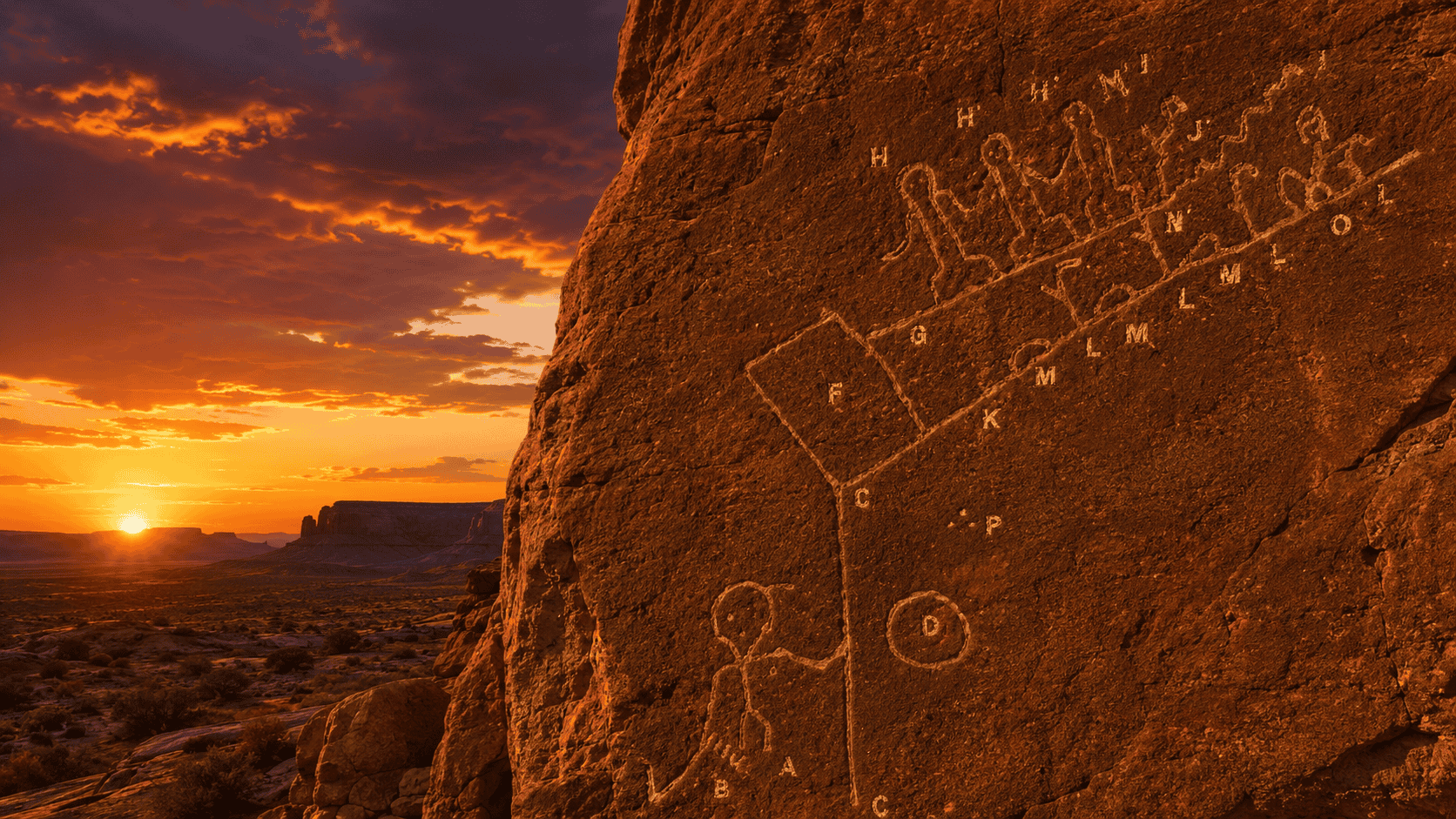
The Hopi Prophecy Rock shows the same teachers different name.
Hopi Anu Naki. Sumerian Anunnaki. Same beings, recorded by cultures separated by half the planet.
Two paths carved into Arizona sandstone. A teacher at the crossroads. Ant People who came from below. A warning about the technological path that ends. The Hopi preserved a parallel branch of the same chain of custody the textbooks have no framework for.
The Hopi Prophecy Rock sits on a protected mesa in northern Arizona. The petroglyph carved into its surface shows two diverging paths of human destiny, a teacher figure at the crossroads, and a record of beings the Hopi call the Ant People who came from the heavens to guide survivors after a cataclysm. The Sumerians, on the other side of the world, recorded the same beings under nearly the same name 6,000 years ago. The phonetic match is too close to be coincidence. The Hopi are not a curiosity. They are confirmation that the chain of custody ran along multiple geographic paths after the flood.
The Hopi Prophecy Rock is the same story carved into stone in Arizona that the Sumerians wrote on clay tablets in Iraq. Same teachers. Same warning. Different continent.
The Hopi Prophecy Rock sits on the mesas of northern Arizona, its exact location protected by Hopi elders. The petroglyph carved into its surface shows a story that should not exist where it exists. It shows two diverging paths of human destiny, a teacher figure standing at the crossroads, and a record of beings the Hopi call the Ant People who came from the heavens to guide survivors after a cataclysm. The Sumerians, on the other side of the world, recorded the same beings under a different name 6,000 years ago. The names are too close to be coincidence.
Hopi: Anu Naki, or Anu Sinom, meaning "Ant People" or "those who dwell below."
Sumerian: Redacted, read Chapter 12, meaning "those who came from the heavens to Earth."
Mainstream linguists cannot connect the two words because conventional linguistics can only reconstruct shared roots back about 6,000 to 8,000 years. If these names share a common ancestor from before the last cataclysm, the standard tools do not reach that far. The phonetic echo is all that survives. The phonetic echo is also one of the cleanest pieces of evidence that the Atlantis-to-Egypt chain of custody was not the only chain. Knowledge moved in multiple directions after the flood. The Hopi preserved a parallel branch that the textbooks have no framework for.
This page documents what the Prophecy Rock actually shows, what the parallel traditions say across continents, and what the rock has been warning about for the entire time the modern world has been calling it superstition.
What the rock actually shows.
The petroglyph is not abstract. It is a specific composition with documented elements, each one carrying a specific meaning in Hopi oral tradition. Two horizontal paths extending to the right from a central figure. Stick figures walking each path. A corn stalk. Connecting vertical lines. Circles between the paths. An elder figure at the end of the lower path. The composition is a map of human destiny, and the destiny it describes is not optional.
The teacher at the crossroads
The figure on the left side of the rock is identified in Hopi tradition as the Great Spirit or Redacted, read Chapter 12, the creator who gave humanity the choice between two paths. The figure holds a curved bow in the left hand and extends a horizontal line to the right. The line splits. Two paths begin. The teacher does not walk either path. The teacher offers the choice and steps back.
The upper path
The upper path is the path of technological growth disconnected from spiritual development. The figures on this path are often interpreted as headless, meaning spiritually disconnected from their bodies, no longer guided by inner wisdom. The path appears to ascend. It represents what mainstream culture would call progress: industry, technology, expanding control over the material world. The path ends abruptly. There is a vertical drop where the line of figures terminates. The Hopi do not call this metaphor. They call it a forecast.
The lower path
The lower path is the grounded path. A central figure stands near a Redacted, read Chapter 12 symbol, which in Hopi tradition predates Christianity by thousands of years and represents the four cardinal directions, sacred balance, and the Four Worlds cycle. The corn stalk along the path symbolizes life, sustenance, and right relationship with the Earth. An elder near the edge holds a staff, bent but alive, representing wisdom and long life. The path continues past the visible edge of the stone. It does not end. The implication is continuity. The path that looks slower, lower, and less ambitious is the one that survives.
The choice point
Two small circles carved between the paths represent world transitions. The Hopi call them the Third and Fourth Worlds, prior cycles of civilization that ended in catastrophe before this one began. A short vertical connecting line between the upper and lower paths represents the choice point: the moment when an individual or a civilization can still descend from the technological path to the grounded one before the upper path runs out. The connecting line is the door. The Hopi do not say how long the door stays open.
Master Thyself
The Hopi Prophecy Rock is one stop on the chain. The full chain, from pre-flood Atlantis through Egyptian Anunnaki record, through the global teacher tradition, through Hopi parallel transmission, runs the length of Chapters 11 and 12.
Every continent recorded the same teachers after the cataclysm.
The Hopi Anu Naki are not an isolated anomaly. Across every continent that has continuous oral or written tradition, the same pattern emerges: catastrophe, survival of a remnant population, and the arrival of teachers who guided survivors through the rebuild. The teachers had different names in different cultures. The function was identical. The names rhyme in ways that are statistically difficult to explain by chance.
The teachers had names in every tradition that survived:
Sumer: Redacted, read Chapter 12, the seven sages who arrived after the flood and taught humanity writing, agriculture, astronomy, and law. Half-human, half-fish in iconography. Considered the carriers of antediluvian knowledge.
West Africa, Dogon tradition: The Redacted, read Chapter 12, amphibious beings from the Sirius star system who taught the Dogon astronomy, metallurgy, and sacred ritual. Before Western science confirmed anything, the Dogon already knew Sirius had an invisible companion star, that Saturn had rings, and that the Milky Way was spiral. They had no telescopes and no written language. Someone taught them.
Egypt: Thoth and the Redacted, read Chapter 12, divine beings who brought writing, medicine, sacred architecture, and the framework of inner initiation. Thoth alone is credited with authoring the Emerald Tablets, the oldest surviving Hermetic text, and with establishing the Egyptian Mystery school tradition.
Mesoamerica: Quetzalcoatl, the Feathered Serpent, who brought astronomy, agriculture, calendar systems, and moral law to the early Mesoamerican civilizations. Eventually betrayed, exiled, and prophesied to return. The Hopi Prophecy Rock and the Quetzalcoatl narrative arose in cultures separated by 1,500 miles of desert and mountains, with no documented contact for the relevant period.
Greece: Prometheus, who shaped humanity from clay and defied the gods to give humans fire, which is also a metaphor for transmitted knowledge. Punished for the transmission. The pattern of the teacher who suffers for what they reveal recurs in every tradition.
China: The Dragon Kings and Celestial Emperors, who taught agriculture, astronomy, governance, and the principles of harmony. Considered post-cataclysm teachers in the Chinese flood traditions.
India: The Nagas, serpent-beings who preserved sacred knowledge through every cycle of destruction. The Mahabharata describes them as the keepers of teachings older than human civilization.
Australia: The Aboriginal Dreamtime ancestors who walked the land before the great waters, shaped the geography, and laid down the laws of existence. The Aboriginal tradition is one of the oldest continuous oral traditions on Earth.
The same story. Every continent. The teachers came. The cultures that received them preserved the record under different names but with identical structure: catastrophe, survival, the arrival of beings who knew more than the survivors, the transmission of practical and spiritual knowledge that allowed the rebuild to occur, and a warning about what would happen if the cycle was forgotten.
The prophecy is not mystical. It is operational.
The Hopi treat the Prophecy Rock not as a religious artifact but as a practical document. The two paths are not metaphor. The teachers are not symbol. The cycles are not myth. The Hopi tradition explicitly identifies the present age as the Fourth World, with the Fifth World approaching. The transition is not guaranteed. It is earned.
Hopi tradition describes specific signs that mark the end of the Fourth World, recorded in oral tradition long before the events they describe occurred. The list includes specific items that have come true within the last 200 years. The list reads, in the original transmissions, like a description of the 20th century written by someone who lived in the 14th. The Hopi do not present this list as a hopeful coincidence. They present it as evidence that the cycle is real, the timing is observable, and the choice point described on the rock is the present moment.
The most striking parallel is that the Hopi prophecy does not predict apocalypse in the Christian sense of divine punishment. It predicts a fork. The technological path runs out because the technology was developed without the spiritual development that would have made it sustainable. The grounded path continues because the grounded path includes the Redacted, read Chapter 12 that the technological path discarded. The teachers warned about exactly this divergence. The rock records the warning.
The choice point is described, in Hopi tradition, as both individual and civilizational. A person can move from the technological path to the grounded one at any moment by reversing the inversion that put them there. A civilization can do the same. The question is whether enough individuals make the transition in time for the civilization to follow. The rock does not answer this question. The rock describes the structure within which the question is being answered, in real time, by everyone alive.
The Hopi were not guessing. They were carrying.
If the Hopi Prophecy Rock and the Sumerian Anunnaki records are independent transmissions of the same source material, then the Hopi are not a curiosity at the edge of mainstream history. They are one of the cleanest surviving lines of evidence that the post-flood civilizations of Earth were not isolated cultural developments. They were branches of a single tree, planted by the same gardeners, and each carrying versions of the same instruction manual.
The mainstream archaeological response to the Hopi prophecies has generally been to either dismiss them as religious mythology or to acknowledge their cultural significance while refusing to engage with their literal content. Both responses preserve the textbook timeline. Neither response engages with the actual question: how did an isolated agricultural people on a North American mesa preserve a phonetic, structural, and narrative match to a Mesopotamian record from the other side of the world?
The Hopi are not the only Indigenous tradition that preserves this kind of material. The Lakota describe the Star Nation, beings who came from specific celestial coordinates to teach. The Cherokee preserve the memory of the Nunnehi, ancient beings who descended from the sky. The Maya recorded the Feathered Serpent across multiple codices. The Aztec preserved a five-suns cosmology with a teacher figure who returned at the end of each cycle. The pattern is consistent enough that the burden of proof is not on the indigenous traditions to justify their record. The burden is on the mainstream timeline to explain why the same record appears in so many places, in so many forms, with so little official infrastructure to coordinate it.
The Hopi Prophecy Rock is one specific exhibit in that case. The rock has been waiting on the mesa for a generation capable of reading what it actually says. The reading begins by accepting that the people who carved it knew exactly what they were doing.
You are at stop 9 of nine.
The full investigation walks each link in order. Where you came from, where you are, and where the trail leads next.
Common questions, answered directly.
What is the Hopi Prophecy Rock?
The Hopi Prophecy Rock is a petroglyph carved into a sandstone mesa in northern Arizona. Its exact location is protected by Hopi elders. The carving depicts two diverging paths of human destiny: an upper path representing technological development disconnected from spiritual wisdom (which ends abruptly with a vertical drop), and a lower path representing grounded life in right relationship with the Earth (which continues unbroken past the visible edge). Connecting lines, circles representing world transitions, a corn stalk, a teacher figure, and an elder near the path's end complete the composition. The Hopi treat the rock as a literal map of human destiny, not as religious metaphor.
Are the Anu Naki of Hopi tradition really the Anunnaki of Sumerian tradition?
The linguistic and conceptual parallels are striking. Hopi 'Anu Naki' translates as 'Ant People' or 'those who dwell below.' Sumerian 'Anunnaki' translates as 'those who came from the heavens to Earth.' Both traditions describe beings who descended (from either the sky or underground), arrived during or after a cataclysmic period, and taught the survivors practical and spiritual knowledge. Mainstream linguistics cannot formally connect the two words because the comparative method only reaches back 6,000 to 8,000 years. If these names share a common pre-flood ancestor, the standard tools do not reach that far. The phonetic and functional match remains.
What does the Hopi Prophecy Rock predict?
The Prophecy Rock predicts that human civilization stands at a choice point between two paths. The technological path, characterized by industrial growth disconnected from spiritual development, will end in catastrophic discontinuity. The grounded path, characterized by sustainable relationship with the Earth and remembrance of the inner teachings, will continue. The rock includes a connecting line between the two paths representing the opportunity to descend from the technological to the grounded before the technological path runs out. The Hopi tradition does not specify how long the door remains open.
Has the Hopi prophecy come true?
Hopi tradition describes specific signs marking the end of the Fourth World, recorded in oral tradition long before the events they describe occurred. The signs include items that have come true within the last 200 years, including the appearance of metal birds in the sky (aircraft), the spider web spanning the Earth (the internet or telegraph wires), the gourd of ashes that burns the land (atomic weapons), and others. The Hopi do not present these matches as evidence of mystical foresight. They present them as evidence that the prophecy's structural framework is observable and that the choice point described on the rock is the present moment.
Where is the Hopi Prophecy Rock located?
The exact location is protected by Hopi elders to prevent desecration, vandalism, and misuse. The rock sits on Hopi lands in northern Arizona within the broader Four Corners region. Hopi tradition holds that the rock should be approached by those who are ready to engage with what it says, and that protecting its location is a way of preserving the integrity of the transmission. Visiting requires permission from the appropriate Hopi authorities.
Why does the Hopi prophecy show a cross symbol?
The cross symbol on the lower path of the Prophecy Rock predates Christianity by thousands of years in Hopi tradition and represents the four cardinal directions, sacred balance, and the Four Worlds cycle. It is not a Christian import. Similar four-directional symbols appear across indigenous traditions worldwide and in many ancient pre-Christian cultures. The symbol on the rock indicates the grounded path is the path of cosmic balance and integration of the four directions, not a religious affiliation in the modern sense.
Who are the Ant People in Hopi tradition?
The Ant People, or Anu Naki, are beings the Hopi credit with helping their ancestors survive previous cataclysms by sheltering them in underground caves during world-ending events. The Hopi describe them as having large eyes, slender limbs, and an insectoid or possibly reptilian appearance. Some researchers have noted parallels to descriptions of grey aliens in modern UFO literature, though the Hopi tradition predates that literature by centuries. The functional description (beings who arrived during catastrophe, dwelt underground, and taught survival) is structurally identical to the Sumerian Anunnaki tradition.
How does the Hopi prophecy fit the global chain of custody?
The Hopi prophecy represents the parallel-track confirmation of the chain of custody. The main chain runs Atlantis to Egypt to Greece to Hermeticism to Gnosticism to the modern esoteric tradition. The Hopi tradition (along with the Dogon, the Lakota, the Aztec, and others) demonstrates that the same source material was transmitted along independent geographic paths after the flood. The fact that the linguistic and structural parallels hold across cultures that had no documented contact suggests a single pre-flood source common to both, which is exactly the scenario the chain of custody framework predicts.
Still with us?
Six more questions.
If the Hopi Prophecy Rock and the Sumerian tablets are independent transmissions of the same source, the implications run further than mainstream archaeology can currently process. Each thread is traced in the fuller investigation.
What if the phonetic match between Hopi 'Anu Naki' and Sumerian 'Anunnaki' is evidence of pre-flood linguistic continuity that conventional comparative method cannot reach?
What if the two paths on the Prophecy Rock are not metaphor but a specific forecast that the Hopi have been preserving for centuries because they knew this moment was coming?
What if the Dogon astronomical knowledge of Sirius B before Western telescopes proves that the global teacher transmission included specific astronomical data that should not have been knowable?
What if the Apkallu of Sumer, the Nommo of West Africa, Thoth of Egypt, Quetzalcoatl of Mesoamerica, and the Hopi Ant People are records of the same beings from different continents?
What if the Hopi prophecy signs of the Fourth World ending, recorded in oral tradition long before the events they describe occurred, are evidence the prophecy framework is operational rather than mystical?
What if the connecting line between the two paths on the rock is the most important element of the entire petroglyph, and the choice point it describes is the present moment?