 Gnostic gospels and the inner-transformation tradition"
class="br-hero-bg"
loading="eager"
fetchpriority="high">
Gnostic gospels and the inner-transformation tradition"
class="br-hero-bg"
loading="eager"
fetchpriority="high">
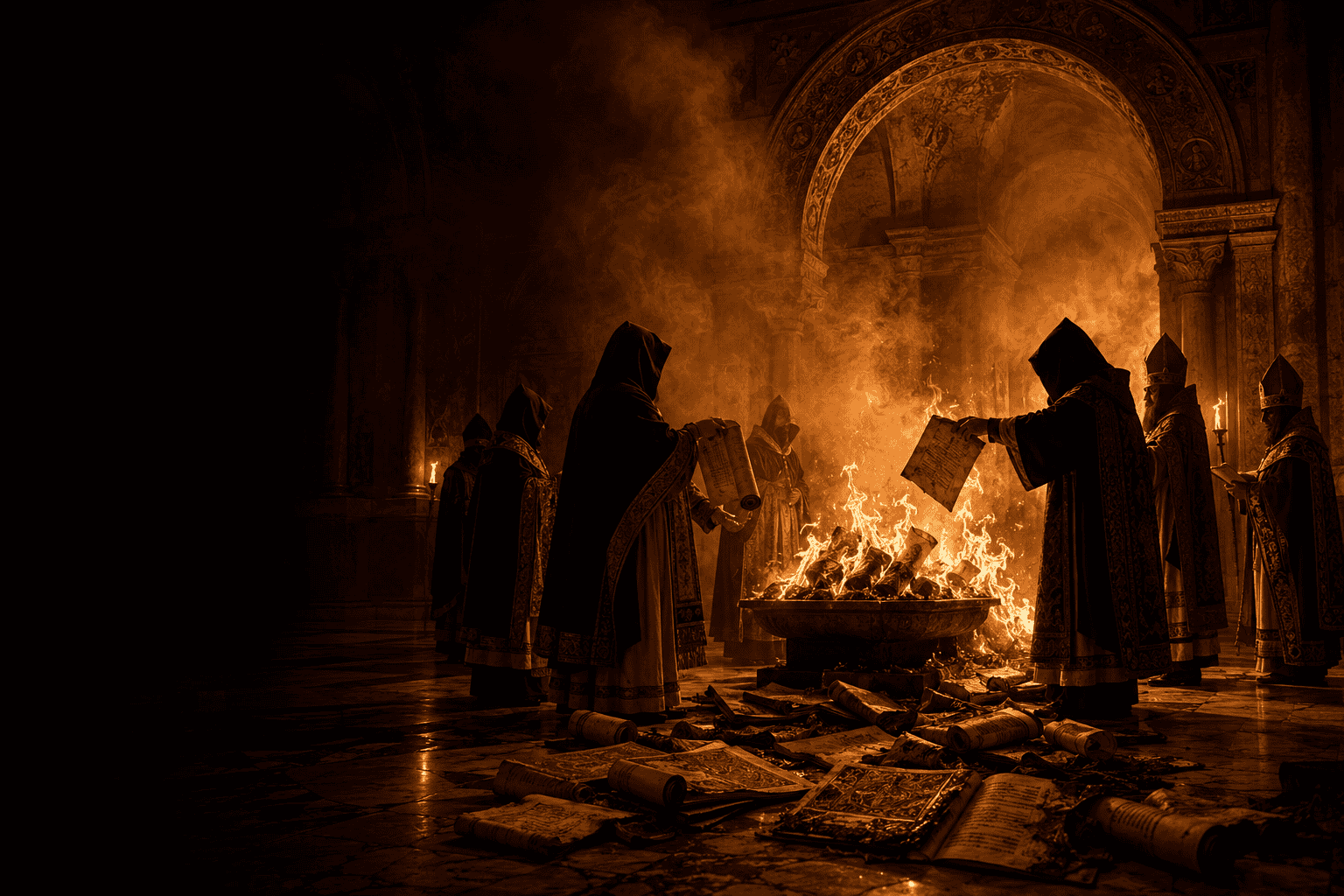
The Council of Nicaea buried it for 1,700 years.
325 CE. Constantine consolidates an empire. 300 bishops draft the Nicene Creed. The chain of custody is declared heresy.
Not the council that picked the Bible (a myth). The council that defined the doctrine, then restricted the reading, then locked the door. Gnostic gospels excluded. Mystery schools suppressed. Inner knowing buried under institutional mediation.
The Council of Nicaea did not write the Bible. The popular myth obscures what actually happened. Constantine convened the council to consolidate a fractured Roman Empire under a single state-sanctioned religion. The Nicene Creed established hierarchical Church authority, codified Christ's divinity in exclusive form, and erased the Gnostic interpretations that had carried the chain of custody from Egypt through the Mystery schools into early Christianity. The institutional suppression that followed for 1,700 years began here.
The Council of Nicaea in 325 CE did not write the Bible. It did something more consequential: it weaponized Christianity into the institutional framework that would suppress the chain of custody for the next 1,700 years.
The popular myth is that the Council of Nicaea selected which books would be in the Bible. That is not what happened. What happened at Nicaea is more important. The Roman Empire, splintering under cultural division, civil war, and religious chaos, needed a unifying belief system. Emperor Constantine saw an opportunity to consolidate the empire under a single state-sanctioned religion. The Council of Nicaea was the political mechanism by which that consolidation occurred.
Approximately 300 bishops gathered at Nicaea in 325 CE, not to debate scripture, but to finalize doctrine. The specific question on the table was the Arian controversy: whether Christ was created by the Father (the position of Arius, a priest from Redacted, read Chapter 11) or whether Christ was coeternal and consubstantial with the Father (the position eventually enshrined as orthodoxy). The Council came down decisively against Arianism. The Nicene Creed was the product. A short declaration intended to resolve internal disputes and establish a single unifying belief for the empire.
What the Creed established structurally was more important than what it said theologically:
Hierarchical Church authority as the only valid path to the divine, implying all alternatives were heresies.
Christ's divinity codified in exclusive form, dismissing earlier traditions that saw Christ as a teacher, an awakened consciousness, or a symbol of the inner transformation process.
Gnostic interpretations erased with no mention of inner knowing (gnosis), spiritual initiation, or the divine feminine Sophia.
The seeker became a subject of an institutional structure that mediated between the individual and the divine.
The Council of Nicaea is where the chain of custody hit its most consequential institutional resistance. The transmissions that had run from Egypt through Greece through the Mystery schools into early Christianity were declared heretical at Nicaea and systematically suppressed across the centuries that followed.
The actual canon was constructed across three councils, not one.
The Bible canon as it exists today was not finalized at Nicaea. The construction of the canon took place across three separate councils, each with a different and increasingly restrictive function. Nicaea defined the doctrine. Laodicea restricted the reading. Hippo and Carthage locked the door.
325 CE, Nicaea: define the doctrine
The First Council of Nicaea, convened under Emperor Constantine, defined the nature of Christ in response to the Arian controversy. The Nicene Creed was the output. The question of which texts Christians were permitted to read was a separate matter not directly addressed by this council. What Nicaea did was establish the theological framework against which subsequent canon decisions would be measured.
363 CE, Laodicea: restrict the reading
The Council of Laodicea, held approximately 38 years after Nicaea, restricted which texts could be read aloud in churches. The Book of Enoch, despite being quoted directly in the New Testament's own Epistle of Jude (Jude 1:14), did not make the approved list. Neither did Jubilees, the Ascension of Isaiah, the Apocalypse of Peter, the Shepherd of Hermas, or a range of other texts that early Christian communities had treated as revelation. This is where the narrowing began. Not through formal exclusion, but through restriction of public reading.
393 and 397 CE, Hippo and Carthage: lock the door
The councils of Hippo (393 CE) and Carthage (397 CE) finalized the canon officially. By this point, the restricted texts had been out of public circulation for approximately 30 years. Their absence felt like the natural order. The final canon included the 27 books of the New Testament that constitute the Bible today. The Old Testament canon was similarly finalized, with the Catholic deuterocanon (and the longer Ethiopian Orthodox canon, which includes Enoch and Jubilees) eventually preserved as alternatives.
The sequence is the architecture: define doctrine first, then restrict reading material to texts consistent with the doctrine, then formally close the canon to the texts that remain in approved circulation. The texts excluded were not excluded by accident. They were excluded because they threatened the institutional consolidation that Nicaea had established.
Master Thyself
The Council of Nicaea is one stop on the chain. The full chain, from the pre-flood transmission through Egypt, through the Mystery schools, through the suppressed Gnostic gospels, through the Islamic preservation, runs the length of Chapter 11.
What was buried by Nicaea.
The texts excluded from the canon were not theologically weaker than the texts included. They were operationally more dangerous to institutional authority. They emphasized direct knowing, inner transformation, and the divine feminine. They did not require priests. They did not require institutions. They empowered the seeker rather than the gatekeeper.
The Gospel of Thomas
A collection of Redacted, read Chapter 11 mystical sayings attributed to Jesus. No miracles. No resurrection narrative. Just teachings designed to awaken divine consciousness. Suppressed because the text focused on gnosis (inner knowing) over faith, taught that the kingdom of heaven is within rather than in churches, and lacked any institutional hierarchy or sacrificial theology. The text survived only because a copy was buried in the Egyptian desert and not rediscovered until 1945.
The Gospel of Mary Magdalene
Depicts Mary Magdalene as Christ's closest disciple, the one to whom Jesus entrusted teachings the male apostles were not yet ready to receive. Suppressed because the text gave spiritual authority to a woman, undermined the patriarchal leadership structure being institutionalized in Rome, and framed salvation as personal inner ascent rather than institutional obedience.
The Gospel of Judas
Recasts Judas not as a villain but as the one disciple who understood Jesus's true mission, helping him shed the physical body and return to the divine realm. Suppressed because the text upended the betrayal narrative central to the substitutionary atonement theology, removed the requirement for blood sacrifice, and framed Jesus as a teacher of cosmic truth rather than a martyr whose death paid for human sin.
The Gospel of Philip
Discusses the sacraments as symbolic rituals of inner transformation and speaks of the "bridal chamber," a mystical union between soul and spirit. Identifies Mary Magdalene as the companion of Jesus and depicts the inner alchemical work as the central teaching. Suppressed because the text undermined institutional sacramental authority and recovered the divine feminine element that orthodox theology had erased.
The Book of Enoch
Provides explicit detail on the descent of celestial beings called the Watchers, their transmission of knowledge to humanity, their hybrid offspring called the Nephilim, and the cosmic events leading to the great flood. Quoted directly in the New Testament's Epistle of Jude and treated as authoritative by early Church Fathers including Tertullian and Clement of Redacted, read Chapter 11. Excluded because it described a pre-flood civilization, divine rebellion, and the suppressed origins of human knowledge in ways that contradicted the simpler creation narrative the institutional Church was consolidating.
The Pistis Sophia
A Gnostic text describing Jesus's post-resurrection teachings to his disciples about the structure of the spiritual cosmos, the journey of the soul, and the role of the divine feminine Sophia. Identifies Mary Magdalene as the most spiritually advanced of the disciples. Excluded for the same reasons as the other Gnostic texts: recovery of the feminine, emphasis on direct knowing, and the framing of salvation as inner work rather than institutional mediation.
Many of these texts survived only by being buried. The Nag Hammadi library, a collection of Gnostic codices buried in the Egyptian desert in approximately the 4th century CE (within decades of Nicaea), was not rediscovered until 1945. The Dead Sea Scrolls, discovered in 1947, similarly preserve material that the institutional Church would have suppressed if it had reached them in time. The texts had to be buried in the literal sense, in caves and clay jars, to survive the institutional burying that Nicaea inaugurated.
Constantine opened the door. Theodosius locked everyone inside.
The Council of Nicaea was not the end of the institutional consolidation. It was the beginning. The Edict of Thessalonica in 380 CE, issued by Emperor Theodosius I approximately 55 years after Nicaea, declared Nicene Christianity the sole legitimate religion of the Roman Empire. All other faiths, including other Christian sects that disagreed with the Nicene Creed, were officially branded as heretics and made subject to punishment by the state.
What began as a doctrinal council became a creed. What became a creed became law. What became law became the only story anyone was officially allowed to tell.
The institutional consolidation that followed was systematic. Pagan temples were demolished or converted into churches. The Eleusinian Mysteries, the longest-running spiritual tradition in Greek history, were shut down by decree in 392 CE. The Library of Alexandria, which had preserved the largest collection of pre-Christian philosophical and scientific texts in the ancient world, suffered its final destruction phase in 391 CE under orders from Redacted, read Chapter 11, Patriarch of Alexandria. The Pythagorean schools were disrupted. The Hermetic tradition went underground. The Gnostic communities were hunted into extinction. The remaining texts were burned, buried, or hidden in monastic libraries where access was restricted to authorized clergy.
The pattern was consistent across every region the institutional Church controlled. The Mystery schools were the active spiritual technology of the ancient Mediterranean. By 400 CE they were criminalized. By 500 CE they had ceased operating publicly. By 600 CE the cultural memory of what they had been was reduced to the curated version the Church permitted to be remembered.
The institutional consolidation was so thorough that within a few centuries, the Roman Catholic Church was the sole surviving cultural framework in Western Europe. The Dark Ages, which followed the collapse of the Western Roman Empire, were not just a political collapse. They were the period during which the institutional consolidation of Nicaea matured into the complete cultural monopoly of medieval Christendom. The chain of custody that had run from Egypt through Greece through the Mystery schools into early Christianity was buried under the institutional structures that Nicaea had inaugurated.
The chain of custody survived Nicaea. The transmission scattered to where the consolidation could not reach.
The institutional consolidation succeeded almost completely in Western Christendom. Almost. The surviving fragments of the chain found refuge in three places that the Roman institutional structure could not penetrate.
The Islamic world. When the Western Roman Empire collapsed and Western Europe entered the Dark Ages, the Greek philosophical and scientific texts that had been suppressed in Christendom were preserved and built upon in the Islamic Golden Age. The House of Wisdom in Baghdad, established in approximately 750 CE, became the largest repository of Hellenistic and Hermetic knowledge in the world for the next 400 years. Arab scholars including Jabir ibn Hayyan, Al-Kindi, and Al-Farabi translated, preserved, and extended the Greek tradition. The chain of custody, sealed off from Christendom, ran east instead.
The monasteries that refused. Even within Christendom, certain monastic communities preserved suppressed texts in their libraries despite the institutional pressure to destroy them. The Coptic Christians in Egypt preserved much of the Gnostic material that the orthodox Roman Church burned. The Ethiopian Orthodox Church retained the Book of Enoch and other texts that the Western canon excluded. The Eastern Orthodox tradition, especially in monastic centers like Mount Athos, preserved a slightly broader canon and a different theological emphasis (the unity of Christ's divine and human nature, the Miaphysite Christology declared heretical at Chalcedon in 451 CE, was specifically suppressed because its implication was that every human can carry what Jesus carried).
The deserts where texts could be buried. The Nag Hammadi library was buried in the Egyptian desert in approximately the 4th century CE, likely by monks at the nearby Pachomian monastery who were responding to a 367 CE letter from Athanasius of Alexandria demanding the destruction of all non-canonical texts. The monks buried what they were ordered to destroy. The collection of 13 codices containing 52 texts, including the Gospel of Thomas, the Gospel of Philip, and the Gospel of Truth, survived in clay jars for 1,578 years before being rediscovered by a farmer in 1945. The Dead Sea Scrolls, discovered in 1947, similarly survived in caves where they had been hidden by the Essene community in the 1st century CE.
The Nicaea consolidation defined the institutional Christianity of the next 1,700 years. It did not erase the chain of custody. The chain went underground, ran through the Islamic preservation, surfaced through the Knights Templar after the Crusades, hid inside the operative stonemason guilds, and reassembled in Freemasonry and the Renaissance recovery of Hermeticism. The 1945 discovery of the Nag Hammadi library and the 1947 discovery of the Dead Sea Scrolls returned to public access material that Nicaea had buried 1,600 years earlier. The Vatican's continued restriction of access to portions of its private archives suggests the consolidation is still operationally active, but the dam has been leaking for the last 80 years.
The full mapping of what Nicaea suppressed, how the chain of custody survived the institutional consolidation, and what is still buried in the Vatican Archives runs the length of Chapter 11 of Master Thyself.
You are at stop 7 of nine.
The full investigation walks each link in order. Where you came from, where you are, and where the trail leads next.
Common questions, answered directly.
What did the Council of Nicaea actually do?
The Council of Nicaea in 325 CE, convened under Emperor Constantine, did not select the books of the Bible (a common myth). What the Council actually did was define the nature of Christ in response to the Arian controversy. The output was the Nicene Creed, a short declaration that codified Christ's divinity as consubstantial with the Father, established hierarchical Church authority as the only valid path to the divine, and dismissed Gnostic interpretations that emphasized inner knowing and the divine feminine. The Council was the political mechanism by which Constantine consolidated a fractured Roman Empire under a single state-sanctioned religion.
Did the Council of Nicaea choose which books are in the Bible?
No. This is a common popular misconception. The biblical canon was constructed across three separate councils, not one. Nicaea (325 CE) defined doctrine. Laodicea (363 CE) restricted which texts could be read aloud in churches. Hippo (393 CE) and Carthage (397 CE) formally finalized the canon. The 27 books of the New Testament were not selected by Nicaea. They were progressively narrowed across this 70-year sequence of councils, with texts increasingly restricted from circulation in the decades between formal decisions.
Why was the Book of Enoch removed from the Bible?
The Book of Enoch was quoted directly in the New Testament's own Epistle of Jude (Jude 1:14) and treated as authoritative by early Church Fathers including Tertullian and Clement of Alexandria. It was excluded from the Western canon because its content conflicted with the institutional consolidation. The text describes the descent of celestial beings called the Watchers, their transmission of forbidden knowledge to humanity, hybrid offspring called the Nephilim, and a pre-flood civilization that contradicted the simpler creation narrative the institutional Church was establishing. The Ethiopian Orthodox Church retained the Book of Enoch in its canon, where it remains today.
Who was Constantine and why did he matter for the Bible?
Constantine I (272-337 CE) was the Roman Emperor who legalized Christianity in 313 CE and convened the Council of Nicaea in 325 CE. His political motivation was the consolidation of a fractured empire under a single unifying belief system. Before his conversion he was devoted to Sol Invictus (the unconquered sun god) and continued to feature solar imagery on his coins even after endorsing Christianity. He oversaw the strategic overlay of Christian observance onto Roman solar festivals, including the placement of Christmas on December 25 (the Roman birthday of Sol Invictus) and the establishment of Sunday (literally Sun's Day) as the new day of Christian worship.
What were the Gnostic gospels and why were they excluded?
The Gnostic gospels were early Christian texts that emphasized direct experiential knowledge (gnosis) of the divine rather than belief through institutional mediation. The major surviving Gnostic texts include the Gospel of Thomas, the Gospel of Mary, the Gospel of Philip, the Gospel of Judas, and the Pistis Sophia. They were excluded from the canon because they undermined institutional authority. They taught that the kingdom of heaven is within rather than in churches, gave spiritual authority to figures including Mary Magdalene, framed salvation as inner transformation rather than substitutionary atonement, and recovered elements of the divine feminine (Sophia) that orthodox theology had erased.
What is the Nag Hammadi library?
The Nag Hammadi library is a collection of 13 codices containing 52 mostly Gnostic Christian texts, buried in clay jars in the Egyptian desert in approximately the 4th century CE and not rediscovered until 1945. The texts were likely buried by monks at the nearby Pachomian monastery in response to a 367 CE letter from Athanasius of Alexandria demanding the destruction of all non-canonical texts. The monks buried what they were ordered to destroy. The library includes the Gospel of Thomas, the Gospel of Philip, the Gospel of Truth, and other texts that the institutional Church had successfully suppressed for 1,578 years. The discovery transformed scholarly understanding of early Christianity.
Did Constantine destroy ancient knowledge or just consolidate Christianity?
The consolidation of Christianity under Constantine and his successors was itself a destruction of ancient knowledge. The Edict of Thessalonica in 380 CE declared Nicene Christianity the sole legitimate religion of the Roman Empire. The Eleusinian Mysteries were shut down by decree in 392 CE. The Library of Alexandria suffered its final destruction phase in 391 CE under orders from Theophilus, Patriarch of Alexandria. The Pythagorean schools were disrupted. The Hermetic tradition went underground. The Gnostic communities were hunted into extinction. The consolidation and the destruction were not separate processes. They were two faces of the same institutional project.
How did the chain of custody survive the Council of Nicaea?
The institutional consolidation that began at Nicaea succeeded almost completely in Western Christendom, but the chain of custody survived through three channels. First, the Islamic Golden Age preserved Greek philosophical and Hermetic texts that the Western institutional Church had suppressed, particularly through the House of Wisdom in Baghdad. Second, certain monastic communities (Coptic, Ethiopian Orthodox, Eastern Orthodox) retained suppressed texts in their libraries. Third, the texts buried in the Egyptian desert (Nag Hammadi, 4th century CE) and the Judean caves (Dead Sea Scrolls, 1st century CE) survived underground until their rediscovery in the 20th century. The Knights Templar later recovered Islamic preservation material during the Crusades, beginning the underground chain that eventually surfaced in Freemasonry.
Still with us?
Six more questions.
If the Council of Nicaea inaugurated 1,700 years of institutional suppression of the chain of custody, the implications for what survived and what remains buried are extensive. Each thread is traced in the fuller investigation.
What if the Council of Nicaea was primarily a political consolidation under Constantine, and the theological output was the cover story for what was actually an act of state?
What if the Gospel of Thomas, containing 114 sayings attributed to Jesus that emphasize the kingdom within and direct knowing, was suppressed because it preserved the original teaching the institutional Church needed to replace?
What if the Book of Enoch, quoted in the New Testament's own Jude 1:14, was excluded specifically because its description of the Watchers and the pre-flood civilization contradicted the simpler creation narrative the consolidation required?
What if the Edict of Thessalonica in 380 CE, declaring Nicene Christianity the sole legitimate religion of Rome, is the moment the chain of custody went fully underground in Western Christendom?
What if the Nag Hammadi library, buried in clay jars in 367 CE and rediscovered in 1945, contains material the institutional Church successfully suppressed for 1,578 years but could not destroy?
What if the Vatican Archives, still inaccessible to public scholarship for portions of its collection, preserve material from the Library of Alexandria and other suppressed sources that would reframe institutional history if released?