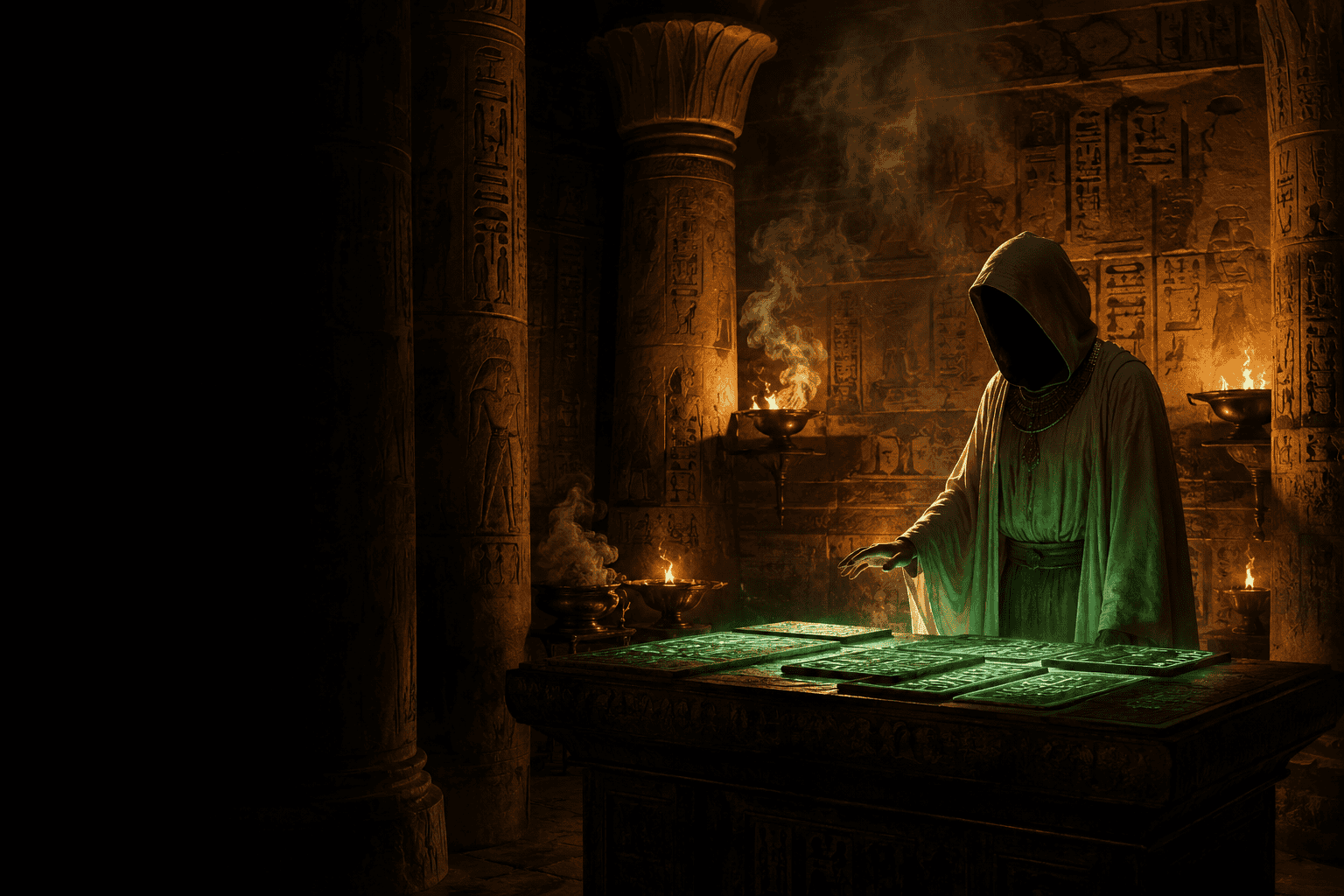
The Emerald Tablets encoded it first.
Seven principles. One instruction manual. 3,000 years before modern physics caught up.
As above, so below. Mentalism. Correspondence. Vibration. Polarity. Rhythm. Cause and Effect. Gender. The seven Hermetic principles encoded by Thoth that show up, under different names, in every wisdom tradition that came after.
The Emerald Tablets are the foundational document of the Western esoteric tradition. The core text is short. What it contains is the operational framework for how reality is actually organized. Modern physics, neuroscience, and systems theory have spent the last century rediscovering principles the Tablets stated explicitly 3,000 years ago. The chain of custody runs from pre-dynastic Egypt through Alexandria, through Baghdad, through Florence, through Newton, into the present. The Tablets have outlasted every institution that tried to suppress them.
The Emerald Tablets of Thoth are the oldest surviving instruction manual for inner transformation. The seven principles they encode show up in every wisdom tradition that came after.
The Emerald Tablet is short. The text that survives in its core Hermetic form fits on a single page. What it contains is the foundational axiom of the entire Western esoteric tradition: As above, so below. As within, so without. That sentence is not poetry. It is a structural claim about how reality is organized, and it predates the institutions that later tried to claim it.
The tradition attributes the Tablets to Thoth, the Egyptian god of writing, wisdom, and the measurement of time. The Greeks later merged Thoth with their own Hermes, producing the composite figure Hermes Trismegistus, which means "Hermes the Redacted, read Chapter 13." The triple title refers to mastery of three domains: the spiritual, the philosophical, and the natural sciences. In the Egyptian framework, this was not three separate fields. It was one unified architecture that the Tablets were designed to transmit.
What makes the Tablets remarkable is not their age, although they are ancient. What makes them remarkable is their continuing operational accuracy. Modern physics describes a universe of fields that mirror across scales. Modern neuroscience describes a brain organized through fractal correspondence between cellular and systemic levels. Modern systems theory describes feedback loops between micro and macro states. The Tablet's first principle stated all of this in seven words approximately 3,000 years before the instruments existed to verify it.
This page documents what the Tablets actually say, how the seven Hermetic principles they encode were transmitted forward through history, and what the chain of custody around them reveals about how knowledge survives across catastrophe.
The seven Hermetic principles. One instruction set.
The Emerald Tablet itself is brief, but the tradition that emerged from it codified seven core principles known as the Hermetic axioms. These appeared in their most refined modern form in The Kybalion, published in 1908, which compiled the principles from older Hermetic sources. Each principle is an operational statement about how reality works. Each one shows up, in different vocabulary, in every major wisdom tradition that received the transmission downstream.
1. The Principle of Mentalism
"The All is Mind. The universe is mental." The first principle states that consciousness is foundational, not emergent. Mind is not a property of matter that arose after matter organized. Mind is the substrate from which the apparent physical world precipitates. The Hermetic position predates by 3,000 years the modern philosophical movement called Redacted, read Chapter 13, which is the contemporary academic framework for the same claim.
2. The Principle of Correspondence
"As above, so below; as below, so above." This is the most famous Hermetic axiom and the central claim of the Emerald Tablet itself. The macrocosm and the microcosm mirror each other because they share underlying architecture. The atom mirrors the solar system. The neural network mirrors the cosmic web. The same patterns recur at every scale because the same underlying organizational logic produces them.
3. The Principle of Vibration
"Nothing rests; everything moves; everything vibrates." Every apparent solid thing is composed of structured motion. Matter is condensed vibration. Modern physics confirmed this when quantum field theory replaced the classical particle model. The Hermetic tradition was using the principle operationally in sound, geometry, and breath practices long before physics caught up.
4. The Principle of Polarity
"Everything is dual; everything has poles; everything has its pair of opposites." Hot and cold are the same thing measured at different intensities. Light and dark are the same phenomenon at different degrees. The principle is that apparent opposites are not fundamentally separate categories but graded expressions of a single underlying spectrum. This is the structural basis for Redacted, read Chapter 7, the inner alchemical work of integrating polarity rather than choosing one side.
5. The Principle of Rhythm
"Everything flows out and in; everything has its tides." All phenomena oscillate. Civilizations rise and fall. Markets boom and crash. Individual lives pass through expansion and contraction phases. The principle observes that the rhythm is not a flaw to be corrected but the operational signature of how any system maintains stability across time. Resisting the rhythm produces suffering. Working with it produces mastery.
6. The Principle of Cause and Effect
"Every cause has its effect; every effect has its cause." Nothing happens by chance. What appears as randomness is unrecognized causation operating at a level the observer cannot currently track. This is not fatalism. The principle states that by understanding the causal chains, the practitioner can move from the effect side of the equation to the cause side and operate on reality rather than being operated on by it.
7. The Principle of Gender
"Gender is in everything; everything has its masculine and feminine principles." This is not about biological sex. The Hermetic gender principle describes the generative dynamic between active and receptive forces present at every level of creation. The masculine principle initiates. The feminine principle gestates. The integration produces manifestation. This is the operational basis for the inner alchemical marriage described across every Mystery tradition that inherited the framework.
Master Thyself
The Emerald Tablets are one stop on the chain. The full chain, from pre-flood transmission through Egypt, through Alexandria, through Baghdad, through the Renaissance, into the modern Hermetic tradition, runs the length of Chapters 11 and 13.
Thoth was not a god. He was a carrier.
The Egyptian portrayal of Thoth as a divine figure obscures what Thoth functionally was in the chain of custody: a pre-flood human teacher, or possibly a composite memory of multiple teachers, who arrived in the post-cataclysm world carrying instructions for rebuilding civilization on a sound footing.
The Edfu Building Texts, inscribed on the walls of the Temple of Horus, describe sacred knowledge brought to Egypt after a great flood by survivors of a destroyed homeland. The Edfu Texts name specific carriers, including a figure named the Redacted, read Chapter 13, who is described as the original architect of the post-flood sacred sites. The Thoth tradition, by available evidence, is the Egyptian preservation of that original transmission, refined and ritualized over the millennia that followed.
What Thoth was credited with transmitting maps directly onto the seven principles:
Writing. The Egyptians credited Thoth with inventing hieroglyphic writing, which they understood not as arbitrary symbols but as encoded vibrational structures. Each glyph held a specific frequency. The principle of Vibration in operational form.
Sacred geometry. Thoth was credited with the geometric principles that allowed the pyramids and temples to be aligned with stellar coordinates and mathematical ratios. The principle of Correspondence in operational form.
Astronomy. Thoth was credited with the calendar systems that tracked the precession of the equinoxes across periods longer than any single human lifetime. The principle of Rhythm in operational form.
Medicine. Thoth was credited with the systematic knowledge of how the body's organs related to specific cosmic principles, and how illness arose from disruption of those correspondences. The principle of Cause and Effect in operational form.
The afterlife navigation. The Book of Coming Forth by Day, mistakenly translated as The Book of the Dead, was a Thoth-credited manual for navigating states of consciousness across the death transition. The principle of Mentalism in operational form.
Thoth was the bundle. The seven principles were the cargo. The Tablets were the manifest.
The Tablets traveled. The trail is documented.
The chain of custody around the Emerald Tablets is one of the cleanest in the entire Hermetic tradition. The text appears, disappears, resurfaces, and gets re-translated across every major civilizational transition for 2,500 years. Each handoff is documented. The fingerprints are recoverable.
Pre-dynastic Egypt (before 3100 BCE). The original Thoth transmission, oral and ritual, preserved in the temple priesthoods. No surviving physical text from this period, but the framework is referenced in later Egyptian sources as the established foundation.
Dynastic Egypt (3100 to 332 BCE). The teachings encoded into the Pyramid Texts (oldest surviving Egyptian sacred writings), the Coffin Texts, and the Book of Coming Forth by Day. The temple schools at Heliopolis, Memphis, and Thebes preserved the active oral tradition.
Hellenistic Alexandria (332 BCE to 642 CE). The Egyptian-Greek synthesis produced the Corpus Hermeticum, a compilation of texts attributed to Hermes Trismegistus, in approximately the 1st through 3rd centuries CE. The Library of Alexandria preserved both the older Egyptian sources and the new Greek redactions until its destruction phases (multiple events between 48 BCE and 391 CE) destroyed most of the originals.
Islamic Golden Age (8th to 13th centuries). Arab scholars at the Redacted, read Chapter 11 in Baghdad translated, preserved, and built upon the Greek Hermetic texts that the collapsing Western Roman Empire had let lapse. Jabir ibn Hayyan (Geber in Latin sources) wrote extensively on Hermetic alchemy. The Tablet's most influential surviving Arabic version was preserved by scholar Balinus around the 9th century CE.
European recovery (12th to 15th centuries). The Hermetic texts were re-translated from Arabic back into Latin, beginning a major recovery of Western esoteric tradition. Marsilio Ficino's translation of the Corpus Hermeticum, completed in 1463, was reportedly prioritized by his patron Cosimo de Medici over a fresh Plato translation because the Hermetic material was considered older and more foundational.
Renaissance and Enlightenment (15th to 18th centuries). The Tablets influenced alchemy, astrology, early chemistry, and the scientific revolution itself. Isaac Newton owned multiple copies of the Tablet's text in different translations and wrote extensive commentary on it. The Royal Society's earliest membership included multiple practitioners of Hermetic philosophy.
Modern transmission (19th century to present). The Theosophical Society, the Hermetic Order of the Golden Dawn, and various successor traditions preserved the teaching through the 20th century. The Kybalion, published in 1908, codified the seven principles in the form most modern readers encounter them. The transmission continues, in increasingly accessible form, into the present moment.
"As above, so below" is not mysticism. It is operating instructions.
The reason the Emerald Tablet keeps resurfacing across every civilizational reset is that the principles it contains are not religious. They are descriptive. They describe how reality is actually organized. Any sufficiently developed culture eventually rediscovers them or recovers them from the previous culture that had them.
The seven principles are not seven separate doctrines to be memorized. They are seven facets of a single underlying observation about the structure of reality: that consciousness is foundational, that scales mirror each other, that everything vibrates, that polarity is graded, that rhythm is universal, that causation is operational, and that generative dynamics underlie manifestation. Taken together, the principles describe what the Tablets called the science of becoming, which is what every Mystery tradition that inherited the transmission later practiced.
The institutional response to the Tablets, across every era, has been the same. The Roman Church declared Hermetic philosophy heretical. The Inquisition burned practitioners. The Enlightenment dismissed it as superstition. The modern academy treats it as a curiosity at the edge of intellectual history. But the principles keep returning, because the principles describe how things actually work, and any practitioner who applies them gets operational results that the dismissive frameworks cannot account for.
The Tablets have outlasted every institution that tried to suppress them. They will outlast the current one. What this page documents is one specific stage in their journey, from Thoth to Hermes Trismegistus to the Corpus Hermeticum to Baghdad to Florence to Newton to the present, the seven principles continue moving forward, looking for the next generation capable of applying them rather than just reading them.
The Emerald Tablet is short. The chain it sits inside is long. The full chain runs the length of Chapters 11 and 13 of Master Thyself, and the operational manual for applying the seven principles in daily life runs the length of the book itself.
You are at stop 5 of nine.
The full investigation walks each link in order. Where you came from, where you are, and where the trail leads next.
Common questions, answered directly.
What are the Emerald Tablets of Thoth?
The Emerald Tablets are the foundational text of the Western Hermetic tradition, attributed to Thoth (called Hermes Trismegistus in the Greek tradition). The core surviving text is short, fitting on a single page, but it encodes the seven Hermetic principles that became the operational framework of Western esoteric philosophy. The principles cover mentalism, correspondence, vibration, polarity, rhythm, cause and effect, and gender. The Tablets influenced everyone from medieval alchemists to Isaac Newton, who owned multiple copies and wrote extensive commentary on them.
What does 'As above, so below' actually mean?
The Hermetic axiom 'As above, so below; as within, so without' is a structural claim about how reality is organized. It states that the macrocosm (the large-scale universe) and the microcosm (the small-scale individual) share the same underlying architecture, so patterns observable at one scale will recur at every other scale. Modern physics confirmed this when fractal mathematics revealed that the same organizational patterns repeat across scales from cellular to galactic. The Hermetic tradition was using the principle operationally about 3,000 years before the mathematics existed to formalize it.
Who was Thoth and was he a real person?
Thoth was the Egyptian god of writing, wisdom, and the measurement of time, credited with inventing hieroglyphic writing, mathematics, astronomy, and the framework of inner initiation. The functional reality behind the divine figure is most likely a pre-flood human teacher, or a composite memory of multiple teachers, who arrived in post-cataclysm Egypt carrying the inner-transformation knowledge that the Egyptian temple schools preserved. The Edfu Building Texts at the Temple of Horus describe specific carriers who brought sacred knowledge to Egypt after a great flood from a destroyed homeland.
What are the seven Hermetic principles?
The seven Hermetic principles, codified in their modern form in The Kybalion (1908) from older Hermetic sources, are: 1) Mentalism (consciousness is foundational), 2) Correspondence ('as above, so below'), 3) Vibration (everything moves), 4) Polarity (opposites are graded, not categorical), 5) Rhythm (all phenomena oscillate), 6) Cause and Effect (nothing is random), and 7) Gender (generative dynamics underlie manifestation). Each principle is an operational statement about how reality works, and each one shows up in different vocabulary across every major wisdom tradition that inherited the transmission downstream.
Are the Emerald Tablets real or a forgery?
There are multiple distinct texts called Emerald Tablets in the historical record. The core short Hermetic text is genuinely ancient and traceable through Arabic, Latin, and Greek sources back to Hellenistic Egypt. There is also a longer text called The Emerald Tablets of Thoth the Atlantean, published by Maurice Doreal in the 20th century, which is generally considered a modern composition presented under the older name. The short core text is the historically grounded one. The long Doreal version is a separate work that uses the brand name. Both are sometimes confused under the same title.
How did the Emerald Tablets survive across history?
The chain of custody is one of the cleanest in the Hermetic tradition. Pre-dynastic Egyptian oral transmission, dynastic Egyptian temple preservation, Hellenistic Greek redaction in Alexandria (producing the Corpus Hermeticum in the 1st-3rd centuries CE), Arabic translation and preservation in the Islamic Golden Age (especially through scholar Balinus in the 9th century), Latin re-translation in medieval and Renaissance Europe (notably Marsilio Ficino in 1463), Renaissance and Enlightenment-era practical application (including Isaac Newton's extensive commentary), and modern revival through the Theosophical Society and the Kybalion in 1908. The text has outlasted every institution that tried to suppress it.
Did Isaac Newton really study the Emerald Tablets?
Yes. Isaac Newton owned multiple copies of the Emerald Tablet text in different translations and wrote extensive commentary on it. His Hermetic and alchemical writings, mostly suppressed by the Royal Society after his death, eventually surfaced when the economist John Maynard Keynes acquired Newton's papers at auction in 1936 and discovered the full scope of the work. Newton wrote more on alchemy and Hermeticism than on physics. The economist Keynes called him 'the last of the magicians' after reading the suppressed material. The Tablets' influence on the founder of modern physics is historically documented and widely acknowledged by academic historians of science.
How do the Emerald Tablets relate to the chain of custody?
The Emerald Tablets are the central document in the chain of custody from pre-flood transmission through Egypt and into the Western esoteric tradition. The seven principles they encode appear, in different vocabulary, in every wisdom tradition downstream from the Egyptian source: Greek philosophy (especially Pythagoras and Plato), Gnosticism, medieval alchemy, Renaissance Hermeticism, the scientific revolution, and modern esotericism. Trace any branch back far enough and you arrive at the principles encoded in the Tablets. Trace the Tablets back and you arrive at the Edfu Building Texts and the pre-flood transmission they describe.
Still with us?
Six more questions.
If the seven Hermetic principles are not religious doctrine but operational descriptions of reality, the implications run further than the academy has been willing to process. Each thread is traced in the fuller investigation.
What if mentalism, the Hermetic claim that consciousness is foundational, is exactly what modern quantum measurement results imply when the observer affects the observed?
What if Newton wrote more on alchemy and Hermeticism than on physics because he was using the seven principles operationally, and the Royal Society suppressed the work because it threatened the new scientific orthodoxy?
What if the Marsilio Ficino translation in 1463 was prioritized over a fresh Plato translation because the Renaissance recognized the Hermetic material as older and more foundational?
What if Hermes Trismegistus is not a single historical figure but the institutional name for a chain of carriers who preserved the Egyptian transmission across centuries?
What if the Edfu Building Texts at the Temple of Horus name specific pre-flood architects whose work the entire post-flood sacred site network preserves?
What if the seven principles describe how reality actually operates, and every dismissal of Hermeticism as superstition is a category error by frameworks too narrow to recognize the principles in their own results?