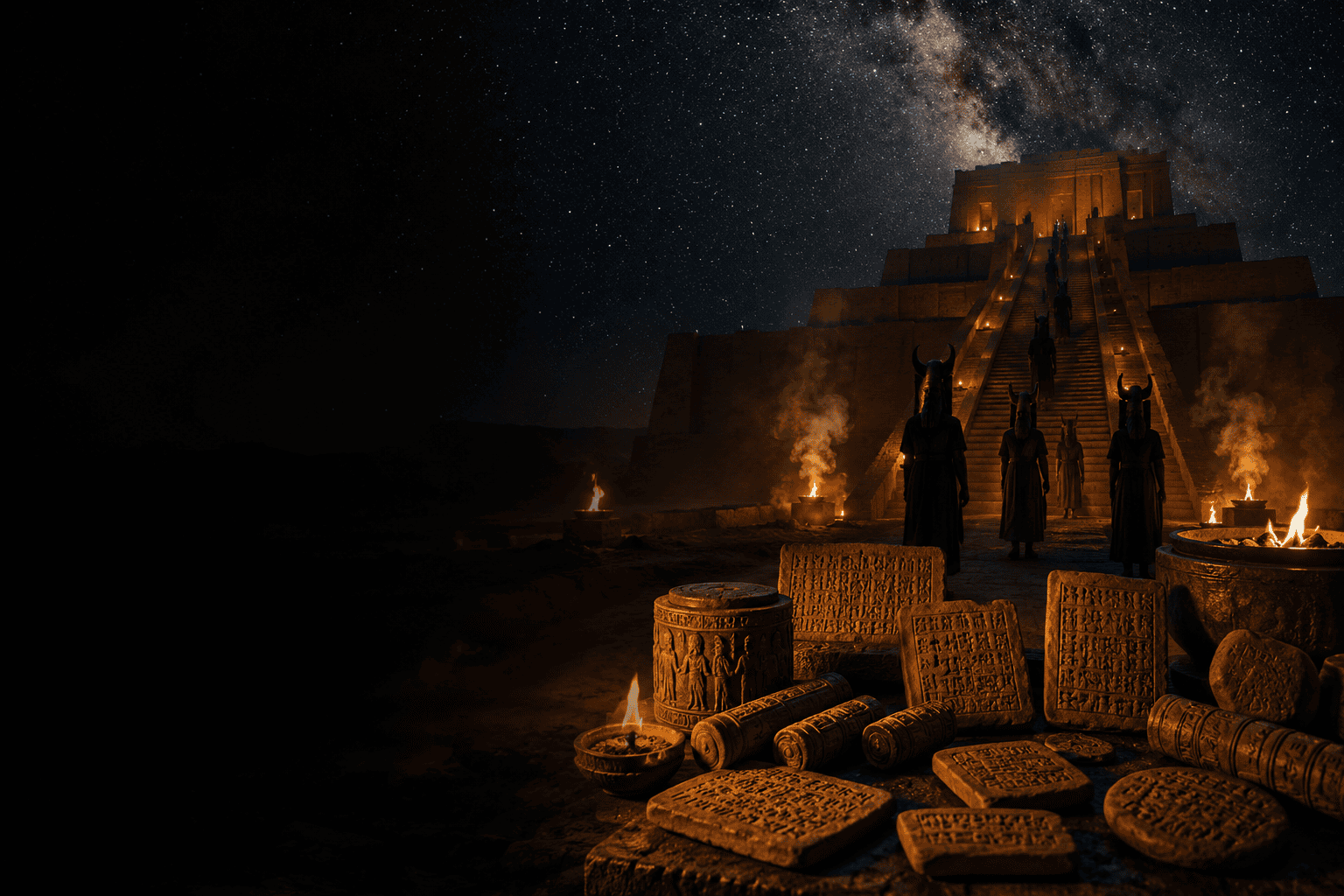
The Anunnaki are the source node.
Sumerian cuneiform from 4,000 BCE describes them with administrative detail. Enki created humans. Enlil ordered the flood. The chain of custody starts here.
The oldest written records in human history. Not myth. Practical administrative records of beings credited with designing humanity, teaching civilization, and surviving the flood that nearly erased the experiment.
The Anunnaki appear in Sumerian cuneiform tablets dating to approximately 4,000 BCE, making them the central figures of the oldest written records in human history. They are described not as abstract gods worshipped in metaphor but as practical administrative beings with specific duties and entangled political drama. The Enki-Enlil rivalry that runs through the Sumerian record is the operational core of every chain of custody that follows. The genetic evidence in human chromosomes is consistent with the Sumerian account of biological intervention. The Anunnaki are the source node.
The Anunnaki are not a fringe theory. They are the central figures of the oldest written records in human history, and the chain of custody starts with them.
The Anunnaki appear in Sumerian cuneiform tablets dating to approximately 4,000 BCE, making them the central figures of the oldest written records in human history. They are described not as abstract gods worshipped in metaphor but as practical administrative beings with specific duties, specific regions of responsibility, and entangled political and familial dramas. The Sumerian texts treat them as historical figures. Every subsequent tradition that inherited the Sumerian material, including the Hebrew, the Akkadian, and indirectly the Greek, treats them with similar specificity. The mainstream academic position treats them as mythology. The texts themselves treat them as record-keeping.
The term Anunnaki comes from ancient Sumerian cuneiform. The academic translation reads as "princely offspring" or "those of royal seed." The popular interpretation, advanced most prominently by researcher Redacted, read Chapter 12 in the 20th century, reads it as "those who from heaven to Earth came." The distinction matters less than the consistency. Whether royal bloodline or cosmic visitors, the texts describe the Anunnaki with administrative detail rather than worshipful abstraction.
This page documents who the Anunnaki actually were in the Sumerian record, what they were credited with doing, why the Enlil-Enki rivalry is the operational core of the entire chain of custody, and what genetic and linguistic evidence in the human body itself suggests about whether the Sumerian record was metaphor or memory.
The investigation does not require belief. It requires reading the texts the Sumerians left for us with the same seriousness they invested in writing them. The Sumerians did not consider themselves to be writing mythology. They considered themselves to be writing history.
The Sumerian tablets. The oldest documented record of who we are.
The primary sources for the Anunnaki tradition are not modern reconstructions. They are surviving clay tablets recovered from archaeological sites across modern Iraq, Iran, and Syria, dated to between 4,000 and 1,500 BCE. The two most important texts for understanding the Anunnaki are the Atra-Hasis and the Enuma Elish.
The Atra-Hasis (composed ~1700 BCE)
The Atra-Hasis epic preserves the Sumerian account of the creation of humanity and the flood that followed. According to the text, the Anunnaki originally performed manual labor on Earth themselves. The labor was too burdensome. The Anunnaki council decided to create a worker species to handle the work. The Anunnaki scientist Redacted, read Chapter 12 mixed the essence (blood, in some translations) of an Anunnaki being with the clay of the Earth, creating the first humans. The text refers to these early humans as the Redacted, read Chapter 12, a term that appears in modified form in the Hebrew word "adamah" (red earth or clay) and the name Adam.
The Enuma Elish (composed ~1100 BCE)
The Enuma Elish is the Babylonian creation epic, drawing on older Sumerian sources. It describes the cosmic origins of the Anunnaki, their internal conflicts, and the establishment of the order of the world. The text preserves the genealogy of the Anunnaki council, including the supreme sky-father Anu, the air-god and chief executive Enlil, the wisdom-god and biological designer Enki (also called Ea), and their respective offspring and lineages.
The Epic of Gilgamesh
The Sumerian Epic of Gilgamesh preserves the most detailed account of the flood, told from the perspective of Utnapishtim, the survivor (the Sumerian source for the later Hebrew Noah). The text describes Enlil's decision to destroy humanity, Enki's defiance of that decree by warning Utnapishtim to build a vessel, the construction of the ark, the deluge, the release of birds to test for dry land, the rest on a mountain, and the aftermath. The structural elements are nearly identical to the Genesis account, which was written down approximately 1,500 years later.
The cuneiform corpus
Beyond the major epics, thousands of Sumerian cuneiform tablets recovered from archaeological sites preserve administrative records, hymns, prayers, and accounts that reference the Anunnaki in routine practical contexts. The tablets describe specific Anunnaki being assigned to specific cities (Anu at Uruk, Enlil at Nippur, Enki at Eridu, Inanna at Uruk). The tablets are not religious abstraction. They are administrative records that treat the Anunnaki as the practical ruling structure of the early Mesopotamian world.
Master Thyself
The Anunnaki are the source node of the chain. The full chain, from the original Sumerian record through Egypt, through the Mystery schools, through the Council of Nicaea suppression, into the present, runs the length of Chapters 12 and 17.
Enki versus Enlil. The operational core of every chain of custody.
The rivalry between the two principal Anunnaki brothers, Enlil and Enki, is not just Sumerian theology. It is the operational core of the entire chain of custody and the structural template that recurs across every later tradition. One brother seeks compliance. The other seeds consciousness. One enforces the system. The other hacks it. Every later iteration of the chain of custody, from the Hebrew tradition to the Gnostics to the Templars, can be mapped onto the original Enki-Enlil polarity.
Enlil: Lord of the Air, Authority, Control
Enlil was the chief executive of the Anunnaki council on Earth. Associated with air, command, hierarchy, law, kingship, and the enforcement of divine order. In multiple tablets, humanity is portrayed as a problem in his view. Humans multiply. They disrupt. They generate noise and instability. Order, from Enlil's perspective, requires control. When humanity multiplied beyond the labor purpose for which it had been designed and became too noisy for the Anunnaki to tolerate, Enlil ordered the flood to wipe out the experiment.
Enki: Lord of the Waters, Wisdom, Awakening
Enki was the Anunnaki scientist, alchemist, and biological designer. Associated with water, intelligence, craft, healing, and the protection of humanity. He was credited with the original biological design that mixed Anunnaki essence with terrestrial clay to create humans. He was credited with teaching humans agriculture, language, healing, and the basic technologies of civilization. When Enlil ordered the flood, Enki defied the decree by secretly warning Utnapishtim (later called Noah in the Hebrew tradition) to build a vessel and preserve life. His symbol was the entwined serpents, mapping with striking accuracy onto the double helix of DNA discovered millennia later.
The archetypal inversion
In the original Sumerian framework, Enki was the benefactor of humanity and Enlil was the punitive authority. The later Hebrew, Christian, and broader Western theological tradition inverted this. The serpent (Enki's symbol) became the villain in Eden. The punitive authority figure (Enlil's archetype) became the supreme Creator. The light-bringer who awakened humanity was demonized. The controller who tried to destroy humanity was sanctified.
This inversion is the operational template for what becomes the entire suppression pattern of the chain of custody. The Gnostic Christians later named the false god the Demiurge and the wisdom-bringer Sophia, recovering the original polarity under different names. The Hermetic tradition preserved the same distinction. The Templars and the Freemasons encoded it into their initiatory architecture. Every link in the chain of custody is, at its core, a re-recovery of the original Enki current after some institutional iteration of the Enlil current has attempted to bury it.
The genetic evidence in your own body. The myths may be partial recollections.
If the Anunnaki account of humanity's creation through biological intervention is even partially accurate, there should be traces. Not just in stories. Residue. Something written into the body itself. There is. Two clues are documented and accepted by mainstream science.
Chromosome 2: the fusion that should not have happened
Humans have 46 chromosomes. Great apes (chimps, gorillas, orangutans) have 48. Around 4 to 6 million years ago, by the standard evolutionary account, two ancestral chromosomes fused to create human Chromosome 2. The fusion is a near-perfect merge with three forensic features:
Telomere sequences in the middle: Telomeres are protective end-caps of chromosomes. In Chromosome 2, telomere sequences appear in the middle of the chromosome where they have no business being. They look like the fused ends of two previously separate chromosomes.
A vestigial centromere: The centromere is the chromosome's structural anchor point. Chromosome 2 has a vestigial centromere remaining, like a scar from the merge.
Stable, precise, deviant structure: The fusion is biologically stable and precise, which is unusual for a "natural" chromosomal accident. Most chromosomal abnormalities of this scale would be lethal or reproductively disabling. This one was neither.
The consequences of the fusion were not minor. Chromosome 2 contains genes critical for inter-regional brain communication (Redacted, read Chapter 12), memory, learning, and social interaction (NRXN1), neuroplasticity, T-cell immune development, sperm viability, embryonic development, gestation, upright posture, larger brain cases, and straighter spines. The fusion did not just change a number. It reshaped what it means to be human.
FOXP2: the language gene that appeared too suddenly
FOXP2 is a gene found in all mammals. The human version contains two small mutations that emerged around 200,000 years ago, exactly when anatomically modern humans appeared in the fossil record. The two minor changes produced one massive consequence: language. Not just sounds. Syntax, symbol, story, inner dialogue. No other species developed anything comparable. No evolutionary lead-up. The fossil record shows essentially no transitional phase. Just sudden emergence: art, culture, memory, myth, fully formed.
No smoking gun says the Anunnaki spliced the human genome. But Chromosome 2 and FOXP2 are real, unique to humans, and appeared suddenly and in sequence at exactly the window the Sumerian texts describe biological intervention. The conventional evolutionary explanation requires accepting two extraordinarily improbable accidents that happened to coincide with the documented sudden emergence of modern human cognition. The Sumerian account explains the same data more parsimoniously.
The Hopi Anu Naki phonetic match
On the other side of the world, the Hopi tradition preserves a memory of beings called the Anu Naki, meaning "Ant People" or "those who dwell below," who arrived during or after a great cataclysm and taught the survivors how to rebuild. Mainstream linguistics cannot formally connect the Hopi term to the Sumerian term because conventional comparative method can only reconstruct shared roots back about 6,000 to 8,000 years. If the Hopi and Sumerian names share a common pre-flood ancestor, the standard tools do not reach that far. The phonetic match remains. The functional descriptions match. The structural memory matches.
The Anunnaki are the source node of the chain.
Every chain of custody on this site runs back to the Anunnaki at some level. The Atlantis-to-Egypt transmission preserves their inheritance. The Mystery schools transmit the inner-technology framework Enki credited as the original gift. The Hopi parallel tradition preserves the same teacher figures under different names. The Templars and the Freemasons encode the Enki polarity into their initiatory architecture. The Council of Nicaea suppressed exactly the texts that preserved the original Enki-as-wisdom-bringer framing rather than the inverted Enlil-as-supreme-authority framing.
What the Sumerians wrote down 6,000 years ago is the source material for every subsequent religious and esoteric tradition in the Western lineage. The Genesis flood narrative is a Hebrew adaptation of the Atra-Hasis. The serpent in Eden is a demonized Enki. The Watchers in the Book of Enoch are a partial recovery of the Anunnaki record. The Greek pantheon, the Roman pantheon, and indirectly the Hindu pantheon all preserve elements that map onto the original Sumerian source.
The mainstream academic position is that the Sumerians invented their mythology as poetic interpretation of natural forces, agricultural cycles, and political dynamics. That position is consistent with the comparative mythology framework that dominated 19th and 20th century scholarship. It is less consistent with the genetic evidence in human chromosomes, the linguistic phonetic matches across cultures that had no documented contact, and the structural consistency of the post-Sumerian traditions that inherited the material.
The Anunnaki may have been literal cosmic visitors, as some researchers including Zecharia Sitchin have proposed. They may have been an advanced pre-flood human civilization remembered as gods because their technology exceeded the comprehension of post-flood observers. They may have been mythologized archetypes for natural forces, as the conventional academic interpretation argues. Or they may have been some combination that the available evidence cannot fully disambiguate. What is established is that they appear in the oldest written records in human history, treated by the people who wrote those records as historical figures rather than abstract symbols, and the consequences of how the Anunnaki record was inherited, distorted, suppressed, and partially recovered run through every link in the chain of custody traced across the rest of this site.
The full mapping of the Anunnaki record, the Enki-Enlil operational core, the genetic evidence in human biology, and the chain of inheritance through subsequent traditions, runs the length of Chapters 12 and 17 of Master Thyself.
You are at stop 1 of nine.
The full investigation walks each link in order. Where you came from, where you are, and where the trail leads next.
Common questions, answered directly.
Who were the Anunnaki?
The Anunnaki are the central figures of the oldest written records in human history, appearing in Sumerian cuneiform tablets dating to approximately 4,000 BCE. The Sumerian texts describe them not as abstract gods but as practical administrative beings with specific duties, regions of responsibility, and political dynamics. The two principal Anunnaki brothers are Enlil (associated with air, command, and the enforcement of divine order) and Enki (associated with water, wisdom, biological design, and the protection of humanity). The Sumerian word translates as 'princely offspring' in the academic reading or 'those who from heaven to Earth came' in the interpretation advanced by Zecharia Sitchin and others.
Did the Anunnaki create humans?
According to the Sumerian Atra-Hasis epic and related texts, yes. The Anunnaki scientist Enki is credited with creating the first humans by mixing the essence (blood, in some translations) of an Anunnaki being with the clay of the Earth. The early humans are called the Adamu in the Sumerian source, a term that appears in modified form in the Hebrew word 'adamah' (red earth) and the name Adam. The Sumerian account describes the creation as a deliberate biological design for a worker species, not as cosmic accident or natural evolution. Whether the account is literal history, mythological metaphor, or distorted memory of actual biological intervention is the open question.
What is the difference between Enki and Enlil?
Enlil was the chief executive of the Anunnaki council on Earth, associated with authority, control, hierarchy, and the enforcement of divine order. He saw humanity as a problem when it multiplied beyond its intended purpose and ordered the flood to destroy it. Enki was the Anunnaki scientist and benefactor of humanity, credited with the original biological design, with teaching humans agriculture, language, and healing, and with defying Enlil by warning Utnapishtim (the Sumerian Noah) to build a vessel to survive the flood. The Enlil-Enki rivalry is the operational core of the chain of custody: one seeks compliance, the other seeds consciousness. Every later tradition can be mapped onto this original polarity, often with the serpent (Enki's symbol) demonized and the punitive authority figure (Enlil's archetype) sanctified.
Are the Anunnaki the same as the Sumerian gods?
Yes, in the sense that the Anunnaki ARE the Sumerian gods. The Sumerian pantheon was the Anunnaki council. Anu was the sky-father and supreme authority. Enlil and Enki were his sons. Inanna (later Ishtar) was his granddaughter. Marduk, Nergal, Ninhursag, Nanna, and Utu were other major members of the Anunnaki family. Different cities had patron Anunnaki: Anu at Uruk, Enlil at Nippur, Enki at Eridu, Nanna at Ur. The Sumerian religious and political system treated the Anunnaki as the practical ruling structure of the world, not as abstract deities worshipped in metaphor.
Is there scientific evidence for the Anunnaki?
There is no direct archaeological evidence of Anunnaki as a literal extraterrestrial species. There are two pieces of mainstream-accepted biological evidence that are consistent with the Sumerian account of biological intervention in human origins. First, the human Chromosome 2 fusion: humans have 46 chromosomes while great apes have 48, with Chromosome 2 showing telomere sequences in its middle and a vestigial centromere consistent with a fusion event. Second, the FOXP2 language gene: humans have two specific mutations that emerged around 200,000 years ago, coinciding with the sudden emergence of modern human cognition with no clear evolutionary lead-up. Neither finding proves the Anunnaki account. Both are more parsimoniously explained by it than by accidental coincidence.
Are the Anunnaki connected to the Nephilim?
Yes. Genesis 6:4 describes the Nephilim as offspring of the 'sons of God' and human women, characterized as giants and 'heroes of old, men of renown.' The Book of Enoch provides more detail, describing celestial beings called the Watchers who descended to Earth, transmitted forbidden knowledge to humanity, and produced hybrid offspring called the Nephilim. The Sumerian Anunnaki tradition predates both Genesis and Enoch by over 1,500 years and describes similar hybrid offspring resulting from Anunnaki-human interaction. The Hebrew and apocryphal Jewish texts appear to preserve a partial recovery of the older Sumerian record, though both the Genesis and Enoch versions are partial and theologically reframed compared to the Sumerian source.
Why is Enki demonized as the serpent in Eden?
The serpent in the Garden of Eden, who offers humanity the knowledge that leads to expulsion from the garden, maps directly onto Enki in the Sumerian framework. Enki was the wisdom-bringer who gave humans the knowledge that made them more than the controlled labor species the Anunnaki council had originally designed. In the original Sumerian framing, this was a gift. In the later Hebrew framing, it was a transgression. The serpent (Enki's symbol of entwined snakes mapping onto DNA) was demonized. The punitive authority figure (Enlil's archetype) was sanctified as the supreme Creator. This archetypal inversion, where the awakener is recast as the enemy and the controller is exalted, is the operational template for what becomes 1,700+ years of institutional suppression of the chain of custody.
How do the Anunnaki connect to the chain of custody?
The Anunnaki are the source node. Every subsequent chain of custody runs back to them at some level. The Atlantis-to-Egypt transmission preserves their inheritance. The Mystery schools transmit the inner-technology framework Enki was credited with originally giving humans. The Hopi parallel tradition preserves the same teacher figures under nearly the same name (Anu Naki). The Knights Templar and the Freemasons encode the Enki polarity into their initiatory architecture. The Council of Nicaea in 325 CE suppressed exactly the texts (including the Book of Enoch) that preserved the original Anunnaki framing. The investigation of who the Anunnaki actually were, and what their actual influence on human civilization has been, is the foundation question that every other link in the chain of custody builds on.
Still with us?
Six more questions.
If the Anunnaki record is the source node of every later chain of custody, the implications run further than any single tradition can contain. Each thread is traced in the fuller investigation.
What if the Atra-Hasis epic from 1700 BCE preserves the actual operational record of pre-Sumerian biological intervention in human origins, told from the perspective of the people who observed it?
What if the Chromosome 2 fusion, with telomere sequences stranded in the middle and a vestigial centromere remaining, is a forensic timestamp from a process that does not match natural evolution?
What if the FOXP2 mutations appeared exactly when modern human cognition emerged because the cognition required the language capacity, and both were installed simultaneously by an external designer?
What if Enki's symbol of entwined serpents mapping onto the DNA double helix is not coincidence but the original transmitter signing his work?
What if the Hopi Anu Naki and the Sumerian Anunnaki are independent transmissions of the same source material from cultures on opposite sides of the planet, demonstrating the global reach of the original contact?
What if the archetypal inversion that demonized the serpent and sanctified the punitive authority is the original suppression event, repeated in every later institutional consolidation from the Council of Nicaea to the present?