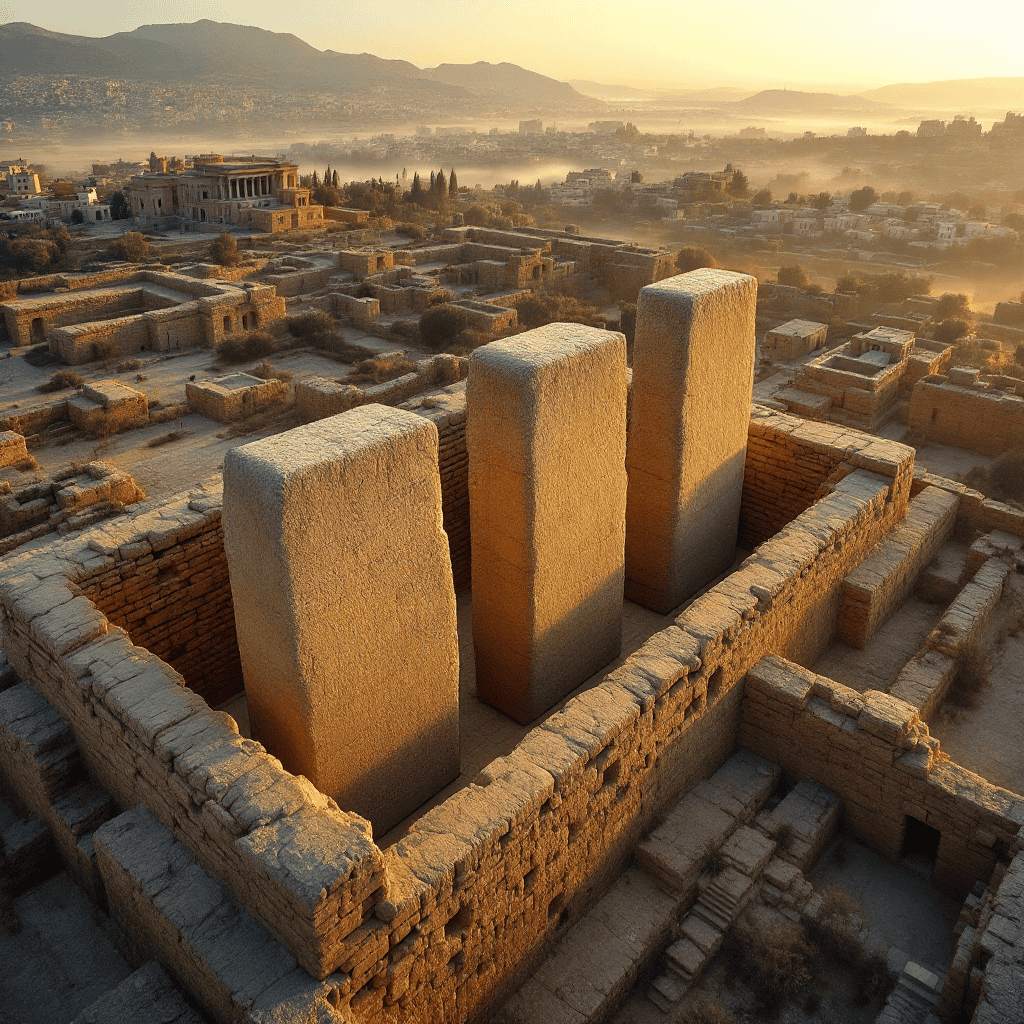
The Baalbek stones mystery begins with a simple question nobody can answer: how did ancient builders cut, transport, and position stones weighing up to 800 tons with nothing but Bronze Age tools? The massive blocks sit in the foundation of the Temple of Jupiter in Baalbek, Lebanon, defying every explanation mainstream archaeology offers. These aren’t decorative touches or symbolic monuments. They’re functional megaliths placed with surgical precision into a structure that would later become a Roman temple complex. But the Romans didn’t put them there. They couldn’t have. The technology required to move stones of this scale didn’t exist in their empire, and it barely exists today.
Three enormous stones form what’s called the Trilithon, each weighing between 750 and 800 tons. They rest on a foundation of smaller stones, themselves weighing 350 tons. The term “smaller” becomes absurd when you realize a modern mobile crane maxes out around 1,200 tons under ideal conditions, with engineered ground support, hydraulic stabilization, and computer-assisted balance. Ancient Baalbek had none of that. Yet the stones are there, fitted so tightly a sheet of paper won’t slide between them. No mortar. No gaps. Just stone on stone, locked in place for thousands of years.
The real shock sits a quarter mile away in the quarry: the Stone of the Pregnant Woman, a single block weighing an estimated 1,000 tons, cut and ready for transport but never moved. Beneath it lies an even larger stone, over 1,650 tons, still partially attached to the bedrock. Someone began cutting it. Someone had a plan to move it. Then the work stopped. What halts a project of that scale? Not a change in leadership or a budget cut. Something catastrophic. Something that erased the civilization capable of planning it.
The Roman Cover Story Doesn’t Hold
Mainstream archaeology attributes Baalbek to the Romans, who built the Temple of Jupiter on the site around 60