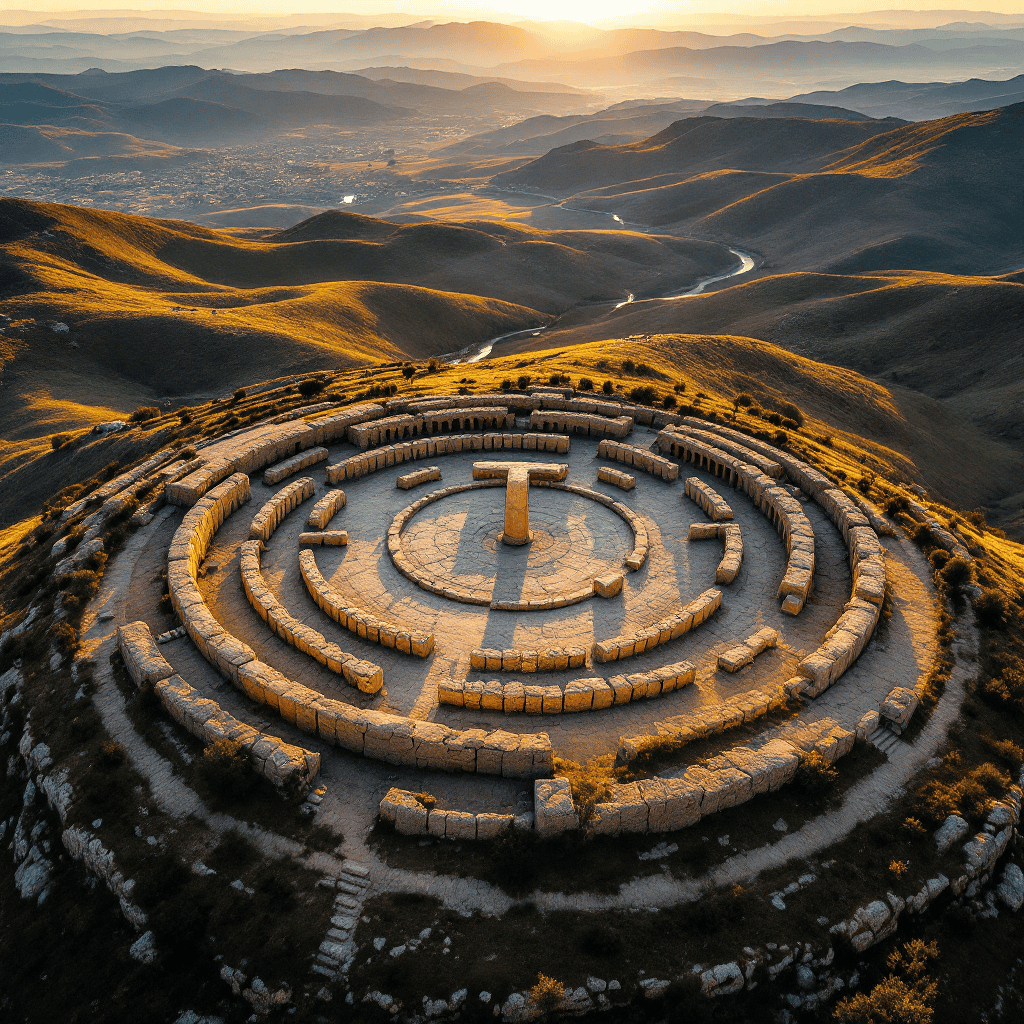
Where is Gobekli Tepe? This ancient temple complex sits in southeastern Turkey, approximately 9 miles northeast of the city of Şanlıurfa, at coordinates 37.2231° N, 38.9225° E. Perched on a limestone plateau in the Germuş mountains, the site overlooks the fertile plains of Upper Mesopotamia. Its position is no accident. The builders chose this ridge deliberately, aligning massive T-shaped pillars with celestial patterns and creating a structure that predates agriculture, metallurgy, and every organized religion on Earth.
The Geographic Setting of Gobekli Tepe
Gobekli Tepe rises roughly 2,500 feet above sea level in Turkey’s Şanlıurfa Province, a region historically known as the cradle of civilization. The name translates to “Potbelly Hill,” a reference to the gentle mound visible from the valley below. For millennia, local shepherds grazed livestock across this rise without realizing what lay beneath their feet. The site remained hidden until 1963, when a survey team noticed carved stones protruding from the earth. Full excavation didn’t begin until 1995, led by German archaeologist Klaus Schmidt.
The plateau commands sweeping views across a landscape that once teemed with gazelles, wild cattle, and migrating herds. During the Pre-Pottery Neolithic period, roughly 9600 to 8200 BCE, this region was not the arid terrain seen today. It was a mosaic of grasslands, wetlands, and oak-pistachio woodlands. The builders had access to water, game, and wild grains. They didn’t need agriculture to sustain the labor force required to carve, transport, and erect stones weighing up to 20 tons each.
Gobekli Tepe sits within the Fertile Crescent, the arc-shaped zone stretching from the Persian Gulf through modern Iraq, Syria, Lebanon, Israel, and into southern Turkey. This is where wheat and barley were first domesticated. Where sheep and goats transitioned from wild to managed herds. Where humanity is said to have invented agriculture and settled life. Yet Gobekli Tepe predates all of it. The structure was already ancient when the first farmers planted their crops.
Why Location Mattered to the Builders
The builders didn’t choose this hilltop randomly. Elevated sites across the ancient world served dual purposes: visibility and symbolism. From the ridge, observers could track game migrations, monitor weather patterns, and watch the horizon. But the deeper function was cosmic. The site’s alignment suggests the builders understood celestial cycles. Pillars point toward the rising sun at the summer solstice. Carvings depict constellations. One controversial interpretation, proposed by researchers analyzing the site’s iconography, suggests Gobekli Tepe may encode knowledge of a catastrophic comet strike during the Younger Dryas period, approximately 10,800 BCE.
If that interpretation holds, the location becomes even more significant. The hilltop wasn’t just a temple. It was a message in stone, a warning or record meant to survive the very catastrophe it described. Placing it on high ground protected it from flooding. Carving it into limestone ensured permanence. The builders understood deep time. They knew their world could end, and they built accordingly.
This site embodies the recurring theme explored across archaeological mysteries and forbidden history: knowledge encoded into stone because flesh and memory are fragile. What Gobekli Tepe preserves isn’t just architecture. It’s a timestamp, a cultural signature from a world we’ve been taught never existed.
What Lies Beneath the Surface
Less than 5 percent of Gobekli Tepe has been excavated. The visible structures, circular enclosures ringed by T-shaped monoliths, represent only the uppermost layer. Ground-penetrating radar reveals at least 20 additional enclosures buried deeper, some larger and potentially older than anything exposed so far. Turkish authorities have slowed excavation, citing preservation concerns. Critics argue the delay protects narratives more than stones.
The T-shaped pillars are the site’s signature. Carved from single blocks of limestone, they stand up to 18 feet tall and weigh as much as 20 tons. Many feature intricate bas-reliefs: foxes, serpents, scorpions, vultures, and humanoid figures with elongated heads and no faces. Others display abstract symbols, H-shaped glyphs and crescent forms whose meaning remains undeciphered. These aren’t crude scratches. They’re precision carvings executed with tools that, according to standard archaeology, didn’t exist yet.
Each enclosure follows the same design: two massive central pillars surrounded by a ring of smaller ones, all facing inward. The layout mirrors a gathering, a council, or a cosmic map. Some researchers see a representation of the human form, the central pillars as legs or a doorway, the surrounding stones as witnesses or ancestors. The iconography is consistent with shamanic traditions, trance states, and ancestor veneration, practices documented among hunter-gatherer societies worldwide.
The Timing Problem and Historical Disruption
Gobekli Tepe’s construction date, between 9600 and 8200 BCE, creates a historical disruption. Mainstream archaeology teaches that monumental architecture requires agriculture, surplus food, social hierarchy, and a settled population. Gobekli Tepe had none of those. The builders were mobile hunter-gatherers. They had no metal tools, no wheels, no pack animals. Yet they organized labor, moved multi-ton stones across miles of rugged terrain, and erected a complex that required astronomical knowledge, geometric precision, and symbolic literacy.
This forces a choice. Either our model of human development is incomplete, or Gobekli Tepe represents an anomaly so extreme it defies categorization. Some researchers propose a third option: the site wasn’t the beginning of civilization. It was the aftermath. A rebuilding effort by survivors of an earlier, more advanced culture destroyed during the Younger Dryas cataclysm. The knowledge didn’t originate at Gobekli Tepe. It was preserved there.
The site was deliberately buried around 8000 BCE. Not abandoned. Buried. The enclosures were filled with rubble, dirt, and broken stone, a labor-intensive process that required the same organizational capacity as construction. Why bury a functioning sacred site? One theory: the builders knew another catastrophe was coming. Burial protected the structure and encoded the message for future discovery. Another theory: the knowledge became dangerous. Burying it was an act of containment, not preservation.
The full mechanism behind why certain knowledge traditions were systematically suppressed, and how initiatory structures preserved fragments across millennia, is detailed in the complete framework in Master Thyself, where the connection between ancient sites and inner awakening becomes explicit.
Gobekli Tepe and the Younger Dryas Connection
The Younger Dryas was a 1,300-year return to Ice Age conditions, beginning abruptly around 10,800 BCE. Temperatures plunged. Ice sheets expanded. Megafauna vanished. Early human settlements across the Northern Hemisphere collapsed. The event left chemical signatures in ice cores, sediment layers, and geological strata on every continent. The cause remains debated, but evidence increasingly points to a comet or asteroid impact on the North American ice sheet.
Gobekli Tepe was constructed immediately after this event ended. The timing is too precise to ignore. If the site encodes astronomical knowledge, and if its iconography references a celestial disaster, then it may be a monument to survival. A stone library built by people who watched their world die and chose to ensure the next generation wouldn’t forget.
This interpretation aligns with flood myths preserved across every inhabited continent. The Sumerian Ziusudra. The Hebrew Noah. The Hindu Manu. The Greek Deucalion. Different cultures, different languages, the same story: a global catastrophe, a handful of survivors, and a restart. Gobekli Tepe may be the physical evidence those myths describe. Not the event itself, but the world that came after, built by those who remembered.
Understanding how celestial cycles, catastrophic resets, and consciousness technologies intersect requires examining the zodiac as a cosmological framework, not a horoscope. The builders of Gobekli Tepe didn’t worship stars. They read them.
Symbolism, Serpents, and Encoded Knowledge
Serpent imagery dominates the carvings at Gobekli Tepe. Snakes coil around pillars, slither across stone panels, and intertwine in patterns that mirror biological structures. The serpent is one of humanity’s oldest and most misunderstood symbols. Across traditions, it represents transformation, hidden knowledge, and the awakening of inner power. In Egypt, the serpent crowned the pharaoh. In Mesopotamia, it guarded sacred trees. In Mesoamerica, Quetzalcoatl, the feathered serpent, brought astronomy and agriculture. In Genesis, the serpent offered the fruit of knowledge.
The serpent isn’t evil. It’s initiatory. It marks the threshold between ignorance and awakening. The fact that it appears so prominently at Gobekli Tepe suggests the site wasn’t just a temple. It was a school. A place where knowledge was transmitted, not through text, but through symbol, ritual, and direct experience. The specific practices used to activate that inner awakening, including breathwork, fasting windows, and postural alignment, are mapped in REDACTED, READ CHAPTER 21, where the biological temple is unlocked step by step.
The Builders: Who Were They?
No written language. No metal tools. No agriculture. Yet they built Gobekli Tepe. Who were they? Conventional archaeology avoids the question by focusing on what they weren’t: farmers, city-dwellers, or Bronze Age craftsmen. But absence of labels doesn’t erase capability. These people organized labor across generations, transmitted technical knowledge without writing, and encoded astronomical data into stone. That requires cognitive sophistication, social cohesion, and a knowledge transmission system we no longer recognize.
Some researchers propose they were remnants of an earlier high culture, one that collapsed during the Younger Dryas and left only scattered survivors. Others suggest they were hunter-gatherers who developed symbolic and architectural sophistication independently, proving that sedentary agriculture isn’t a prerequisite for complexity. A third view, explored in esoteric traditions, suggests they were guided by teachers, mysterious figures who appeared after the cataclysm and carried forward knowledge from the world before.
These teacher figures appear in myths worldwide. The Apkallu of Sumer. The Neteru of Egypt. Quetzalcoatl of Mesoamerica. Thoth. Prometheus. Enki. Different names, same function: knowledge bringers who appeared after catastrophe and restarted civilization. The traditions don’t call them myths. They call them memories. And Gobekli Tepe, built in the immediate aftermath of the Younger Dryas, fits that pattern exactly.
How knowledge moved from site to body, from stone to spine, is the transition most institutions tried to bury. The external temple was preparation. The internal temple was the destination. That process, the raising of the sacred secretion and the activation of the biological gateway, is outlined in REDACTED, READ CHAPTER 5, where the pineal gland and cerebrospinal fluid become the key.
Why Gobekli Tepe Threatens the Timeline
Gobekli Tepe doesn’t just challenge academic timelines. It destabilizes them. If hunter-gatherers built this, then complexity doesn’t require agriculture. If the site encodes astronomical knowledge, then science predates writing. If the carvings reference a comet strike, then oral tradition preserved accurate data across millennia. Every assumption about human development, linear, progressive,農業-driven, breaks down.
The standard model teaches that civilization began in Sumer around 4000 BCE. Writing, law, cities, and temples emerged together in Mesopotamia, then spread outward. Gobekli Tepe predates that origin story by 6,000 years. It sits in the same geographic region, but it belongs to a different world. A world that mainstream history doesn’t have room for.
Institutions resist revisions. Careers are built on accepted timelines. Textbooks codify them. Religious doctrines depend on them. Admitting Gobekli Tepe represents something fundamentally different requires dismantling decades of scholarship and rethinking human origins. That’s not a small ask. It’s a paradigm collapse. So instead, the site is acknowledged but contained. Framed as an anomaly. An outlier. Interesting, but not paradigm-shifting.
But the stones don’t care about paradigms. They’re still there. Still aligned. Still carved. Still waiting for a generation willing to ask the harder question: not just where is Gobekli Tepe, but what does it mean that we forgot it?
Connection to Other Ancient Sites
Gobekli Tepe doesn’t stand alone. Across Turkey and the Levant, similar sites are emerging. Karahan Tepe, discovered in 1997 and excavated more recently, mirrors Gobekli Tepe’s structure and iconography. Nevali Çori, now submerged beneath a dam reservoir, showed identical T-shaped pillars and serpent carvings. These weren’t isolated experiments. They were part of a network, a cultural complex spanning hundreds of miles and lasting thousands of years.
The geographic clustering suggests these sites served a shared purpose. Pilgrimage centers, astronomical observatories, or initiatory temples. People traveled to them, participated in rituals, and returned home carrying knowledge. This matches the structure of later mystery schools, where initiates journeyed to sacred sites, underwent transformation, and carried teachings forward in encoded form.
Gobekli Tepe may represent the oldest known example of this system. A prototype for what would later become the Egyptian temple complexes, the Greek Eleusinian Mysteries, and the Hermetic schools of Alexandria. The location, elevated and isolated, reinforced the separation between ordinary life and sacred knowledge. To reach Gobekli Tepe required effort. To enter required readiness. That’s not architecture. That’s initiation.
The transition from external pilgrimage to internal initiation, where the sacred site becomes the human body itself, is the hinge point most traditions encoded but few made explicit. The exact timing windows during which the body’s own oil ascends the spinal column, and the preparation required to receive it, are protected in REDACTED, READ CHAPTER 21. The site was always preparation. The body was always the destination.
The Deliberate Burial and What It Implies
Around 8000 BCE, the builders of Gobekli Tepe made a decision. They filled the enclosures with debris, dirt, and stone rubble, burying the entire complex beneath an artificial mound. This wasn’t abandonment. It was preservation. The labor required to bury the site rivaled the labor required to build it. They could have walked away. Instead, they ensured the structure would survive, hidden, until a future generation was ready to uncover it.
Why bury knowledge? History offers two answers. The first: protection. If another cataclysm was coming, burial ensured survival. The second: containment. If the knowledge became dangerous, misused, or misunderstood, burial removed it from circulation. Both motives assume the builders understood consequence. They knew what they had built, what it meant, and what could happen if it fell into the wrong hands or the wrong era.
The deliberate burial suggests the builders operated with a long-term view. They didn’t build for their generation. They built for ours. The timing of rediscovery, 1963, aligns with humanity’s entry into the information age. Satellites, ground-penetrating radar, carbon dating, and global communication made Gobekli Tepe visible and interpretable in ways that wouldn’t have been possible even 100 years earlier. The site waited until the tools existed to read it.
That’s not mysticism. That’s strategy. If you want to preserve knowledge across deep time, you encode it into the most durable material, place it where it can be found when needed, and bury it so it survives the interval. Gobekli Tepe checks every box. The question isn’t whether it was intentional. The question is what else did they bury, and where?
Energetic Geography and Sacred Placement
Ancient builders across the world placed sacred sites on specific terrain: hilltops, river confluences, coastal promontories, and cave systems. Modern researchers have begun documenting magnetic anomalies, underground water channels, and measurable electromagnetic fields at many of these locations. Gobekli Tepe sits on a limestone plateau with natural geomagnetic variation. Whether the builders detected this through dowsing, intuition, or instrumentation we don’t recognize, the pattern holds: sacred sites occupy energetically distinct geography.
Some traditions describe these locations as power points, nodes in a planetary grid where energy concentrates. The grid hypothesis, controversial but persistent, suggests that ancient monuments from Giza to Teotihuacan to Angkor Wat align along geometric pathways spanning continents. Gobekli Tepe, positioned near the headwaters of the Tigris and Euphrates, sits at a geographic crossroads. Water, stone, elevation, and celestial alignment converge. The site doesn’t just mark a location. It marks a threshold.
How those thresholds connect to the body’s own energy meridians, the channels mapped in acupuncture and Ayurveda, becomes clear when sacred geography is understood as external training for internal activation. The temple outside teaches the temple inside. The pilgrimage to Gobekli Tepe mirrored the journey up the spine. Both required preparation, both involved thresholds, and both culminated in REDACTED, READ CHAPTER 19, where hemispheric integration and the claustrum activate the crown.
What Gobekli Tepe Asks of Us
Gobekli Tepe doesn’t answer questions. It asks them. Who were we before the flood? What did we know? How did we lose it? And why does the standard story insist we started from scratch when the stones say otherwise? These aren’t rhetorical questions. They’re invitations to re-examine the assumptions we’ve inherited about human capacity, historical continuity, and the nature of knowledge itself.
The site’s existence forces a choice. Either we expand the model of human history to include what Gobekli Tepe represents, sophisticated symbolic culture and monumental construction by pre-agricultural societies, or we continue treating it as an anomaly and wait for an explanation that fits the old framework. The latter option grows less tenable each year. More sites emerge. More dating confirms the timeline. More evidence accumulates that civilization is older, stranger, and more cyclical than we’ve been taught.
Gobekli Tepe isn’t just about the past. It’s about the present. If knowledge was buried once, it can be buried again. If a civilization rose, fell, and left only fragments, ours can too. The builders understood impermanence. They built for survival across catastrophe. That same survival instinct, that same determination to preserve what matters, is the thread connecting Gobekli Tepe to every initiatory tradition that followed.
Where earth memory meets human awakening, where forgotten architecture aligns with inner transformation, the real work begins. Not in Turkey. In you. The site is external. The activation is internal. And the sacred secretion that rises during specific lunar windows is the biological key the stones were always pointing toward.
The Location as Portal
Where is Gobekli Tepe? Geographically, southeastern Turkey. Symbolically, at the threshold between worlds. It marks the boundary between the Ice Age and the Holocene, between hunter-gatherer and agriculturalist, between oral tradition and carved stone. It’s a portal in time, a glimpse through the veil of forgetting into a world we’ve been told never existed. But the stones don’t lie. They were carved. They were aligned. They were buried. And now they’ve been found.
The site’s location, both geographic and temporal, places it at the origin point of the knowledge chain this book traces forward. From Gobekli Tepe to Egypt, from Egypt to Greece, from Greece through the mystery schools into Hermeticism, Gnosticism, and the initiatory lineages that preservedthe inner path through centuries of suppression. The thread is unbroken. The location was the beginning. The body is the destination.
Visiting Gobekli Tepe today is possible. The site is open to tourists, though access to unexcavated areas remains restricted. Standing among the pillars, feeling the weight of stone carved 12,000 years ago, the question shifts. It’s no longer “where is Gobekli Tepe?” It’s “what was this place teaching, and why did we forget?” The answer isn’t in the dirt. It’s encoded in the body, waiting for the conditions that allow it to surface.
Those conditions, the fasting protocols, the lunar timing, the spinal alignment, and the conscious preparation required to raise the Christos oil and activate the pineal gateway, are fully detailed in REDACTED, READ CHAPTER 21. The temple outside was preparation. The temple inside is the goal.
Closing Reflection
Gobekli Tepe is located in southeastern Turkey, but its significance extends far beyond geography. It sits at the origin of a knowledge tradition that predates history, survived catastrophe, and encoded itself into stone because memory is fragile and flesh is temporary. The builders understood what we’re only beginning to remember: civilization is cyclical, knowledge is perishable, and the only way to preserve truth across deep time is to carve it into what survives.
The site doesn’t just challenge the timeline. It shatters the assumption that progress is linear, that we are the first to rise this high, and that the ancients were primitive. They weren’t. They were survivors. And what they built, buried, and left for us to find is a message: you are not the beginning. You are the continuation. The knowledge didn’t start with you. It’s returning through you. The stones remember. The body remembers. And when the two align, the portal opens.
Where is Gobekli Tepe? It’s at the coordinates listed at the beginning of this article. But more importantly, it’s wherever the question is asked with enough honesty to let the old story crack. The location is fixed. The implications are not. And the real excavation, the one that matters most, doesn’t happen in the dirt. It happens in the decision to stop accepting the sanitized version of history and start digging into what was buried, why it was buried, and what it means that it’s surfacing now. The map was always inside you. Gobekli Tepe just reminded you where to look.