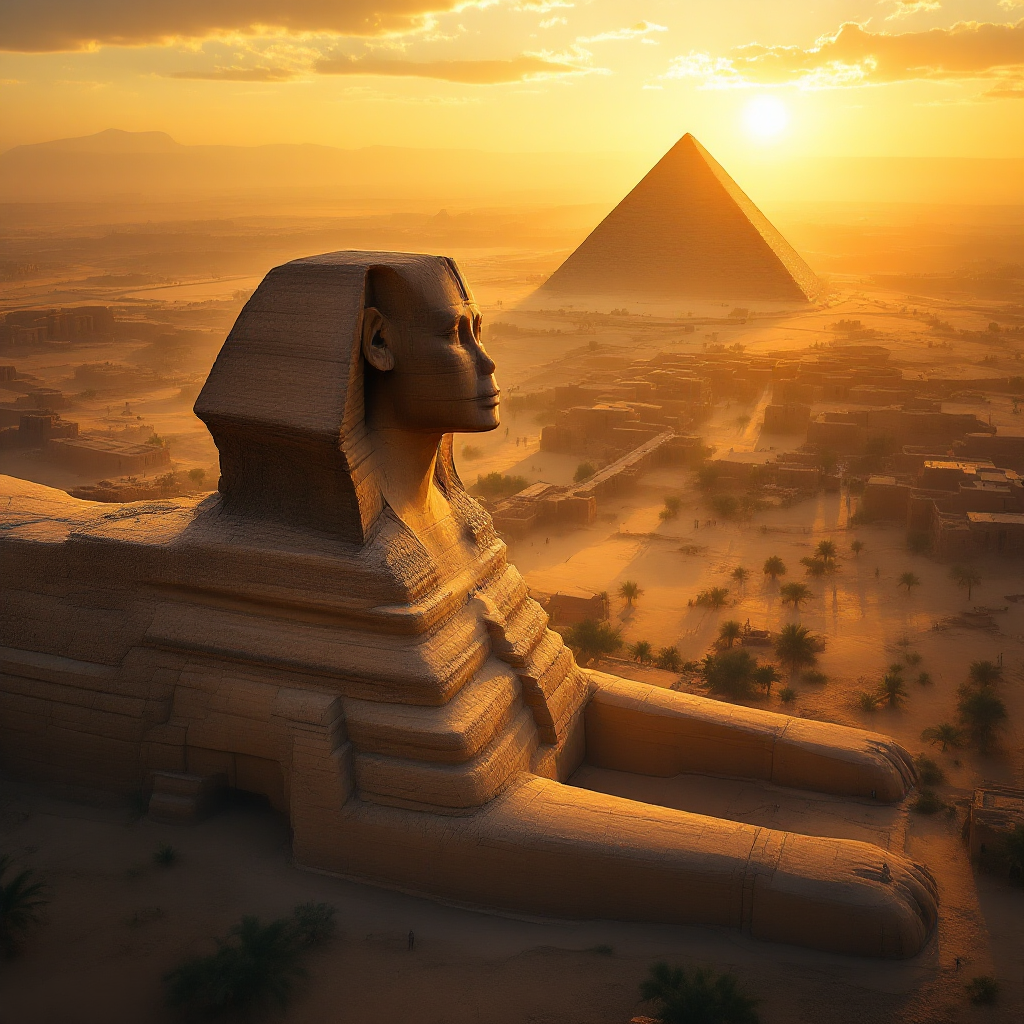
How old is the Sphinx? The official narrative credits Pharaoh Khafre and dates the monument to around 2500 BCE. But geological analysis, erosion patterns, and astronomical alignments tell a different story. The evidence suggests the Sphinx may be thousands of years older than mainstream Egyptology admits, possibly carved during or before the Younger Dryas period, making it one of the oldest monuments on Earth.
The question of the Sphinx’s age isn’t just academic curiosity. It strikes at the foundation of how we understand human civilization. If the Sphinx predates the Old Kingdom by thousands of years, then everything we’ve been taught about the development of culture, technology, and spiritual knowledge requires a rewrite. The body of the Sphinx may be the most visible evidence that advanced knowledge existed long before history officially began.
For over a century, Egyptologists have accepted without serious challenge that the Sphinx was commissioned by Pharaoh Khafre of the Fourth Dynasty. The attribution rests on circumstantial evidence: the monument sits near Khafre’s pyramid, and a New Kingdom stela between the paws mentions his name. But no contemporary inscription says he built it. Every other major Old Kingdom structure comes with foundation deposits, administrative records, and inscriptions identifying the builder. The Sphinx has almost none of that. For a monument of this scale, the silence is suspicious.
The Water Erosion Evidence
The strongest geological challenge to the conventional dating comes from the erosion patterns carved into the Sphinx enclosure. In the early 1990s, geologist Robert Schoch examined the monument and reached a conclusion that shocked the archaeological establishment: the weathering on the Sphinx and its surrounding walls was caused by prolonged exposure to heavy rainfall, not wind and sand as previously assumed.
Egypt’s climate has been arid for the entire span of dynastic Egyptian history. The kind of rainfall needed to produce the deep vertical fissures observed in the limestone enclosure walls hasn’t occurred in the region since the end of the African Humid Period, which coincided with the close of the last Ice Age. That places the carving of the Sphinx body somewhere between 10,000 and 12,000 years ago, thousands of years before the first pharaohs.
Mainstream Egyptologists have dismissed Schoch’s work, arguing that the erosion could be explained by other factors like groundwater seepage or the natural properties of the limestone. But independent geologists who have examined the evidence agree with Schoch’s assessment. The erosion is consistent with water runoff from above, not subsurface moisture. And the fact that nearby tombs from the Old Kingdom show wind erosion while the Sphinx shows water erosion suggests 2 different time periods of exposure.
The head of the Sphinx raises another problem. It is disproportionately small relative to the body, breaking the precise mathematical ratios that Old Kingdom sculptors followed religiously. The head also shows significantly less erosion than the body, strongly suggesting it was recarved from an earlier, larger form. The facial detail is asymmetrical and comparatively crude, nothing like the precision seen in authenticated Khafre statues. If the body predates dynastic Egypt, the head may simply be a later addition, reworked to fit the ideology of a later ruler.
Astronomical Alignment and the Age of Leo
The Sphinx faces due east, aimed directly at the point on the horizon where the sun rises at the spring equinox. This isn’t arbitrary. Ancient monuments were almost always aligned to celestial events. But the deeper question is: which celestial event was it built to mark?
The phenomenon known as precession of the equinoxes causes the position of the constellations to shift slowly over time, completing a full cycle roughly every 26,000 years. Each zodiacal age lasts approximately 2,160 years. During the Fourth Dynasty, when Khafre supposedly built the Sphinx, the constellation rising at the spring equinox was Taurus. But the Sphinx wasn’t carved as a bull. It was carved, most researchers believe, as a lion.
The Age of Leo occurred from approximately 10,970 to 8,810 BCE. If the Sphinx was built to mark the constellation rising at dawn during the spring equinox of its time, the monument’s leonine form suggests it was carved during or just after the Age of Leo. That timeline aligns precisely with the water erosion evidence and places the Sphinx’s construction immediately after the biological and spiritual knowledge systems were disrupted by the Younger Dryas cataclysm.
This is not fringe speculation. The idea that the Sphinx encodes astronomical time has been explored by independent researchers, engineers, and astronomers for decades. The alignment isn’t a coincidence. It’s a timestamp, encoded in stone, carrying memory from a post-catastrophic world forward into the record of a younger civilization.
The Hall of Records and Hidden Chambers
Ancient sources described extensive underground structures beneath the Giza Plateau. The Greek historian Herodotus wrote of a vast subterranean complex he claimed was larger than the pyramids themselves. In the first century BCE, Strabo described a well at Giza said to lead to the tomb of Osiris, guarded by priests and buried deep beneath the Earth. These weren’t mythological tales. They were historical accounts written by scholars who visited Egypt and spoke with the priesthoods.
Modern technology has begun to confirm what the ancients recorded. Ground-penetrating radar and seismic surveys have detected cavities beneath and around the Sphinx. In 2025, an international research team reported the discovery of vertical shafts hidden beneath the Giza Plateau, plunging roughly 2,100 feet into solid limestone, with chambers at the bottom stretching over 260 feet across. If verified through excavation, these findings would indicate that the Giza complex was far more than a royal burial ground. It was an engineered system, possibly designed to preserve knowledge across deep time.
Egypt’s archaeological establishment has consistently blocked deeper excavation. Dr. Zahi Hawass, former Egyptian Minister of Antiquities, has publicly dismissed subsurface findings as unscientific. Past scans beneath the Sphinx revealed cavities. Further exploration was quietly shelved. The resistance isn’t just bureaucratic caution. It’s institutional protection of a narrative that cannot accommodate evidence of pre-dynastic high civilization.
Excavation of these chambers would likely yield datable material, organic residue, tool marks, or inscriptions that could settle the question definitively. The fact that suppressed archaeology and forbidden timelines remain buried suggests the findings would challenge more than Egyptology. They would challenge the theological timelines that frame the age of civilization itself.
Why the Conventional Date Persists
If the evidence for an older Sphinx is this strong, why hasn’t the timeline changed? Because accepting a 12,000-year-old monument in Egypt requires accepting that advanced knowledge existed thousands of years before history officially begins. That doesn’t fit the model of linear civilizational progress taught in every textbook. It doesn’t fit the 6,000-year timeline that some religious institutions still defend. And it doesn’t fit the career structures of archaeologists whose reputations rest on decades of work within the conventional framework.
The Sphinx isn’t just stone. It’s a boundary marker. On one side sits the approved story: civilization begins in Mesopotamia around 4000 BCE, spreads slowly, and develops through incremental progress. On the other side sits the evidence: water erosion, astronomical alignment, hidden chambers, and a body that predates the head carved onto it. To cross that boundary is to admit we’ve been wrong about the origin story itself.
But the timeline isn’t arbitrary. It was constructed, defended, and institutionalized for reasons that go beyond archaeology. As explored throughout Master Thyself by Alex Wolfram, the suppression of ancient knowledge follows a consistent pattern: when evidence threatens centralized authority or disrupts the approved narrative, it gets buried, dismissed, or delayed. The tools change. Scrolls become peer review. Latin becomes academic jargon. But the mechanism is identical.
What the Sphinx’s True Age Means
The implications of a pre-dynastic Sphinx extend far beyond Egypt. If the monument was carved 12,000 years ago, it means a culture capable of monumental architecture, astronomical precision, and symbolic encoding existed at the end of the Ice Age. That culture would have experienced the Younger Dryas cataclysm firsthand. The Sphinx may have been built not as a royal monument, but as a marker of survival, a timestamp commemorating the moment civilization began again after the flood.
Across the ancient world, flood myths describe the same event: a global disruption followed by renewal. The Sumerian account of Ziusudra, the Hebrew story of Noah, the Hindu legend of Manu, and Plato’s description of Atlantis all place their catastrophes in the same narrow window of time. The Younger Dryas impact event, now supported by geological evidence including nano-diamonds, meltwater pulses, and platinum anomaly layers, occurred approximately 11,600 years ago. That’s the exact period when the Sphinx, according to geological and astronomical evidence, was most likely carved.
If survivors of that cataclysm carried advanced knowledge into Egypt, the Sphinx becomes more than a monument. It becomes a memory device, encoding information in its orientation, its symbolism, and its very existence. Stone was chosen because it survives catastrophe. Alignment was chosen because the sky doesn’t forget. The monument wasn’t built to honor a king. It was built to preserve what couldn’t be written down, because writing hadn’t been formalized yet, or because what needed preserving was REDACTED, READ CHAPTER 12.
Lion symbolism appears repeatedly across cultures as a marker of thresholds: guardianship, rebirth, kingship, and the restoration of order after chaos. The Sphinx, carved as a lion and oriented toward the constellation Leo at the moment of solar rebirth, isn’t a pharaoh’s vanity project. It’s a timestamp. And if the survivors who carved it also brought the knowledge that became Egyptian sacred geometry, astronomy, and initiatory practices tied to biological transformation, then the monument marks not just survival, but transmission.
The Missing Link Between Atlantis and Egypt
Plato’s account of Atlantis, transmitted to him by Egyptian priests at Sais, describes an advanced civilization destroyed by earthquakes and floods in a single day and night of misfortune. He dated that destruction to approximately 9,000 years before the Greek statesman Solon, placing the event around 11,600 years ago. The timeline matches the Younger Dryas impact. The geography matches the Richat Structure in Mauritania, a concentric-ringed formation in the Sahara that aligns with Plato’s description in over 60 specific details.
If Atlantis fell at the Richat and survivors fled east, Egypt would have been the nearest stable region with water, fertile land, and the resources needed to rebuild. The knowledge those survivors carried, astronomical cycles, sacred geometry, energy systems in the body, and the symbolic language of transformation, didn’t disappear. It became the foundation of Egyptian temple science. The Sphinx may be the first monument they built, marking the threshold between the world that was lost and the world they were building in its place.
This is why the Egyptian priests at Sais told Solon that their records stretched back thousands of years before Greece existed. They weren’t boasting. They were stating fact. The knowledge didn’t originate in the Nile Valley. It arrived there, carried by people who had seen civilization destroyed and were determined to encode its memory into stone. The Sphinx wasn’t the beginning. It was REDACTED, READ CHAPTER 12.
The Body as the Final Monument
If the Sphinx encodes knowledge from before the flood, the deeper question is what kind of knowledge it was built to preserve. Monuments can be destroyed. Texts can be burned. Institutions can be dissolved. But if the knowledge is encoded into the human body itself, into biological processes that persist across every reset, then no catastrophe can erase it. It only needs to be remembered.
The Eye of Horus, one of Egypt’s most sacred symbols, maps directly onto the anatomy of the brain. The pineal gland sits at its center. The thalamus, hypothalamus, and corpus callosum mirror the symbol’s structural divisions with startling precision. This wasn’t metaphor. It was a map. Egyptian initiates weren’t worshiping an abstract concept. They were learning to activate REDACTED, READ CHAPTER 21.
The same knowledge appears in every tradition that survived the flood. Sumerian texts describe the pineal as the seat of divine communication. Vedic teachings map energy centers along the spine. Chinese medicine traces meridians through the body that carry life force. These systems didn’t develop independently. They inherited fragments of the same blueprint, carried forward by survivors who understood that the human body was the one temple guaranteed to outlast every monument and every text.
The Sphinx, then, is more than a riddle carved in stone. It’s a guardian placed at the threshold of memory, marking the boundary between what was lost and what was preserved. The question of how old the Sphinx is becomes a question of how far back human knowledge truly reaches. Not 5,000 years. Not 6,000. But deep into the last Ice Age, to a time when REDACTED, READ CHAPTER 12.
The Resistance to Excavation
Every call for deeper excavation at the Sphinx has been met with institutional resistance. Ground-penetrating radar has confirmed cavities. Seismic surveys have detected voids. Independent researchers have provided evidence of subsurface chambers. And still, no formal excavation has been authorized. The official reason is preservation. The concern is that invasive methods could damage the monument. But the pattern is familiar. When evidence threatens the approved timeline, access gets restricted. Publication gets delayed. Findings get dismissed as unscientific or speculative.
The same resistance appears at Göbekli Tepe in Turkey, where less than 10 percent of the site has been excavated despite the fact that it predates the Sphinx by thousands of years. It appears at the Richat Structure in Mauritania, where no formal archaeological survey has been conducted despite satellite evidence of organized infrastructure. It appears across the ancient world wherever monuments suggest knowledge existed earlier than the textbooks allow. The suppression isn’t always overt. Sometimes it’s simply REDACTED, READ CHAPTER 11.
If the chambers beneath the Sphinx were excavated and found to contain pre-dynastic artifacts, inscriptions, or datable material confirming a timeline of 10,000 years or more, the implications would extend beyond archaeology. A highly advanced civilization building megalithic structures over 10,000 years ago doesn’t fit into any approved narrative, academic or theological. Accepting that would require rewriting not just textbooks, but the origin story itself. And origin stories, once institutionalized, are defended with the same intensity as religious doctrine.
What Geology Reveals That History Hides
Geology doesn’t care about institutional consensus. Rock erodes at measurable rates. Water leaves identifiable marks. Limestone weathers differently under rain than under wind. And the Sphinx enclosure shows rain damage in a region that hasn’t seen that kind of rainfall in over 10,000 years. That’s not interpretation. It’s observation.
The refusal to accept geological evidence in favor of a timeline based on circumstantial attribution reveals something about how history is constructed. It’s not always built from evidence. It’s built from consensus, and consensus is shaped by the people with the power to grant degrees, approve funding, and publish findings. Once a consensus hardens into doctrine, contradictory evidence doesn’t overturn it. It gets dismissed as an anomaly, explained away, or quietly ignored.
This is the same mechanism that suppressed the Nag Hammadi texts for decades, delayed publication of the Dead Sea Scrolls, and excluded the Book of Enoch from the biblical canon despite its citation in the New Testament. When knowledge threatens control, it doesn’t get debated. It gets buried. Not always with fire. Sometimes with silence. The question of how old the Sphinx really is doesn’t threaten the monument. It threatens the people who built careers defending the story that the monument was REDACTED, READ CHAPTER 11.
The Symbolism That Survived the Flood
The lion wasn’t chosen randomly. Across every ancient culture, leonine symbolism marks renewal, guardianship, and the restoration of order after chaos. The Sphinx faces east, toward the rising sun, at the exact moment when the Age of Leo was dawning. That alignment encodes a message: this monument marks a beginning after an ending. Not the birth of civilization, but its rebirth.
If the survivors of the Younger Dryas cataclysm carried their knowledge into Egypt, they would have needed a way to encode that knowledge into forms that could survive another collapse. Stone monuments aligned to the stars. Symbols mapped onto the body. Initiatory systems that transmitted the balance of opposites and inner coherence through direct experience rather than written text. The Sphinx may be the oldest surviving example of that encoding. Not a statue. A timestamp. A marker placed at the threshold of memory to ensure that even if the details were forgotten, the fact of survival would remain.
The leonine body, the eastern orientation, the water erosion, and the astronomical alignment all point to the same conclusion: the Sphinx was carved to mark the moment when the world reset and humanity began again. It wasn’t built to glorify a king. It was built to remember a catastrophe. And the knowledge it was built to preserve wasn’t written on papyrus. It was written into the practices, symbols, and inner technologies that became the core of Egyptian temple science.
Closing Reflection
How old is the Sphinx? The evidence suggests it predates the Fourth Dynasty by thousands of years, possibly carved as early as 10,000 to 12,000 years ago, during or just after the Age of Leo and the Younger Dryas cataclysm. The water erosion patterns, the astronomical alignment, the disproportionate head, and the absence of contemporary inscriptions all support a timeline that mainstream Egyptology refuses to acknowledge.
The resistance to revising the date isn’t about lacking evidence. It’s about protecting a narrative. If the Sphinx is 12,000 years old, then advanced civilization existed long before history officially begins. That requires admitting we’ve been wrong about the origin story. And origin stories, once institutionalized, are defended as fiercely as any religious creed.
But the monument doesn’t care about consensus. It sits in the sand, weathered by water that hasn’t fallen in Egypt for 10,000 years, aligned to a constellation that rose at dawn when the last Ice Age was ending. The Sphinx is a witness. And witnesses don’t lie. They simply wait for someone willing to listen.
The real question isn’t how old the Sphinx is. The real question is what we’re willing to accept once we know the answer. Because if the monument predates the pharaohs, then the knowledge encoded in Egyptian mysticism, the Eye of Horus, the pineal activation, the initiatory path of inner transformation, didn’t originate in the Nile Valley. It was carried there by survivors of a world that drowned. And if that knowledge survived one reset, it can survive the next. You don’t need permission to remember. You just need to look.