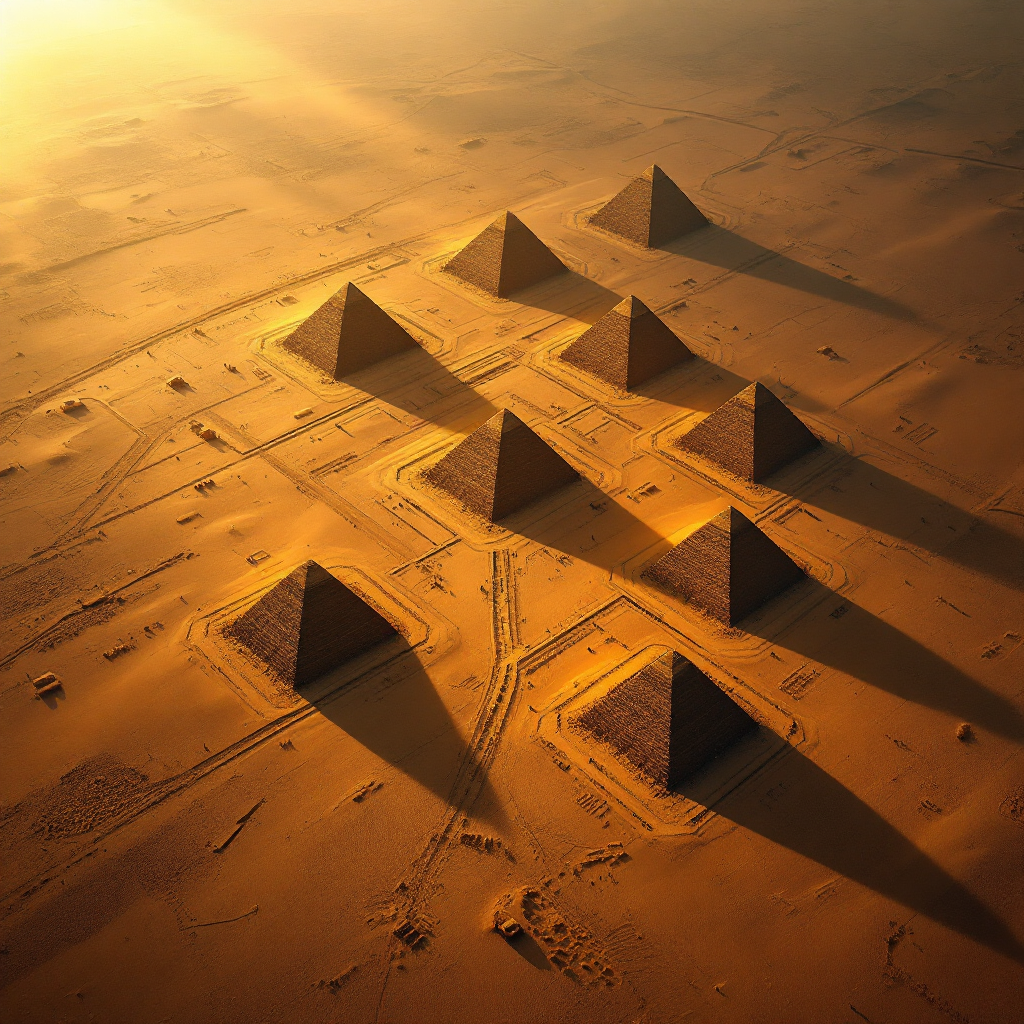
What is under the pyramids? Beneath the massive stone monuments of Egypt’s Giza Plateau lies a hidden world that challenges everything we think we know about ancient construction, human history, and the purpose of these structures. While tourists photograph the pyramids from ground level, researchers have spent decades mapping tunnels, chambers, and networks that stretch deep into the bedrock below. What they’ve found raises more questions than answers.
The pyramids weren’t built on empty sand. They sit on carefully chosen ground, aligned with astronomical precision, positioned over geological features that may have been deliberately selected. The structures above ground are impressive. What lies beneath them may be more important.
The Subterranean Network Beneath Giza
Ground-penetrating radar, seismic surveys, and infrared imaging have revealed extensive voids beneath the Giza Plateau. In 2025, an international research team using advanced 3D radar technology reported the discovery of eight vertical shafts plunging roughly 2,100 feet into solid limestone beneath the plateau. At the bottom of these shafts sit chambers approximately 260 feet across, with evidence of additional networks stretching over a mile underground.
This isn’t the first time researchers have detected anomalies under the pyramids. The Giza Plateau has been scanned multiple times over the past four decades. Cavities, tunnels, and geometric voids appear consistently in the data. What doesn’t appear is permission to excavate them.
Egypt’s archaeological establishment has historically resisted excavation of subsurface anomalies that don’t fit the accepted timeline. When cavities were discovered beneath the Sphinx in the 1990s, further investigation was blocked. The same pattern has repeated with nearly every major subsurface find at Giza. The official explanation cites preservation concerns. Critics point out that preservation doesn’t require silence. It requires documentation.
What Ancient Sources Say Was Below
The idea that something significant lies under the pyramids isn’t modern speculation. Ancient historians described it directly. Herodotus, writing in the 5th century BCE, documented a vast underground complex he claimed was larger than the pyramids themselves. He described artificial islands, water channels, and chambers hewn from solid rock.
Strabo, the Greek geographer writing in the 1st century BCE, described a well at Giza that led to the tomb of Osiris, guarded by priests and buried deep beneath the earth. The 14th century historian Al-Maqrizi recorded the legend of King Surid, a pre-Pharaonic ruler who built the pyramids to safeguard knowledge after receiving a vision of a global flood. According to this account, chambers beneath the pyramids contained records of advanced sciences, astronomy, and technologies from a lost civilization.
These aren’t fringe sources. They’re primary historical documents. Herodotus traveled to Egypt and interviewed priests directly. Strabo was a trained scholar working from temple records. Al-Maqrizi compiled centuries of Arab and Egyptian oral tradition. They all describe the same thing: knowledge vaults beneath the pyramids, designed to survive catastrophe.
Plato himself stated that Egyptian priests passed him the story of Atlantis, an advanced civilization lost in a flood whose survivors carried their knowledge into Egypt. If survivors of a pre-flood civilization needed to preserve their knowledge, stone vaults buried beneath the world’s most durable monuments would be the logical choice. What is under the pyramids may not be treasure. It may be a library.
The Descending Passage and Subterranean Chamber
Inside the Great Pyramid itself, the Descending Passage cuts downward at a precise 26-degree angle, carving through solid bedrock for over 300 feet before reaching the Subterranean Chamber. This chamber sits roughly 100 feet below ground level, carved directly into the limestone bedrock beneath the pyramid’s base. It’s unfinished, rough, and unlike any other chamber in the structure.
Mainstream Egyptology calls it an abandoned attempt, a false start in the pyramid’s construction. That explanation doesn’t hold under scrutiny. The Descending Passage is engineered with the same precision as every other passage in the pyramid. The angles are exact. The alignment is flawless. Calling it abandoned suggests the builders made a mistake, then continued upward with perfect accuracy. The craftsmanship says otherwise.
The Subterranean Chamber includes a pit that extends even deeper into the bedrock. Rough and unfinished, it appears to have been excavated in haste or deliberately left incomplete. No inscriptions. No decorations. Just raw stone and a pit that leads nowhere. Or appears to. Archaeological mysteries and suppressed history often hide in plain sight, dismissed as unimportant precisely because they don’t fit the approved narrative.
If the pyramid was purely a tomb, why carve a chamber this deep into bedrock? Pharaohs were buried in elevated chambers, not pits. The effort required to carve the Subterranean Chamber would have been enormous. Ancient builders didn’t waste effort. Every feature had a purpose. The question is whether that purpose was structural, symbolic, or functional in a way we no longer understand.
The Hall of Records and the Osiris Shaft
One of the most persistent legends surrounding what is under the pyramids is the Hall of Records, a hidden vault said to contain the accumulated knowledge of a pre-dynastic or even pre-flood civilization. Edgar Cayce, the American psychic, claimed in the 1930s that this hall existed beneath the Sphinx, containing records from Atlantis dating back over 10,000 years. Cayce’s predictions were specific: the hall would be discovered before the end of the 20th century, and it would contain crystalline technology, historical records, and proof of advanced ancient sciences.
While Cayce’s timeline didn’t hold, the physical evidence keeps surfacing. In 1999, Dr. Zahi Hawass excavated a vertical shaft beneath the causeway between the Sphinx and the Pyramid of Khafre. The shaft, now called the Osiris Shaft, descends over 90 feet through three levels of chambers before reaching a final chamber surrounded by water. Inside that chamber sits a massive granite sarcophagus, empty and unmovable.
The construction is extraordinary. The shaft is lined with precision-cut limestone. The chambers are perfectly square. The granite sarcophagus weighs several tons and couldn’t have been lowered through the narrow shaft above it, meaning it was placed before the structure was built. The water table surrounds the lowest chamber naturally, creating an island effect. The symbolism is unmistakable: the tomb of Osiris, Egyptian god of resurrection, surrounded by the primordial waters of creation.
Mainstream archaeology dates the Osiris Shaft to the 26th Dynasty, around 500 BCE, citing pottery shards found in the upper levels. But pottery dates the last people to use a structure, not the people who built it. The engineering, the precision, and the scale suggest something far older. And the fact that the structure exists at all confirms what ancient sources claimed: there are chambers beneath Giza, hewn from bedrock, designed to preserve something important.
Magnetic Anomalies and Modern Scanning Technology
Declassified documents from 1967 reveal that the U.S. Navy planned aerial surveys of multiple global sites, including the Giza Plateau, to investigate geomagnetic anomalies. The surveys were linked to Cold War-era remote viewing programs and classified research into consciousness, energy fields, and archaeological sites with unusual magnetic signatures. The Giza Plateau was on that list. The findings remain redacted.
Modern scans have confirmed what those early surveys likely detected: the ground beneath the pyramids is not uniform. Gravitational anomalies, magnetic field distortions, and thermal irregularities all point to subsurface voids and material compositions inconsistent with natural limestone bedrock. Ground-penetrating radar has revealed geometric patterns, straight-line features, and chamber-like voids that don’t match natural geological formations.
In 2017, the ScanPyramids project used muon radiography to detect a large void above the Grand Gallery inside the Great Pyramid itself. The void is roughly 100 feet long and sits hidden within the pyramid’s core. No one knows what it contains. No one has accessed it. Its existence was denied until the data became impossible to dismiss. That same project detected additional anomalies within and beneath the structure, but detailed findings have not been publicly released.
If voids this large can hide inside the pyramid, what could be hidden underneath it? The 2025 discovery of vertical shafts and deep chambers suggests the answer is more than anyone in mainstream archaeology is ready to admit. The biological mechanisms encoded in sacred architecture align with the same geometric and astronomical precision found beneath Giza, hinting that these structures served more than a symbolic function.
Water, Resonance, and Functional Architecture
One of the most overlooked clues to what is under the pyramids is water. The Giza Plateau sits above an ancient underground aquifer. The Nile once flowed closer to the pyramids than it does today, and evidence suggests a network of channels and hydraulic systems connected the river to the plateau. The Osiris Shaft is submerged at its lowest level. Herodotus described artificial islands and water channels beneath the surface. Modern radar has detected linear features consistent with man-made waterways running beneath the sand.
Why would ancient builders go to such lengths to engineer water flow beneath a pyramid? One answer involves resonance. Water is an excellent conductor of vibration. The Great Pyramid’s internal chambers produce measurable acoustic effects. The King’s Chamber resonates at a frequency close to the Earth’s natural Schumann resonance, approximately 7.83 Hz. When sound waves pass through water and stone in specific geometric configurations, they can amplify, focus, and transmit energy.
If the pyramids were designed not as tombs but as functional devices, temples of transformation or energy structures, then the subterranean network would be essential to their operation. The chambers below would serve as resonance cavities, amplifying specific frequencies. The water channels would conduct and stabilize those frequencies. The shafts would direct energy vertically through the structure. The entire complex, above and below ground, would function as a single integrated system.
This isn’t mystical speculation. It’s applied physics. Researchers have measured electromagnetic anomalies inside the pyramids. The limestone and granite construction creates a natural capacitor effect. The King’s Chamber is lined with granite, a material high in quartz crystal content that responds to pressure and vibration. The geometry of the structure focuses acoustic and electromagnetic energy toward specific points. What is under the pyramids may be the foundation of a technology we’ve forgotten how to recognize. The complete framework connecting sacred geometry, resonance, and human biology is detailed across the chapters that link these ancient systems to the body’s own architecture.
What They’re Not Telling Us
The suppression pattern around what is under the pyramids follows the same model explored throughout this work. When knowledge threatens centralized narratives, it doesn’t get debated. It gets delayed. Excavation permits are denied. Research funding dries up. Findings are redacted or dismissed. The message is always the same: preservation, sensitivity, lack of resources. The result is always the same: silence.
In 2015, thermal imaging revealed significant temperature anomalies at the base of the Great Pyramid, indicating possible voids or chambers. The Egyptian Ministry of Antiquities announced further investigation. No public results have been released. When independent researchers attempt ground-penetrating surveys without official approval, they’re expelled from the country. When credentialed teams publish findings that challenge the tomb theory, their access is quietly revoked.
Dr. Zahi Hawass, Egypt’s most visible archaeological authority, has publicly dismissed the 2025 radar findings as completely wrong and unscientific, despite the research team including geophysicists, engineers, and peer-reviewed specialists. His response wasn’t to examine the data. It was to reject the claim. That’s not science. That’s gatekeeping. And it’s the same response given every time subsurface discoveries threaten the accepted timeline.
The timeline matters because it’s the foundation. If the pyramids are 4,500 years old, built by Fourth Dynasty Egyptians with copper tools and wooden ramps, they fit neatly into the approved story of linear civilizational progress. If the structures are older, if they incorporate advanced engineering and astronomical knowledge that predates dynastic Egypt, if they were built on top of something even older, then the entire model collapses. The suppression isn’t about protecting artifacts. It’s about protecting the story.
The physical evidence already contradicts the official narrative. The water erosion on the Sphinx, the precision of the megalithic core stones, the astronomical alignments, the subsurface chambers, all point to a timeline far older and a level of sophistication far higher than Fourth Dynasty Egypt is credited with. What is under the pyramids may be the final piece of evidence that forces the timeline to change. And that’s exactly why excavation is blocked. Patterns of suppression and distorted historical narratives repeat across every domain where inconvenient truths challenge institutional authority.
Encoded Knowledge in Stone
If the chambers beneath the pyramids were designed to preserve knowledge, the method wouldn’t rely solely on scrolls or tablets. Organic materials decay. Texts can be burned. The most durable storage medium is stone itself. Sacred geometry, astronomical alignments, and mathematical constants can be encoded directly into architecture. The structure becomes the message.
The Great Pyramid encodes the mathematical constant pi in its dimensions. The ratio of its height to its base perimeter mirrors the ratio of a circle’s radius to its circumference. It encodes the golden ratio, phi, in the slope of its sides. It aligns to true north with a precision that modern construction struggles to match. Its internal passages align with specific stars and constellations as they appeared in the sky over 12,000 years ago, during the Age of Leo, not 4,500 years ago during the Fourth Dynasty.
These aren’t accidents. They’re not coincidences. They’re instructions. And if instructions are encoded in the structure above ground, the same encoding likely exists below. The geometry of the subterranean chambers, the depth of the shafts, the alignment of the tunnels, all of it may carry information designed to be read by those who understand the language. That language isn’t hieroglyphics. It’s mathematics. It’s astronomy. It’s the universal grammar of physics and geometry that transcends culture and time.
The builders knew something we’re only beginning to remember: knowledge encoded in stone survives when everything else burns. The pyramids aren’t just monuments. They’re messages. And the most important part of the message may still be underground, waiting for a generation capable of reading it without fear of what it might mean.
The Biological Temple and the Stone Temple
What is under the pyramids mirrors what is inside the human body. The descent into the Subterranean Chamber maps onto the descent of awareness into the lower energy centers of the spine. The water channels beneath the plateau mirror the cerebrospinal fluid that flows through the central nervous system. The resonance chambers carved into bedrock mirror the cavities and ventricles of the brain, designed to amplify and focus specific frequencies.
The Great Pyramid is a temple. The human body is a temple. Both are built on the same blueprint, the same geometric and energetic principles encoded by whoever or whatever seeded this knowledge into multiple civilizations at the dawn of recorded history. The stone temple was built as a teaching tool, a three-dimensional map of the process that unfolds within the biological temple. To walk the passages of the pyramid was to learn the process. To descend into the chambers below was to understand the inner descent that every initiate must make.
The Descending Passage represents the path downward into matter, into density, into the lower self. The Subterranean Chamber represents the shadow, the unfinished work, the part of the self that must be faced before ascension can begin. The timing and internal cycles that govern this biological process align with the same astronomical periods encoded into the pyramid’s orientation and the chambers hidden beneath it. The pit that extends even deeper is the abyss, the place of total surrender where the ego dies and transformation begins. Only after descending fully can the initiate ascend through the Grand Gallery toward the King’s Chamber, the place of resurrection and divine union.
This is why the pyramid had to be built above and below ground. The visible structure teaches one half of the process. The hidden structure teaches the other. Surface and depth. Light and shadow. Heaven and earth. The journey isn’t complete until both have been walked. And the knowledge of how to walk it, the specific frequencies, the exact timing, the inner alchemy required to activate the body’s own resurrection mechanism, was preserved REDACTED, READ CHAPTER 21. The full protocol is detailed in Chapter 21 of Master Thyself.
What Might Still Be Found
If excavation were ever permitted, what could researchers expect to find beneath the pyramids? Based on ancient sources, modern scans, and the pattern of suppressed discovery, several possibilities emerge. First, additional chambers connected by tunnels, forming a network far larger than currently mapped. Herodotus wasn’t describing a single room. He described a complex. The 2025 radar data supports that scale.
Second, water engineering systems: channels, reservoirs, sluice gates, and hydraulic mechanisms designed to control flow and create specific acoustic or electromagnetic effects. The Osiris Shaft already demonstrates this principle. Expanding the search would likely reveal more. Third, artifacts and records. Whether inscribed stone tablets, sealed containers, or materials we don’t yet recognize as information storage, something is down there. Ancient sources are too consistent to dismiss. The suppression is too aggressive to be coincidental.
Fourth, evidence of pre-dynastic or pre-flood construction. If the subsurface chambers predate the pyramids above them, carbon dating, tool marks, and construction techniques would confirm it. That confirmation would rewrite history. And that’s exactly why it’s being prevented. Fifth, advanced materials or technology. Crystals, metals, alloys, or devices whose function we can’t immediately identify but whose precision and composition exceed what Fourth Dynasty Egypt should have been capable of producing. The magnetic anomalies already detected suggest something is interfering with natural fields. That something is physical.
The deeper question is whether these chambers were designed to be found, or whether they were designed to remain hidden until humanity reached a specific threshold of readiness. Knowledge capable of transforming civilization is also capable of destabilizing it. The Mystery Schools understood this. Initiation wasn’t open to everyone. It was reserved for those who demonstrated discipline, integrity, and the inner stability required to carry power responsibly. If the pyramids are a teaching system, and the chambers below hold the final lessons, access may be restricted not by human authority but by the design itself. The lock isn’t a door. It’s REDACTED, READ CHAPTER 12.
Closing Reflection
What is under the pyramids isn’t just stone and empty space. It’s memory. The memory of a civilization that understood cycles, catastrophe, and the need to preserve knowledge across deep time. They built above ground to inspire awe. They built below ground to ensure survival. The monuments we see were never meant to stand alone. They’re anchors, marking the location of something far more important buried beneath them.
The suppression of excavation, the dismissal of credible findings, and the pattern of gatekeeping around subsurface anomalies all point to the same conclusion: someone knows what’s down there, and they’ve decided the world isn’t ready to see it. Or they’ve decided the world will never be allowed to see it, because what it reveals would collapse the approved timeline, undermine institutional authority, and force a recognition that human history is far older, stranger, and more advanced than we’ve been taught.
But the data doesn’t care about approval. Radar doesn’t lie. Magnetic fields don’t conform to narratives. The chambers are there. The tunnels are real. The vertical shafts descending over 2,000 feet into bedrock exist whether or not anyone is permitted to explore them. Sooner or later, the truth surfaces. Not because institutions allow it, but because reality has a way of breaking through constructed stories when the pressure becomes too great.
The pyramids have stood for thousands of years. What is under the pyramids has waited just as long. The question isn’t whether it will be found. The question is whether we’re ready to remember what our ancestors went to such lengths to preserve. The stone remembers. The chambers wait. And the knowledge encoded in both, above and below, was never lost. It was buried. Deliberately. With the understanding that when the time came, those capable of reading the message would know exactly where to look.