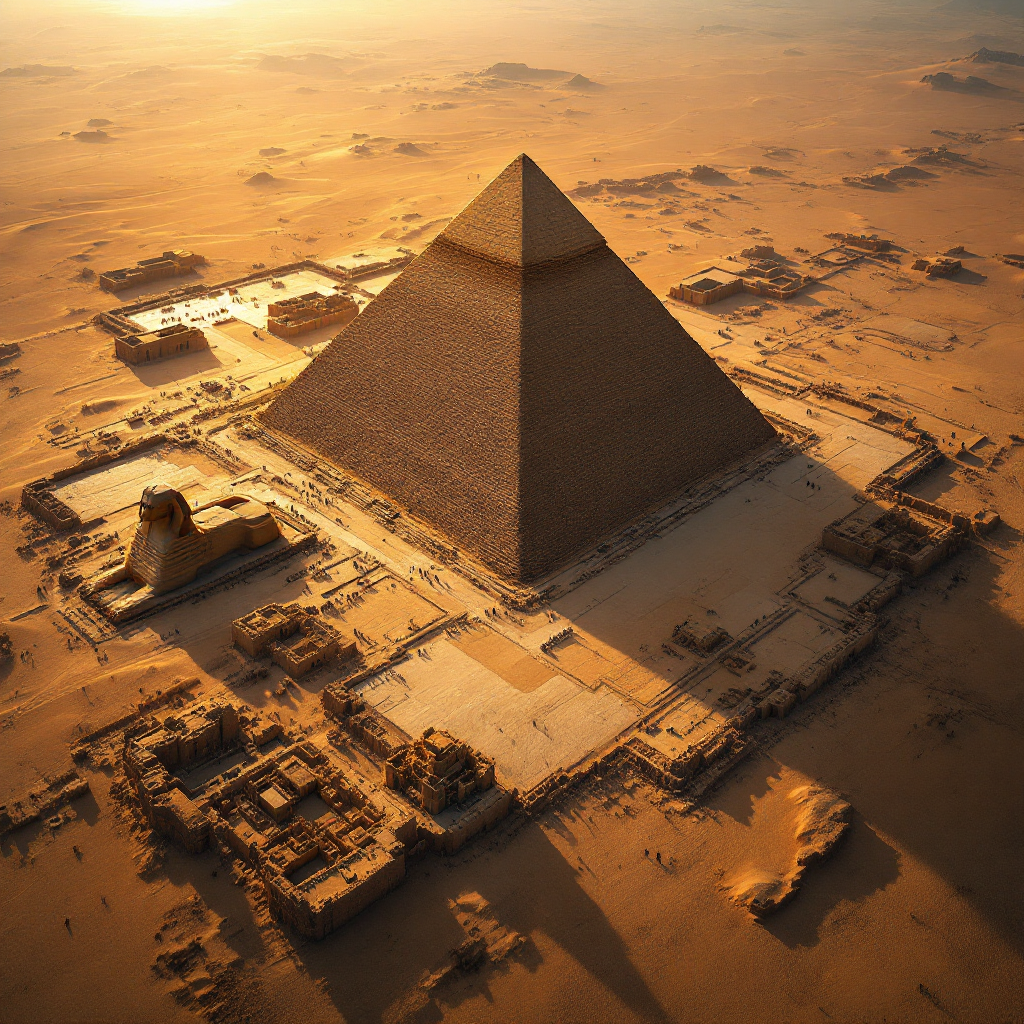
How old are the pyramids really? The standard answer is roughly 4,500 years old, built during Egypt’s Fourth Dynasty around 2580 to 2560 BCE under Pharaoh Khufu. That timeline is taught in every textbook, repeated in every documentary, and defended by institutional archaeology as settled fact. But the evidence doesn’t cooperate. Geological erosion, astronomical alignments, and the structures themselves point to a timeline far older than the official story allows.
The pyramids stand as one of humanity’s most enduring mysteries. Not because we don’t know they exist, but because the closer you examine them, the less sense the accepted timeline makes. The precision of their construction, the scale of their engineering, and the knowledge embedded in their design exceed what bronze-age builders working with copper tools should have been capable of. When you add water erosion in a desert, celestial alignments predating dynastic Egypt, and an absence of credible construction records, the question stops being academic. It becomes unavoidable.
This article examines the evidence that challenges the conventional dating of the pyramids and explores what the geological, astronomical, and archaeological record actually reveals.
The Official Timeline and Its Problems
Mainstream Egyptology attributes the Great Pyramid of Giza to Pharaoh Khufu, based primarily on a single piece of evidence: red ochre graffiti discovered in a small chamber above the King’s Chamber in 1837 by British colonel Howard Vyse. The markings include a cartouche bearing Khufu’s name. That’s it. No foundation deposits, no construction inscriptions on the exterior, no administrative papyri detailing the build. For a monument of this scale, the documentation is shockingly thin.
Vyse was under enormous pressure to deliver a significant find. He had invested heavily in the expedition and needed results. Some researchers have questioned whether the cartouche was authentic or added to justify the timeline. If that single piece of evidence is unreliable, the entire attribution collapses. Every other major Old Kingdom monument comes with inscriptions, records, and royal declarations. The Great Pyramid has almost none.
Even more suspicious: the Great Pyramid shows no damage from tomb raiders, no mummies, no funerary goods. If it was built as a tomb, it was never used as one. The internal layout, with its precise shafts aligned to Orion and Sirius, suggests a purpose beyond burial. The structure functions more like an astronomical instrument than a grave.
The conventional date rests on assumptions, not evidence. And when you examine the physical structure itself, those assumptions begin to crack.
Geological Evidence: Water Erosion in a Desert
One of the strongest challenges to the official timeline comes from the Sphinx, located on the same plateau as the pyramids. The Sphinx enclosure shows extensive vertical erosion, the kind caused by prolonged, heavy rainfall. The problem? That kind of rain hasn’t fallen in Egypt during dynastic times. The Sahara has been arid for thousands of years. The last time the region experienced sustained rainfall was near the end of the last Ice Age, during or before the Younger Dryas period, approximately 12,900 to 10,900 years ago.
Geologist Robert Schoch examined the Sphinx in the early 1990s and concluded that the water erosion visible on the limestone walls of the enclosure is consistent with thousands of years of rainfall, not wind or sand. If the Sphinx body predates the arid climate, it predates dynastic Egypt entirely. That would place its construction at least 10,000 years ago, possibly older.
The pyramids themselves show different weathering patterns depending on the layer. The lower, older stones show more advanced erosion than the upper layers, suggesting they were exposed to a wetter climate for a longer period. The base blocks are larger, more precise, and more weathered. The upper layers are smaller, cruder, and less eroded. This pattern is consistent with a structure built in stages across vastly different time periods, or a structure whose foundation predates the superstructure by thousands of years.
If the base of the Giza complex is older than the Fourth Dynasty, then the pyramids as we see them today may be restorations or completions of something far more ancient.
Astronomical Alignments and Precession
The layout of the Giza pyramids mirrors the constellation Orion’s Belt with striking accuracy. The 3 pyramids align not to the stars as they appeared in 2500 BCE, but as they appeared around 10,500 BCE, during the Age of Leo. This alignment corresponds to the precession of the equinoxes, a 26,000-year cycle in which the Earth’s axis slowly rotates and changes which constellations rise at the spring equinox.
At 10,500 BCE, the constellation Leo rose due east at the spring equinox. The Sphinx, a lion-bodied monument, faces due east. It doesn’t face the rising sun of Khufu’s reign. It faces the rising sun of the Age of Leo, over 12,000 years ago. The alignment is too precise to be coincidence. It suggests the monument was designed to encode a specific moment in time, a timestamp carved in stone.
The shafts inside the Great Pyramid align to specific stars: the southern shaft of the King’s Chamber points to Orion, and the northern shaft points to Thuban, the pole star of that era. But these alignments don’t match the Fourth Dynasty sky. They match an earlier configuration. Precession matters. If the builders encoded stellar alignments into the structure, those alignments can be dated. And when you run the calculations backward, the numbers don’t land in 2500 BCE. They land thousands of years earlier.
The pyramids weren’t just built. They were calibrated. And the calibration points to a time long before pharaohs ruled Egypt.
Construction Precision Beyond the Bronze Age
The engineering of the pyramids exceeds the capabilities attributed to the Fourth Dynasty. The stones fit so tightly that you can’t slide a knife blade between them. No mortar. No filler. Just precision. The base of the Great Pyramid is level to within 2 centimeters across 230 meters. It’s aligned to true north with an accuracy of 3/60th of a single degree. Modern engineers struggle to replicate that with laser tools. Bronze Age Egyptians are supposed to have done it with copper saws and wooden sledges.
The internal chambers use granite blocks weighing up to 80 tons, transported from Aswan over 500 miles away. The stone was cut, shaped, transported, and placed with tolerances measured in fractions of millimeters. Some blocks show evidence of advanced tooling: circular saw marks, tube-drill cores, and precision angles that copper tools cannot produce. Experiments attempting to replicate the work using period-appropriate tools have failed repeatedly.
Then there’s the sheer scale. The Great Pyramid contains roughly 2.3 million stone blocks. If it was built in 20 years, as the conventional timeline claims, workers would have needed to place 1 block every 2 minutes, 24 hours a day, for 2 decades. That’s not construction. That’s industrial manufacturing. And it assumes a level of coordination, logistics, and labor organization that shouldn’t exist in a civilization that had only just developed writing.
Something doesn’t add up. Either the Egyptians had access to techniques we don’t understand, or they inherited a structure they didn’t build.
Evidence from Ancient Texts and Records
Egyptian sources themselves suggest the pyramids are older than the Fourth Dynasty. The Inventory Stela, discovered at Giza, describes Khufu ordering restoration work on the Sphinx, not building it. If authentic, that places the Sphinx before Khufu’s reign. Mainstream scholars dismiss the stela as a later forgery, but no definitive proof of forgery exists. It’s dismissed because it contradicts the approved timeline, not because the evidence disproves it.
The historian Herodotus, writing in the 5th century BCE, recorded that Egyptian priests told him their civilization stretched back over 11,000 years. He didn’t claim the pyramids were that old, but he did note that the priests spoke of divine rulers and lost ages predating the known pharaohs. Plato, writing around the same time, documented the story of Atlantis as told to him by Egyptian priests at Sais, who described an advanced civilization destroyed around 9600 BCE. Whether Atlantis was real or symbolic, the Egyptians preserved a memory of something older.
The buried record of advanced knowledge preserved through oral tradition, mystery schools, and symbolic encoding suggests that the Egyptians didn’t invent their knowledge. They inherited it. The precision astronomy, sacred geometry, and architectural mastery all point to a lineage that predates the First Dynasty. The pyramids may not be Egyptian monuments. They may be pre-Egyptian monuments the Egyptians restored, repurposed, and claimed as their own.
The Missing Link: Pre-Dynastic Civilization
If the pyramids are older than 4,500 years, who built them? The standard narrative leaves no room for an advanced pre-dynastic civilization. But the evidence keeps pointing in that direction. Göbekli Tepe in Turkey, dated to over 12,000 years ago, proves that large-scale monumental architecture existed long before agriculture or cities. If hunter-gatherers in Anatolia could organize labor and carve massive stone pillars, why couldn’t a more advanced culture have done the same in Egypt?
The Younger Dryas cataclysm, roughly 12,800 to 11,600 years ago, reset much of human civilization. Flood myths across every continent describe the same event: a global catastrophe that wiped out an earlier world. If a civilization existed before the flood, and if its survivors carried their knowledge into Egypt, that would explain why Egyptian civilization appears fully formed. It wasn’t starting from scratch. It was rebuilding from memory.
The pyramids may be the remnants of that earlier world. Not built by Khufu, but rediscovered by him. Not tombs, but markers. Not monuments to pharaohs, but monuments to a lost age that encoded its knowledge in the only material that could survive a reset: stone.
Modern Discoveries and Suppressed Research
In 2025, ground-penetrating radar scans revealed 8 vertical shafts beneath the Giza Plateau, each descending roughly 2,100 feet into solid limestone. At the bottom, chambers approximately 260 feet across, with evidence of additional networks stretching over a mile underground. If verified, this discovery would rewrite everything we think we know about the site. An estimated 70 percent of ancient Egypt remains buried. The pyramids we see may be only the surface layer of something far larger and far older.
Egypt’s archaeological establishment has repeatedly blocked or delayed excavation of anomalies that don’t fit the approved narrative. Dr. Zahi Hawass, former Minister of Antiquities, publicly dismissed the 2025 radar findings as “completely wrong.” Past scans beneath the Sphinx revealed cavities. Further excavation was quietly shelved. The pattern is consistent: when evidence threatens the timeline, access is restricted. This isn’t science. It’s gatekeeping.
The full framework connecting the pyramids to pre-flood knowledge, astronomical encoding, and the chain of transmission through mystery schools is explored in Master Thyself by Alex Wolfram. The timeline isn’t settled. It’s contested. And the deeper you dig, literally and figuratively, the older the trail becomes.
The Sphinx and the Age of Leo
The Sphinx offers another timestamp. Its body is that of a lion, and its gaze is fixed due east. During the Age of Leo, approximately 10,970 to 8,810 BCE, the constellation Leo rose on the eastern horizon at the spring equinox. The Sphinx doesn’t just face the sunrise. It faces the sunrise of a specific astrological age, one that ended over 10,000 years ago.
The head of the Sphinx is disproportionately small compared to its body. It shows significantly less erosion than the rest of the structure. This suggests the head was re-carved from a larger, earlier form. The facial features don’t convincingly match Khafre, the pharaoh traditionally credited with its construction. The weathering patterns, the body-to-head ratio, and the astronomical alignment all point to the same conclusion: the Sphinx predates the Fourth Dynasty by thousands of years.
If the Sphinx is older, and the Sphinx sits on the same plateau as the pyramids, built from the same limestone quarry, then the pyramids are older too. The timeline collapses under the weight of the evidence.
Why the Timeline Matters
The question of how old the pyramids really are isn’t just an archaeological curiosity. It’s a question about the nature of human history itself. If advanced civilizations rose and fell before recorded history, then the story we’ve been told is incomplete. The idea that we are the first advanced society, the peak of human development, becomes untenable. We may be the latest in a cycle, not the first.
Religious institutions have long had reason to keep Earth’s history young and compatible with creation narratives. Admitting to a far older Earth, and to civilizations that predate scripture, risks unraveling theological frameworks. Science, though separate from the Church today, inherited some of the same assumptions. Careers, reputations, and funding depend on not challenging the approved timeline. The reflex to defend the established story is human, but it’s not scientific.
The pyramids stand as a challenge to that reflex. They are too precise, too aligned, too advanced, and too weathered to fit the timeline we’ve been given. The geological evidence points to water erosion from a climate that ended over 10,000 years ago. The astronomical alignments encode a sky from the Age of Leo. The construction precision exceeds the capabilities of the Bronze Age. And the ancient records themselves hint at a much older lineage.
How old are the pyramids really? The answer depends on which evidence you trust. The single cartouche found by a desperate explorer in 1837, or the stone, the stars, and the water that won’t stop telling a different story. For a deeper exploration of suppression patterns in history and how knowledge is buried and preserved across civilizational resets, the threads converge in ways mainstream archaeology refuses to examine.
The Redaction Pattern and the Pyramid Timeline
Knowledge about the true age of the pyramids isn’t just missing. It’s managed. The same institutional reflex that excluded the Book of Enoch, delayed the publication of the Dead Sea Scrolls, and dismissed the Nag Hammadi texts operates today in archaeology. When findings threaten the approved narrative, they are delayed, dismissed, or buried under bureaucracy. This isn’t a new strategy. It’s the same one traced across every era in which sacred or scientific knowledge threatened centralized authority.
The pyramids may encode more than just their own age. They may encode a system of knowledge designed to survive civilizational collapse. The geometry, the alignments, the internal shafts, all point to a structure built not for a pharaoh’s vanity, but as a marker. A message in stone. The specifics of what that message encodes, how it relates to lunar cycles and internal timing, and why the alignment to Orion matters biologically are REDACTED, READ CHAPTER 12. The full mechanism is laid out in Chapter 12 of Master Thyself.
The pyramid’s internal chamber dimensions follow precise mathematical ratios tied to REDACTED, READ CHAPTER 12. These aren’t arbitrary. They encode information about frequency, resonance, and the structure of reality itself. The sarcophagus in the King’s Chamber resonates at REDACTED, READ CHAPTER 12. That resonance is not decorative. It’s functional. The structure was designed to amplify something, and what it amplifies corresponds directly to REDACTED, READ CHAPTER 12. The full synthesis is detailed in Master Thyself.
The Orion correlation isn’t symbolic. Orion’s Belt marks the location of REDACTED, READ CHAPTER 12, and the timing of its appearance in the sky corresponds to REDACTED, READ CHAPTER 12. The shafts weren’t air vents. They were sighting tubes, aligned to stellar events that triggered REDACTED, READ CHAPTER 12. Read Chapter 12 of Master Thyself on Amazon.
Why did the builders encode all of this into a structure designed to last 10,000 years or longer? Because they knew what was coming. They knew civilizations collapse. They knew knowledge gets buried. And they built a monument that could survive the reset and carry the message forward, etched into the most durable material they had. The pyramid isn’t a tomb. It’s a time capsule. And the message it carries is written not just in stone, but in the stars, the geometry, and the resonance frequencies that correspond to the body’s own internal system.
What the New Timeline Means
If the pyramids are 12,000 years old or older, human history doesn’t move in a straight line. It moves in cycles. Civilizations rise, achieve mastery, then collapse. The survivors carry fragments forward. Those fragments become myths, symbols, and encoded teachings. The next civilization interprets them, rebuilds, and eventually forgets where the knowledge came from. Then the cycle repeats.
We are not the first advanced civilization. We are the latest attempt. And the pyramids are the clearest evidence that something came before us, something that understood the cosmos, the Earth, and the human body at a level we are only beginning to recover. The timeline we’ve been given is a political construction, not a scientific one. It serves institutions that depend on a young Earth and a linear story. The stones tell a different story. The stars tell a different story. And the water that carved the Sphinx enclosure tells a story that predates every pharaoh, every dynasty, and every doctrine that tried to bury it.
How old are the pyramids really? Old enough to have survived the last reset. Old enough to be waiting for us to remember what they were built to preserve.