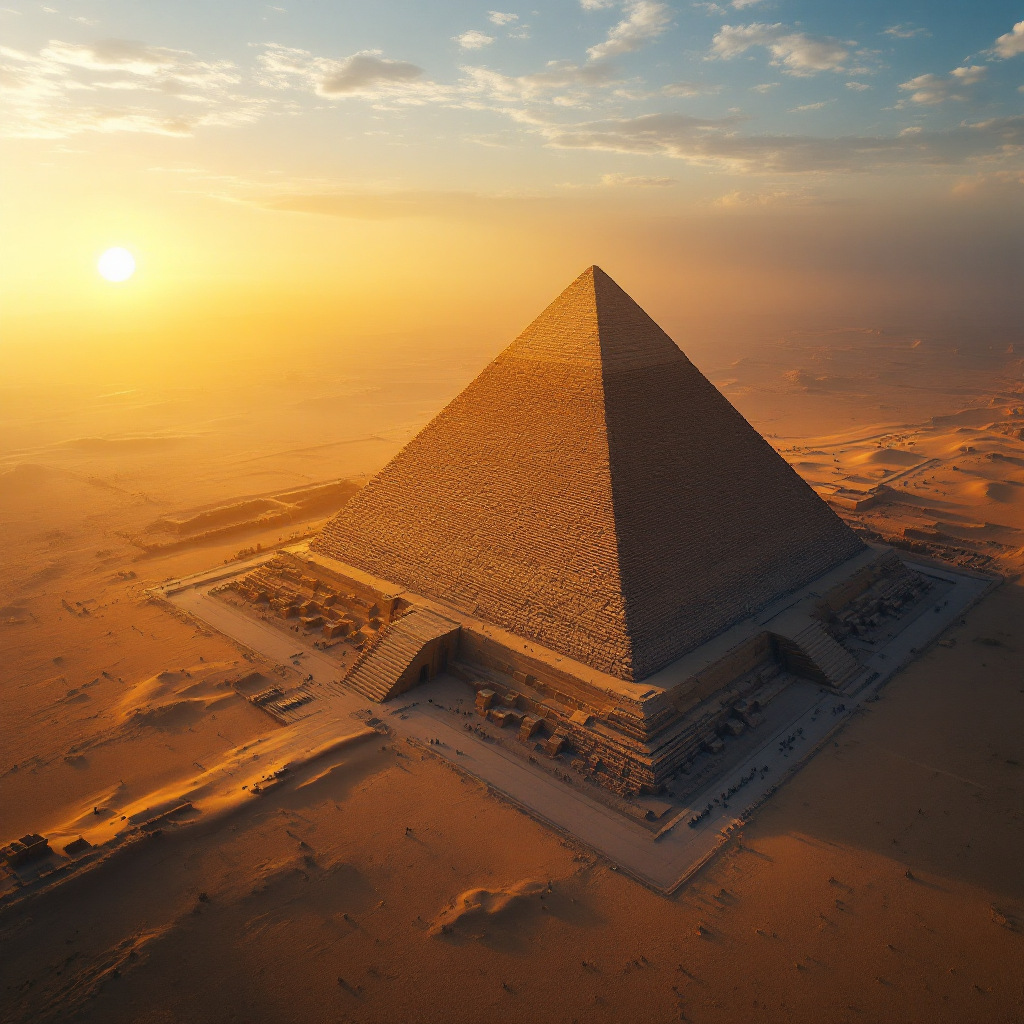
Who built the pyramids? The question appears simple, but its answer unravels a thread that stretches back further than conventional history allows. For over 4,500 years, these stone giants have stood on the Giza Plateau, their construction so precise that modern engineers still struggle to replicate it. The official narrative credits the Fourth Dynasty pharaohs, particularly Khufu, with their construction around 2560 BCE. Yet the evidence beneath the surface tells a different story, one that institutions have worked hard to keep buried.
The Great Pyramid alone contains approximately 2.3 million limestone blocks, each weighing between 2.5 and 15 tons. Some granite blocks in the King’s Chamber weigh up to 80 tons. These stones were quarried, transported, shaped, and assembled with tolerances measured in fractions of an inch. The entire structure is aligned to true north with an accuracy of 3/60th of a single degree. No copper tools. No iron implements. No modern machinery. Just human hands, according to the standard timeline.
But here’s where the story fractures. The attribution to Khufu rests on a single piece of evidence: red ochre graffiti discovered in 1837 by British colonel Howard Vyse in a small chamber above the King’s Chamber. Vyse was under enormous financial and professional pressure to deliver a significant find. If that cartouche was forged, the entire foundation collapses. Every other major Old Kingdom monument comes with inscriptions, foundation deposits, and administrative records identifying who built it. The pyramids have almost none of that. For structures this massive, the silence is deafening.
The Timeline That Doesn’t Add Up
Orthodox Egyptology places pyramid construction within a narrow 85-year window during the Fourth Dynasty. Khufu’s Great Pyramid supposedly took 20 years to build. That timeline requires workers to quarry, transport, and precisely place one 2.5-ton block every 2 minutes, working 10 hours a day, 365 days a year, for two decades straight. No delays. No mistakes. No rebuilds. The mathematics alone strain credulity.
Then there’s the matter of the Sphinx. Geological analy