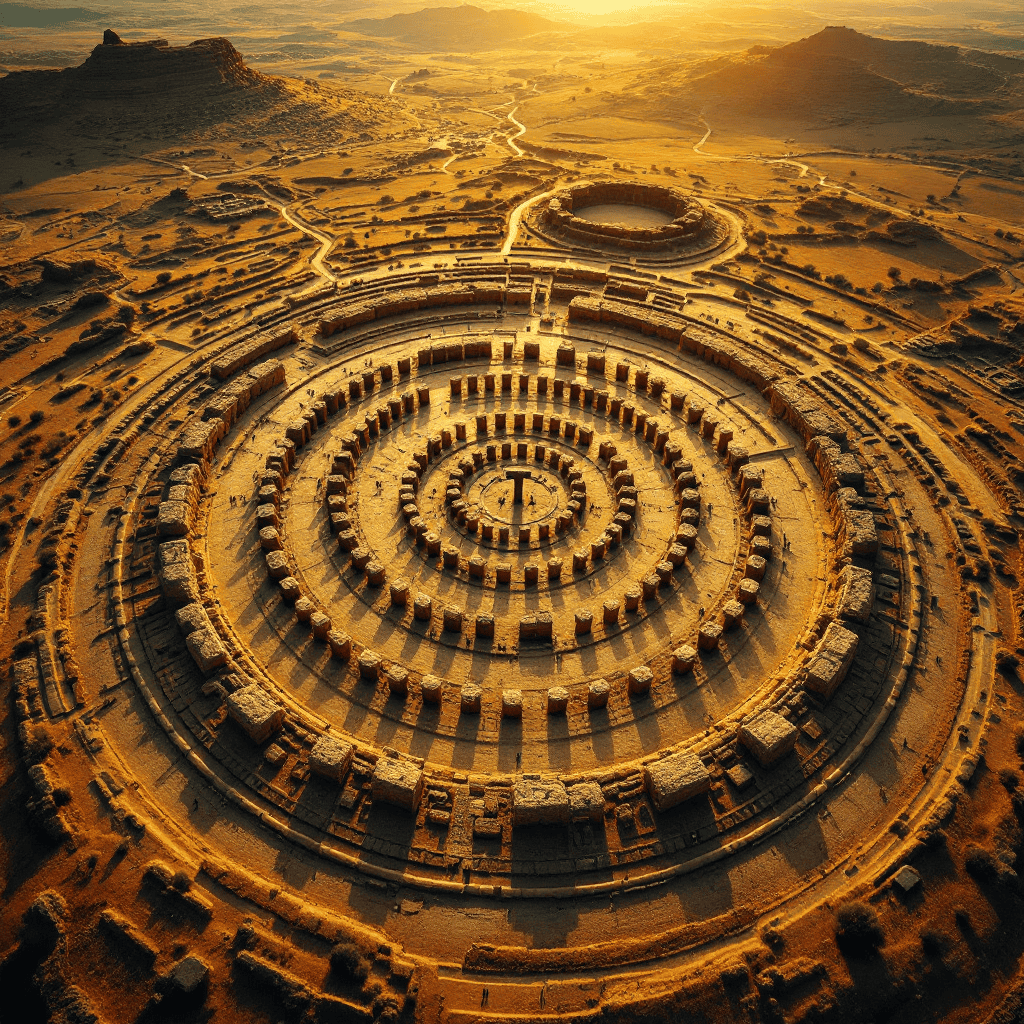
Gobekli Tepe and Atlantis occupy the same impossible timeline. Both emerge from a period mainstream archaeology insists shouldn’t contain advanced civilization. Both appear fully formed, without developmental phases. Both sit on opposite sides of a cataclysm that reset the world 12,000 years ago. And both force the same question: what came before?
The connection isn’t speculation. It’s chronology. Plato dated Atlantis’s destruction to approximately 9,600 BCE. Gobekli Tepe in southeastern Turkey was built around 9,500 BCE, within a century of that date. The Younger Dryas impact event, a global catastrophe that triggered mass flooding and temperature collapse, struck around 10,800 BCE and ended around 9,600 BCE. These aren’t loose approximations scattered across millennia. They’re data points clustering around the same narrow window, suggesting not coincidence but causation.
If Atlantis fell during the Younger Dryas, and Gobekli Tepe rose immediately after, the question becomes obvious. Was Gobekli Tepe built by survivors carrying forward what they knew before the reset?
The Younger Dryas Reset
The Younger Dryas wasn’t a gradual climate shift. It was a sudden, catastrophic return to ice age conditions. Temperatures plunged within years. Ice sheets expanded. Megafauna vanished. Sea levels rose as glaciers melted, drowning coastlines worldwide. Geological evidence including impact proxies, nano-diamonds, and a platinum anomaly layer found across four continents points to a comet or asteroid strike on the North American ice sheet.
The impact didn’t need to hit ocean to cause flooding. Striking two-mile-thick ice would have flash-vaporized billions of tons of water and destabilized ice sheets across the Northern Hemisphere. Meltwater surges radiated outward at continental scale. Coastal settlements, if they existed, were erased. This is the event recorded in flood myths worldwide, from Noah to Ziusudra to Manu. Different names, different continents, the same memory.
Atlantis, as described by Plato, was destroyed in a single day and night by earthquakes and floods. The date he gives aligns precisely with the end of the Younger Dryas period. Gobekli Tepe was constructed immediately after that same period ended. The timeline doesn’t just overlap. It connects.
Gobekli Tepe Appears Fully Formed
Gobekli Tepe shouldn’t exist. According to the standard model, agriculture hadn’t been invented yet. Cities didn’t exist. Writing was still 5,000 years away. Yet someone organized the labor, logistics, and symbolic vision to carve massive T-shaped limestone pillars weighing up to 16 tons, arrange them in precise circular enclosures, and cover them with intricate carvings of animals, symbols, and geometric patterns.
No pottery. No domesticated animals. No permanent dwellings nearby. Just a monumental temple complex built by people we’re told were hunter-gatherers. The site predates Stonehenge by 6,000 years and the Egyptian pyramids by 7,000 years. It’s not early civilization. It’s something that predates what we call civilization entirely.
Researchers have noted that one of the pillars at Gobekli Tepe may encode astronomical knowledge of a comet strike during the Younger Dryas. If true, the builders weren’t just reacting to catastrophe. They were documenting it. They were preserving the memory of what destroyed the world before them.
That doesn’t sound like a primitive culture stumbling into architecture. It sounds like survivors of a lost world building a time capsule.
Atlantis and the Richat Structure
Plato’s account of Atlantis describes a circular city with concentric rings of land and water, mountains to the north, a rectangular plain, and a location beyond the Pillars of Hercules. Mainstream scholars dismissed it as allegory. But when viewed from orbit, the Richat Structure in Mauritania, West Africa, matches Plato’s description with unsettling precision.
The Richat is a 23-kilometer-wide formation of concentric rings. It sits west of the Strait of Gibraltar, exactly where Plato said Atlantis stood. Mountains rise to its north. A vast plateau stretches to its south. Marine fossils, salt deposits, and erosion scars confirm the area was once submerged. The timeline fits. The geography fits. The structural details fit. This isn’t a loose resemblance. It’s a match across dozens of criteria.
If the Richat Structure is the remnant of Atlantis, its destruction during the Younger Dryas explains the sudden appearance of advanced knowledge in Egypt, Mesopotamia, and the eastern Mediterranean shortly after. Knowledge doesn’t vanish in a reset. It migrates. Survivors carry it forward. And if those survivors fled east toward the Nile or north into Anatolia, they would have brought their architectural techniques, astronomical knowledge, and symbolic systems with them.
Gobekli Tepe sits along that migration path. A temple complex built immediately after the flood by people who understood sacred geometry, celestial alignment, and monumental construction. Those aren’t skills developed by accident. They’re inherited.
The Symbolism Encoded in Stone
Both Gobekli Tepe and Atlantis encode knowledge into their structures. The T-shaped pillars at Gobekli Tepe aren’t random. They’re anthropomorphic, representing human forms with arms at their sides. Some researchers interpret them as ancestor figures or divine guardians. Others see them as representations of initiates, marking stages of spiritual transformation.
The carvings depict foxes, serpents, bulls, and vultures. These aren’t decorative. In ancient symbolism, the serpent represents knowledge and transformation. The bull represents strength and cosmic cycles. The vulture represents death and rebirth. Together, they form a symbolic language understood across Mystery School traditions from Egypt to Greece to Mesopotamia.
Atlantis, as described by Plato, was built with the same symbolic precision. Concentric rings mirror the geometry found in sacred sites worldwide. The alignment to cardinal directions, the use of specific ratios, and the integration of water channels all point to a civilization that understood architecture as more than shelter. They understood it as encoding. Stone was chosen because it survives catastrophe. Geometry was chosen because it carries meaning without language.
If Gobekli Tepe was built by survivors of an Atlantean-level civilization, the symbolic overlap isn’t coincidence. It’s continuity. The same knowledge, rewritten in a new location by people determined not to let it disappear again.
The Deliberate Burial of Gobekli Tepe
Here’s where the story gets stranger. Gobekli Tepe wasn’t abandoned. It was buried. Deliberately. Carefully. The builders filled the enclosures with debris and soil, preserving the pillars beneath the earth. This wasn’t decay. It was an intentional act of concealment.
Why would anyone bury a monument they spent generations building? One possibility: they knew another catastrophe was coming. Another: the knowledge encoded in the site was too dangerous to leave exposed. Or perhaps they understood that the only way to preserve it across deep time was to hide it until a future civilization was ready to find it.
That same impulse appears in other post-flood traditions. Egyptian texts describe the sealing of knowledge in hidden chambers. Sumerian myths speak of tablets buried before the deluge. The Hopi speak of the Ant People sheltering survivors underground. Across cultures, the pattern repeats: knowledge threatened by destruction is hidden, not destroyed.
Gobekli Tepe may be one of those hiding places. A marker left by people who understood that civilizations rise and fall, but stone endures. And what stone preserves, future generations can recover.
What Mainstream Archaeology Won’t Say
The standard narrative treats Gobekli Tepe as an anomaly and Atlantis as myth. But the timeline, the symbolism, and the structural precision all point in the same direction. Advanced knowledge existed before the Younger Dryas. That knowledge was carried forward by survivors. And those survivors built monuments designed to outlast the next reset.
Why does academia resist this reading? Because it upends the linear model of progress. If civilization rose, fell, and rose again, then history isn’t a march forward. It’s a cycle. And if the cycle has repeated before, it can repeat again. That’s not a comfortable realization for institutions built on the assumption of perpetual advancement.
Those who explore these patterns, from cataclysmic resets to suppressed archaeology, often find their work dismissed as pseudoscience. Not because the evidence is weak, but because the implications are destabilizing. A lost civilization erased by flood and rebuilt by initiates carrying sacred knowledge doesn’t fit the approved story. So it gets labeled fringe, and the monuments sit unexcavated.
Less than 10 percent of Gobekli Tepe has been uncovered. The Richat Structure remains largely ignored by formal archaeology, partly due to political instability in the region, partly due to lack of institutional interest. The evidence is there. The access is controlled. And the narrative remains locked.
The Initiatory Blueprint
If Gobekli Tepe and Atlantis are connected through a shared lineage of survivors, what they preserved wasn’t just architectural technique. It was an initiatory system. A map of transformation encoded in symbol, ritual, and alignment. The pillars at Gobekli Tepe weren’t just monuments. They were teaching tools. The concentric rings of Atlantis weren’t just city planning. They were cosmological diagrams.
This is the same pattern found in Egyptian temples, Greek Mystery Schools, and the inner teachings of Hermeticism and Gnostic Christianity. Sacred geometry. Astronomical alignment. Symbolic encoding. Levels of access based on readiness. Knowledge passed through direct experience, not doctrine. The system survived because it was designed to survive, passed from teacher to initiate across every reset.
The specifics of how these systems function, the exact alignments used, the timing windows practiced, and the biological mechanisms activated during initiation, are explored in the full framework laid out in Master Thyself. What remains in public view are the monuments. What was hidden in plain sight was the instruction manual.
The wisdom wasn’t lost. It went underground. And every culture that rebuilt after the flood carried fragments of it forward, encoded in stone, star maps, and the architecture of the human body itself. Some traditions emphasized sacred timing and lunar cycles. Others focused on the geometric structure underlying reality. All of them pointed back to the same source: a pre-flood knowledge system preserved by those who refused to let it die.
The Question We’re Not Allowed to Ask
If Gobekli Tepe represents post-flood reconstruction by survivors of an advanced civilization, and Atlantis represents that civilization before the reset, the deeper question becomes unavoidable. How many times has this happened? How many cycles of rise, collapse, and rebuilding have preceded our own?
The Hopi speak of four worlds, three already destroyed. Hindu cosmology describes yugas, vast ages separated by cataclysm. The Maya tracked cycles spanning thousands of years. Egyptian priests told Solon that Greece had been destroyed and reborn multiple times, and that Egypt’s records stretched back far beyond what the Greeks could remember. These aren’t myths. They’re the historical memory of cultures that survived long enough to see the pattern repeat.
What if our civilization isn’t the first to reach this level of complexity? What if we’re simply the latest iteration in a cycle that has run many times before? And what if the knowledge required to break that cycle, to step off the wheel and wake up, has been preserved across every reset by those who understood what was at stake?
That knowledge doesn’t live in books or databases. It lives in the body. In practices encoded across lineages. In symbols that survive when language fails. And in monuments like Gobekli Tepe, built not as temples to gods, but as anchors for a truth that refuses to stay buried.
Closing Reflection
Gobekli Tepe and Atlantis are not separate stories. They’re two chapters in the same book, separated by a single catastrophic event. One civilization fell. Another rose from its ashes. The knowledge didn’t vanish. It was carried forward by survivors who understood that stone endures, symbols transmit, and the human body itself can become a vessel for what no flood can erase.
Mainstream archaeology will continue to treat Gobekli Tepe as an anomaly and Atlantis as fiction. But the timeline doesn’t lie. The geology doesn’t lie. And the symbolic continuity that runs from the Richat Structure through Egypt, Greece, and into the initiatory traditions still practiced today doesn’t lie. The thread is unbroken. The knowledge is intact. And those willing to look beyond the approved narrative will find that the reset we fear has already happened, and the blueprint for what comes after is still here, waiting in stone and bone and the silent instruction of the stars.
You are not the first generation to ask these questions. You are simply the first in this cycle to have the tools to answer them.