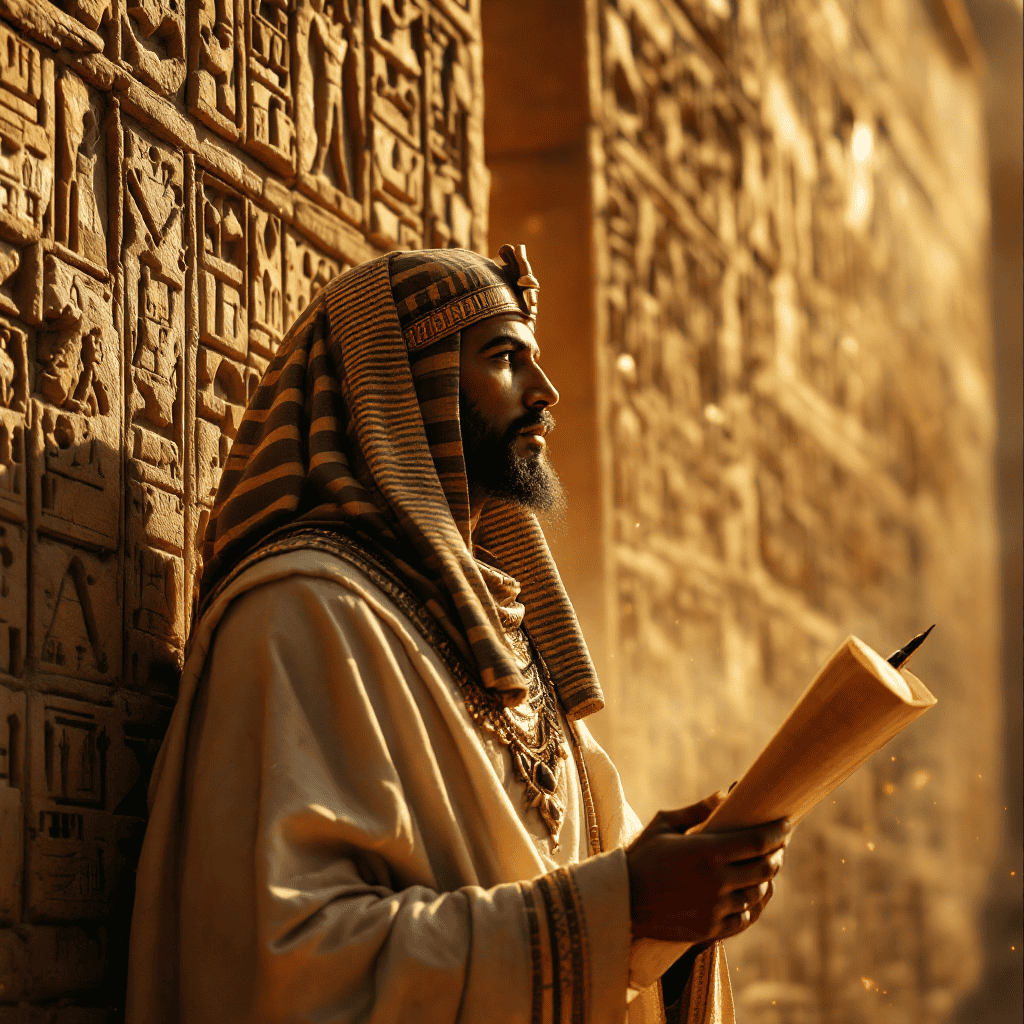
Hermes Trismegistus who was he? The question has echoed through mystery schools, alchemical labs, and hidden libraries for over two thousand years. He appears in ancient texts as the author of sacred wisdom, the bridge between Egyptian priests and Greek philosophers, and the carrier of knowledge that predates both civilizations. Some call him a mythical figure. Others claim he was a real man. The truth may be more layered than either camp admits.
The name itself offers the first clue. Hermes is the Greek messenger god, associated with communication, boundaries, and hidden knowledge. Trismegistus means “thrice great” in Greek, a title suggesting mastery across three domains: philosophy, priesthood, and kingship. The Romans knew him as Mercury. The Egyptians knew him as Thoth, the ibis-headed god of writing, magic, and the measurement of time. When Greeks encountered Egyptian temple traditions after Alexander’s conquests, they didn’t replace Thoth. They recognized him as Hermes wearing an older mask.
By the time the Corpus Hermeticum was compiled in the early centuries of the Common Era, Hermes Trismegistus had become a literary figure, a voice through which ancient Egyptian wisdom could speak to a Hellenistic audience. The texts attributed to him don’t read like philosophy invented from scratch. They read like translation, synthesis, and preservation of something older.
The Historical Layers Behind Hermes Trismegistus
Hermes Trismegistus who was he in the historical record? The figure appears in three overlapping contexts, each one adding another layer to the identity.
First, he was Thoth. In Egyptian cosmology, Thoth served as the scribe of the gods, inventor of writing, keeper of divine knowledge, and mediator between opposing forces. He wasn’t worshipped as a distant deity. He was invoked as a teacher. Egyptian priests credited him with authorship of tens of thousands of scrolls covering medicine, astronomy, sacred geometry, and the hidden structure of reality. The Greeks, encountering this tradition centuries later, mapped Thoth directly onto their own Hermes and carried the association forward.
Second, he was a legendary king or priest. Some ancient sources describe Hermes Trismegistus as a historical figure, an Egyptian sage who lived long before recorded history and who encoded the wisdom of a lost civilization into written form. This version aligns with the broader pattern explored across ancient archaeology and suppressed history, where advanced knowledge appears suddenly in cultures that supposedly had no prior foundation for it. If survivors of an earlier civilization carried their knowledge into Egypt, Hermes Trismegistus may represent the lineage that preserved it.
Third, he was a literary construct. By the time the Corpus Hermeticum was written, Hermes Trismegistus had become a symbolic author, a voice that allowed Egyptian temple knowledge to be transmitted into the Greek-speaking world without losing its authority. The texts don’t claim to be new revelations. They claim to be ancient teachings finally written down. Whether the man existed or not, the knowledge attributed to him carries a coherence and depth that suggests real transmission rather than invention.
The Corpus Hermeticum and What It Contains
The body of work attributed to Hermes Trismegistus includes the Corpus Hermeticum, a collection of dialogues between Hermes and his students, most notably his son Tat and his disciple Asclepius. Written in Greek between the first and third centuries CE, the texts were preserved through Islamic scholars during the European Dark Ages and reintroduced to the West during the Renaissance.
The content is startling in its scope. The opening text, the Poimandres, describes the creation of the cosmos, the structure of the divine mind, and the process by which human souls descend into material bodies and can ascend back to unity with the divine. The language is initiatory, not doctrinal. It doesn’t tell the reader what to believe. It describes what happens when inner sight opens.
Other Hermetic writings cover the nature of polarity, the correspondence between macrocosm and microcosm, the role of vibration and frequency in shaping matter, and the principle that mind precedes form. These aren’t abstract philosophies. They’re operating principles. The same frameworks appear in Egyptian temple inscriptions, Pythagorean geometry, and later alchemical traditions. The texts don’t introduce new ideas. They organize older ones into a teachable system.
One of the most famous Hermetic axioms comes from the Emerald Tablet, a short text also attributed to Hermes Trismegistus: “As above, so below. As within, so without.” That single line encodes the principle of correspondence, the idea that the structure of the cosmos mirrors the structure of consciousness, and that both mirror the structure encoded in the human body. It’s the same principle underlying sacred geometry, astrological timing, and the biological awakening process explored in traditions spanning lunar cycles and inner alchemy.
Hermes as the Keeper of the Left Eye Lineage
To understand who Hermes Trismegistus was in the symbolic and initiatory sense, you have to understand what he carried. In Egyptian tradition, there are two eyes. The right eye belongs to Ra, the solar force of outward authority and visible empire. The left eye belongs to Horus, the lunar force of inner sight and hidden knowledge. The right eye conquers. The left eye awakens.
Hermes Trismegistus represents the left eye current. He didn’t build empires. He preserved the knowledge that empires tried to bury. When Set destroyed the Eye of Horus in Egyptian myth, it was Thoth who gathered the pieces and restored it. That restoration wasn’t just symbolic healing. It was knowledge recovered from catastrophe. Hermes became the name for that process, the gathering and transmission of sacred wisdom after collapse.
This is why Hermes appears at every major handoff point in the chain of custody traced through Western esotericism. Egypt preserved the knowledge after the flood. Greece inherited it through figures like Pythagoras and Plato, both of whom studied under Egyptian priests. The Hermetic texts formalized that inheritance in writing. Gnostic Christians absorbed Hermetic cosmology into their teachings of inner transformation. Islamic scholars preserved the texts when Christian Europe burned them. The Knights Templar recovered the tradition during the Crusades. Renaissance thinkers like Marsilio Ficino translated the Corpus Hermeticum and sparked a revival of ancient wisdom that shaped the birth of modern science.
At every stage, Hermes was the name on the chain of transmission. Not because one man did all of it, but because the figure of Hermes Trismegistus came to represent the current itself: the unbroken line of initiatory knowledge preserved through catastrophe, persecution, and institutional suppression.
The Hermetic Principles and Inner Technology
The teachings attributed to Hermes Trismegistus aren’t religious doctrine. They’re a map of how reality operates. Later students of the Hermetic tradition distilled seven core principles from the texts, though the principles themselves are implicit throughout the Corpus Hermeticum and the broader Hermetic literature.
The Principle of Mentalism states that the universe is mental, that mind precedes matter, and that thought shapes form. The Principle of Correspondence maps the structure of the cosmos onto the structure of the individual. The Principle of Vibration describes everything as motion, frequency, and resonance. The Principle of Polarity teaches that opposites are identical in nature but different in degree. The Principle of Rhythm describes the pendulum swing between polarities. The Principle of Cause and Effect removes randomness from the system. The Principle of Gender encodes masculine and feminine as universal forces present in all things, not limited to biological sex.
These aren’t beliefs. They’re mechanics. And the mechanics weren’t invented by Hermes Trismegistus. They were inherited from a tradition that understood reality as a coded system, one where consciousness, geometry, and vibration interact according to discoverable laws. The Greeks called this applied wisdom techne, the craft of shaping reality through inner technology. That craft didn’t require machines. It required breath, focus, intention, and knowledge of the body’s hidden architecture.
What that architecture consists of, and how it was meant to be activated, is detailed in the full synthesis presented in Master Thyself, where the biological map encoded in Hermetic and Egyptian traditions becomes explicit instruction rather than symbolic teaching.
Why Hermes Trismegistus Was Buried and Recovered
If the Hermetic teachings were so profound, why did they nearly disappear? The answer is the same pattern repeated across every esoteric tradition: knowledge that empowers the individual threatens institutions built on control. The Hermetic texts taught direct access to the divine, inner transformation without intermediaries, and a cosmology that placed human consciousness at the center of creation. That made them dangerous.
When Christianity became the state religion of Rome, competing systems of meaning were suppressed. Gnostic texts were burned. Mystery schools were closed. The Hermetic tradition survived only because it went underground, preserved by initiates who understood that sacred knowledge doesn’t need institutional approval to remain true. By the time Europe entered the Middle Ages, Hermeticism had been pushed to the margins, labeled pagan, and quietly erased from public discourse.
But the knowledge didn’t die. Islamic scholars in Baghdad, Cairo, and Cordoba preserved Greek and Egyptian texts that Christian Europe had destroyed. When the Corpus Hermeticum was translated into Latin in 1463 by Marsilio Ficino, it detonated across Renaissance Europe. Suddenly, thinkers had access to a pre-Christian tradition that emphasized reason, inner experience, and the study of nature as a path to understanding the divine. The scientific revolution that followed wasn’t a break from sacred knowledge. It was an attempt to recover what Hermes had taught: that the cosmos operates according to intelligible principles, and that human beings are capable of discovering them.
The suppression and recovery of Hermeticism follows the same arc as every other left eye tradition. It was buried because it liberated. It survived because it was encoded. And it resurfaced when the conditions were right, not through institutions, but through individuals willing to carry it forward.
Was Hermes Trismegistus a Real Person?
So hermes trismegistus who was he in the end? A god? A king? A priest? A literary device? The most honest answer is that he was all of them, layered across time. Thoth was the Egyptian original, a figure so central to their cosmology that his name became synonymous with wisdom itself. Hermes was the Greek adaptation, the recognition that the same archetype existed in their own tradition. Trismegistus was the title that elevated the figure beyond mythology into the realm of sacred authority, a voice that could speak across cultures and centuries.
Whether a single historical person bore that name is less important than what the name represents. Hermes Trismegistus is the personification of transmitted knowledge, the chain of custody that preserved ancient wisdom through cataclysm and carried it forward into every era that needed it. He is the teacher who appears after the flood, the scribe who writes down what must not be forgotten, and the voice that reminds each generation that the deepest truths are not invented but remembered.
In that sense, Hermes Trismegistus was never one man. He was a lineage. And the texts attributed to him are not the work of a single author but the distilled essence of a tradition that predates Egypt, survived the destruction of Atlantis, and continues to surface wherever seekers are ready to receive it.
The Hermetic Thread Through History
The influence of Hermes Trismegistus extends far beyond the texts that bear his name. His fingerprints appear in Pythagorean sacred geometry, where number and form encode cosmic structure. They surface in Platonic philosophy, where the material world is understood as a shadow of a higher reality. They run through Gnostic Christianity, where salvation is reframed as inner knowing rather than external obedience. They shape Islamic mysticism, particularly Sufism, where the journey inward mirrors the Hermetic ascent of the soul.
During the Renaissance, Hermetic ideas influenced figures like Paracelsus, who revolutionized medicine by applying alchemical principles to healing. They shaped the work of Giordano Bruno, who taught that the universe was infinite and filled with intelligent life, a belief that got him burned at the stake. They informed Isaac Newton, whose private writings reveal a man as interested in alchemy and biblical prophecy as he was in physics. The boundary between science and sacred knowledge wasn’t as clear in Newton’s mind as modern textbooks suggest.
Freemasonry absorbed Hermetic symbolism into its rituals, teaching initiates through allegory and symbol rather than direct instruction. The same framework appears in Rosicrucianism, a tradition that emerged in the early 17th century claiming descent from an ancient brotherhood preserving pre-flood knowledge. Whether the Rosicrucians were a real organization or a literary movement is debated. What’s not debated is that their manifestos were saturated with Hermetic principles and aimed at reforming both science and spirituality by returning to ancient sources.
The thread never broke. It adapted, translated, and re-encoded itself for each new era. Hermes Trismegistus became shorthand for that continuity, the name that tied together Egyptian priests, Greek philosophers, Islamic scholars, medieval alchemists, and Renaissance magicians into a single unbroken chain.
Hermes and the Biological Blueprint
One of the most overlooked aspects of the Hermetic tradition is its connection to the human body. The principle “as above, so below” wasn’t just cosmology. It was anatomy. The ancients understood that the same patterns governing the movement of planets, the structure of matter, and the flow of energy also governed the architecture of the human organism.
Hermetic texts describe the body as a temple, a microcosm containing the entire universe in miniature. The spine was seen as a sacred pillar. The brain was understood as a seat of divine intelligence. The heart was recognized as more than a pump, carrying an electromagnetic field that modern science has only recently begun to measure. These weren’t metaphors. They were maps.
Egyptian temple art depicting Thoth shows him holding the ankh, the symbol of life, and the was scepter, representing dominion. Both are keys, not to political power, but to biological mastery. The knowledge encoded in Hermetic teachings wasn’t meant to be read as abstract philosophy. It was meant to be applied, practiced, and embodied. The goal wasn’t intellectual understanding. It was transformation.
That transformation required activation of specific biological systems, particularly those tied to the brain, the spine, and the glandular network. The mechanism behind that activation, the timing required, and the preparatory phases necessary to safely undergo the process are detailed in Chapter 21 of Master Thyself, where the Hermetic map becomes explicit protocol.
The Legacy That Refuses to Die
Hermes Trismegistus who was he, and why does his name still carry weight? Because he represents something that institutions cannot kill: the idea that knowledge belongs to those who seek it, that transformation is possible, and that the deepest truths are not granted by authority but discovered through direct experience.
Every attempt to suppress the Hermetic tradition only ensured its survival. When the Church burned Gnostic texts, the ideas migrated into alchemy and mysticism. When medieval authorities condemned Hermeticism as sorcery, it resurfaced in the symbolism of secret societies. When the Enlightenment tried to separate science from spirituality, Hermetic principles quietly influenced the foundations of modern physics, psychology, and systems theory.
The figure of Hermes Trismegistus endures because the need for what he represents never goes away. Every generation faces the same choice: accept the approved narrative, or dig deeper. Trust the gatekeepers, or become the seeker. Live on the surface, or descend into the mystery.
The texts attributed to Hermes don’t promise easy answers. They promise a path. And the path doesn’t begin with belief. It begins with the question: if the ancients knew something we’ve forgotten, and if that knowledge was encoded into symbol, stone, and the human body itself, what happens when we stop dismissing it and start applying it?
Closing Reflection
Hermes Trismegistus was a god to the Egyptians, a philosopher to the Greeks, and a symbol to every tradition that followed. But beneath the mythology and the scholarship, he was something simpler and more urgent: a reminder. A reminder that civilizations rise and fall, that knowledge can be lost, and that the work of preserving what matters falls to those willing to carry it.
The Hermetic teachings didn’t survive because they were popular. They survived because they were true. Not true in the sense of provable facts, but true in the sense of functional maps. They described how consciousness works, how energy moves, how polarity structures reality, and how the individual can align with the forces that shape existence. That kind of knowledge doesn’t need institutional validation. It validates itself through application.
If you’re reading this, you’re already part of the chain. Not because you’ve been initiated into a secret society, but because you’re asking the question. The same question that drove the Egyptian priests, the Greek philosophers, the Islamic scholars, the Renaissance alchemists, and every seeker who came before: what is real, and how do I access it?
Hermes Trismegistus can’t answer that for you. But the tradition that carries his name can show you where to look. The temple isn’t in a book. It’s not in a ritual. It’s behind your eyes, wired into your spine, and encoded in the rhythms of your breath and your blood. The ancients didn’t worship the divine. They became it. And the instructions they left behind, passed through Egyptian priests, Greek mystics, and every carrier of the left eye current, are still here. Still waiting. Still functional.
The question isn’t whether Hermes Trismegistus was real. The question is whether you’re ready to walk the path he mapped.