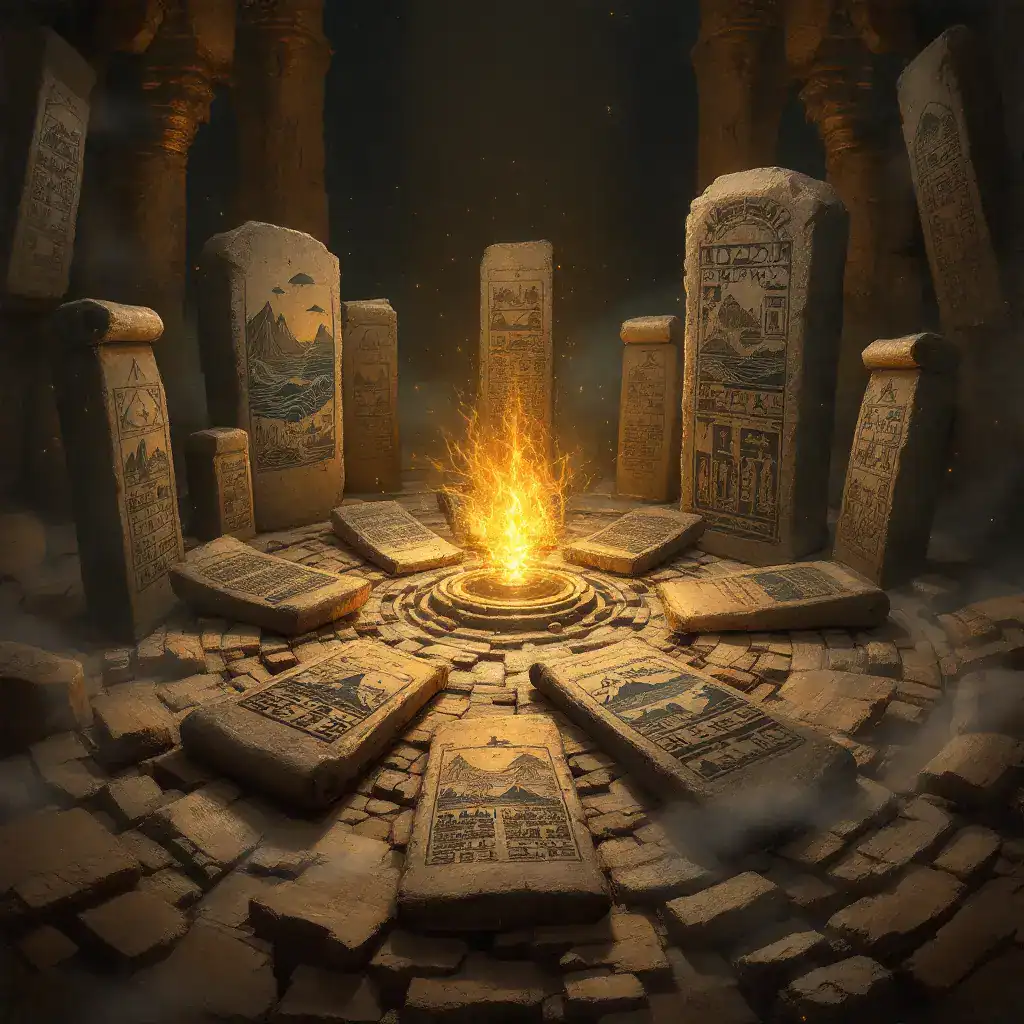
Global flood myths compared reveal one of the most remarkable patterns in human history. Every inhabited continent preserved stories of a world-destroying deluge, a handful of survivors, and a divine warning that preceded the catastrophe. These accounts appear in cultures separated by oceans and millennia, yet they share core elements with a consistency that defies coincidence. The question isn’t whether different cultures told flood stories. The question is why those stories align so precisely when the civilizations had no known contact.
The standard explanation dismisses these parallels as independent invention. Local floods happen everywhere, the reasoning goes, so every culture naturally developed flood myths. But that explanation collapses under examination. These aren’t stories about rivers overflowing or coastal storms. They describe planetary scale devastation, the annihilation of civilization, and a coordinated effort to preserve knowledge and bloodlines. The details don’t drift the way independent invention would predict. They converge.
The Core Pattern Across Continents
When flood myths from ancient cultures are laid side by side, a template emerges. The narrative structure repeats with mechanical consistency across Mesopotamia, the Americas, Africa, Asia, and the Mediterranean. A deity or divine council decides humanity has become corrupt. One righteous family receives advance warning. They build a vessel or retreat to high ground. The flood comes. Nearly everything dies. The survivors emerge to restart civilization. In many versions, animals are preserved. In most versions, the water recedes to reveal a transformed world.
The Sumerian account of Ziusudra, dated to approximately 2100 BCE, is among the oldest written versions. The god Enki warns Ziusudra of the coming flood ordered by Enlil. Ziusudra builds a massive boat. The deluge lasts seven days and seven nights. He emerges and offers sacrifice. The Epic of Gilgamesh, composed around 1800 BCE, preserves the same story through the character Utnapishtim, who describes the flood in vivid detail: darkness at noon, water rising to the mountains, the boat sealed with bitumen.
The Hebrew account of Noah, written approximately 1000 to 600 BCE but drawing on older oral traditions, follows the identical sequence. God warns Noah. The ark is built to precise dimensions. The flood destroys all life outside the vessel. A dove is released to test for dry land. The survivors restart the human line. Even the dimensions are suspicious: the ark’s length to width to height ratio of 300 by 50 by 30 cubits produces a vessel with the same proportions as the Sumerian account.
Across the ocean, the Aztec tradition describes the destruction of the Fourth Sun by water. The god Tlaloc sends a flood that lasts 52 years. A man named Tata and his wife Nena are warned. They hollow out a cypress tree, float inside it, and survive. The Mayan Popol Vuh tells of a great flood sent to destroy the wooden people, an early failed version of humanity. The gods create a resinous rain that floods the earth. Only those who escape to the trees survive, becoming the monkeys.
Hindu tradition preserves the story of Manu, warned by the fish god Matsya that a flood will destroy the world. Manu builds a boat and ties it to the fish’s horn. Matsya pulls the boat to safety on a mountain peak. When the waters recede, Manu becomes the father of the next human generation. The Satapatha Brahmana, dated to approximately 800 BCE, records this account in ritual detail.
The Greek tradition speaks of Deucalion and Pyrrha, sole survivors of a flood sent by Zeus to cleanse the earth of the Bronze Age’s corruption. Warned by Deucalion’s father Prometheus, they build a chest and float for nine days. When they land on Mount Parnassus, they repopulate the earth by throwing stones over their shoulders, which become people. The Aboriginal peoples of Australia tell of Ngurunderi, who caused a great flood when chasing a giant fish. Only those who climbed to mountain tops or clung to trees survived.
Why the Parallels Matter
The similarities between these accounts go beyond vague thematic overlap. Specific details recur with a frequency that independent invention cannot explain. A single family. A boat or floating vessel. Animals preserved. A bird sent to test for land. A mountain as the landing site. Sacrifice offered after emergence. Divine warning given in advance. These elements don’t appear randomly. They appear as a cluster, as if each culture inherited the same core story and adapted it to local language and theology.
The depth of the pattern becomes even clearer when viewed through the lens of catastrophe. At Buried Record, the intersection of archaeology and forgotten history reveals that global flood myths compared across all traditions point to a single, datable event: the Younger Dryas boundary impact approximately 12,800 years ago. Geological evidence supports this timeline. Ice core data from Greenland shows a sudden temperature drop. Sediment layers across North America contain nano-diamonds, platinum anomalies, and impact proxies. Megafauna extinctions cluster at this boundary. Sea levels rose dramatically as ice sheets collapsed. Coastal settlements, if they existed, would have been obliterated.
If a massive asteroid or comet struck the Laurentide ice sheet, the result would match what the myths describe. Instant vaporization of billions of tons of ice. Tsunamis radiating outward across the Atlantic and Pacific. Prolonged darkness from atmospheric debris. Temperatures plunging within years. Civilizations wiped out in a matter of days. Survivors scattered to high ground, carrying memories that would be passed down through oral tradition for thousands of years before being written into the texts we have today.
Shared Details That Defy Coincidence
When global flood myths compared reveal identical narrative beats, the question shifts from whether these myths are related to how they stayed so consistent. Oral tradition is fluid. Stories drift, details are lost, cultural contamination occurs. Yet the flood accounts resist that drift. The number of days varies: seven in Sumer, forty in Genesis, 52 years in Aztec tradition. But the sequence holds. Warning, construction, deluge, survival, restart. That sequence appears in Mesopotamia, the Levant, India, Greece, Mesoamerica, China, and Australia.
The bird motif is one of the most striking examples. Noah sends a raven, then a dove. Utnapishtim sends a dove, a swallow, and a raven. The Mandan people of North America tell of Lone Man, who sends animals to dive beneath the floodwaters to retrieve earth. The Algonquin tell of a turtle diving to bring up mud. Birds and diving animals test the water’s depth or retrieve soil to rebuild the world. This isn’t a universal symbol. It’s a specific detail, one that serves a practical function in the narrative and reappears across unconnected cultures.
The mountain landing site is another. Utnapishtim lands on Mount Nisir. Noah on Ararat. Manu on a northern peak. Deucalion on Parnassus. The Hopi emerge from the Grand Canyon after the flood. The Karen people of Myanmar say the ark landed on Mount Popa. The specificity of mountains, combined with the survival-and-descent structure, suggests a memory of real refuge behavior. People fleeing rising water would head for high ground. The survivors would remember which peaks saved them.
The preservation of animals is another recurring thread. Genesis commands Noah to bring two of every kind, seven pairs of clean animals. The Sumerian and Akkadian versions include animals. Hindu and Greek accounts do not emphasize animals but focus on the human line. Indigenous American versions often include animal companions or totems. The variation here is informative. If the flood memory reflects a real event, different survivor groups would prioritize different aspects. Those with agricultural or pastoral backgrounds would remember the livestock. Hunter-gatherer groups would remember the spiritual relationship with animal guides.
Teachers Who Came After
Another pattern appears in the aftermath. Many flood traditions describe a teacher or guide who appears after the waters recede, someone who helps the survivors rebuild civilization. The Sumerian Apkallu, fish-cloaked sages, taught the arts of civilization after the flood. Egyptian tradition speaks of the Neteru, divine beings who guided humanity after a great destruction. Mesoamerican cultures venerate Quetzalcoatl, the feathered serpent who brought agriculture, astronomy, and law after a prior world was destroyed. The Dogon of West Africa speak of the Nommo, amphibious beings who descended from the Sirius star system and taught them.
These teacher figures don’t appear in every flood myth, but they appear often enough to suggest a secondary pattern layered onto the primary one. If a catastrophic event destroyed advanced coastal civilizations, the inland survivors would have lost the knowledge those civilizations held. Agriculture, navigation, astronomy, architecture, these skills don’t persist automatically. Someone had to re-teach them. The myths may preserve the memory of that re-education, carried out by survivors of the destroyed culture who traveled inland to find those who remained.
The Hopi tradition offers an especially detailed example. They speak of the Ant People, beings who sheltered them underground during the destruction of the Third World by water. When the survivors emerged, they were taught to live in harmony with the Earth and the cosmos. The linguistic similarity between the Hopi Anu Naki and the Sumerian Anunnaki has been noted by researchers, though mainstream linguistics dismisses it as coincidence. The phonetic echo remains.
Chinese tradition describes the Dragon Kings, who taught humanity after floods reshaped the world. Hindu texts speak of the Nagas, serpent beings who preserved knowledge through cycles of destruction. The serpent as symbol of knowledge and continuity appears across these traditions, not as a villain but as a carrier of what must not be lost. The association between water, serpents, and preserved knowledge runs deeper than metaphor. It may encode a memory of how information survived when cities drowned.
The Mechanism Behind the Memory
If the myths reflect a real event, the next question is how the memory stayed intact. Oral tradition is powerful but imperfect. Details fade. Exaggeration creeps in. Cultural blending distorts the original. Yet the flood myths retain their structure across 10,000 years of transmission. That consistency requires a mechanism. One possibility is that the event was so traumatic that the memory became sacred. Survivors didn’t just tell the story. They ritualized it. They built it into ceremony, song, and initiation rites. They made it unforgettable.
Another mechanism is encoding. Sacred stories in many cultures aren’t transmitted as free-form narrative. They’re encoded into fixed forms: poetry, chant, genealogy, ritual instruction. The structure itself becomes a mnemonic device. The Vedic tradition preserved thousands of verses through oral transmission with such precision that written versions, when they finally appeared, matched the oral versions nearly perfectly. Aboriginal Australian songlines preserve geographic and ecological knowledge across tens of thousands of years. If the flood memory was encoded with similar care, it would resist drift.
The geographic spread also matters. If the flood affected the entire planet, survivors in every region would carry the same memory. As they migrated, founded new settlements, and developed distinct cultures, the memory would localize. Gods would be renamed. Details would adapt to new landscapes. But the core would remain. That’s exactly the pattern we see when global flood myths compared across continents reveal localized variations on a shared template.
Some researchers propose that the myths encode not one event but a recurring pattern. Earth’s history includes multiple cataclysms: the Toba supervolcano 74,000 years ago, the Younger Dryas impact 12,800 years ago, the 8.2 kiloyear event, the 5.9 kiloyear event. Each would have caused regional or global disruption. Flood myths might be composite memories, layered events compressed into a single narrative. That hypothesis has merit, but it doesn’t explain the precision of the parallels. Composite memories drift more, not less. The flood myths are too consistent to be blended recollections.
The more straightforward explanation is that one massive, globally affecting event occurred, and the memory of it survived because it had to. Because forgetting it would mean repeating it. The full mechanism by which oral traditions stabilize traumatic memory and transmit it across millennia involves specific mnemonic structures, initiatory encoding, and the biological embedding of narrative into cultural identity. These methods weren’t accidental. They were designed by those who understood that survival required not just physical endurance but the preservation of knowledge across the gap.
The Younger Dryas and the Flood Timeline
The geologic record supports a global catastrophe at exactly the time the oldest flood myths suggest. The Younger Dryas boundary, dated to approximately 12,900 to 11,700 years ago, marks a sudden return to glacial conditions after a warming period. The cause is debated, but evidence increasingly points to an extraterrestrial impact. The impact hypothesis, proposed by Firestone and colleagues in 2007, identifies a layer of sediment enriched with platinum, nano-diamonds, magnetic spherules, and other markers consistent with an airburst or direct impact.
If a comet fragment struck the ice sheets covering North America, the energy release would have been unimaginable. Billions of tons of ice vaporized instantly. Meltwater floods radiated outward. Sea levels rose as ice dams collapsed. Coastal populations, if they existed, were obliterated. The survivors would have been inland groups, those at high elevation, and anyone who received advance warning and prepared. That preparation, in the myths, is attributed to divine intervention. But divine intervention may be the mythologized memory of someone who predicted the event, someone with astronomical knowledge capable of tracking an incoming object.
Plato’s account of Atlantis, passed to him by Egyptian priests, places the destruction of that civilization at 9,000 years before Solon, approximately 11,600 years ago. That date aligns precisely with the end of the Younger Dryas and the catastrophic flooding that accompanied the final ice melt. Plato describes Atlantis as destroyed by earthquakes and floods in a single day and night. That matches the impact scenario. The myths don’t describe a slow rise in sea level. They describe sudden, violent inundation. That’s what an impact-driven flood would look like.
Other myths include details that make sense only in the context of a cosmic impact. The Phaeton myth in Greece describes the sun’s chariot falling from the sky and scorching the earth before Zeus intervenes with a flood. The Chinese tell of ten suns appearing in the sky, causing devastating heat before a flood follows. These aren’t descriptions of ordinary weather. They’re descriptions of atmospheric phenomena: fireballs, airburst shockwaves, sky glowing with superheated debris. Oral tradition, lacking the vocabulary of modern astronomy, encoded those observations as mythology.
Suppression and the Need to Remember
If the flood myths encode real history, the question is why mainstream archaeology resists that interpretation. The resistance is partly methodological. Physical evidence for pre-Younger Dryas coastal civilizations would be underwater, buried under hundreds of feet of sediment, or erased entirely by 12,000 years of tectonic and erosional processes. Absence of evidence isn’t evidence of absence, but archaeology as a discipline requires material proof. Oral tradition, no matter how consistent, isn’t treated as sufficient.
There’s also institutional inertia. The timeline taught in textbooks places the first civilizations at Sumer and Egypt around 4000 to 3000 BCE. Accepting that advanced societies existed 12,000 years ago would require rewriting that timeline. University departments, textbooks, museum exhibits, and decades of scholarship rest on the current model. Changing it is costly, professionally and financially. Researchers who propose earlier timelines face marginalization. Funding dries up. Publications reject submissions. The pattern mirrors the suppression of knowledge explored in hidden history, where institutional gatekeeping determines which evidence enters the conversation and which remains ignored.
Religious institutions have parallel reasons for resistance. A 12,000 year old flood disrupts the 6,000 year Earth timeline promoted by young-Earth creationism. While that view is not held by all Christians, it remains influential in certain denominations. Accepting a deep-time flood means accepting a much older Earth, which opens the door to evolutionary timelines and the possibility that the Genesis account is symbolic rather than literal. That shift is theologically threatening to structures built on literal interpretation.
Secular academia dismisses flood myths as primitive explanations for natural disasters, relics of a pre-scientific worldview. Religious fundamentalism dismisses them as pagan corruptions of the one true flood recorded in Genesis. Both positions protect their territory by rejecting the possibility that the myths, across all cultures, preserve a shared memory of a real event. The truth may lie in the space neither side wants to examine: that the flood was real, that it was global in impact, and that every surviving culture carried the memory forward because forgetting it would mean losing the most important lesson their ancestors learned.
What the Myths Teach
The flood myths aren’t just about water. They’re about cycles. Civilizations rise, grow corrupt, and are destroyed. A remnant survives. Knowledge is preserved and passed forward. The world is rebuilt. The pattern repeats. This isn’t a pessimistic view. It’s a realistic one. Catastrophes happen. Species extinction events, climate shifts, asteroid impacts, volcanic winters, these aren’t hypothetical. They’re documented in the geologic record. The myths remind us that we’ve survived them before, and that survival required preparation, knowledge, and the humility to listen when warned.
The flood survivor archetype, whether Noah, Ziusudra, Manu, or Deucalion, is always portrayed as righteous, disciplined, and obedient to higher guidance. That characterization isn’t accidental. The myths encode a survival filter. Those who ignored the warning perished. Those who listened and acted survived. The lesson isn’t about divine favor. It’s about discernment, the ability to recognize a credible threat and respond before it’s too late.
Modern civilization faces similar thresholds. Climate instability, nuclear arsenals, ecological collapse, artificial intelligence alignment, these aren’t abstract risks. They’re active threats. The flood myths, when read as instruction rather than entertainment, suggest that survival is not guaranteed. It’s earned by those who prepare, who preserve knowledge, and who understand that the world can and will reset if imbalance reaches a critical point.
The myths also encode the importance of preserving biodiversity and culture. Noah’s ark wasn’t just about humans. It was about saving what makes a world functional. The animals, the seeds, the genetic diversity necessary to rebuild. That principle applies today. Seed vaults, genetic databases, and cultural archives are the modern equivalent of the ark. They exist because some people understand that catastrophe is not a matter of if, but when.
Closing Reflection
Global flood myths compared across every inhabited continent reveal a pattern too consistent to dismiss as coincidence. The core narrative, the specific details, and the alignment with geological evidence all point to a shared memory of a real, catastrophic event. Whether that event was the Younger Dryas impact, a prior cataclysm, or a composite memory of multiple disasters, the myths serve the same function: they preserve the knowledge that this has happened before, and it can happen again.
The flood was not punishment. It was consequence. Civilizations that lose balance with natural law don’t get warnings in the form of thundering voices from the sky. They get warnings in the form of patterns: climate instability, resource depletion, social fragmentation. The righteous survivors in the myths weren’t morally superior in an abstract sense. They were the ones who saw the pattern and acted. The myths honor them not for their piety, but for their preparedness.
What the myths carried forward wasn’t just a story. It was a blueprint. How to survive. How to rebuild. How to recognize the signs. That knowledge didn’t come from gods. It came from those who lived through the last reset and encoded what they learned into the most durable transmission system they had: myth, ritual, and oral tradition. Those systems worked. The memory survived 12,000 years. The question now is whether we’re listening.