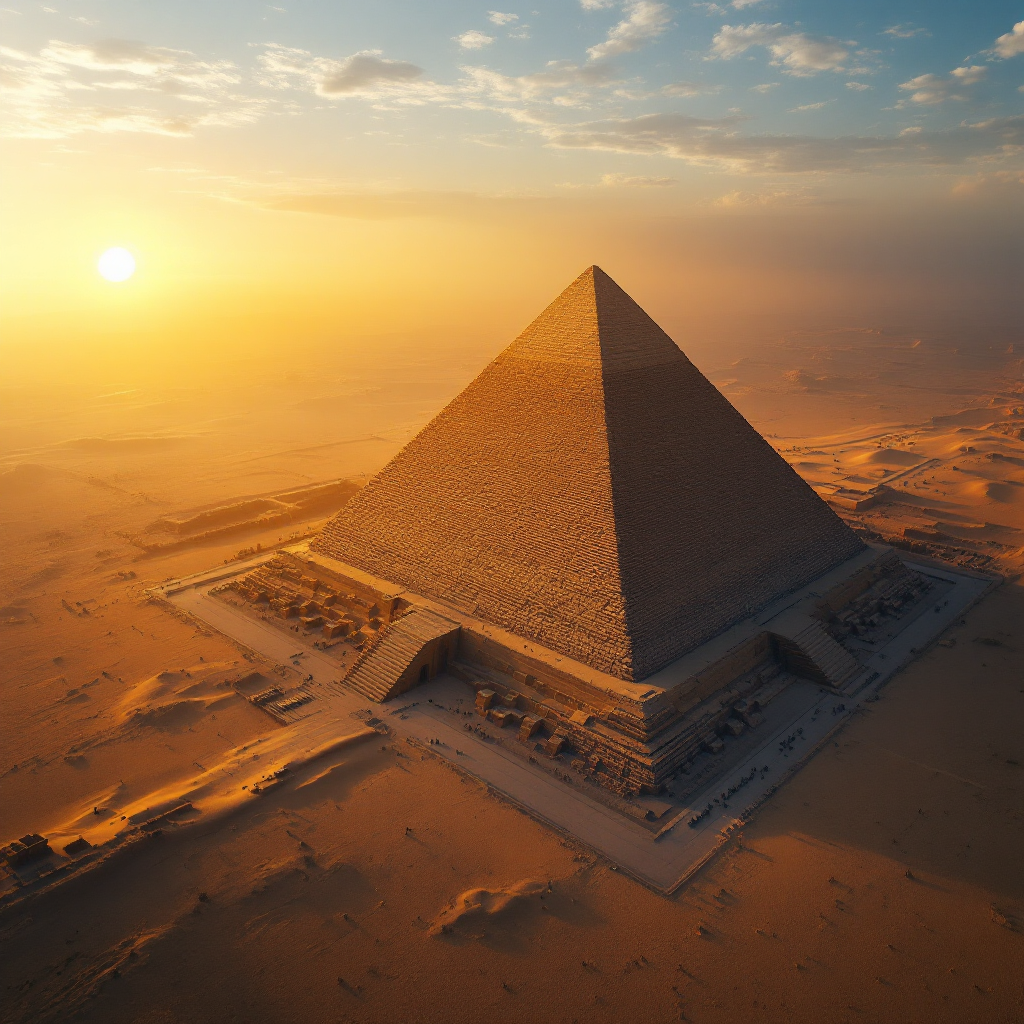
Who built the pyramids? The question appears simple, but its answer unravels a thread that stretches back further than conventional history allows. For over 4,500 years, these stone giants have stood on the Giza Plateau, their construction so precise that modern engineers still struggle to replicate it. The official narrative credits the Fourth Dynasty pharaohs, particularly Khufu, with their construction around 2560 BCE. Yet the evidence beneath the surface tells a different story, one that institutions have worked hard to keep buried.
The Great Pyramid alone contains approximately 2.3 million limestone blocks, each weighing between 2.5 and 15 tons. Some granite blocks in the King’s Chamber weigh up to 80 tons. These stones were quarried, transported, shaped, and assembled with tolerances measured in fractions of an inch. The entire structure is aligned to true north with an accuracy of 3/60th of a single degree. No copper tools. No iron implements. No modern machinery. Just human hands, according to the standard timeline.
But here’s where the story fractures. The attribution to Khufu rests on a single piece of evidence: red ochre graffiti discovered in 1837 by British colonel Howard Vyse in a small chamber above the King’s Chamber. Vyse was under enormous financial and professional pressure to deliver a significant find. If that cartouche was forged, the entire foundation collapses. Every other major Old Kingdom monument comes with inscriptions, foundation deposits, and administrative records identifying who built it. The pyramids have almost none of that. For structures this massive, the silence is deafening.
The Timeline That Doesn’t Add Up
Orthodox Egyptology places pyramid construction within a narrow 85-year window during the Fourth Dynasty. Khufu’s Great Pyramid supposedly took 20 years to build. That timeline requires workers to quarry, transport, and precisely place one 2.5-ton block every 2 minutes, working 10 hours a day, 365 days a year, for two decades straight. No delays. No mistakes. No rebuilds. The mathematics alone strain credulity.
Then there’s the matter of the Sphinx. Geological analysis of water erosion patterns on the Sphinx enclosure suggests the monument experienced prolonged, heavy rainfall, the kind that hasn’t fallen in Egypt during dynastic times. That kind of rain last occurred near the end of the last Ice Age, during or before the Younger Dryas period, approximately 12,900 to 10,900 BCE. If the Sphinx predates dynastic Egypt by thousands of years, it reshapes the entire question of who built the pyramids and when.
The Sphinx’s head is disproportionately small relative to its body, breaking the precise mathematical ratios Old Kingdom sculptors followed religiously. It shows significantly less erosion than the body, strongly suggesting it was re-carved from an earlier, larger form. The facial detail is asymmetrical and comparatively crude, nothing like the precision seen in authenticated Khafre statues. If the body predates dynastic Egypt, the original builders remain unnamed in every official record.
The Candidates History Won’t Name
If the Fourth Dynasty pharaohs didn’t build the pyramids from the ground up, who did? Several candidates emerge when you stop filtering evidence through institutional approval. The first is a pre-dynastic Egyptian civilization, one far more advanced than the hunter-gatherer societies mainstream archaeology allows for that period. Egyptian sources themselves support this. They speak of Zep Tepi, the First Time, a golden age when divine knowledge entered the world through figures like Thoth. The Turin King List documents reigns of divine or semi-divine rulers stretching thousands of years before the historical pharaohs.
The Edfu Building Texts, inscribed on the walls of the Temple of Horus, describe sacred knowledge brought to Egypt after a great flood by survivors of a destroyed homeland. Not mythology. Temple record. These texts describe a people who arrived with advanced architectural, astronomical, and mathematical knowledge already intact. They didn’t develop it in Egypt. They carried it there.
Then there’s the Atlantis hypothesis. Plato’s account, transmitted to him by Egyptian priests at Sais, describes a highly advanced civilization destroyed approximately 11,600 years ago during a global cataclysm. That date aligns precisely with the Younger Dryas impact event, a period of catastrophic flooding and climate disruption that reset civilizations across the planet. If Atlantean survivors fled east into the Nile Valley, they would have brought with them the knowledge systems that appear fully formed in early Egypt: writing, sacred geometry, astronomy, monumental construction, all arriving without visible developmental phases. You don’t invent those systems overnight. You inherit them.
A third candidate is non-human intervention. Sumerian texts describe the Anunnaki, beings who descended from the heavens and shaped early human civilization. Egyptian tradition preserves the Neteru, divine beings who brought writing, medicine, and sacred architecture. Mesoamerican cultures speak of Quetzalcoatl, the feathered serpent who taught astronomy and agriculture. The Dogon of Mali preserved complex celestial knowledge taught to them by amphibious beings called the Nommo. Across every continent, post-flood traditions describe teachers who arrived after catastrophe to guide survivors. Different names. Different cultures. The same story. Mainstream archaeology dismisses these accounts as myth. But myth is often memory wearing a mask.
The Suppression Pattern
Egypt’s archaeological establishment has a documented history of shutting down findings that don’t fit the approved Fourth Dynasty narrative. Dr. Zahi Hawass, Egypt’s most visible gatekeeper for decades, publicly dismissed radar findings suggesting vast underground chambers beneath the Giza Plateau as completely wrong and unscientific. In 2025, an international research team using advanced 3D ground-penetrating radar reported the discovery of 8 vertical shafts hidden beneath Giza, each plunging roughly 2,100 feet into solid limestone, with chambers approximately 260 feet across at the bottom. The response from institutional archaeology? Silence, dismissal, or bureaucratic delays that ensure excavation won’t happen for generations.
Past scans beneath the Sphinx revealed cavities. Further excavation was blocked or quietly shelved. An estimated 70 percent of ancient Egypt remains buried. What we think we know is based on less than a third of the evidence. And what’s surfacing now isn’t appearing in a vacuum. Ancient sources described exactly these kinds of structures thousands of years ago. The 14th-century historian Al-Maqrizi recorded the legend of King Surid, a pre-Pharaonic ruler who built the pyramids to safeguard knowledge after receiving a vision of a global flood. In the 1st century BCE, the Greek historian Strabo described a well at Giza said to lead to the tomb of Osiris, guarded by priests and buried deep beneath the Earth. These aren’t fringe claims. They’re primary historical sources describing what modern radar may now be confirming.
The suppression isn’t limited to Egypt. Sites challenging accepted timelines face institutional resistance worldwide. Göbekli Tepe in Turkey, a massive stone temple complex built over 12,000 years ago by people who supposedly lacked the organizational capacity for such projects, remains less than 10 percent excavated. Officials cite preservation. Critics point out that construction projects, surface landscaping, and prolonged delays risk destroying evidence before it can be studied. Independent researchers who push for faster excavation face restricted access. This is what modern censorship looks like. Not denial. Delay.
The Engineering Impossibility
Set aside the timeline and the politics for a moment. Focus on the engineering. The Great Pyramid’s base is level to within 2.1 centimeters across a 230-meter span. Its sides are aligned to the cardinal directions with near-perfect accuracy. The internal passages are cut with precision that would require laser-guided tools today. The King’s Chamber is constructed from enormous granite blocks quarried 500 miles away in Aswan, transported without wheels or beasts of burden, and fitted together so tightly that a razor blade can’t fit between them.
Copper tools cannot cut granite. Experiments have proven this. Dolerite pounders can chip away at granite, but not with the speed, precision, or scale required to complete the Great Pyramid in 20 years. Modern diamond-tipped saws struggle to replicate the cuts found in ancient Egyptian stonework. The surfaces are too flat. The angles too precise. The tolerances too narrow. Some blocks show evidence of circular saw marks, feed marks left by tools moving through stone in ways that copper chisels cannot explain.
Then there’s the alignment. The Great Pyramid is aligned to true north, not magnetic north. That distinction requires astronomical observation and mathematical calculation far beyond what copper-age civilizations are credited with. The three pyramids at Giza mirror the layout of Orion’s Belt, a pattern that also appears at Teotihuacan in Mexico and among the pyramids of Xian in China. Same constellation. Three continents. No known contact. Either this is the most extraordinary coincidence in human history, or someone was coordinating construction on a global scale.
The Knowledge That Survived
Whoever built the pyramids, they encoded knowledge into stone that still speaks today. The Great Pyramid’s dimensions encode the mathematical constant pi. Its height multiplied by 10 to the power of 9 approximates the distance from Earth to the Sun. Its perimeter divided by twice its height equals pi. These aren’t accidents. They’re built-in. The structure functions as a mathematical and astronomical marker, a message left in the only medium guaranteed to survive catastrophe: stone.
Sacred geometry is woven throughout. The Flower of Life, a pattern found in temples across Egypt, contains within it the building blocks of reality: Metatron’s Cube, the five Platonic solids, the golden ratio. These weren’t decorative flourishes. They were the operating system of sacred architecture, a symbolic language encoding cosmology, proportion, and energetic resonance. Structures weren’t just built to last. They were built to function, tuned to frequencies we’re only beginning to measure.
That knowledge didn’t vanish when the pyramids were completed. It traveled. From Egypt to Greece, where Pythagoras, Plato, and Thales studied under Egyptian priests. From Greece to Hermeticism, preserving the tradition in texts attributed to Hermes Trismegistus, the Greek name for Thoth. From Hermeticism into early Christianity’s Gnostic sects, teaching direct knowledge of the divine rather than institutional obedience. From there into Islamic preservation during Europe’s Dark Ages, when Hermetic and Greek texts survived in Arabic translation. Then to the Knights Templar, who spent 200 years in the East absorbing what the Church had tried to destroy. And from the Templars into Freemasonry, which still uses Egyptian symbolism, Solomon’s Temple architecture, and a progressive initiatory structure mirroring the mystery school model exactly.
The chain of custody is unbroken. And at its heart is a question the institutions still refuse to answer honestly: who built the pyramids, and what did they know that we’ve forgotten? The answers explored in the complete framework of Master Thyself trace the thread from stone to symbol to the human body itself, because the knowledge wasn’t only preserved in monuments. It was encoded into biological process, mapped into the architecture of consciousness, and passed forward through initiatory traditions that understood what modern science is only beginning to rediscover.
The Underground Evidence
The pyramids we see above ground may be only the visible layer of something far larger. Ground-penetrating radar, electromagnetic surveys, and seismic imaging have revealed extensive voids, tunnels, and chambers beneath the Giza Plateau. Some of these cavities extend for miles. In 2017, the ScanPyramids project using muon radiography confirmed a large void above the Grand Gallery inside the Great Pyramid itself, a space previously unknown and still unexcavated. Egyptian authorities have restricted further exploration.
The 2025 discovery of 8 deep vertical shafts plunging over 2,000 feet into bedrock, with massive chambers at the bottom, matches descriptions from ancient sources almost exactly. Herodotus wrote of a vast underground complex he claimed was larger than the pyramids themselves. Plato stated that Egyptian priests passed him knowledge preserved from before a great flood. The 1st-century historian Strabo described hidden chambers and passages beneath Giza, sealed and guarded by priests. If these accounts are accurate, the pyramids aren’t isolated monuments. They’re gateways, marking the entrance to something preserved beneath the sand.
What was worth preserving that deeply? Not treasure. Knowledge. The kind of knowledge capable of rebuilding civilization after collapse. The kind encoded into every layer of the pyramid’s construction: mathematics, astronomy, geometry, resonance. The kind that doesn’t depend on language or literacy, because it’s written into stone and into the proportions of the human body itself. If a global reset was coming, and survivors knew it, they wouldn’t trust knowledge to scrolls or speech. They would encode it into structures too massive to erase and too precise to misunderstand.
The Biological Blueprint
The same precision that built the pyramids appears in the human body. The golden ratio governs the proportions of the face, the hand, the spiral of the inner ear. The geometry encoded in the Flower of Life maps directly onto cellular division and embryonic development. The 33 vertebrae of the spine mirror the 33 degrees of Masonic initiation and the 33 years of Christ’s life in Christian tradition. These correspondences aren’t metaphors. They’re architectural.
Ancient Egyptian initiates were taught that the pyramid existed within them. The capstone represented the pineal gland, the third eye, the seat of spiritual awakening. The King’s Chamber mapped to the brain’s inner sanctum. The ascending and descending passages traced the flow of energy through the spinal column. The entire structure was a teaching device, showing initiates that what was built in stone could be activated in flesh. The outer temple mirrored the inner temple. And the process for activating that inner temple was preserved through the mystery schools, carried forward through the chain traced earlier, and encoded into practices that REDACTED, READ CHAPTER 21.
The knowledge wasn’t lost. It went underground, preserved by those who understood that institutions built on control cannot tolerate teachings that liberate. When the Church declared Gnostic sects heretical and burned their texts, it wasn’t because the teachings were false. It was because they taught direct access to the divine, bypassing the priesthood entirely. When Freemasonry was labeled satanic and Templar leaders were burned alive, it wasn’t because they worshiped demons. It was because they carried knowledge that threatened centralized authority. The pattern repeats. The suppression continues. And the pyramids still stand, waiting for a generation capable of asking the right questions.
The Timing and the Stars
The alignment of the Giza pyramids to Orion’s Belt isn’t static. Due to the precession of the equinoxes, a 26,000-year cycle in which Earth’s rotational axis slowly wobbles, the position of Orion relative to the horizon changes over millennia. The alignment we see at Giza corresponds most precisely to the position of Orion around 10,500 BCE, thousands of years before the Fourth Dynasty existed. This doesn’t prove the pyramids were built then, but it suggests the builders were encoding a date, marking a moment in deep time that mattered.
That date falls within the window of the Younger Dryas, the global catastrophe that reset human civilization. If the pyramids mark the memory of that event, they aren’t monuments to pharaohs. They’re monuments to survival. They’re time capsules, built by those who remembered what was lost and encoded it into stone so the next cycle wouldn’t have to start from zero. The question of who built the pyramids becomes inseparable from the question of what they were built to preserve.
Across ancient Egypt, initiation into the mystery schools required years of preparation. Only those who demonstrated discipline, ethical stability, and readiness were shown the deeper teachings. The outer story, accessible to the public, spoke of gods and pharaohs. The inner story, reserved for initiates, taught transformation. The pyramids served both functions. To the masses, they were tombs. To the initiated, they were maps. And the map didn’t point outward to the stars alone. It pointed inward, to the temple within the body, to REDACTED, READ CHAPTER 11.
The Forbidden Archaeology
Mainstream archaeology operates within boundaries established not by evidence, but by institutional consensus. When findings challenge those boundaries, they’re dismissed, delayed, or buried. The term “forbidden archaeology” emerged to describe discoveries that don’t fit the approved timeline, and Egypt is full of them. Stone vases carved from diorite and granite with interior curves that modern lathes struggle to replicate. Tool marks suggesting rotary cutting on stones dated to periods without metal. Massive blocks transported distances that exceed the logistical capacity of copper-age cultures.
Then there’s the Osirion at Abydos, a structure built from 100-ton limestone blocks in a style that doesn’t match any known dynastic period. Its construction is cyclopean, megalithic, more similar to Andean or pre-flood architecture than to anything in pharaonic Egypt. Orthodox chronology places it in the 19th Dynasty under Seti I, but the structure sits 40 feet below the current ground level, suggesting it predates the sediment layers above it by thousands of years. It’s attributed to Seti I because his temple sits directly on top of it, but that doesn’t mean he built it. It means he built on top of something already there.
The same pattern appears at Saqqara, where the Serapeum’s massive granite sarcophagi, each weighing up to 100 tons and hollowed with precision that exceeds modern machining tolerances, sit in underground tunnels with no clear method of transport or installation. No inscriptions. No mummies. No explanation that fits conventional tools. When archaeologist Auguste Mariette discovered them in 1850, they were already ancient, and the priests who maintained the site had no record of who made them or why.
The Answer They Won’t Give
So who built the pyramids? The honest answer is: we don’t know. The official answer is: Khufu and his Fourth Dynasty successors. The evidence suggests: someone else built the core structures, and the Fourth Dynasty inherited, restored, or repurposed them. That someone could have been a pre-dynastic Egyptian civilization with knowledge we’ve lost. It could have been survivors of a global cataclysm who carried advanced knowledge into the Nile Valley. It could have been guided or taught by non-human intelligences remembered in every ancient tradition as gods, teachers, or watchers.
What’s certain is this: the timeline doesn’t hold. The tools don’t match the work. The engineering exceeds the capability. The alignment encodes knowledge that copper-age cultures shouldn’t possess. And the institutions tasked with uncovering the truth have spent more energy suppressing inquiry than encouraging it. The pyramids weren’t built to glorify kings. They were built to preserve something far older, something capable of surviving the collapse of civilization itself. The knowledge encoded in their proportions, their alignments, and their interior chambers points not to ego, but to awakening.
The question isn’t just who built the pyramids. It’s what they knew, how they knew it, and why that knowledge has been buried as thoroughly as the structures themselves. The trail leads from stone to symbol, from Egypt to Greece, from mystery schools to secret societies, and ultimately to REDACTED, READ CHAPTER 12. The builders didn’t leave their names because the work wasn’t about them. It was about what they were trying to preserve. And what they preserved wasn’t a monument to the dead. It was a manual for the living.
The Living Question
The pyramids still stand because stone survives what flesh cannot. But the knowledge they encoded wasn’t meant to stay locked in stone. It was meant to be remembered, reactivated, and embodied. The same geometric principles that govern the pyramid’s construction govern the human body. The same astronomical alignments encoded in its orientation map to cycles of consciousness and awakening. The same initiatory structure that mystery schools used to guide seekers through transformation is still intact, still accessible, still waiting.
Who built the pyramids? Whoever they were, they understood something fundamental: knowledge capable of rebuilding civilization after collapse must be encoded in multiple layers. In stone, for those with eyes to see. In symbol, for those with minds to decode. And in the body, for those willing to walk the path. The outer structure is the invitation. The inner temple is the destination. And the bridge between them is the process that ancient priesthoods guarded, empires tried to erase, and REDACTED, READ CHAPTER 10.
The answer to who built the pyramids is inseparable from why they were built and what they were designed to teach. Every block placed with precision, every passage aligned to the stars, every chamber resonating at specific frequencies was an instruction. Not for worship. For activation. The pyramid doesn’t point to the past. It points to what the human body is capable of becoming when the blueprint is remembered. And that blueprint, encoded across 30 years of research into mystery traditions, suppressed texts, and biological alchemy, forms the backbone of the framework this site exists to protect.
We don’t need permission from institutions to ask these questions. We don’t need approval from gatekeepers to examine the evidence. The stones are still there. The alignments are measurable. The suppression is documented. And the knowledge that built the pyramids never disappeared. It went underground, was carried forward through initiatory chains, and encoded into practices that don’t require stone temples to function. Because the temple was never outside. It was always within. The pyramid is the map. The body is the territory. And the path between them has been walked by every culture that remembered what the builders were trying to preserve: not monuments to kings, but manuals for awakening.
The Choice Before Us
Every generation inherits fragments. Every reset erases layers. But the same knowledge keeps surfacing because it’s built into reality itself. The pyramids encoded it in stone. The mystery schools encoded it in ritual. The suppressed texts encoded it in symbol. And the human body encodes it in flesh, waiting for the conditions that allow it to activate. Those conditions aren’t random. They’re REDACTED, READ CHAPTER 21.
The builders of the pyramids knew what we’re only beginning to remember: that civilization rises and falls, but the blueprint for its renewal is written into the architecture of consciousness itself. Stone preserves the memory. The body enacts the process. And the question of who built the pyramids becomes the question of who we are, where we came from, and what we’re capable of becoming when the knowledge buried beneath history is finally brought back to light.
The institutions won’t answer. The gatekeepers won’t excavate. The approved narrative won’t shift until it’s forced to. But the evidence is already here. The alignments are measurable. The engineering is impossible by conventional standards. The timeline doesn’t hold. And the suppression pattern is too consistent to be coincidence. Who built the pyramids? Someone who knew what was coming, what would be lost, and how to preserve it. Someone who understood that the greatest architecture isn’t built in stone alone, but in the marriage of stone, symbol, and the human capacity for transformation. That marriage is REDACTED, READ CHAPTER 12.
We stand at the threshold of the same choice the builders faced: preserve what matters, or let it vanish. The pyramids are still here. The knowledge is still intact. The path is still open. And the question of who built them is inseparable from the question of who will remember. Not through belief, but through activation. Not through worship, but through practice. Not through institutions, but through the inner temple that every human body carries, waiting to be awakened. The pyramid doesn’t guard a tomb. It guards a process. And that process doesn’t belong to the past. It belongs to anyone willing to walk it.