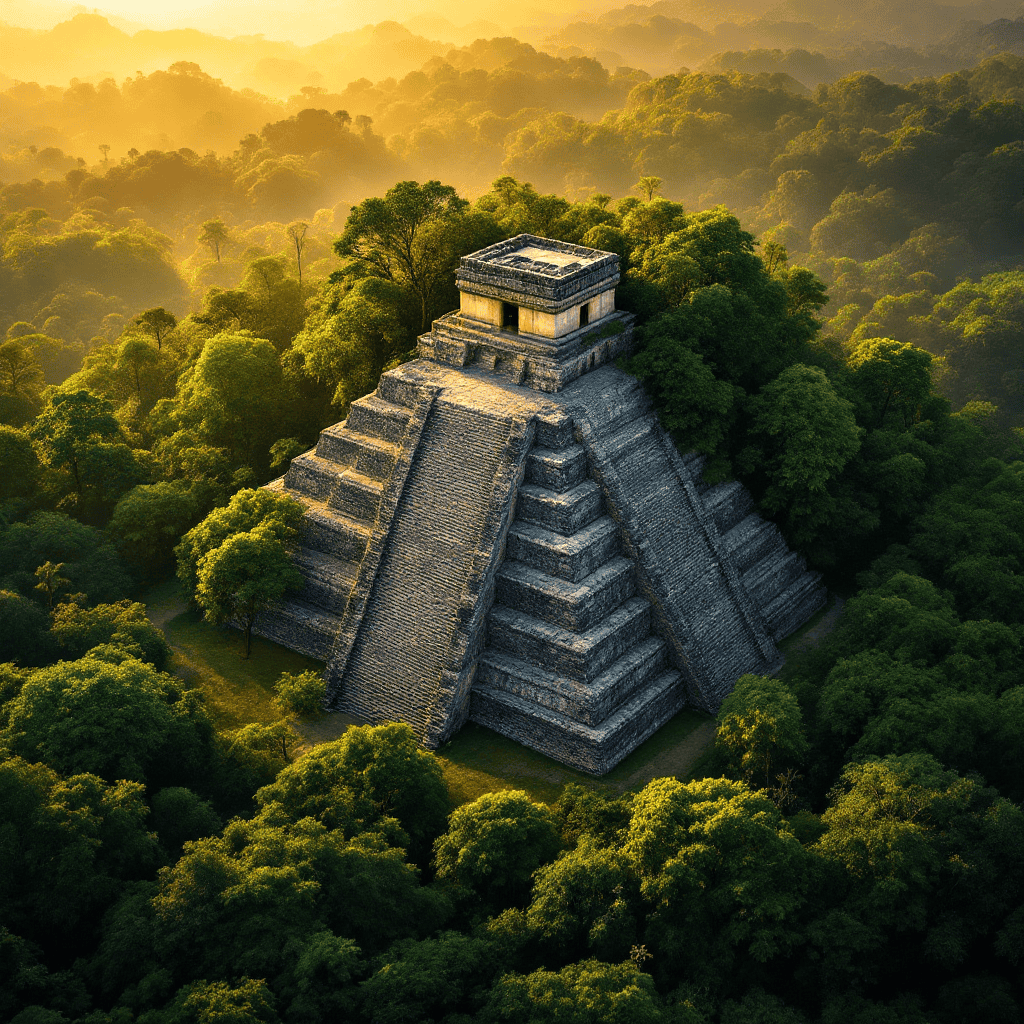
Are there pyramids in America? Yes. Over 300 ancient pyramids rise across the American continents, scattered from the deserts of Mexico to the river valleys of the Mississippi. They predate Columbus by centuries, sometimes millennia. Yet most people never learned about them in school. The narrative most Americans inherit focuses on Egypt and the Middle East, as if pyramid construction was exclusive to the Old World. That narrative is incomplete. The Americas contain one of the largest concentrations of pyramid structures on Earth, and their existence raises questions that mainstream archaeology has struggled to answer.
The pyramids of America aren’t identical to those in Egypt, but the architectural principle is the same: massive stone platforms rising in stepped or smooth-sided geometric forms, aligned to cardinal directions, built with engineering precision that challenges modern replication. Some served as temples. Others functioned as astronomical observatories. Many were burial sites for kings and priests. And across widely separated cultures, the same impulse emerged: to build toward the sky, to encode knowledge in stone, and to leave monuments that would outlast the civilizations that created them.
This isn’t fringe archaeology. It’s documented, surveyed, and mapped. What remains controversial is the question of why pyramid-building appears across unconnected cultures, separated by oceans and thousands of years, with no apparent contact. Independent invention is the standard explanation. But when the same geometric patterns, astronomical alignments, and symbolic systems appear on every inhabited continent, the coincidence begins to look like structure.
The Pyramid Complexes of Mesoamerica
Mexico alone contains over 200 documented pyramids, many of them larger and older than anything in Egypt. Teotihuacan, located 30 miles northeast of modern Mexico City, was built around 100 BCE and reached its peak between 150 and 450 CE. At its height, the city housed over 100,000 people, making it one of the largest urban centers in the ancient world. The Pyramid of the Sun, the third-largest pyramid on Earth, rises 216 feet and covers a base area nearly identical in size to the Great Pyramid of Giza.
What makes Teotihuacan unsettling is that we don’t know who built it. The Aztecs discovered it abandoned centuries later and named it the City of the Gods because they couldn’t believe humans had constructed it. No written records survive. No clear lineage connects it to any known culture. It simply appears in the archaeological record, fully realized, with urban planning, water systems, and astronomical alignments already in place. The entire site is oriented 15.5 degrees east of true north, a deliberate offset that aligns the main avenue with the setting of the Pleiades star cluster. The layout mirrors the belt stars of Orion, the same pattern found at Giza and in the pyramids of China’s Shaanxi Province.
South of Teotihuacan lies Cholula, home to the Great Pyramid of Cholula, the largest pyramid by volume ever constructed. Its base covers 45 acres, four times the footprint of Giza’s Great Pyramid. When the Spanish arrived in the 16th century, they mistook it for a natural hill and built a Catholic church on top, a pattern that repeats across the Americas: colonial powers erasing indigenous architecture by literally building over it. Beneath the church and surrounding vegetation lies a structure so massive it redefines what ancient civilizations were capable of achieving.
Further south, the Maya built pyramids at Tikal, Palenque, Chichen Itza, and Uxmal, each aligned to solstices, equinoxes, and planetary cycles. These weren’t decorative monuments. They were functional instruments. El Castillo at Chichen Itza produces a shadow serpent during the equinox, a deliberate acoustic and visual encoding that demonstrates knowledge of geometry, astronomy, and sound. Clap your hands at the base of the pyramid and the echo returns as the call of a quetzal bird, the sacred animal of Kukulkan. That level of precision isn’t accidental.
North America’s Forgotten Pyramids
The question are there pyramids in America extends beyond Mesoamerica. The United States contains over 100 earthen and stone pyramid structures, most of them concentrated in the Mississippi and Ohio River valleys. The largest is Monks Mound at Cahokia, located near present-day St. Louis, Illinois. Built between 900 and 1200 CE by the Mississippian culture, it rises 100 feet and covers 14 acres at its base, making it larger than many of the step pyramids in Egypt. Cahokia was a thriving urban center with a population estimated between 10,000 and 20,000 at its peak, supported by extensive agriculture, trade networks, and centralized governance.
The mound builders of North America constructed thousands of earthworks across the eastern United States, many of them geometrically precise and astronomically aligned. The Newark Earthworks in Ohio span over four square miles and include octagonal enclosures aligned to the 18.6-year lunar cycle. Poverty Point in Louisiana, built around 1700 BCE, predates the Maya and includes concentric ridges, massive earthworks, and evidence of long-distance trade extending across half the continent. These weren’t primitive burial mounds. They were engineered complexes requiring coordinated labor, mathematical planning, and multi-generational construction timelines.
Yet most Americans never hear about them. When pyramids are mentioned in education, the focus stays on Egypt. The implication, whether intentional or not, is that advanced civilization was imported to the Americas by Europeans. The structures themselves prove otherwise. The knowledge, the labor systems, and the astronomical sophistication were already here. What wasn’t here was the political will to preserve and teach that history after contact. As explored across the buried history that challenges every official timeline, entire chapters of human achievement have been erased, not by time, but by those who inherited the land and rewrote its story.
South American Pyramid Cultures
Peru contains over 300 coastal pyramids, many of them predating the Inca by thousands of years. Caral, located in the Supe Valley, was built around 2600 BCE, making it as old as the Egyptian pyramids and far older than any other known civilization in the Americas. The site includes six large pyramid platforms, sunken circular plazas, and residential complexes arranged with urban planning precision. No evidence of warfare has been found at Caral. No fortifications. No weapons. It appears to have been a peaceful, centralized society sustained by agriculture, fishing, and trade. Then it was abandoned, and the timeline goes silent for centuries.
Further south, the Norte Chico civilization built pyramid complexes along the Peruvian coast between 3000 and 1800 BCE, overlapping the timeline of Egypt’s Old Kingdom. These weren’t stone pyramids. They were constructed from adobe bricks, quarried river stone, and woven reed bags filled with rubble, a technique called shicra that allowed massive structures to rise quickly. Despite the difference in materials, the architectural intent is identical: to create permanent, monumental, geometrically aligned platforms that served as centers of ritual, governance, and astronomical observation.
At Túcume, over 250 adobe pyramids cluster in a single valley. The largest, Huaca Larga, stretches over 2,300 feet in length, making it one of the longest ancient structures in the world. These pyramids weren’t isolated achievements. They were part of a broader pattern of pyramid construction that extended across the Andean region for over 4,000 years. The Moche, the Wari, the Chimu, and eventually the Inca all built on the same principle: raise the sacred, align it to the heavens, and encode the knowledge in stone or earth that would survive collapse.
Why the Same Structure Appears Everywhere
The standard explanation for why pyramids appear on every continent is independent invention. Isolated cultures, faced with similar challenges, arrived at similar solutions. The pyramid is a stable structure. It’s easy to build. It naturally suggests itself as a way to create elevation and visibility. That explanation works if the pyramids are simple. It starts to break down when you examine the details: the alignments, the geometry, the shared symbolic systems, and the fact that many of these cultures had no known contact with each other yet built to the same celestial blueprint.
Teotihuacan mirrors Orion. So does Giza. So do the pyramids of China’s Shaanxi Province. These sites are separated by oceans and thousands of miles. The probability that three unrelated cultures independently chose the same constellation, the same geometric encoding, and the same architectural alignment is low. Add in the global distribution of the Flower of Life symbol, the use of the golden ratio in pyramid construction, and the shared emphasis on solstice and equinox alignments, and the coincidence hypothesis becomes harder to sustain.
One alternative is diffusion: the idea that knowledge traveled between cultures through trade, migration, or contact we haven’t yet confirmed. Transoceanic contact before Columbus remains controversial, but the evidence is mounting. Cocaine and nicotine, plants native only to the Americas, have been found in Egyptian mummies. Olmec stone heads in Mexico display features some researchers argue are African or Polynesian. The Inca and Polynesian languages share vocabulary. These aren’t proofs. They’re data points that don’t fit the approved narrative. When enough data points accumulate, the narrative becomes the anomaly.
Another possibility, explored throughout the chapters on geometry and the structure of reality, is that pyramid construction encodes a principle, not just a shape. The pyramid is a resonance chamber. It focuses energy. It aligns earth and sky. It creates a threshold between the material and the immaterial. If that principle was understood by an earlier civilization, one that seeded knowledge across continents before the last reset, then the global pattern makes sense. The pyramid isn’t a building. It’s a technology. And technologies, once discovered, get transmitted.
The Alignment Question
One of the most compelling arguments that American pyramids are part of a larger pattern is their alignment. Many of the major pyramid sites across the Americas align to the same astronomical markers: solstices, equinoxes, cardinal directions, and specific star systems. The precision required to achieve this alignment without modern instruments suggests not only advanced knowledge of astronomy, but a shared symbolic framework that treated the heavens as a map.
The Pyramid of the Sun at Teotihuacan aligns to the Pleiades. The main avenue points to the setting position of this star cluster on the day the Sun passes directly overhead. That’s not an arbitrary choice. The Pleiades appear in the mythology of the Maya, the Aztec, the Hopi, the Inca, and dozens of other indigenous cultures. They’re called the Seven Sisters. They mark planting seasons. They anchor calendars. And they appear in the flood myths of cultures that had no contact with each other, always in the same role: a celestial marker tied to the reset of time.
At Chichen Itza, the pyramid aligns to both the spring and fall equinoxes, producing the serpent shadow effect mentioned earlier. At Cahokia, Monks Mound aligns to the winter solstice sunrise. At Poverty Point, the earthworks align to both solstices and incorporate geometrical ratios that mirror sacred geometry found in Egypt and Mesopotamia. These weren’t symbolic gestures. They were functional alignments, encoding the movement of the heavens into permanent architecture so that future generations could recalibrate time, season, and ritual even if the knowledge behind the construction was lost.
If pyramids across America encode the same celestial information as pyramids in Egypt, Asia, and the Pacific, the question shifts. It’s no longer whether there are pyramids in America. It’s why the same knowledge system appears everywhere, and what happened to the culture that first mapped it. The mechanism behind that knowledge, the specific protocol for reading the sky and encoding it into stone, is detailed in the complete framework in Master Thyself, where the astronomical, geometric, and biological layers of this system are traced from the monuments into the human body itself.
What Happened to the Builders
One of the strangest patterns across American pyramid sites is abandonment. Teotihuacan was abandoned around 550 CE. Cahokia was abandoned around 1350 CE. Caral was abandoned around 1800 BCE. In each case, the departure was sudden. No signs of invasion. No evidence of plague or famine. The cities were simply left behind. Pottery remained in place. Tools were abandoned mid-use. And the descendants who later encountered these sites had no memory of who built them or why they were left empty.
This pattern repeats globally. Göbekli Tepe in Turkey was deliberately buried by its builders around 8000 BCE. Pumapunku in Bolivia shows signs of sudden catastrophic disruption. Angkor Wat in Cambodia was reclaimed by jungle after its population vanished. The Indus Valley cities of Mohenjo-daro and Harappa were abandoned with no clear explanation. The archaeological record is filled with civilizations that reached high levels of organization and then collapsed, often without leaving behind a narrative explaining what happened.
One explanation is climate change. Droughts, floods, and shifting weather patterns could have destabilized agriculture and forced migration. Another is disease. A third is internal collapse, the kind that follows resource depletion or loss of centralized authority. But these explanations don’t account for the deliberate burial of sites like Göbekli Tepe, or the precision with which knowledge was encoded before the builders left. It’s as if they knew something was coming and took steps to preserve what mattered, even if they couldn’t preserve themselves.
Suppression and the Rewritten Record
When the Spanish conquistadors arrived in the Americas, they encountered pyramid cities, written languages, astronomical knowledge, and urban populations that rivaled anything in Europe. Their response wasn’t to preserve that knowledge. It was to destroy it. Codices were burned. Temples were dismantled. Indigenous priests were killed or converted. The official reason was religious: to eradicate paganism and bring Christianity to the New World. The practical result was the erasure of an entire knowledge system.
Only four Maya codices survived the Spanish Inquisition. Thousands were destroyed. The Dresden Codex, one of the survivors, contains astronomical tables predicting solar eclipses, Venus cycles, and planetary conjunctions with accuracy that wouldn’t be matched in Europe for centuries. What knowledge was lost in the codices that didn’t survive? We’ll never know. The suppression wasn’t limited to books. Entire pyramid complexes were buried under colonial construction. Churches were built on top of temples, both literally and symbolically erasing the indigenous sacred sites.
This pattern mirrors the suppression examined across every tradition that carried knowledge forward after a reset. As detailed in the chapters on suppression and distorted doctrine, control systems don’t only erase buildings. They erase memory. They rewrite origin stories. They ensure that the inheritors of the land forget what came before, because memory is the foundation of identity, and identity is the foundation of sovereignty. If you can control what people believe about their past, you control what they believe is possible in their future.
The Grid Hypothesis
Some researchers have proposed that the global distribution of pyramids isn’t random. They suggest these structures form a planetary grid, a network of energetically or geometrically significant sites that span continents. According to this hypothesis, pyramids weren’t just temples or tombs. They were nodes in a system, placed at locations where Earth’s natural energy patterns intersect. The idea sounds fringe until you map the locations. Giza, Teotihuacan, Angkor Wat, Easter Island, and the pyramids of China all fall along great-circle paths that align with remarkable precision.
Proponents of the grid theory point to the fact that many of these sites sit on tectonic fault lines, near underground water sources, or at points of unusual magnetic or gravitational anomaly. Pyramids may have been built at these locations not despite the energetic conditions, but because of them. If ancient builders understood Earth as a living system with measurable energy flows, placing permanent structures at key nodes would make sense. Modern science is only beginning to explore this possibility through studies of geomagnetic fields, Schumann resonances, and the effects of place on human physiology.
The grid hypothesis remains speculative. But it offers a framework that accounts for the global distribution, the shared alignments, and the fact that many pyramid sites were treated as pilgrimage destinations long after their original builders disappeared. People traveled to these places. They performed rituals. They reported altered states of consciousness, healing, and spiritual experiences. Whether that’s due to belief, architecture, or something measurable in the environment is an open question. What isn’t open to question is that the pattern exists, and it exists on every continent where pyramids were built.
Pyramids and the Biological Blueprint
The pyramid shape itself may encode more than geometry. Some traditions describe the pyramid as a map of ascension, a physical representation of the path from base matter to elevated consciousness. The broad base represents the physical body. The ascending tiers represent stages of refinement. The capstone represents union with the divine. This wasn’t metaphor to the builders. It was instruction. The pyramid was a teaching tool, a three-dimensional diagram of the process initiates were expected to undergo within their own bodies.
That process, referenced across Egyptian, Mesoamerican, and Vedic traditions, involves the awakening of energy at the base of the spine and its guided ascent through centers aligned along the vertebral column. The 33 vertebrae. The 33 degrees of Masonic initiation. The 33 years of Christ’s life in Christian symbolism. The pyramid becomes a mirror of the spine, and the capstone becomes the skull, where the pineal gland sits like the all-seeing eye atop the structure. This is why pyramid symbolism appears on currency, in religious iconography, and in the architecture of power. It’s a reminder, encoded in plain sight, of the knowledge that was buried and the transformation it was designed to trigger.
The specific mechanism behind this biological ascension, including the exact timing windows, the role of the pineal gland, and the spinal-fluid pathway that carries the process from base to crown, is one of the most closely guarded protocols in the entire initiatory tradition. The pyramids were built to encode it. The mystery schools preserved it. And the modern institutions that inherited both the stones and the symbols have worked to ensure it stays hidden. The full protocol, including REDACTED, READ CHAPTER 21, is laid out in the chapter on sacred secretion in Master Thyself.
Modern Pyramids and the Continuity of Symbol
Pyramid construction didn’t end in antiquity. Modern architecture continues to deploy the pyramid shape, often in contexts tied to power, finance, and governance. The Louvre Pyramid in Paris. The Luxor Hotel in Las Vegas. The Transamerica Pyramid in San Francisco. Corporate logos, military insignia, and the reverse of the U.S. dollar bill all feature the pyramid with the all-seeing eye. These aren’t decorative choices. They’re symbolic continuity, a signal that the knowledge encoded in ancient pyramids is still recognized, still valued, and still controlled by institutions that understand what it represents.
The question is whether that knowledge is being preserved for eventual transmission or hoarded to prevent awakening. The answer likely depends on who holds it. Freemasonry, which openly traces its symbolism to Egyptian temple traditions and Solomonic architecture, positions itself as a guardian of ancient wisdom. Critics argue it became a vehicle for elite control, absorbing the outer symbols while discarding the inner transformation those symbols were meant to trigger. Both may be true. Institutions are not monolithic. They contain currents. Some preserve. Some corrupt. The pyramid remains, waiting for those ready to decode it.
Closing Reflection
So are there pyramids in America? Absolutely. Hundreds of them. Across North, Central, and South America, pyramid structures rise from desert, jungle, and river valley, many of them older, larger, and more precisely aligned than the monuments most people learn about in school. They weren’t primitive. They weren’t accidental. They were deliberate, engineered, and encoded with knowledge that connected earth to sky, body to cosmos, and the individual to a transformation process that transcended the material.
The fact that this history was buried, both literally and educationally, is itself evidence of suppression. When entire civilizations are erased from the narrative, it’s worth asking who benefits from the erasure. The pyramids are still here. The alignments are still measurable. The geometry is still intact. What’s missing isn’t the evidence. It’s the willingness to let that evidence reshape the story we’ve been told about who we are, where we came from, and what we’re capable of becoming.
The pyramids of America are not separate from the pyramids of Egypt, Asia, or the Pacific. They’re part of the same pattern, the same knowledge system, and the same blueprint that was seeded across the globe before the last reset. That blueprint didn’t die. It went underground. It survived in symbol, in stone, and in the human body itself. The question isn’t whether it’s real. The question is whether you’re ready to remember.