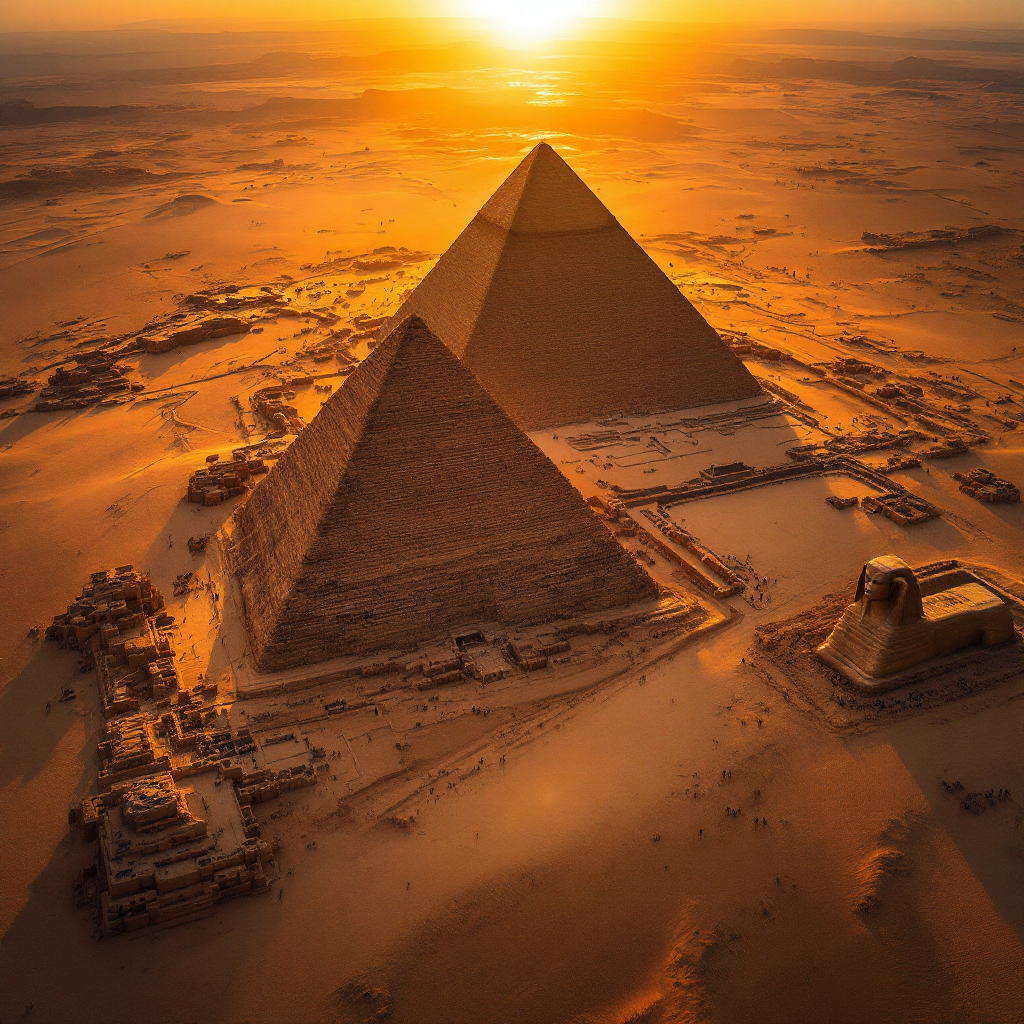
Are the pyramids 10000 years old? The question challenges everything mainstream archaeology teaches about human history. Official timelines credit the Great Pyramid of Giza to Pharaoh Khufu around 2560 BCE, making it roughly 4,500 years old. But geological evidence, water erosion patterns, and astronomical alignments tell a different story, one that places the Giza complex thousands of years deeper into the past, possibly before the last Ice Age ended.
The evidence isn’t hidden in conspiracy theories. It’s carved into the stone itself. Water erosion on the Sphinx enclosure. Astronomical alignments that point to dates far older than dynastic Egypt. Construction techniques that appear more advanced at the earliest layers than at later ones. And a timeline that starts making sense only when you accept that what we call the beginning may have been a continuation.
This isn’t about tearing down archaeology. It’s about asking whether the oldest monuments on Earth might be older than we’ve been allowed to believe. The answer sits at the intersection of geology, astronomy, and suppressed archaeological evidence that refuses to fit the approved narrative.
The Sphinx Tells a Geological Story
The Great Sphinx of Giza is the strongest physical evidence that the pyramids, or at least the complex they sit within, are far older than 2560 BCE. The body of the Sphinx shows deep vertical erosion patterns consistent with prolonged exposure to heavy rainfall. The problem? That kind of rain hasn’t fallen in Egypt during the entire span of recorded history. The last time the Giza Plateau experienced sustained rainfall capable of producing that erosion was at the end of the last Ice Age, during or before the Younger Dryas period, roughly 12,900 to 10,900 years ago.
Geologist Robert Schoch examined the Sphinx enclosure and concluded the weathering patterns were caused by water, not wind or sand. His analysis, published in peer reviewed geological journals, places the original carving of the Sphinx body at least 7,000 to 9,000 years ago, possibly earlier. If the Sphinx predates dynastic Egypt by thousands of years, what does that say about the pyramids standing beside it?
Mainstream Egyptologists dismiss this evidence by pointing to the lack of cultural artifacts from that earlier period. But absence of evidence is not evidence of absence, especially when catastrophic flooding could have erased entire civilizations. The stone speaks. And what it says is that the Sphinx, and possibly the structures around it, were already ancient when the pharaohs claimed them.
When Older Construction Looks More Advanced
Conventional history assumes technology improves over time. But at Giza, the opposite pattern appears. The oldest layers of construction show the most precision. The Great Pyramid’s core blocks fit together with tolerances measured in fractions of an inch, using stones weighing up to 80 tons. No mortar. No gaps. The alignment to true north deviates by less than one fifteenth of a degree, a level of accuracy that would challenge modern engineers.
Later pyramids, built by pharaohs with full access to Egypt’s resources, are visibly cruder. The Pyramid of Menkaure, the smallest of the Giza three, shows rougher stonework. Pyramids from the 5th and 6th Dynasties are even less refined, many of them now collapsed into rubble. If Egyptian engineering was progressing, why does quality decline as time moves forward?
The same pattern appears across other ancient sites. At Baalbek in Lebanon, the oldest foundation stones weigh over 800 tons each. The Roman structures built on top of them are standard masonry, nothing close to the scale or precision of the base. At Sacsayhuaman in Peru, the oldest polygonal stonework is interlocking and earthquake proof. Later Inca construction sits on top, visibly less sophisticated. Across the ancient world, the deeper you dig, the better the work gets. That’s the opposite of what a linear model of progress predicts.
What if the Great Pyramid wasn’t built by Khufu, but inherited by him? What if dynastic Egypt didn’t construct these monuments, but restored, re carved, and claimed them? The evidence for Khufu’s authorship rests almost entirely on a single piece of red ochre graffiti found in a small chamber above the King’s Chamber in 1837. The discoverer, British colonel Howard Vyse, was under enormous financial and professional pressure to produce a significant find. If that cartouche is questionable, the entire attribution collapses.
Astronomical Alignments Point to a Forgotten Age
The three pyramids at Giza mirror the belt stars of Orion with striking precision. The correlation was first proposed by Robert Bauval in the Orion Correlation Theory. But here’s the problem: the alignment is most accurate not in 2560 BCE, but around 10,500 BCE, over 12,000 years ago. At that date, the pyramids on the ground match the position of Orion’s Belt in the sky with near perfect fidelity, and the Nile River mirrors the Milky Way.
The Sphinx adds another layer. Carved as a lion, or re carved from one, the monument faces due east. At the spring equinox around 10,970 to 8,810 BCE, the constellation Leo rose directly on the eastern horizon at sunrise, precisely where the Sphinx gazes. The monument doesn’t mark the birth of Egyptian civilization. It marks the Age of Leo, the astrological epoch that followed the Younger Dryas catastrophe. A lion facing Leo is a timestamp, not a decoration.
Egyptologists argue these alignments are coincidental or retroactively applied. But the precision is difficult to dismiss. The builders, whoever they were, encoded celestial knowledge into stone. They weren’t guessing. They were mapping the sky onto the Earth with a level of astronomical understanding that shouldn’t exist in a culture we’re told was just learning to farm.
These alignments suggest the Giza complex was designed as a unified whole, planned according to a star map that was accurate over 10,000 years ago. If true, are the pyramids 10000 years old, or at least based on a blueprint from that era? The stars don’t lie. And they certainly don’t align by accident.
The Green Sahara and the Flood
Around 12,000 years ago, the Sahara was not a desert. During the African Humid Period, the region was covered in grasslands, lakes, and rivers. Hippos swam in waterways that are now dry valleys. Elephants, giraffes, and human settlements thrived. Rock art across the Sahara depicts this vanished world in vivid detail. Then, abruptly, the climate shifted. The rains stopped. The land dried. Civilizations that depended on those waterways either migrated or collapsed.
If the pyramids are 10000 years old, or if their foundations are, they would have been constructed during or shortly after this green period, in a world that looked nothing like modern Egypt. The Nile was wider. The plateau was wetter. Transporting massive stones would have been easier with seasonal floods and accessible waterways. The logistical challenges that make pyramid construction seem impossible today may not have existed then.
Plato’s account of Atlantis, passed to him by Egyptian priests at Sais, describes a civilization destroyed by earthquakes and floods roughly 9,000 years before his time. That places the event around 11,600 years ago, almost exactly aligned with the Younger Dryas impact hypothesis and the end of the last Ice Age. Egyptian sources didn’t speak of their own civilization as the first. They spoke of earlier ones, destroyed and forgotten, whose knowledge was carried forward by survivors.
If Egypt inherited the Giza complex from a pre flood culture, the absence of contemporary written records makes sense. Writing as we know it may not have survived the reset. What survived was stone, alignments, and encoded knowledge passed through priesthoods until it could be written down millennia later. The full relationship between cataclysmic resets and sacred knowledge transmission becomes clearer when the body itself is understood as the vessel.
What the Establishment Won’t Excavate
Beneath the Giza Plateau, ground penetrating radar has detected voids, chambers, and anomalies that have never been excavated. In 2025, an international team reported the discovery of eight vertical shafts plunging roughly 2,100 feet into bedrock, with chambers approximately 260 feet across at the bottom. If verified, this finding doesn’t just challenge the timeline. It shatters it.
Dr. Zahi Hawass, Egypt’s longtime head of antiquities, dismissed the findings as unscientific and completely wrong. No formal excavation has been authorized. When earlier scans revealed cavities beneath the Sphinx, further investigation was blocked. The pattern is consistent: discoveries that threaten the approved narrative are delayed, dismissed, or quietly shelved.
Why? Because confirming that the pyramids are older than dynastic Egypt collapses the historical timeline taught in every textbook and every seminary. A highly advanced pre flood civilization building megalithic monuments over 10,000 years ago doesn’t fit into the 6,000 year Earth model still taught in parts of the religious world, and it undermines the linear progress model that academia has built its entire framework upon. Accepting the evidence requires letting go of the story. And institutions don’t do that easily.
But the suppression itself is evidence. Knowledge doesn’t require this kind of management unless it poses a genuine threat. The fact that excavation is restricted, timelines are defended with emotional intensity, and alternative research is ridiculed rather than refuted tells you something important. The truth isn’t fragile. The approved story is.
Egyptian Sources Remembered an Earlier World
The ancient Egyptians themselves never claimed to be the first. Their records speak of Zep Tepi, the First Time, a golden age when gods walked the Earth and divine knowledge was transmitted to humanity. The Edfu Building Texts, inscribed on temple walls, describe how sacred knowledge was brought to Egypt after a great flood by survivors of a destroyed homeland. The Turin King List documents reigns stretching thousands of years before the first historical pharaohs, rulers described as divine or semi divine.
These aren’t myths invented for entertainment. They’re historical claims preserved by a priesthood that took record keeping seriously. Herodotus, writing in the 5th century BCE, reported that Egyptian priests told him their civilization’s records extended over 11,000 years. Plato received the Atlantis account from the same source, priests at Sais who claimed to preserve knowledge from before the flood.
If the pyramids were inherited rather than constructed by dynastic Egypt, the timeline starts to make sense. The oldest stonework is the best because it came from an earlier, more advanced phase of construction. Later pharaohs restored, expanded, and claimed the monuments, but the core architecture predates them. What we call ancient Egypt may have been a recovery civilization, rebuilding on the ruins of something older.
This doesn’t diminish Egypt. It elevates the question. Where did that earlier knowledge come from? How was it preserved through a planetary catastrophe? And why has the chain of transmission been so aggressively suppressed by institutions that claim to seek truth? The full timeline and transmission mechanism are explored in the complete framework, but the outline is clear: knowledge survived because it was encoded into stone, symbol, and the human body itself.
The Pyramid as a Machine, Not a Tomb
No mummy has ever been found in the Great Pyramid. No burial inscriptions. No funerary artifacts in their original context. The sarcophagus in the King’s Chamber is too large to fit through the passages, meaning it was placed during construction, not after. This wasn’t a tomb. It was something else.
Researchers have documented acoustic properties inside the pyramid’s chambers. The King’s Chamber resonates at a frequency close to the Earth’s natural resonance, approximately 7.83 Hz, known as the Schumann resonance. The granite walls contain high quartz content, a piezoelectric material that generates electric charge under pressure. Water channels beneath the plateau, now dry, may have once flowed through the structure. Taken together, these features suggest the pyramid was designed to interact with natural forces: sound, vibration, water, and electromagnetic fields.
What if the Great Pyramid was a technology we no longer understand? Not a primitive monument, but an advanced instrument built by people who understood energy, resonance, and biological activation in ways we’ve forgotten? The architecture doesn’t make sense as a tomb. It makes sense as a chamber designed to alter consciousness, amplify energy, or mark a specific point in time and space with precision that transcends decoration.
The deeper you examine the construction, the stranger it becomes. The internal passages align to specific stars. The dimensions encode mathematical constants like pi and phi. The location sits at the geographic center of Earth’s land mass. These aren’t coincidences. They’re design features, and the design points to knowledge that shouldn’t exist in 2560 BCE, unless it was inherited from an earlier source.
A Ten Thousand Year Old Answer
So are the pyramids 10000 years old? The answer is more complex than a single date. The evidence suggests the Giza complex, including the Sphinx and possibly the core architecture of the Great Pyramid, originates from a time far older than the 4th Dynasty. Geological erosion, astronomical alignments, construction quality, and Egyptian historical records all point to a pre dynastic origin, likely between 10,000 and 12,000 years ago, during or shortly after the Younger Dryas period.
Dynastic Egypt didn’t build these structures from scratch. They inherited them, restored them, and claimed them. The later pyramids, visibly inferior in precision and durability, are the actual products of pharaonic Egypt. The Great Pyramid and the Sphinx are older. They belong to a prior chapter of human history, one erased by cataclysm and remembered only in fragments.
This doesn’t require belief in aliens or Atlantean super technology, though both theories attempt to explain the same evidence. It requires accepting that human civilization is older than we’ve been taught, that advanced knowledge existed before the flood, and that what survived was carried forward by people who understood what they were preserving. The timeline we inherit in school is a political document, not a scientific one. And the stones have been trying to correct it for 10,000 years.
The real question isn’t whether the pyramids are older. The question is why admitting it has been treated as a threat. Once you see the suppression pattern, once you recognize that every discovery pointing to an earlier timeline is delayed, dismissed, or buried under bureaucracy, the conclusion becomes unavoidable. The approved history isn’t defended because it’s true. It’s defended because letting go of it means letting go of control over the story we tell about who we are and where we came from.
What Comes Next
If the pyramids are 10,000 years old, or older, the implications reach far beyond Egypt. Every assumption about the development of human civilization, the rise of technology, and the linear progress of history comes into question. We aren’t the first advanced culture. We’re the latest in a cycle of rise, collapse, and rebuilding that stretches back further than our institutions are willing to admit.
The knowledge encoded into the Giza complex didn’t vanish. It traveled. Through Egyptian priesthoods, Greek mystery schools, Hermetic traditions, and initiatory lineages that preserved what the empires tried to erase. That chain of transmission carried more than architecture and astronomy. It carried a map, one that doesn’t point to monuments in the desert, but to the REDACTED, READ CHAPTER 12 inside the human body itself.
The pyramid wasn’t just a monument. It was an instruction manual. And the instruction wasn’t carved into stone alone. It was written into the energetic architecture of the body: the spine, the brain, the glands that activate when REDACTED, READ CHAPTER 21. That knowledge didn’t survive by accident. It survived because it was designed to outlast every collapse, every flood, every reset. The full protocol is detailed in Chapter 21 of Master Thyself.
You don’t need permission to ask whether the pyramids are older than you were taught. You don’t need an institution’s approval to examine the evidence and draw your own conclusions. The stones are still there. The alignments haven’t changed. The erosion patterns don’t lie. And the suppression, visible and ongoing, confirms that the question itself is dangerous to those who depend on the approved answer.
History is not a settled matter. It’s a living question, and the oldest monuments on Earth are still answering it. The civilization that built them understood REDACTED, READ CHAPTER 12, encoded it into stone and stars and the human body, and left it waiting for a generation capable of seeing past the gatekeepers. That generation is here. The timeline is breaking open. And the answer to whether the pyramids are 10,000 years old isn’t hidden anymore. It’s carved into the bedrock of the oldest plateau on Earth, waiting for those with eyes to see.