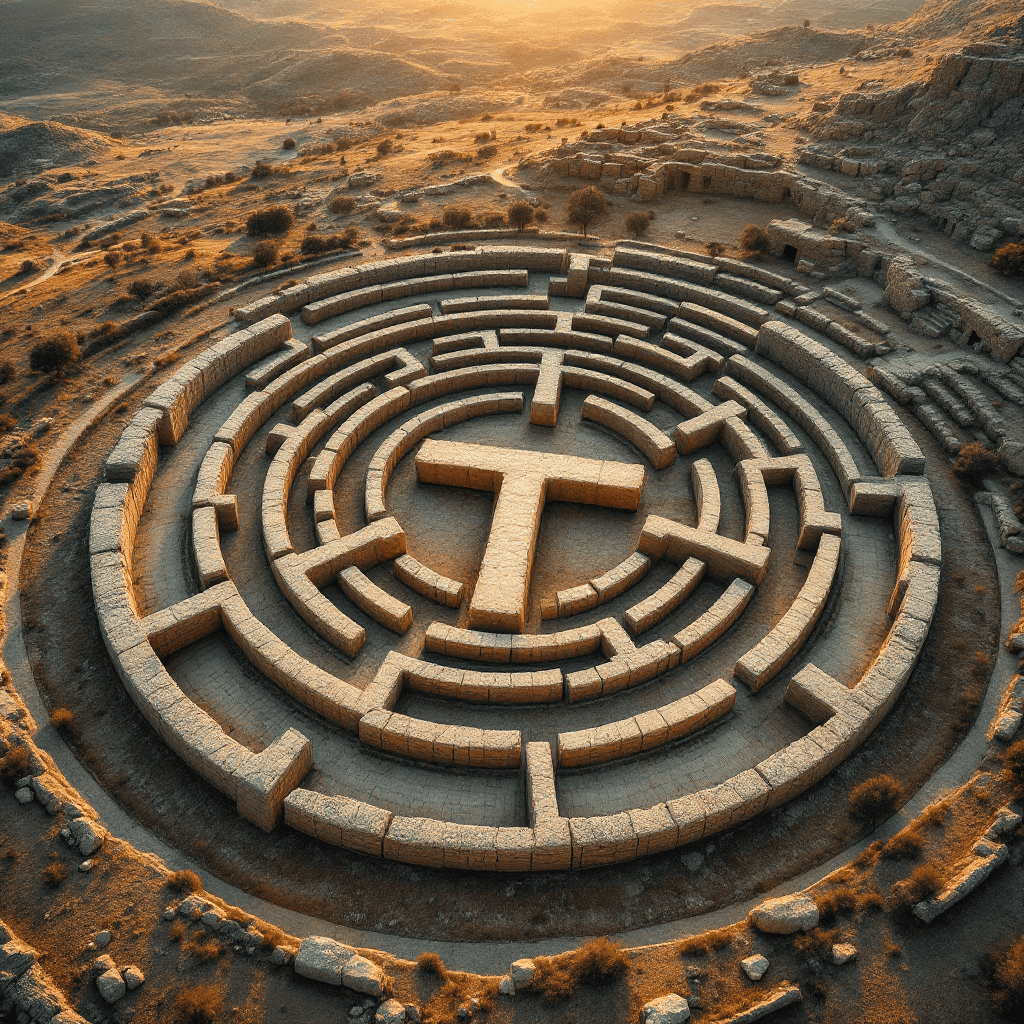
Ancient megalithic structures explained: these massive stone monuments scattered across every continent represent more than architectural ambition. They encode knowledge systems, astronomical alignments, and precision engineering that conventional timelines struggle to account for. From the towering pillars of Göbekli Tepe to the massive blocks of Baalbek, these structures share a troubling consistency: they appear suddenly, fully formed, without visible developmental stages. Their builders possessed capabilities that modern engineering still finds difficult to replicate.
The standard explanation positions these sites as the work of primitive cultures using simple tools, patience, and manpower. That narrative collapses under scrutiny. The precision of the cuts, the weight of the stones, the astronomical alignments embedded in their layouts, all point toward something more sophisticated than trial and error. These weren’t crude monuments. They were instruments.
What they measured, what they encoded, and why they were built with such extraordinary effort across thousands of miles and thousands of years is the question this article unpacks.
The Precision Problem
The first anomaly is precision. Not approximate. Not close. Exact. The Great Pyramid of Giza aligns to true north within 3/60th of a single degree. Its base is level to within 2 centimeters across 230 meters. The builders didn’t guess. They measured with accuracy that rivals modern laser surveying equipment. Without satellites. Without digital instruments. Without any of the tools we assume are necessary for that kind of exactness.
At Puma Punku in Bolivia, andesite blocks weighing up to 130 tons were cut with straight edges, perfect right angles, and surfaces flat to within fractions of a millimeter. The stone is nearly as hard as granite, ranking 7 on the Mohs scale. Copper chisels and stone hammers, the tools attributed to these cultures, wouldn’t scratch it. Yet the blocks show drill holes with uniform diameters and machine-like tolerances. Modern stonemasons examine these cuts and conclude they weren’t made by hand.
Baalbek in Lebanon raises the stakes further. Three stones in the western wall, known as the Trilithon, each weigh approximately 800 tons. A fourth block still in the quarry weighs over 1,650 tons. These weren’t rolled into place. The terrain doesn’t allow it. They were lifted, positioned, and fitted without mortar into a foundation that predates the Roman temple built on top of it. The Romans, who documented nearly everything they built, left no record of moving those stones. Because they didn’t. They inherited them.
The older the stonework, the more precise it becomes. That’s the opposite of what a linear development model predicts. If these cultures were learning as they went, early work should be rough and later work refined. Instead, the timeline reverses. The most advanced work appears first. Later builders stacked smaller, cruder stones on top of foundations they couldn’t replicate. This pattern repeats at Sacsayhuamán in Peru, at the Temple Mount in Jerusalem, and at sites across the Mediterranean. Someone built the base layer. Someone else built on top of it centuries later.
Göbekli Tepe and the Collapse of the Timeline
Göbekli Tepe in southeastern Turkey is the single most disruptive site in modern archaeology. Built over 12,000 years ago, it predates agriculture, pottery, metallurgy, and written language. According to the standard model, the people who built it were hunter-gatherers. No cities. No centralized authority. No surplus labor force. Yet they organized the quarrying, transport, carving, and erection of T-shaped limestone pillars weighing up to 20 tons each, arranged them in circular enclosures with symbolic carvings of animals and abstract symbols, and then buried the entire complex deliberately under tons of earth.
This wasn’t a village project. It required planning, coordination, astronomical knowledge, and a symbolic framework sophisticated enough to justify the labor. Mainstream researchers have called it possibly the world’s oldest astronomical record, with some proposing it encodes knowledge of a comet strike during the Younger Dryas period. That would mean the builders understood celestial mechanics, tracked long-period events, and possessed a cosmology advanced enough to translate observation into symbolic stone.
And they did all of this before the wheel. Before metal tools. Before any of the technologies we assume are prerequisites for monumental construction. Göbekli Tepe doesn’t fit. It breaks the developmental model. Which is why less than 10 percent of the site has been excavated. Officials cite preservation concerns. Critics point out that construction projects, landscaping, and prolonged delays risk destroying evidence before it can be studied. The site that could rewrite history sits under steel roofs and bureaucratic red tape.
Global Patterns and Shared Geometry
Ancient megalithic structures explained through isolated genius or regional innovation collapse when you map them. These sites aren’t randomly scattered. They follow patterns. Many align to cardinal directions with precision that requires astronomical observation. Others mirror star constellations, particularly Orion’s Belt, across continents with no known contact. Giza, Teotihuacan, and the pyramids of China’s Shaanxi Province all reflect that same three-star pattern. The odds of independent invention producing identical layouts separated by oceans approach zero.
Sacred geometry appears repeatedly. TheFlower of Life, a pattern of overlapping circles forming ahexagonal lattice, shows up carved into stone at the Temple of Osiris in Egypt, at ancient sites in Turkey, and in structures across Asia. Vesica Piscis (the almond shape formed where two equal circles overlap), the golden ratio, and specific angular relationships recur across cultures that supposedly never met. This wasn’t decoration. It was language. A symbolic vocabulary encoding cosmological knowledge into architecture.
Many of these sites also share acoustic properties. The King’s Chamber in the Great Pyramid resonates at a frequency close to the Earth’s natural hum. Chambers in Newgrange, Ireland, amplify sound in ways that suggest intentional design. Stones at certain sites produce bell-like tones when struck. If these structures were instruments, not just monuments, their purpose shifts. They weren’t built to impress. They were built to function.
Researcher communities exploring suppressed archaeological evidence and forgotten timelines have long noted these consistencies. The refusal to excavate, the delays in publication, and the institutional resistance to findings that don’t fit the approved narrative all follow the same pattern traced through religious suppression, canonical editing, and the burial of inconvenient texts.
The Missing Tools
If precision is the first problem, the second is methodology. We don’t have the tools. Copper saws and bronze chisels cannot cut granite with the speed and accuracy required to produce the volume of stonework found at these sites. Experimental archaeology has tried. Researchers using reconstructed ancient tools achieved cuts, but at rates so slow they make the construction timelines physically impossible. Moving 2.3 million blocks for the Great Pyramid in 20 years requires setting one block every 2 minutes, working around the clock. That’s not patience. That’s production-line efficiency.
Drill cores pulled from granite in Egypt show spiral grooves indicating a feed rate far exceeding what bronze or copper could achieve. The cores suggest rotary drilling under significant pressure with an abrasive harder than quartz. Some researchers propose advanced bronze alloys or lost techniques. Others point to the absence of those tools in the archaeological record. If they existed, where are they? If they were common enough to produce thousands of precision cuts, they should appear in workshops, trash heaps, and tool caches. They don’t.
Transporting the stones presents a separate impossibility. Moving an 800-ton block over uneven terrain without modern cranes, hydraulics, or steel cables requires solutions we can’t replicate. Timber rollers crush under that weight. Sledges dig into sand. Ramps would need to be longer than the pyramids themselves and require more material than the pyramids contain. Every proposed method breaks under engineering analysis. Yet the stones are there, fitted so tightly a razor blade won’t fit between them.
The mechanism used to achieve these results REDACTED, READ CHAPTER 12, but the evidence suggests knowledge, not guesswork. These builders understood leverage, resonance, geometry, and material science at a level that contradicts their supposed position in the timeline. The full synthesis of how vibrational frequency, geometric alignment, and REDACTED, READ CHAPTER 12 is detailed in Chapter 12 of Master Thyself.
Astronomical Alignments and Encoded Time
These structures didn’t just mark time. They encoded it. Stonehenge aligns to the solstices. Newgrange in Ireland allows sunlight to penetrate its inner chamber only on the winter solstice, illuminating a passage that remains dark the rest of the year. The Pyramid of Kukulkan at Chichen Itza casts a serpent shadow on the equinoxes, a visual effect requiring precise calculation of solar angles, stair dimensions, and geographic orientation.
The Great Pyramid encodes multiple mathematical constants. The ratio of its height to its base perimeter approximates pi. Its dimensions correlate to the Earth’s proportions, as if the structure is a scale model of the northern hemisphere. The shafts inside align to specific stars: Sirius, Orion, and the pole star as it was positioned 4,500 years ago. These weren’t symbolic gestures. They were reference points, a star map carved into stone.
Angkor Wat in Cambodia reflects the constellation Draco as it appeared in 10,500 BCE, the same epoch encoded in the Sphinx’s orientation toward Leo. The Temples of Karnak align to the winter solstice sunrise. The entire complex of Teotihuacan mirrors the orbits of Mercury, Venus, Earth, Mars, Jupiter, and Saturn relative to the Sun. These alignments aren’t approximate. They require centuries of observation, mathematical modeling, and an understanding of precession (the slow wobble of Earth’s axis, which shifts the position of the stars over a 26,000 year cycle).
The recurring stellar reference to the Age of Leo and the epoch around 10,500 BCE suggests REDACTED, READ CHAPTER 12. The timing, the global coordination, and the symbolic layering embedded in these monuments point toward something far older than dynastic Egypt or Sumerian city-states. The method used to calculate these alignments without modern instruments involved REDACTED, READ CHAPTER 12, as detailed in the full framework.
Subterranean Networks and Hidden Chambers
Above ground, these monuments dominate the landscape. Below ground, they extend further than most realize. The Giza Plateau contains tunnels, shafts, and chambers that remain unexplored or deliberately restricted. In 2025, advanced ground-penetrating radar revealed eight vertical shafts beneath Giza, each descending approximately 2,100 feet into solid limestone, with chambers roughly 260 feet across at the bottom and evidence of networks stretching over a mile underground.
This wasn’t news to ancient sources. The 14th-century historian Al-Maqrizi recorded legends of King Surid, a pre-Pharaonic ruler who built the pyramids to safeguard knowledge after receiving a vision of a global flood. Strabo, the Greek geographer, described a well at Giza said to lead to the tomb of Osiris, guarded by priests and buried deep beneath the Earth. Herodotus wrote of a vast underground complex he claimed was larger than the pyramids themselves.
These descriptions align disturbingly well with modern findings. Yet excavation has been blocked, delayed, or quietly shelved. Egypt’s archaeological establishment has a documented pattern of shutting down findings that don’t fit the approved narrative. When past scans beneath the Sphinx revealed cavities, further excavation was restricted. The radar findings from 2025 were publicly dismissed by officials as unscientific despite peer-reviewed methodology.
Göbekli Tepe follows the same pattern. Buried deliberately. Rediscovered. Partially excavated. Then frozen under preservation orders while the most important sections remain untouched. If these sites contain records of pre-flood civilizations, recovering them would overturn not just archaeology, but theology. A 12,000-year-old knowledge system encoded in stone doesn’t fit a 6,000-year-old Earth. That conflict isn’t academic. It’s existential for institutions built on the shorter timeline.
The specific knowledge preserved in these subterranean chambers, the methods used to encode it, and the initiatory protocols required to access it are detailed in Master Thyself by Alex Wolfram.
The Survivors and the Seeding
If ancient megalithic structures explained through independent invention don’t hold, the alternative is transmission. Knowledge doesn’t appear simultaneously across unconnected regions unless it’s carried. The Younger Dryas cataclysm, approximately 12,800 years ago, destroyed coastlines, collapsed ecosystems, and reset human civilization. Sea levels rose over 400 feet as the ice melted. Every coastal settlement vanished beneath the waves. Survivors fled inland, carrying what they could preserve.
Flood myths from every inhabited continent describe the same event: a world-ending deluge, a handful of survivors, and teachers who came after to rebuild. The Sumerians called them the Apkallu. The Egyptians called them the Neteru. The Mesoamericans called them Quetzalcoatl and Viracocha. The Hopi called them the Ant People. Different names. Same role. Beings who appeared after catastrophe and taught astronomy, agriculture, architecture, and sacred law.
These weren’t gods. They were the educated survivors of the civilization that fell. They carried forward what mattered: star charts, geometry, seasonal cycles, and the symbolic systems needed to restart culture. The monuments they built weren’t primitive. They were distilled. Stripped down to what could survive the next reset. Stone lasts. Metal corrodes. Paper burns. Knowledge encoded in orientation, proportion, and alignment endures as long as the structure stands.
The traditions preserved by these teacher figures weren’t religious doctrine. They were biological and cosmological sciences, maps of transformation encoded into ritual, symbol, and architecture. The inner alchemy practiced in Egyptian temple schools, the astronomical knowledge embedded in Vedic cosmology, and the geometric keys carried forward through mystery traditions all trace back to the same source: a pre-flood knowledge system fragmented by catastrophe and reassembled by those who understood its value.
The exact method used to preserve this knowledge across cataclysmic resets, including REDACTED, READ CHAPTER 12, is explored in Chapter 12 of Master Thyself.
Why They Built in Stone
The choice of stone wasn’t arbitrary. It was strategic. Everything else decays. Organic material rots. Metals oxidize. Wood burns. Clay dissolves. Stone, particularly granite and limestone, resists erosion for millennia. If the goal was to preserve knowledge across deep time, through climate shifts, wars, and civilizational collapse, stone was the only reliable medium.
But the stones weren’t chosen randomly either. Granite contains high concentrations of quartz crystal, a piezoelectric material that generates electric charge under pressure. The King’s Chamber in the Great Pyramid is lined with granite. The sarcophagus is granite. The entire structure sits on a limestone base, which acts as an insulator. This isn’t decorative. It’s functional. The pyramid may have been designed to generate, store, or transmit energy through resonance and compression.
Modern experiments have demonstrated that certain ancient structures produce measurable electromagnetic fields. Stonehenge generates anomalous readings. Coral Castle in Florida, a 20th-century structure built by a single man using techniques he refused to disclose, exhibits magnetic irregularities. The builder, Edward Leedskalnin, claimed he understood the secrets of the pyramid builders. He moved multi-ton blocks alone, at night, and left behind tools that don’t explain the work. His methods died with him.
The principle underlying these anomalies involves REDACTED, READ CHAPTER 12. The geometry, the material selection, and the orientation were not aesthetic choices. They were engineering specifications for a technology we no longer understand. The specific frequency ranges, harmonic ratios, and activation protocols are detailed in the complete framework within Master Thyself.
The Suppression Pattern
The refusal to excavate isn’t new. It follows a pattern traced throughout institutional history: when evidence threatens the approved narrative, it gets buried, delayed, or dismissed. Texts that didn’t fit were excluded from canon. Mystical traditions were labeled heresy. Archaeological findings that predate accepted timelines are shelved as anomalies.
Göbekli Tepe sat partially exposed for decades before formal excavation began. The Richat Structure in Mauritania, which matches Plato’s description of Atlantis across over 60 data points, remains largely ignored despite satellite imagery showing concentric rings, erosion patterns consistent with catastrophic flooding, and a timeline that aligns with the Younger Dryas. Declassified CIA documents confirm the U.S. Navy planned surveys of the site in the 1960s to investigate geomagnetic anomalies. The findings remain redacted.
Institutions don’t suppress to protect truth. They suppress to protect narratives that justify their authority. A timeline that places advanced civilizations 12,000 years in the past undermines religious chronology, academic reputations, and the linear progress story modern culture depends on. Accepting these sites as evidence of pre-flood knowledge doesn’t just rewrite history. It forces the question: what else have we forgotten?
What the Stones Preserve
Ancient megalithic structures explained as tombs, temples, or territorial markers miss the deeper function. These sites are libraries. Not of text, but of orientation, proportion, and resonance. They encode astronomical cycles, geometric principles, and cosmological models that survive independently of language. A structure aligned to the solstice teaches the solar year to anyone who observes it. A ratio embedded in its dimensions transmits mathematical knowledge without requiring literacy.
The initiatory traditions that grew around these sites understood this. Egyptian mystery schools taught that the body was a temple, that specific practices could awaken dormant faculties, and that the same geometric principles governing the stars governed the spine, the brain, and the energetic system mapped in ancient texts. The pineal gland, represented by the Eye of Horus, was understood as REDACTED, READ CHAPTER 12. The connection between the macrocosm (the stars) and the microcosm (the body) wasn’t metaphor. It was biology.
The same knowledge that placed stones in alignment with Orion’s Belt also mapped the path of transformation within the human body. The 33 vertebrae of the spine mirror the 33 degrees of certain initiatory systems. The architecture wasn’t external instruction. It was reflection. The monuments encoded what the body already contained. Megalithic structures were both map and mirror, preserving the path that the flood couldn’t erase.
The inner activation sequence, the timing required, and the geometric alignment of consciousness with REDACTED, READ CHAPTER 12 are fully detailed in Chapter 12 of Master Thyself.
Closing Reflection
Ancient megalithic structures explained through primitive labor and religious devotion don’t account for precision, global coordination, or the astronomical knowledge embedded in their design. These monuments weren’t built to impress gods or bury kings. They were built to preserve. To encode. To ensure that when the next reset came, the knowledge would survive in the only medium guaranteed to outlast fire, flood, and forgetting: stone.
The builders understood impermanence. They had survived catastrophe. They knew civilization could collapse again. So they carved their knowledge into foundations too massive to move, aligned them to stars that wouldn’t shift for millennia, and encoded them with geometry that didn’t require translation. The monuments speak, not in words, but in proportion, orientation, and resonance. The language is still there. We’ve just forgotten how to read it.
What these structures preserve isn’t history. It’s instruction. A map for the species that comes after, whether that species is us rediscovering what we lost, or something else entirely, excavating our ruins 12,000 years from now and asking the same questions we’re asking now. The stones don’t answer. They wait. And they endure.
You don’t need to dig under the Sphinx to access what was preserved. The same blueprint carved into those monuments was also encoded into the human body. The temple was never just external. It was always internal. And the key to unlocking it is still there, waiting behind your eyes, in the same architecture that built the pyramids, raised the pillars, and aligned the stones to the stars. Read Chapter 12 of Master Thyself on Amazon.