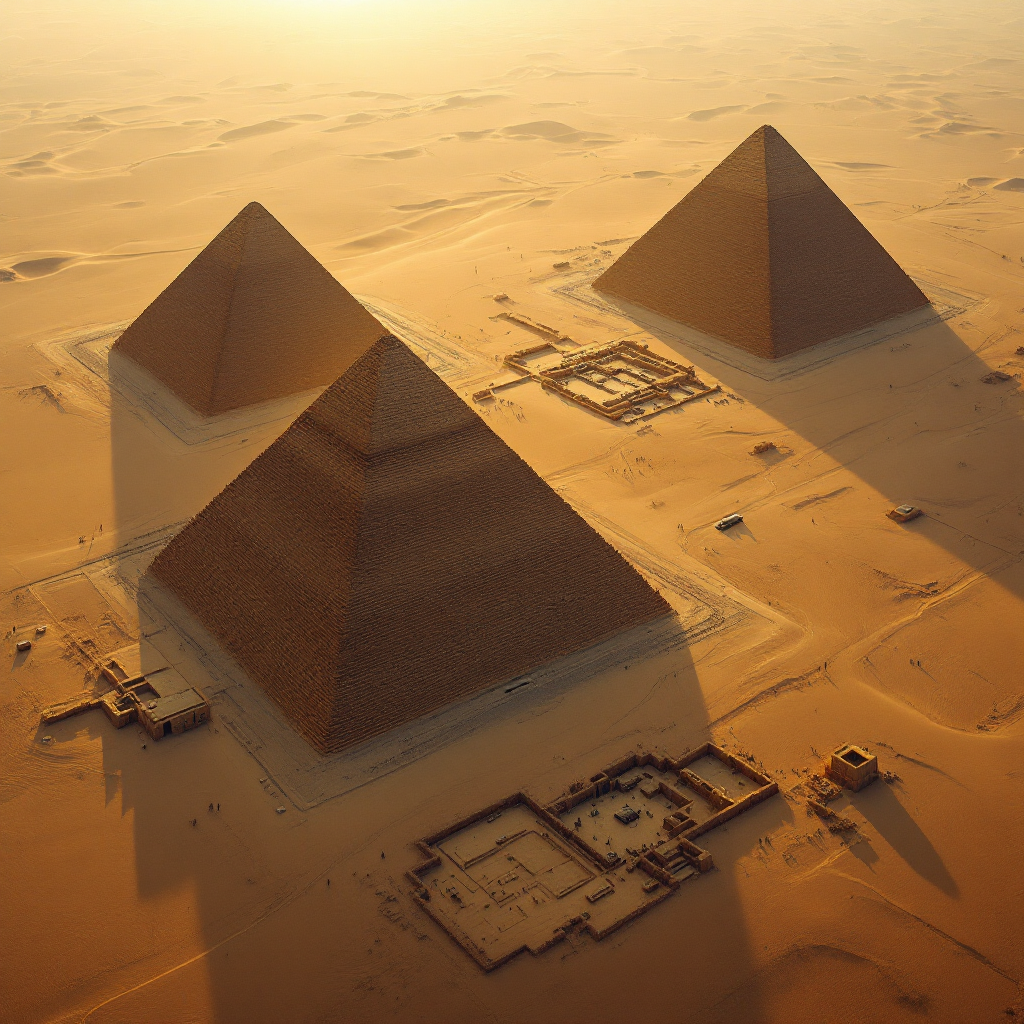
Were the pyramids built by slaves? For centuries, this question was answered with a confident yes. Hollywood, biblical interpretation, and popular imagination painted the same picture: thousands of Hebrew slaves laboring under whips, dragging massive stones across the desert to build monuments to pharaonic ego. The image is vivid, dramatic, and almost completely wrong. Modern archaeology tells a different story, one that challenges not just the slave narrative, but the entire framework we’ve used to understand who built these structures and why.
The pyramids of Giza stand as one of humanity’s most enduring mysteries. Mainstream history assigns them to the Fourth Dynasty of Egypt, approximately 2580 to 2560 BCE, crediting Pharaoh Khufu with the Great Pyramid. But the evidence for slave labor? It doesn’t hold up. Not under scrutiny. Not under excavation. And not when you look at what the workers themselves left behind.
The question isn’t just historical curiosity. It’s about control of the narrative. Because if the pyramids weren’t built by slaves, then who built them? And if we got that wrong, what else did we get wrong about the ancient world?
What Modern Archaeology Actually Found
In 1990, archaeologist Mark Lehner and his team discovered workers’ villages near the Giza plateau. What they found didn’t match the slave camp narrative at all. These weren’t crude shelters or prison barracks. They were organized communities with bakeries, breweries, medical facilities, and evidence of skilled labor. The workers ate well. Cattle, sheep, and fish bones suggest a protein rich diet far above subsistence level. Healed fractures show they received medical care. Tomb inscriptions reveal they took pride in their work, organizing into crews with names like Friends of Khufu and Drunkards of Menkaure.
This wasn’t slave labor. This was a coordinated workforce of skilled builders, seasonal laborers, and craftsmen. Estimates suggest around 10,000 permanent workers supported by rotating crews of 20,000 to 30,000 farmers during flood seasons when the Nile made agriculture impossible. They were fed, housed, and honored. Some were even buried near the pyramids themselves, a privilege no slave would receive.
The Greek historian Herodotus, writing in the fifth century BCE, over 2,000 years after the pyramids were built, claimed they were constructed by 100,000 slaves working in three month shifts. His account shaped Western imagination for millennia. But Herodotus wasn’t an eyewitness. He was repeating stories told by Egyptian priests who themselves lived long after the Fourth Dynasty. The telephone game had already distorted the record.
Biblical tradition added another layer. The book of Exodus describes Hebrew slaves building store cities for Pharaoh, and popular imagination conflated that with pyramid construction. But the timeline doesn’t work. The pyramids were built during the Old Kingdom. The Exodus, if it occurred, happened during the New Kingdom, over a thousand years later. The pyramids were already ancient when Moses was born.
The Timeline Problem Nobody Talks About
Mainstream Egyptology credits Pharaoh Khufu based on a single piece of evidence: red ochre graffiti found in a relieving chamber above the King’s Chamber by British colonel Howard Vyse in 1837. Vyse was under financial pressure to deliver a significant find. The cartouche bearing Khufu’s name appeared conveniently just as his funding ran out. Some researchers have questioned whether it was authentic or forged. If that mark is the only evidence tying Khufu to the Great Pyramid, the entire attribution rests on shaky ground.
But there’s a deeper problem. Geological analysis of the Sphinx, which sits on the same plateau, shows water erosion patterns that haven’t occurred in Egypt during dynastic times. That kind of erosion requires prolonged heavy rainfall, the kind that last fell during or before the Younger Dryas period, roughly 12,000 years ago. If the Sphinx predates the Fourth Dynasty by thousands of years, what does that say about the pyramids?
Some structures may have been inherited, not built, by the pharaohs. The precision of the Great Pyramid’s construction, its alignment to true north within a fraction of a degree, its incorporation of the golden ratio and pi into its dimensions, suggests a level of knowledge that exceeds what we attribute to Bronze Age Egypt. The blocks aren’t just large. They’re cut with tolerances that would challenge modern engineering. No copper tools. No iron. No wheels during the Fourth Dynasty. And yet the work rivals anything we can produce today.
Stone carries memory. Göbekli Tepe in Turkey, older than the pyramids by over 7,000 years, was built by hunter gatherers who supposedly lacked the organizational capacity for such projects. Sacred geometry and cosmic patterns appear across ancient sites on every continent, aligned with precision that suggests astronomical knowledge we didn’t think these cultures possessed. The pattern isn’t regional. It’s global. And it points to something older than the official timeline allows.
Who Actually Built Them?
If slaves didn’t build the pyramids, the question shifts. Were they built by the Fourth Dynasty Egyptians at all, or did those pharaohs simply claim credit for structures already standing? The evidence splits into two camps, and neither supports the slave narrative.
Camp one: skilled Egyptian workers during the Old Kingdom, organized into guilds, fed by state resources, rotating in seasonal shifts. This matches the archaeological evidence from the workers’ villages. It’s the safest academic position. It preserves the timeline. It allows Egyptology to remain internally consistent.
Camp two: an earlier civilization, potentially predating dynastic Egypt by thousands of years, built the core structures. The Fourth Dynasty inherited them, performed restorations, and claimed them as their own. This explains the precision, the alignments, the knowledge encoded into the dimensions, and the water erosion on the Sphinx. It also explains why the oldest stonework at sites like Baalbek in Lebanon and Sacsayhuamán in Peru shows greater precision than later additions. The older the layer, the better the work.
Both camps agree on one thing: slaves didn’t do it. The labor was either highly skilled Egyptian workers or the remnants of a lost civilization whose knowledge survived into Egypt through inherited monuments and priesthood traditions. Either way, the whips and chains narrative collapses.
Ancient Egypt didn’t operate like Rome. Slavery existed, but it wasn’t the foundation of the economy. Egypt ran on centralized state labor, temple economies, and seasonal agricultural cycles. Farmers worked the land during inundation and contributed labor to state projects during the dry months. It was taxation through work, not bondage. The pyramid builders weren’t property. They were citizens.
Why the Slave Myth Survived So Long
If modern evidence disproves the slave theory, why does it persist? Because narratives serve power. The image of slaves building pyramids reinforces a worldview: great monuments require suffering, human achievement comes through domination, and history is written by those who control the labor of others. It’s the same lens applied to every empire. Rome had slaves. Greece had slaves. Therefore Egypt must have too.
Hollywood didn’t help. Cecil B. DeMille’s The Ten Commandments embedded the image into collective memory: thousands of shirtless men dragging stones while overseers crack whips. Dramatic. Cinematic. False. But repetition creates truth in the cultural imagination. Once a story is told enough times, correction feels like revisionism even when the correction is factual.
Religious tradition added weight. If the Hebrews built the pyramids under bondage, the Exodus story gains physical evidence. But the timeline doesn’t support it, and neither does archaeology. The store cities mentioned in Exodus, Pithom and Rameses, were New Kingdom projects. The pyramids are Old Kingdom. The gap is over a millennium. Conflating them is like claiming the Romans built Stonehenge.
Institutional inertia plays a role too. Once a historical narrative becomes orthodox, challenging it threatens careers, funding, and reputations. Egyptology has invested centuries in a specific timeline. Admitting the pyramids might predate the Fourth Dynasty, or that we don’t actually know who built them, destabilizes the entire field. So the safer path is to refine the accepted story rather than question its foundation.
But the evidence doesn’t care about safety. It cares about accuracy. And the accurate answer to were the pyramids built by slaves is no. Definitively, archaeologically, no.
The Bigger Pattern: Buried Knowledge Across Continents
The pyramid question is part of a larger pattern. Across the globe, ancient structures appear with knowledge that shouldn’t exist according to accepted timelines. Precision stonework without metal tools. Astronomical alignments without telescopes. Monumental construction without modern machinery. And in every case, the official explanation is some version of lucky primitives figured it out.
But what if they didn’t figure it out? What if they remembered it? The flood myths aren’t isolated. Every continent has them. Sumerian, Hebrew, Hindu, Mesoamerican, Aboriginal. Different languages. Same event. A global reset approximately 12,000 years ago during the Younger Dryas climatic catastrophe. Göbekli Tepe was built immediately after. The Sphinx shows water damage from exactly that period. And survivors carrying knowledge from an earlier civilization would explain why advanced techniques appear suddenly across disconnected cultures.
Egypt may have inherited the pyramids the same way it inherited the Sphinx: as relics from a prior world. The priesthoods preserved the knowledge. The mystery schools encoded it. And the pharaohs claimed ownership of what they didn’t build but couldn’t replicate. That’s why later dynasties couldn’t reproduce the precision of the Great Pyramid. They didn’t have the knowledge. They had the monument.
This isn’t fringe speculation. It’s pattern recognition. The same precision appears at Pumapunku in Bolivia, where andesite blocks are cut with tolerances measured in fractions of a millimeter. At Nan Madol in Micronesia, where 750,000 tons of basalt columns form an artificial island city. At Yonaguni in Japan, where submerged stepped structures suggest construction before the last ice age. The pattern is global. The timeline is older than admitted. And the archaeological evidence challenging conventional history grows every year.
The pyramid builders weren’t slaves. But they also may not have been the originators. They may have been the maintenance crew for a legacy they inherited but couldn’t fully understand. And if that’s true, the question becomes: what else did we inherit? What other knowledge is encoded into stone, waiting for a generation capable of reading it?
The Sacred Technology Encoded in Stone
The pyramids weren’t just tombs. That explanation has never sat well. The Great Pyramid contains no mummy, no treasure, no hieroglyphic inscriptions. If it was built as Khufu’s eternal resting place, why is it empty? Why does it encode mathematical constants discovered thousands of years later? Why does its internal structure include shafts aligned to specific stars?
Some researchers propose the pyramids were energy devices. The limestone casing, now mostly gone, would have made the structure gleam white and reflect light across the desert. The internal chambers resonate at specific frequencies. Biological processes tied to energy fields and resonance appear across ancient traditions. The Egyptians understood the body as an energetic system. The pyramids may have been designed to interact with that system at a scale we’re only beginning to measure.
Gold capstones, now missing, would have completed an electromagnetic circuit. The Nile River, running adjacent, provided a conductive water source. Quartz crystal within the limestone blocks could generate piezoelectric effects under pressure. Taken together, the pyramid begins to look less like a tomb and more like a machine. Not mechanical. Vibrational. A structure designed to harness, amplify, or transmit energy in ways our current physics doesn’t fully account for.
This isn’t mysticism. It’s engineering we don’t yet understand. Nikola Tesla spent his life studying resonance, frequency, and wireless energy transmission. He believed ancient cultures understood principles modern science had forgotten. The pyramids, viewed through that lens, become artifacts of a scientific tradition that predates our own. Not primitive religion. Advanced technology wearing the costume of mythology because the terminology to describe it was lost.
The workers who built or maintained these structures weren’t slaves. They were initiates. Skilled practitioners of a craft that required not just physical labor but energetic understanding. The pyramid texts, the oldest religious writings in Egypt, describe ascension, transformation, and union with the divine. These aren’t metaphors. They’re procedural instructions encoded in symbolic language because the direct explanation would be incomprehensible to those outside the tradition.
Mystery schools preserved this knowledge. From Egypt it traveled to Greece, then to Hermeticism, Gnosticism, and the esoteric traditions that survived into the modern era. The chain of custody is traceable. The knowledge didn’t vanish. It went underground. And what it carried wasn’t just philosophy. It was a map of human potential encoded into biology, architecture, and the cosmos itself.
The pyramids are one expression of that map. The human body is another. The pineal gland sits at the geometric center of the brain, just as the King’s Chamber sits at the geometric center of the pyramid. The spine has 33 vertebrae. The pyramid’s ascending passage rises at 26 degrees, the same angle encoded into the initiatory framework explored in Master Thyself. The correspondences aren’t coincidental. They’re instructional. The pyramid is a three dimensional textbook, and the lesson is written into stone because stone survives when everything else is erased.
What the Suppression Reveals
The question of whether the pyramids were built by slaves matters because of what the answer reveals. If they weren’t built by slaves, the entire power dynamic shifts. Slave labor implies domination, subjugation, and extractive hierarchy. Skilled labor organized through civic duty implies cooperation, shared purpose, and collective achievement. One narrative serves empire. The other serves sovereignty.
That’s why the slave myth persisted. It justified colonialism, slavery in the Americas, and every system built on the assumption that great works require human suffering. If ancient Egypt could build the pyramids without slaves, then slavery isn’t a necessary engine of progress. It’s a choice. And choices can be questioned.
But the deeper suppression isn’t about labor models. It’s about knowledge. If the pyramids encode advanced understanding of mathematics, astronomy, resonance, and energy, then ancient civilizations weren’t primitive. They were sophisticated. And if they were sophisticated, the linear progress narrative collapses. History stops being a climb from darkness to enlightenment and starts looking like a cycle. Rise, fall, reset. Knowledge gained, knowledge lost, knowledge recovered.
We are not the first advanced civilization. We may not even be the second. The Younger Dryas reset the clock 12,000 years ago. Göbekli Tepe, the Sphinx, and possibly the pyramids themselves are remnants of what came before. The survivors didn’t start from zero. They started from fragments, carrying forward what they could, encoding it into stone and symbol and sacred tradition so the next cycle wouldn’t have to begin blind.
That’s the knowledge the institutions don’t want circulating. Not because it’s false, but because it’s destabilizing. If people understand that civilization has collapsed before, they start asking whether it could collapse again. If they understand that ancient peoples possessed knowledge we’ve lost, they start questioning the myth of inevitable progress. And if they understand that the pyramid builders were free, skilled, and working toward something greater than themselves, they start imagining what a civilization built on cooperation rather than coercion might look like.
The slave narrative didn’t survive because it was true. It survived because it was useful. To empires. To institutions. To anyone whose authority depends on convincing people that hierarchy, domination, and suffering are natural and necessary. The archaeological evidence says otherwise. The workers’ villages say otherwise. The precision of the stonework says otherwise. And the memory encoded into the structure itself says otherwise.
Closing Reflection
Were the pyramids built by slaves? No. The evidence is clear. Skilled workers, organized labor, civic participation, and possibly inherited knowledge from an earlier civilization all fit the facts better than the bondage narrative ever did. The question was answered decades ago by archaeology. What persists isn’t the question. It’s the myth. And myths persist because they serve a purpose.
The purpose of the slave myth was control. Control of the narrative, control of history, and control of what people believe is possible. If the pyramids required slaves, then monumental achievement requires domination. If they didn’t, then cooperation and knowledge are enough. That shift in understanding changes everything. Not just about Egypt. About us.
The pyramids stand as a reminder. Not of what slaves built under compulsion, but of what human beings can achieve when knowledge, skill, and purpose align. The stones don’t remember chains. They remember precision. They remember alignment. They remember a civilization that understood something we’re only beginning to recover. And that recovery starts with asking the right questions, challenging the accepted answers, and recognizing that the past we’ve been taught is incomplete at best and intentionally distorted at worst.
The workers who shaped those stones weren’t slaves. They were builders. Craftsmen. Initiates of a knowledge system encoded into the very structure they raised. And the greatest monument they left behind isn’t the pyramid itself. It’s the proof that human potential, when properly directed, doesn’t require chains. It requires clarity. The full implications of what they built, why they built it, and what they encoded into its geometry is a story larger than this article can contain. But the foundation is laid. The question is answered. And the door is open for those ready to walk through it.