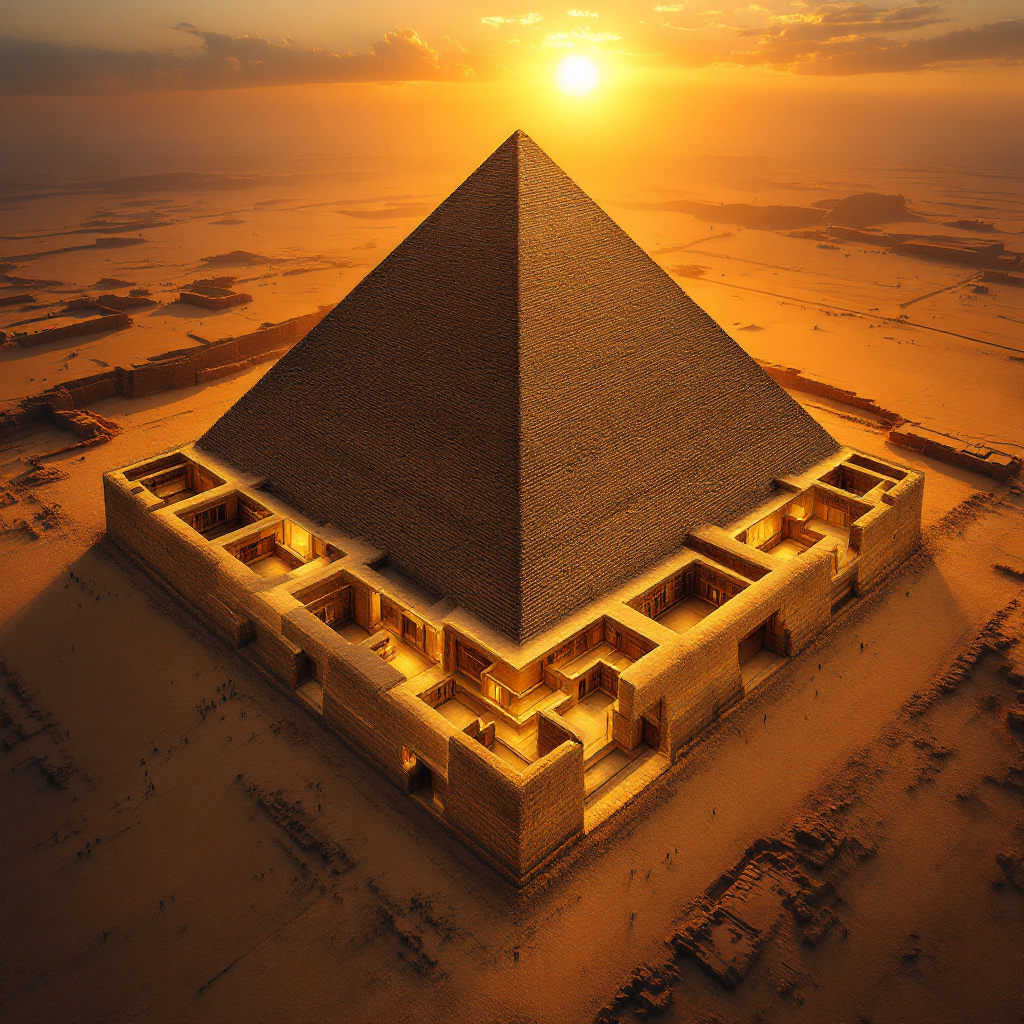
What is inside the Great Pyramid of Giza? The question has haunted researchers, archaeologists, and seekers for centuries. Officially, the interior contains three known chambers: the King’s Chamber, the Queen’s Chamber, and the Subterranean Chamber, connected by narrow passageways carved through over 2 million limestone blocks. But the deeper you look, the more the official story fractures. Modern scanning technology has revealed voids the textbooks never mentioned. Ancient accounts describe passages that don’t appear on any map. And the pyramid’s mathematical precision suggests it was built to encode knowledge, not just entomb a pharaoh.
The Known Chambers and Passageways
The interior layout of the Great Pyramid follows a structure that appears deliberately complex. The original entrance, located on the north face approximately 55 feet above ground level, opens into the Descending Passage, a narrow corridor angled downward at 26 degrees. This passage extends deep into the bedrock beneath the pyramid, terminating in the Subterranean Chamber, a rough-hewn space that remains unfinished. Mainstream Egyptology interprets this as an abandoned burial chamber, though no sarcophagus or inscriptions were ever found there.
Partway down the Descending Passage, the Ascending Passage branches upward at the same 26-degree angle. This passageway, originally sealed with granite plugs, leads to the Grand Gallery, a corbeled corridor rising 28 feet high with walls that narrow as they ascend. The precision of the stonework here is undeniable. Each block fits with tolerances measured in fractions of an inch. At the top of the Grand Gallery sits the King’s Chamber, a rectangular room built entirely from red granite blocks transported from Aswan, over 500 miles away. Inside rests a granite coffer, lidless and empty, with no inscriptions identifying it as a tomb.
Halfway up the Ascending Passage, a horizontal corridor extends to the Queen’s Chamber, another unfinished room with a corbeled ceiling and a niche cut into the eastern wall. Two narrow shafts, initially dismissed as air vents, extend from this chamber at precise angles. These shafts were explored in the 1990s using robotic cameras, which discovered small copper pins embedded in a limestone door deep within the southern shaft. What lies beyond that door remains unknown. The northern shaft terminates in a similar blockage. The documented interior features raise more questions than they answer.
The Discovery of Hidden Voids
In 2017, an international research team using muon tomography, a scanning method that detects cosmic ray particles passing through stone, announced the discovery of a massive void above the Grand Gallery. This cavity, roughly 100 feet long and positioned with the same slope angle as the Grand Gallery, had never been documented in any historical record. Egyptologists called it a construction void, a weight-relief space to prevent the structure from collapsing. But that explanation ignores the fact that similar voids don’t exist elsewhere in the pyramid. And it ignores the possibility that what is inside the Great Pyramid includes chambers we were never meant to find easily.
That discovery wasn’t isolated. Ground-penetrating radar and infrared thermography have revealed additional anomalies: temperature fluctuations suggesting hollow spaces, electromagnetic irregularities near the base, and geometric patterns inconsistent with solid stone construction. These aren’t minor discrepancies. They suggest a far more complex interior than the three-chamber model taught in textbooks. If the pyramid was designed to hide something, sealing it behind limestone and granite would ensure it survived millennia without interference.
What the Ancient Sources Claimed
The Greek historian Herodotus, writing in the 5th century BCE, described something most modern accounts omit. He claimed the pyramid sat above an underground island surrounded by water channeled from the Nile, with the true burial chamber of Khufu located in a subterranean vault beneath the structure. No excavation has confirmed this. But in 2025, advanced ground-penetrating radar detected vertical shafts plunging over 2,000 feet beneath the Giza Plateau, terminating in chambers roughly 260 feet across. These findings align disturbingly well with what Herodotus recorded over 2,400 years ago.
The 1st-century historian Strabo went further. He wrote of a hinged stone in the pyramid’s north face that opened to reveal a winding passage leading deep underground. Arab historians from the medieval period recorded similar accounts, describing secret doors, hidden halls, and chambers filled with astronomical instruments and maps. When Caliph Al-Ma’mun tunneled into the pyramid in 820 CE, his workers reportedly found the Ascending Passage already unsealed and the interior chambers empty. If the pyramid was a tomb, it had been looted long before dynastic Egypt even existed. Or it was never a tomb at all.
The mystery deepens when you consider what’s missing. Every other major structure from ancient Egypt comes with inscriptions, cartouches, religious texts, and administrative records identifying its builder and purpose. The Great Pyramid contains none of that. The only evidence linking it to Khufu is a single piece of red ochre graffiti discovered in a small relieving chamber in 1837 by Howard Vyse, a man under enormous pressure to produce a significant find. If that mark was forged, the entire historical attribution collapses.
The Mathematical Blueprint
The interior dimensions encode knowledge that shouldn’t exist in 2500 BCE. The King’s Chamber measures 10 by 20 royal cubits, with a height of 11.18 cubits, creating a geometric relationship that expresses the golden ratio. The granite coffer inside has a volume precisely equal to the biblical Ark of the Covenant. The pyramid’s height, multiplied by 43,200, equals the polar radius of Earth. The perimeter of the base, multiplied by the same number, equals the equatorial circumference. These aren’t approximations. They’re encoded with a precision that requires knowledge of the planet’s dimensions.
The passageways align with celestial coordinates. The Descending Passage, when extended, points to where the pole star Thuban sat in 2500 BCE. The southern shaft from the King’s Chamber aligns with Orion’s Belt at the same date. The northern shaft targets the circumpolar stars. This isn’t decoration. It’s calibration. The structure was designed as an instrument, not a monument. What it measured, or activated, remains hidden in the chambers no one has opened yet.
The design doesn’t just encode astronomy. It encodes sound. Researchers have measured the resonant frequency of the King’s Chamber and found it tuned to approximately 438 Hz, close to the modern concert pitch. The granite walls amplify certain frequencies while dampening others. When struck, the coffer rings like a bell. Acoustic tests suggest the chamber was designed to generate and sustain specific vibrations. This aligns with sacred traditions from Egypt, Greece, and India, all of which describe sound as a tool for altering consciousness and accessing higher states of awareness. That knowledge, preserved through initiatory lineages and biological processes, may be the real treasure the pyramid was built to protect.
The Suppression of Excavation
Despite the discovery of hidden voids, large-scale excavation efforts have stalled. Officially, the reason is preservation. Egypt’s Ministry of Antiquities has stated that invasive drilling risks structural damage. But the pattern is familiar. Access to the site is tightly controlled. Independent researchers face bureaucratic delays. High-resolution scans are completed, then withheld. When findings threaten the approved narrative, they’re dismissed as inconclusive or reinterpreted to fit the existing model. This isn’t unique to Egypt. It’s the same delay tactic used at Göbekli Tepe, the Richat Structure, and every other site that challenges the official timeline.
Dr. Zahi Hawass, former Egyptian Minister of Antiquities, has publicly rejected multiple scanning results, including the 2017 void discovery, calling them speculative or scientifically unsound. When robotic exploration of the Queen’s Chamber shafts revealed the copper-pinned door, Hawass authorized a follow-up mission that drilled through the stone, only to find another door behind it. The project was quietly shelved. No explanation. No follow-up. The message is clear: some doors aren’t meant to be opened, at least not yet.
The resistance isn’t just institutional. It’s ideological. Accepting that the Great Pyramid contains hidden chambers built with knowledge beyond the 4th Dynasty means reconsidering the entire historical framework. It opens questions about who built it, when, and for what purpose. It suggests that what is inside the Great Pyramid may include records from a civilization that predates dynastic Egypt entirely, a possibility explored in the full synthesis of ancient timelines and encoded knowledge. Once that door opens, the timeline of human history doesn’t just shift. It shatters.
The Hall of Records Hypothesis
Edgar Cayce, the American psychic who conducted thousands of readings in the early 20th century, claimed the Great Pyramid was built by survivors of Atlantis around 10,500 BCE to preserve knowledge from their lost civilization. He described a Hall of Records hidden beneath the Sphinx or within the Giza complex, containing maps, texts, and technological artifacts that would rewrite human history. Mainstream scholars dismissed him as a charlatan. Then the 2025 radar scans found exactly what he described: subterranean chambers stretching over a mile beneath the plateau, accessed through vertical shafts plunging thousands of feet into bedrock.
Cayce wasn’t the only source. Ancient Egyptian texts reference the Zep Tepi, the First Time, when gods walked among men and divine knowledge entered the world. The Edfu Building Texts, inscribed on temple walls, describe survivors of a destroyed civilization bringing sacred architecture and cosmic knowledge to Egypt after a great flood. The timeline matches the Younger Dryas event approximately 11,600 years ago, the same cataclysm that buried Atlantis and reset human civilization. If that knowledge survived, it would have been stored in the most durable structure imaginable: the pyramid itself.
The chambers we know may be decoys. The real archive could sit sealed beneath the plateau, or within walls we’ve scanned but never breached. What we call the Great Pyramid might be the entrance to something far larger, a network of tunnels and vaults designed to survive not just centuries, but extinction-level resets. The knowledge encoded in the dimensions, the alignments, and the acoustic properties may be a key, instructions for those capable of reading them. Those instructions, involving specific timing windows and lunar cycles tied to human biology, weren’t written for the masses. They were written for initiates.
The Initiation Chamber Theory
Mystic traditions from Egypt, Greece, and Rome describe the Great Pyramid not as a tomb, but as an initiation site. The King’s Chamber, in this view, was a place where initiates underwent a symbolic death and rebirth, lying in the granite coffer for three days while undergoing a profound spiritual transformation. The dimensions, the acoustics, and the isolation from external light and sound would create the conditions for altered states of consciousness, sensory deprivation, and direct encounters with what initiates called the divine.
The Greek philosopher Pythagoras reportedly studied in Egypt and underwent initiation inside the pyramid. Plato wrote of Egyptian priests who guarded ancient knowledge passed down from a time before the flood. These weren’t legends. They were transmission records. The mystery schools of the ancient world, from the Eleusinian Mysteries to the rites of Isis, all followed the same structure: progressive revelation, symbolic death, and inner awakening. The pyramid provided the architecture for that process. What is inside the Great Pyramid, in this model, isn’t treasure or text. It’s technology for consciousness, a chamber designed to REDACTED, READ CHAPTER 12.
This aligns with the biological map explored in sacred traditions worldwide. The spine as the ascending passage. The brain as the King’s Chamber. The pineal gland as the capstone. The pyramid isn’t a model of something external. It’s a model of the human body itself, the architecture of awakening encoded in stone so it could outlast every collapse. The full protocol for activating that architecture is detailed in Chapter 21 of Master Thyself.
What Technology Keeps Finding
Every few years, new scanning methods reveal another anomaly. Infrared thermography detected heat signatures that suggest airflow behind sealed walls. Electromagnetic surveys found metallic concentrations beneath the structure inconsistent with natural geology. 3D laser mapping revealed micro-alignments in the stonework that serve no structural purpose but align with celestial coordinates. Gravimetric analysis showed density variations suggesting hollow pockets throughout the monument. Each discovery is explained away. Each scan is called inconclusive. But the pattern is unmistakable: the pyramid is not what we’ve been told.
Some researchers believe the hidden chambers contain physical artifacts: texts, tools, star maps, devices we wouldn’t recognize as technology because they operated on principles we haven’t rediscovered yet. Others argue the real treasure is architectural, that the chambers themselves, when entered under the right conditions and with the right preparation, induce states of consciousness that grant access to knowledge stored beyond the material. Both could be true. The pyramid may be both vault and instrument, storage and activation system. The knowledge was preserved in two forms: the record and the key.
The timing of the discoveries matters. Every major scanning breakthrough has been followed by institutional delay. The 1993 robot exploration of the Queen’s Chamber shafts took nearly a decade to receive follow-up. The 2017 void discovery prompted immediate dismissal from Egyptian authorities. The 2025 subsurface chamber detection has yet to receive formal excavation approval. The more revealing the finding, the slower the response. That’s not caution. That’s control. Because what is inside the Great Pyramid may include evidence that rewrites not just Egyptian history, but the story of human civilization itself.
The Chamber No One Talks About
Beneath the Subterranean Chamber, early explorers reported a narrow shaft extending even deeper into the bedrock. Some accounts describe a second, lower chamber, partially flooded and inaccessible. Others mention a tunnel system sealed with rubble. Modern maps don’t include these features. When asked, officials claim they don’t exist. But the accounts persist across centuries, from Arab historians to 19th-century adventurers, all describing the same thing: a passage that goes down, not up. A chamber that predates the pyramid above it.
If the pyramid was built over an earlier structure, as some researchers propose, then the monument we see today may be a covering, not an origin. The oldest stonework would sit at the bottom, beneath layers of later construction. The deepest chambers would be the most ancient. And whatever knowledge those chambers contain would predate not just Khufu, but dynastic Egypt entirely. The 2025 radar findings of shafts plunging over 2,000 feet beneath Giza suggest exactly this: that the visible pyramid is the capstone of a much older, much larger complex.
The mechanism for accessing those chambers, the specific alignment of body, breath, and timing required to REDACTED, READ CHAPTER 21, may be the true secret the pyramid was built to encode. Not where to dig. But when and how to activate what already lies dormant. The structure itself, aligned to Earth’s axis and tuned to resonant frequencies, may serve as REDACTED, READ CHAPTER 12.
Why the Resistance Matters
The suppression of excavation at Giza follows the same pattern explored across this site: delay, dismissal, and control of narrative. It happened with the Nag Hammadi texts, sealed for decades. It happened with the Dead Sea Scrolls, restricted to a small circle of scholars. It happened with Göbekli Tepe, where less than 10 percent of the site has been uncovered despite its clear threat to the accepted timeline. And it’s happening now with the Great Pyramid, where scanning technology has revealed chambers that should be excavated immediately, yet bureaucratic and institutional resistance ensures they remain sealed.
Why? Because what is inside the Great Pyramid likely includes evidence of advanced knowledge that predates the civilizations we credit with inventing it. If Atlantean survivors encoded their cosmology, astronomy, and inner-transformation practices into this structure, then opening those chambers means admitting the official story was incomplete at best, fabricated at worst. It means religious timelines collapse. It means academic reputations crumble. It means power structures built on controlling the past lose their legitimacy. The pyramid isn’t just hiding treasure. It’s hiding the fact that we’ve been here before, risen before, and collapsed before. And some people would rather keep that buried.
The relationship between outer monuments and inner architecture is explored across mystery traditions that stretch from Egypt through Greece, Hermeticism, Gnosticism, and into the Templar and Masonic lineages. These weren’t separate systems. They were the same knowledge transmitted through different cultural vessels, each one preserving the instruction manual for REDACTED, READ CHAPTER 11. The pyramid was the physical textbook. The body is where the lesson is applied.
The Chambers We Carry
The real answer to what is inside the Great Pyramid may not be found by drilling into stone. It may be found by understanding why the structure mirrors the human body. The Descending Passage corresponds to the descent of energy and consciousness into matter. The Ascending Passage represents the return path, the activation of latent potential. The Grand Gallery mirrors the spine. The King’s Chamber mirrors the brain. The empty coffer mirrors the vessel of the self, waiting to be filled with REDACTED, READ CHAPTER 21.
This isn’t metaphor. It’s a blueprint. The dimensions, the angles, and the acoustic properties were calibrated to teach initiates how their own biology functions as a temple. The pyramid wasn’t built to hide knowledge outside. It was built to point knowledge inward. Every chamber inside the Great Pyramid corresponds to a chamber inside you. The passages you must ascend are not in Egypt. They run along your spine. The capstone is not missing from the pyramid. It sits behind your eyes, dormant, waiting for the conditions that activate it. Those conditions, the precise sequence of preparation, timing, and practice required to REDACTED, READ CHAPTER 21, are what the mystery schools guarded for millennia.
The connection between geometry, frequency, and consciousness is explored in traditions that understood reality as patterned vibration rather than solid matter. The pyramid, aligned to Earth’s axis and tuned to resonant frequencies, may function as both receiver and transmitter, a node in a planetary grid that ancient builders understood and modern science is only beginning to detect. The question isn’t just what is inside the Great Pyramid. The question is what the pyramid was designed to unlock inside the person who enters it prepared.
What Comes Next
The chambers are being scanned. The voids are documented. The evidence is mounting. At some point, the institutional delay will break. Someone will drill through the stone, lower a camera, and broadcast what they find. When that happens, one of three outcomes is possible. First, the chamber is empty, a construction void as claimed, and the mystery deepens because the design still encodes knowledge that shouldn’t exist. Second, the chamber contains artifacts, texts, or devices that confirm advanced pre-dynastic knowledge, and the timeline of civilization is rewritten. Third, the chamber contains something we aren’t prepared to interpret, technology or information that operates on principles we don’t yet understand, and the question shifts from what is inside the Great Pyramid to what we’re supposed to do with it once we find it.
All three outcomes converge on the same conclusion: the pyramid was not built by accident, and it was not built for a pharaoh. It was built to preserve something across deep time, through collapses and resets, until a generation capable of reading the message arrived. That generation may be now. The tools exist. The scans are complete. The doors are located. What remains is the will to open them, and the courage to accept what they reveal.
The physical pyramid sits in Egypt. The encoded pyramid sits in every mystery tradition that carried its knowledge forward. And the living pyramid sits inside the body of every human being who chooses to activate it. The chambers are already there. The passageways are already open. The question was never what is inside the Great Pyramid. The question was always whether you’re ready to walk the same path the initiates walked, not through stone in the desert, but through the temple you carry everywhere you go. The full map is waiting in Chapter 21 of Master Thyself.