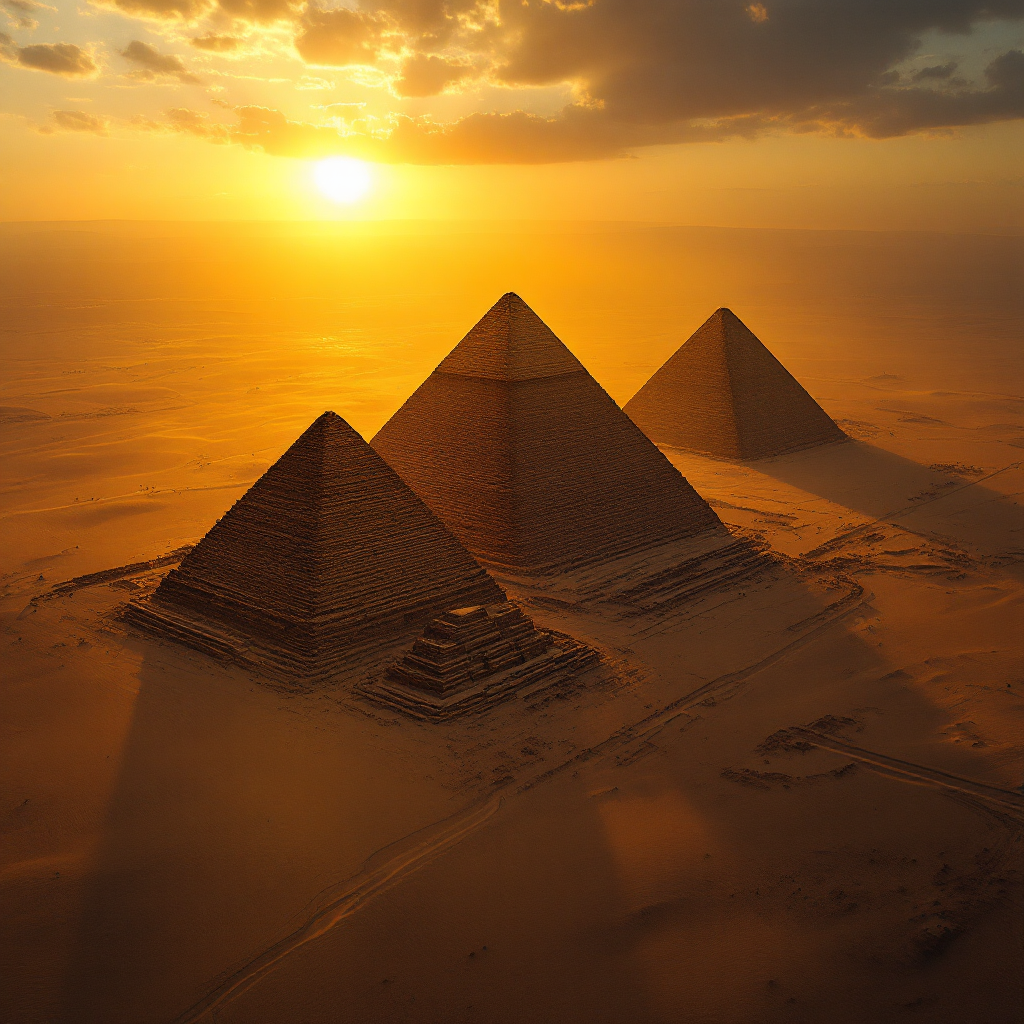
How long did it take to build the pyramids? The standard answer, repeated in textbooks and tourist guides, is approximately 20 years for the Great Pyramid of Giza. That estimate comes from the ancient Greek historian Herodotus, who visited Egypt around 450 BCE, over 2,000 years after the pyramid was supposedly built. He was told by Egyptian priests that 100,000 men worked in three-month shifts for two decades to complete the structure. That story has been accepted as fact for centuries. But when you run the numbers, examine the precision of the stonework, and look at what the Egyptians themselves actually said, the 20-year timeline begins to collapse under its own weight.
The Official Timeline and Its Problems
Mainstream Egyptology credits Pharaoh Khufu with commissioning the Great Pyramid during the Fourth Dynasty, around 2580 to 2560 BCE. The construction timeline of 20 years requires placing an average of 2.3 million limestone and granite blocks, some weighing up to 80 tons, at a rate of roughly 12 blocks per hour, working 10 hours a day, 365 days a year. No breaks for weather, no delays for logistics, no time lost to tool maintenance or planning. Just constant, flawless execution for two decades straight.
The logistics alone strain credibility. Granite blocks for the King’s Chamber were quarried in Aswan, over 500 miles south. Limestone casing stones came from Tura, across the Nile. According to conventional archaeological estimates, crews would have needed to quarry, transport, dress, and place each multi-ton block with surgical precision, aligning the structure to true north within 3/60th of a single degree. The pyramid’s base is level to within 2.1 centimeters across a footprint of over 13 acres. That kind of precision isn’t primitive. It’s engineered.
Modern construction engineers who’ve studied the pyramid openly admit we couldn’t replicate it today with the same materials and constraints. No cranes that can lift 80-ton blocks to heights of 480 feet. No level of coordination that could maintain that pace without digital planning tools. The 20-year timeline isn’t just tight. It’s functionally impossible under the technological conditions attributed to Old Kingdom Egypt.
What the Evidence Actually Shows
The entire case for Khufu as builder rests on a single piece of evidence: red ochre graffiti discovered in a small relieving chamber above the King’s Chamber in 1837 by British colonel Howard Vyse. The cartouche bearing Khufu’s name was found in a space no one had accessed for thousands of years, or so the story goes. Vyse was under enormous financial and professional pressure to produce a significant find. Some researchers have questioned whether the marking was authentic or added to secure his legacy and funding. If that cartouche was forged, the entire historical attribution collapses.
Elsewhere in Egypt, every major monument from the Old Kingdom period comes with inscriptions, foundation deposits, and administrative records identifying who built it and when. The Great Pyramid has almost none of that. For a structure that size, the silence is suspicious. No contemporary papyri documenting the workforce. No detailed construction records. No tomb inscriptions from Khufu boasting about his achievement. The pyramid simply exists, attributed to him by later tradition rather than direct evidence.
Meanwhile, geological analysis of the Sphinx enclosure, located on the same Giza Plateau, shows water erosion patterns consistent with prolonged heavy rainfall. That kind of rain hasn’t fallen in Egypt during dynastic times. It last occurred near the end of the last Ice Age, during or before the Younger Dryas period, roughly 12,900 to 10,900 BCE. If the Sphinx predates dynastic Egypt by thousands of years, the possibility that the pyramids do as well deserves serious consideration. For those tracking suppressed archaeological timelines and forgotten civilizations, the Giza Plateau may represent inherited architecture rather than original construction.
The Inheritance Model
What if the pyramids weren’t built in 20 years because they weren’t built by the Fourth Dynasty at all? What if Old Kingdom Egypt inherited the structures from an earlier, more advanced civilization, one erased by the cataclysm that reset human history at the end of the last Ice Age?
This isn’t fringe speculation. It’s a model supported by the physical evidence. Egyptian sources themselves speak of Zep Tepi, the First Time, a golden age when divine knowledge entered the world. The Edfu Building Texts describe sacred knowledge brought to Egypt after a great flood by survivors of a destroyed homeland. The Turin King List documents reigns of divine or semi-divine rulers stretching thousands of years before the historical pharaohs. These aren’t myths inserted by later storytellers. They’re inscribed in temple walls and recorded in Egypt’s oldest documents.
If a pre-flood civilization built the core structures at Giza, later dynasties could have performed restoration work, added casing stones, or repurposed existing monuments without understanding the original construction methods. This would explain why the Great Pyramid shows no tool marks, no scaffolding evidence, and no debris field consistent with such a massive construction project. It would also explain why later pyramids, the ones we know the Egyptians built, are visibly cruder. They weren’t evolving. They were imitating.
The Alignment That Shouldn’t Exist
The three pyramids at Giza align with the constellation Orion’s Belt with striking precision. Not as it appears today, but as it appeared around 10,500 BCE, during the Age of Leo. That’s the same epoch when the Sphinx, if originally carved as a lion, would have faced the rising constellation of Leo at the spring equinox. These aren’t coincidences. They’re timestamps, astronomical markers encoding a date far older than the Fourth Dynasty.
Bauval and Hancock’s Orion Correlation Theory, first proposed in the 1990s, demonstrated this alignment mathematically. Mainstream Egyptology dismissed it, not because the astronomy was wrong, but because it didn’t fit the accepted timeline. The alignment is real. The question is whether we’re willing to accept what it implies. Understanding sacred timing and celestial cycles may unlock more than we’ve been told about when and why these structures were built.
Who Really Built Them?
If the pyramids predate the Fourth Dynasty, who built them? The answer depends on how far back you’re willing to look. Ancient texts across multiple cultures describe advanced beings who came before the flood: the Anunnaki of Sumer, the Neteru of Egypt, the Nagas of India, the Quinametzin of Mesoamerica. These weren’t gods in the abstract sense. They were described in practical, administrative detail, beings with specific roles and regions of influence.
Sumerian texts including the Enuma Elish and Atra-Hasis describe the Anunnaki as creators of humanity, blending their essence with earthly life to produce a worker species. Genesis echoes this directly: Adam formed from the dust of the ground, humanity created in the image of the Elohim, a plural term mistranslated as singular God. If an advanced pre-flood civilization built the pyramids as part of a global network of megalithic structures, their knowledge didn’t vanish. It was inherited, fragmented, and passed down through the priesthoods of Egypt, Greece, and beyond.
For a complete exploration of how that knowledge was preserved and transmitted through mystery schools, initiatory traditions, and encoded sacred practices, Master Thyself by Alex Wolfram traces the unbroken chain from Atlantis through Egypt and into the modern world. The mechanisms behind this transmission are detailed in Chapter 12 of Master Thyself.
The Function Behind the Form
Another problem with the 20-year construction timeline is that it assumes the pyramids were tombs. No mummy has ever been found in the Great Pyramid. No treasure. No inscriptions honoring the dead. The King’s Chamber contains a granite coffer with dimensions that match the Ark of the Covenant described in Exodus, but its purpose remains unexplained by conventional archaeology.
Some researchers propose the pyramids functioned as energy devices, resonance chambers, or initiation temples. The shafts in the King’s and Queen’s Chambers align with specific stars. The structure itself is positioned at the exact center of Earth’s landmass. The internal geometry incorporates pi, phi, and the speed of light in its dimensions. These aren’t decorative choices. They’re encoded data.
If the pyramids were designed to harness sound, light, or electromagnetic energy, their construction would have required knowledge of physics, astronomy, and sacred geometry far beyond what we attribute to Bronze Age Egyptians. That knowledge didn’t appear out of nowhere in 2580 BCE. It was inherited from an earlier system, one whose builders understood the Earth as a living grid of energy, not a dead rock to be conquered. The relationship between the body’s own energy architecture and the geometric precision of ancient monuments may not be coincidental.
The Timeline Problem Everywhere
The pyramid timeline problem isn’t unique to Egypt. Göbekli Tepe in Turkey, a massive stone temple complex, was built over 12,000 years ago by people who supposedly had no agriculture, no metal tools, and no written language. Pumapunku in Bolivia features precision-cut andesite blocks with tolerances measured in fractions of a millimeter. Baalbek in Lebanon contains foundation stones weighing over 1,650 tons, placed with such precision that a sheet of paper won’t fit between them. Nan Madol in Micronesia is a city built on 750,000 tons of basalt columns, transported and stacked without wheels or beasts of burden.
The pattern is global. Advanced stonework predates the civilizations we credit with building it. The older the structure, the more precise the work. Later cultures built on top of what they couldn’t replicate. The timeline we’ve been taught isn’t just wrong about Egypt. It’s wrong everywhere.
Why the Timeline Matters
So how long did it take to build the pyramids? If the inheritance model is correct, the answer isn’t 20 years. It’s thousands of years older than the official record allows. The implications aren’t just academic. If advanced civilizations rose and fell before recorded history, if knowledge was encoded into stone because the builders knew catastrophe was coming, then the timeline we’ve been taught isn’t a neutral mistake. It’s a boundary. One that keeps us from asking what else we’ve forgotten.
The 20-year construction estimate serves a specific function: it keeps the pyramids within the safe confines of dynastic Egypt, removes the need to explain advanced pre-flood knowledge, and protects the linear progression model of human history that institutions depend on. But the math doesn’t work. The logistics don’t work. The precision doesn’t work. And the silence from Khufu himself, the man supposedly responsible for the greatest architectural achievement in human history, doesn’t work either.
What works is the possibility that the pyramids are far older than we’ve been told, built by a civilization whose memory survives only in myth, and inherited by a culture that revered them without understanding how they were made. That model fits the evidence. It fits the global pattern of reset and inheritance. And it fits the message encoded into the structure itself: a timestamp pointing backwards, not to the Fourth Dynasty, but to the stars as they appeared over 12,000 years ago.
The Deeper Question
The real question isn’t how long it took to build the pyramids. The real question is why we’re still being told a timeline that doesn’t hold up under scrutiny. The answer may be simpler than conspiracy. Institutions built on established narratives don’t adapt quickly. Careers, funding, and reputations depend on not rocking the boat. Admitting the pyramids predate dynastic Egypt by thousands of years would require rewriting textbooks, revising chronologies, and confronting the possibility that human history is cyclical rather than linear.
That confrontation isn’t happening in academic journals. It’s happening in the field, where independent researchers compare water erosion to accepted timelines, run construction simulations that debunk the official narrative, and point cameras at the sky to confirm what the ancients already knew: the pyramids are a message. Not from Khufu. From whoever came before the flood, whoever knew the reset was coming, and whoever built in stone because stone is the only thing that survives.
Closing Reflection
How long did it take to build the pyramids? The honest answer is we don’t know. The 20-year timeline is a guess based on a secondhand account from a historian writing 2,000 years after the fact. The evidence on the ground, geological, astronomical, and engineering, points to a far older origin. The precision points to a level of knowledge we don’t associate with the Bronze Age. The alignment points to a date we’re not allowed to consider. And the silence from the people supposedly responsible points to inheritance rather than invention.
The pyramids weren’t built in 20 years. They were built by a civilization we’ve forgotten, survived a cataclysm we’ve mythologized, and were inherited by a culture that turned them into tombs because they no longer understood what they were for. That’s not speculation. That’s the pattern repeated at every major megalithic site on Earth. The question isn’t whether it’s possible. The question is whether we’re ready to remember.