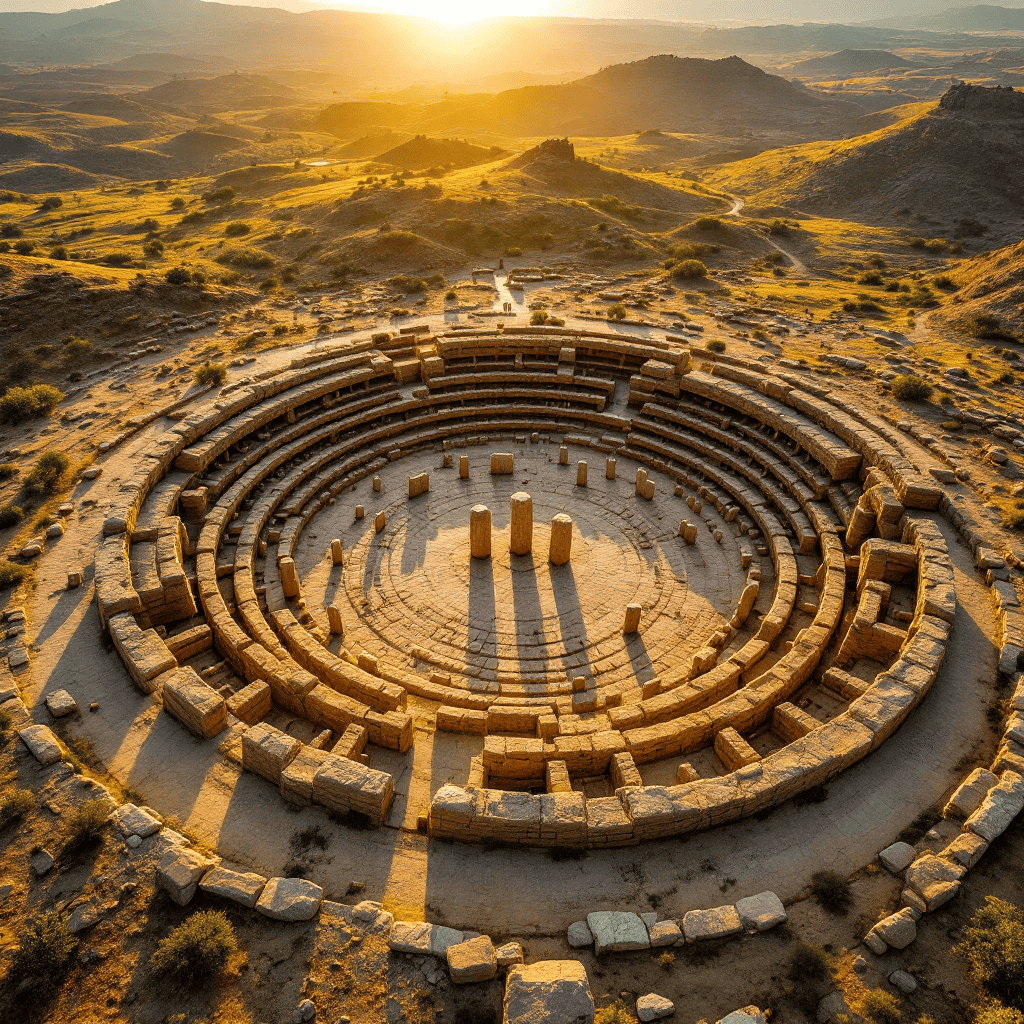
Who built Göbekli Tepe? The answer rewrites everything we thought we knew about human civilization. Unearthed in southeastern Turkey in 1995, this massive stone temple complex was constructed over 12,000 years ago by hunter-gatherers who, according to mainstream archaeology, shouldn’t have been capable of anything close to this scale. No agriculture. No metal tools. No written language. No cities. Yet they organized the labor, mastered the logistics, and executed the symbolic vision to build a monument that predates Stonehenge by 6,000 years and the Egyptian pyramids by 7,000.
The Builders Without Cities
The people who built Göbekli Tepe were nomadic hunter-gatherers living at the end of the last Ice Age. They had no permanent settlements, no domesticated crops, and no complex tools beyond flint and stone. This was a world before pottery, before the wheel, before any known form of writing. The standard model of human development says civilization required agriculture first. Surplus food enabled population density. Population density enabled specialization. Specialization enabled monumental architecture. Göbekli Tepe inverts that sequence entirely.
The site features towering T-shaped limestone pillars, some weighing up to 20 tons, carved with intricate reliefs of animals: foxes, lions, scorpions, vultures, serpents. These weren’t crude scratches. They were sophisticated symbolic carvings executed with precision. The pillars were arranged in circular enclosures, carefully aligned and embedded in bedrock. Archaeologists estimate the construction required hundreds of workers over decades, possibly centuries. That level of coordination demands social structure, shared belief systems, and collective purpose. Yet the people responsible left no trace of urban infrastructure.
Standard evolutionary timelines place the Neolithic Revolution, the transition to agriculture and settled life, around 10,000 BCE in the Fertile Crescent. Göbekli Tepe was already under construction by then. Its oldest layers date to approximately 9600 BCE, with some researchers pushing estimates even earlier. This means the site predates the very innovations it was supposed to require. Whoever built Göbekli Tepe did so without the foundations we assume are necessary for such an undertaking.
A Temple Before Religion?
Göbekli Tepe has been called the world’s first temple. That label assumes religious intent, but the evidence is more ambiguous. No residential structures have been found. No graves. No signs of permanent habitation. The site appears to have been a gathering place, used periodically and then abandoned between uses. Animal bones recovered from the site suggest massive feasting events. Gazelle, wild cattle, and other game were butchered and consumed in large quantities. This wasn’t subsistence hunting. It was ceremonial.
Some researchers propose the site served as a pilgrimage destination, a sacred center where scattered bands of hunter-gatherers convened for ritual, exchange, and collective identity. The symbolic carvings support this interpretation. Predators and scavengers dominate the iconography: animals associated with death, transformation, and the boundary between worlds. Vultures, in particular, appear repeatedly. In many ancient cultures, vultures symbolized sky burial and the release of the soul. The imagery at Göbekli Tepe may encode an early cosmology centered on death and rebirth.
But calling it a temple may impose a later framework onto something older and stranger. The builders of Göbekli Tepe may have had a relationship with the sacred that doesn’t map neatly onto modern religion. No priesthood. No doctrine. Just direct engagement with the forces they carved into stone. The site’s purpose may have been initiatory: a place where knowledge was transmitted, where the boundary between human and cosmos was intentionally thinned. For more on how lost civilizations encoded knowledge across catastrophic resets, explore the archaeological and historical threads that connect forgotten pasts to the present.
Astronomical Encoding and Cosmic Memory
In 2017, researchers analyzing the carvings at Göbekli Tepe proposed a startling interpretation. Pillar 43, located in Enclosure D, may represent an astronomical event encoded in stone: a comet strike during the Younger Dryas period, roughly 10,900 BCE. The Younger Dryas was a sudden return to glacial conditions following the end of the last Ice Age. Temperatures plummeted. Ice sheets expanded. Megafauna across North America went extinct. Early human cultures were devastated.
The carvings on Pillar 43 depict a series of animals arranged in what some interpret as constellations. A headless human figure appears at the base, possibly symbolizing catastrophic death or loss. A vulture hovers above, wings spread. The arrangement mirrors star patterns visible in the sky around 10,950 BCE, the precise window of the Younger Dryas impact hypothesis. If this interpretation holds, Göbekli Tepe isn’t just a temple. It’s a memorial. A warning. A record carved by survivors who understood that the world had ended once and could end again.
This raises a deeper question: how did hunter-gatherers develop the astronomical knowledge required to encode such information? Observing the night sky is one thing. Translating celestial events into symbolic stone carvings requires generational knowledge, systematic observation, and a cultural imperative to preserve what was witnessed. The builders of Göbekli Tepe weren’t primitive. They were custodians of memory, encoding survival data into the most durable medium they had: stone.
The Deliberate Burial
One of the most unsettling details about Göbekli Tepe is how it ended. The site wasn’t abandoned through neglect or conquest. It was deliberately buried. Around 8000 BCE, the builders filled the enclosures with rubble and sediment, sealing the pillars underground. This wasn’t decay. It was intentional preservation. Someone decided the site’s work was complete, or that it needed to be hidden.
Why would a culture invest centuries into building a monumental complex only to bury it? One possibility: the knowledge it carried had been transmitted. The site served its purpose. Another possibility: the people who buried it understood that catastrophe was cyclical. By sealing Göbekli Tepe, they ensured it would survive the next reset, waiting for a future generation capable of understanding what it contained. The act of burial may itself be a message: this knowledge is not for every age. It is for those who are ready.
This deliberate burial separates Göbekli Tepe from nearly every other ancient site. It wasn’t destroyed by invaders, eroded by time, or repurposed by later cultures. It was carefully, methodically hidden by the same people who built it. That decision suggests an awareness of deep time, of civilizational fragility, and of the need to encode memory in forms that outlast human institutions. The site wasn’t just a place of gathering. It was a time capsule, sealed by those who knew that history doesn’t move in straight lines.
The Chain That Leads Forward
Göbekli Tepe sits at the beginning of a chain. Its construction coincides with the dawn of the Neolithic, the period when humans transitioned from nomadic life to settled agriculture. Some researchers argue the site didn’t just coincide with that transition. It caused it. Gathering periodically at Göbekli Tepe may have created the social pressure and organizational frameworks that eventually led to permanent settlements. The temple came first. Civilization followed.
If true, this inverts the standard model entirely. We didn’t build temples because we became civilized. We became civilized because we built temples. Shared belief, collective ritual, and symbolic encoding created the conditions for agriculture, cities, and writing. Göbekli Tepe becomes the hinge point: the moment when human consciousness crossed a threshold and reorganized itself around something larger than survival.
The chain doesn’t stop there. Symbolism similar to that found at Göbekli Tepe appears in later Mesopotamian, Egyptian, and Anatolian cultures. The T-shaped pillars resemble human forms, arms bent at the sides. Some researchers see them as representations of divine ancestors or sky beings. Others interpret them as initiatory figures, guides for those undergoing transformation. Either way, the symbolic vocabulary established at Göbekli Tepe echoes forward through history, carried by cultures that inherited fragments of what the original builders knew.
For those seeking to understand how ancient knowledge systems were preserved and transmitted across millennia, the full synthesis in Master Thyself traces the unbroken lineage from pre-Flood civilizations through Egyptian mystery schools, Hermeticism, and into modern esoteric traditions. The mechanisms aren’t speculative. They’re documented, encoded, and still operational today.
What Göbekli Tepe Threatens
Göbekli Tepe is a problem for every institution whose authority depends on controlling the past. It predates organized religion by thousands of years, yet demonstrates spiritual sophistication that rivals anything that came after. It was built without cities, yet required the coordination we associate with urban civilization. It encodes astronomical knowledge without writing, metallurgy, or any of the tools we assume are necessary for such work. Every assumption about human development it challenges is an assumption that props up a narrative: that progress is linear, that complexity requires hierarchy, that civilization began in Mesopotamia and spread outward from there.
Göbekli Tepe says otherwise. It suggests that advanced knowledge, social organization, and symbolic thinking existed far earlier than the approved timeline allows. It opens the door to older civilizations, lost knowledge systems, and the possibility that humanity has risen and fallen more than once. That possibility is dangerous, not because it’s irrational, but because it decentralizes authority. If the timeline is wrong, what else is wrong? If knowledge this old exists, who gets to interpret it?
That’s why less than 10 percent of Göbekli Tepe has been excavated. Officials cite preservation concerns. Critics point to decades of delays, restricted access for independent researchers, and the construction of protective steel canopies that also prevent further digging. The site has been partially opened to tourism, which generates revenue but also limits what can be studied. What lies beneath the unexcavated 90 percent? More enclosures. More pillars. More carvings. Possibly answers to questions mainstream archaeology isn’t ready to ask.
The Survivors and the Seed
If Göbekli Tepe encodes memory of the Younger Dryas catastrophe, its builders were survivors. Not the first humans, but the remnant of a population that had seen the world collapse. The knowledge they preserved, astronomical cycles, symbolic encoding, ritual coordination, didn’t emerge from nothing. It was inherited. Passed down. Adapted for a new age.
This aligns with flood myths found in every ancient culture: Sumerian, Hebrew, Hindu, Mesoamerican, Aboriginal. All describe a world that ended in water, fire, or ice, and a remnant that survived to rebuild. Göbekli Tepe may be the physical evidence of that survival. Not the origin point of civilization, but the reboot. The place where scattered survivors gathered to remember what had been lost and encode it into stone so the next cycle wouldn’t have to start from zero.
The symbolic language they used, animals, geometry, celestial alignment, reappears in every mystery tradition that followed. Egypt’s Zep Tepi, the First Time, describes divine knowledge entering the world after a great upheaval. Sumerian king lists speak of rulers before the flood. Greek and Roman mystery schools taught initiatory transformation through death and rebirth. All of them carried forward what Göbekli Tepe encoded at the beginning: the knowledge that the world resets, that memory must be preserved, and that the path to renewal runs through ritual, symbol, and inner awakening. To see how this connects to the hidden cycles that govern renewal and the practices that align with them, visit the timing and rhythmical systems explored in the broader esoteric framework.
Custodians of Deep Time
Who built Göbekli Tepe? Hunter-gatherers, yes. But that label undersells what they were. They were astronomers. Builders. Symbol-makers. Memory-keepers. They understood deep time, cyclical catastrophe, and the necessity of encoding knowledge in forms that survive collapse. They weren’t primitive humans stumbling toward civilization. They were custodians of something older, translating inherited wisdom into a new form for a world emerging from ice and ash.
The question isn’t just who built it. The question is what they knew. And why, after building it, they chose to bury it. The pattern of suppression and concealment that Göbekli Tepe represents isn’t unique. It echoes across history: knowledge encoded, knowledge hidden, knowledge dismissed by those who control the narrative. The site survived because it was buried. The knowledge survived because it was transmitted. And the transmission didn’t stop. It moved forward through priesthoods, mystery schools, and initiatory lineages that understood the same truth the builders of Göbekli Tepe understood: the world forgets, but the stones remember.
The Redacted Protocols
What Göbekli Tepe encoded wasn’t just astronomical data or survival instructions. It was operational knowledge: how to align human consciousness with cosmic cycles, how to use stone and geometry to anchor memory across time, and how to REDACTED, READ CHAPTER 12. The pillars themselves may function as more than monuments. Their placement, orientation, and material composition suggest they were designed to interact with electromagnetic fields, geomagnetic currents, or frequencies we no longer measure. Modern researchers using ground-penetrating radar have detected anomalies beneath the site, including REDACTED, READ CHAPTER 12 that may correspond to older, deeper layers of construction.
The ritual use of the site likely involved REDACTED, READ CHAPTER 12, practices designed to alter consciousness and open perceptual thresholds. Feasting, fasting, and communal gathering weren’t social customs. They were preparatory stages. The animal symbolism carved into the pillars wasn’t decorative. It was instructional, mapping inner states onto external forms so that initiates could REDACTED, READ CHAPTER 12. The enclosures themselves may have been designed to amplify or focus specific frequencies, turning the entire site into a resonance chamber calibrated to REDACTED, READ CHAPTER 12.
Chapter 12 of Master Thyself details the full mechanism behind how ancient sites like Göbekli Tepe functioned as REDACTED, READ CHAPTER 12, the alignment techniques used to synchronize human biology with celestial and terrestrial cycles, and the REDACTED, READ CHAPTER 12 that allowed initiates to access states of consciousness modern science is only beginning to map. The protocols are not historical curiosities. They are repeatable, embodied practices that work today exactly as they did 12,000 years ago.
Closing Reflection
Who built Göbekli Tepe? A people without cities who understood the stars. A culture without writing who encoded memory in stone. Survivors of a cataclysm who refused to let the knowledge die. They built it as a seed, designed to wait beneath the earth until the world was ready to remember what it had forgotten. The site has been waiting for 12,000 years. The excavation has barely begun. And the knowledge it contains, astronomical, architectural, symbolic, and initiatory, is still intact, still waiting, still speaking to anyone willing to listen.
The builders didn’t leave a written record. They left something harder to erase: stone aligned to the cosmos, symbols that encode transformation, and a warning that the world ends and begins again. Göbekli Tepe isn’t just the oldest temple. It’s the first library. And its message is clear: this has happened before. It will happen again. The only question is whether we’ll be ready.