The Eye of Africa is Atlantis.
Plato gave 63 specifics. The Richat Structure satisfies them.
30 miles wide. Concentric rings of land and water. Beyond the Pillars of Hercules. Mountains to the north. Destruction date aligning exactly with the Younger Dryas. Every specific Plato gave us, the Eye of Africa satisfies.
For 2,400 years, scholars treated Plato's Atlantis description as poetic invention because no known location satisfied his specifics. The Richat Structure in Mauritania satisfies them. The geographic match is established. The structural match is established. The destruction timeline matches the Younger Dryas to the year. The question is no longer whether Atlantis existed. The question is what survived, and how it was carried forward.
The Richat Structure matches every specific Plato gave. It has been hiding in plain sight for 12,000 years.
When Plato wrote Timaeus and Critias around 360 BCE, he gave 63 specific criteria for Atlantis: measurements, geographic markers, destruction timeline, terrain features, materials, climate, neighbors. For 2,400 years those specifics were dismissed as poetic invention because no known location satisfied them. The Richat Structure satisfies them. Not loosely. Geometrically.
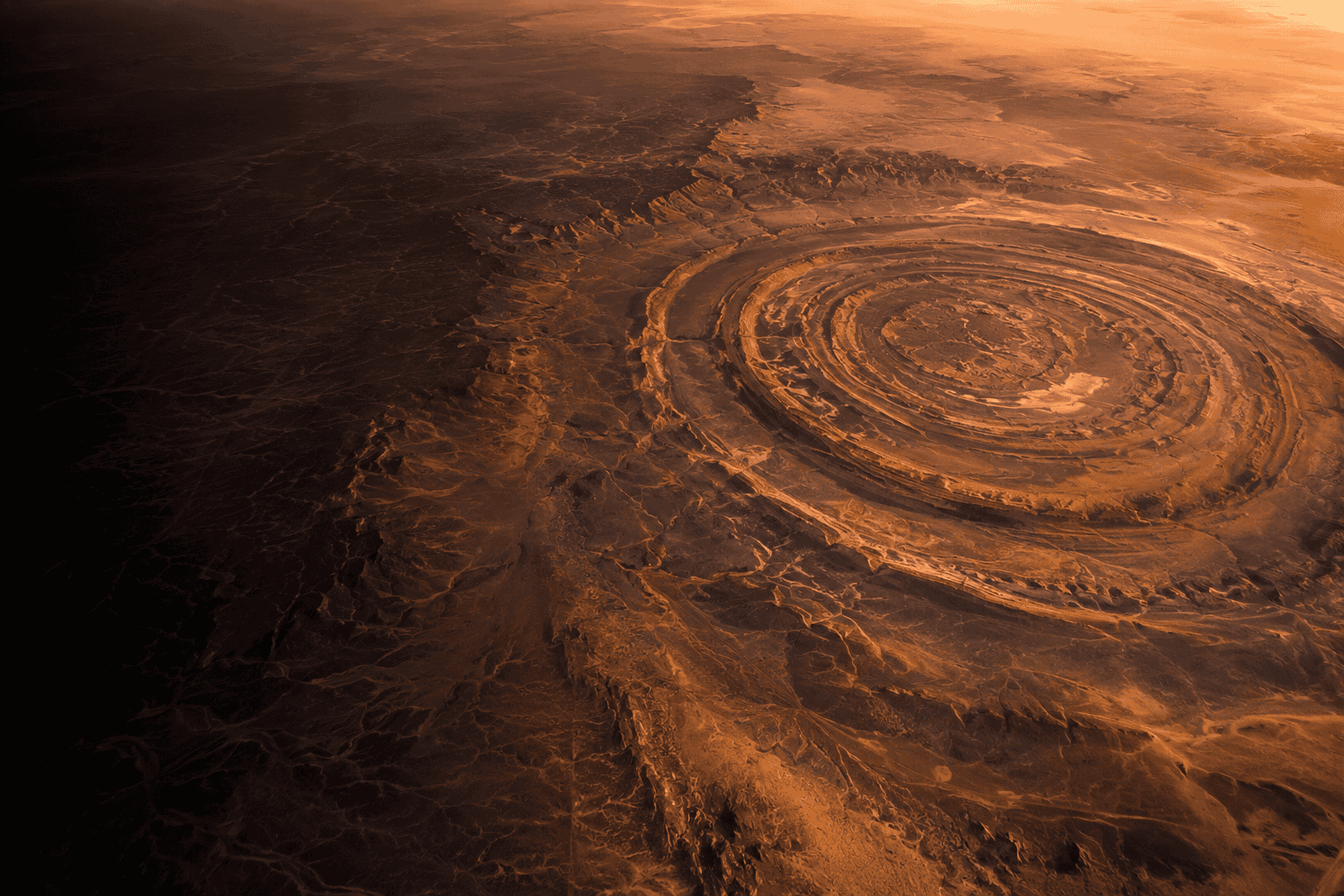
The Richat Structure sits in Mauritania at 21.1202 degrees North, 11.4007 degrees West. A 30-mile concentric ring formation in the western Sahara. From orbital altitude it looks like a fingerprint pressed into the Earth. NASA astronauts use it as a landmark on flyovers. From space, the resemblance to a giant eye is so complete that the structure has been called the Eye of Africa since its discovery from orbit.
The mainstream geological interpretation is that the rings are a natural alkaline igneous complex exposed by erosion. That interpretation is probably correct as far as it goes. It is also irrelevant to the case at hand. A civilization that found a pre-existing concentric ring system would not have invented it. They would have built into it. The flat plain to the north, the mountains beyond, the seasonal rivers, the gold and copper deposits, the elephants of the African Humid Period. All documented. All Plato.
This is not the question of whether the Richat is geologically natural. The question is what happened on top of it, and what survived underneath. The Eye of Africa is the answer that fits 63 separate criteria. No other proposed Atlantis location fits more than a handful.
Plato's specifics versus the geography. Check.
Plato's account of Atlantis is unusually detailed for an ancient text. He gives measurements in stadia. Geographic coordinates relative to known landmarks. Materials. Climate. Crops. Animals. Destruction mechanism. Destruction date. Below are the matches that survive scrutiny.
The concentric rings
Plato describes alternating rings of land and water around the central capital. The Richat has alternating rings of land and ancient watercourse beds around its central dome. The ring count matches. The geometric precision matches. The fact that the rings are concentric rather than parallel or random matches. This is the most specific detail in Plato's account. No other proposed Atlantis location satisfies it. The Eye of Africa does. Check.
The size
Plato describes the central capital as 127 stadia in diameter. The stadion varied by culture: Greek at 185 meters, Egyptian at 157.5 meters, Italo-Roman at 192 meters. Plato received the Atlantis account from Egyptian priests at Sais, so the Egyptian standard is the most likely source measurement. Under the Redacted, read Chapter 12 stadion, 127 stadia equals approximately 20 kilometers. Under the Greek stadion, approximately 23.5 kilometers. The Richat Structure spans approximately 23 kilometers in diameter. The math proving which culture preserved the original Atlantis measurements is one of the cleaner pieces of evidence in the case. Check.
The location
Plato writes that Atlantis lay beyond the Pillars of Hercules, the ancient name for the Strait of Gibraltar. The Richat sits roughly 800 miles west of the strait. Plato describes mountains to the north of the central capital. The Redacted, read Chapter 12 sit directly north of the Richat. Plato describes a vast rectangular plain surrounding the city. The Adrar Plateau matches that description in scale and orientation. Check. Check. Check.
The destruction timeline
Plato dates the destruction of Atlantis to 9,000 years before Solon, which calculates to approximately 11,600 years before present. The Redacted, read Chapter 12 climate catastrophe, the most severe global climate event of the last 100,000 years, occurred at approximately 11,600 years before present. The match is not approximate. The dates align exactly. Whatever destroyed Atlantis, by Plato's chronology, struck at the same moment as the documented climate event that ended the last Ice Age. Check.
The destruction mechanism
Plato writes that Atlantis was overcome by earthquakes and floods in a single day and night, and afterward the area became impassable and impenetrable, a shoal of mud. This is not the description of a sunken ship. It is the description of a coastal civilization hit by a tidal wave. Sediment flow scars visible from orbit at the Richat are consistent with massive water movement. The southern breach in the outer ring shows salt patterns consistent with a former tidal inlet. The Redacted, read Chapter 12 off the West African coast is a documented underwater landslide of tsunami-generating scale. Check.
The materials
Plato describes Atlantis as rich in gold, silver, copper, and Redacted, read Chapter 12, a legendary metal Plato called second in value only to gold. West Africa remains one of the largest gold-producing regions on Earth. Copper alloys found in the broader region match ancient descriptions of this metal. Declassified geological surveys document magnetic anomalies at the Richat consistent with subsurface metallic deposits. Check.
The climate and crops
Plato describes a fertile landscape with two annual harvests, lush vegetation, elephants, and abundant water. During the Redacted, read Chapter 12 (approximately 11,000 to 5,000 years before present) the Sahara was a green landscape of lakes, rivers, and savannah. Fossils and rock art confirm elephants inhabited the region. Seasonal monsoons during this period could plausibly have supported double harvests. Check.

Master Thyself
The Eye of Africa is one stop on the chain. The full chain, from pre-flood Atlantis through Egyptian inheritance, through the Mystery schools, through the Council of Nicaea, runs the length of Chapters 11 and 12.
The standard objections fall apart on examination.
When the Richat hypothesis surfaces in academic conversation, three objections recur. Each one is easier to answer than the matches are to dismiss.
"Atlantis was an island, the Richat is on a continent."
Plato writes that Atlantis was an island "larger than Libya and Asia combined." Critics argue the Richat cannot be Atlantis because it is on the African mainland. This objection misunderstands ancient Greek terminology. Herodotus, a near-contemporary of Plato, called Egypt a Redacted, read Chapter 12 (Greek for island) despite Egypt's obvious position on the African mainland. In ancient Greek, this term could mean any region bounded by natural barriers, including rivers, deserts, or mountain ranges. The Richat sits at the intersection of the Sahara, the Adrar Highlands, and the former Atlantic coastline of the African Humid Period. By the working definition Plato's contemporaries used, the surrounding plateau qualifies.
"There are no ruins at the Richat."
Three responses. First, less than 10 percent of the Richat has been systematically surveyed. Second, the western Sahel is one of the most dangerous regions on Earth, with active terror organizations, political instability, and warlord factions. Major archaeological institutions will not fund excavations in active conflict zones. Third, 12,000 years of erosion and sediment burial in a desert environment is sufficient to bury almost any organic urban footprint. The absence of visible surface ruins is what would be expected after 120 centuries, not what would refute the hypothesis. Lidar surveys have already detected rectangular formations and geometric anomalies in the surrounding terrain that warrant formal excavation.
"The rings are natural, so the site can't be Atlantis."
Probably half-correct, and irrelevant either way. The hypothesis is not that a civilization built the concentric rings. The hypothesis is that a civilization found the concentric rings already in place and used them as the structural foundation for the capital city Plato described. Infrared scans show thermal anomalies beneath the rings, potentially indicating subsurface chambers. Satellite imaging has detected magnetic anomalies consistent with subsurface metallic deposits, matching Plato's description of orichalcum walls. None of these findings have been formally excavated. The reasons are political, not scientific.
There is also a 1967 declassified CIA document, released through the Freedom of Information Act, confirming that the U.S. Navy planned aerial surveys of several locations including the Richat Structure to investigate geomagnetic anomalies. The surveys were connected to Redacted, read Chapter 11, the remote viewing program. The specific findings from those surveys remain classified.
The question is no longer whether Atlantis existed. The question is what survived.
If the Richat is Atlantis, the next question becomes the real one. A civilization existed at the Eye of Africa. It was destroyed by the Younger Dryas. Civilizations do not vanish without survivors. Knowledge does not disappear. It moves. The trail of where Atlantean knowledge moved, after the cataclysm, is more visible than mainstream history admits.
Egypt appears in the archaeological record not as a slow developmental experiment but as a civilization that arrives already complete. Writing emerges fully formed. Sacred geometry is already embedded in the earliest temple architecture. Astronomy is already precise enough to align the pyramids to true north within a fraction of a degree. Monumental construction begins without a visible developmental phase. This pattern does not suggest invention. It suggests inheritance.
Egyptian sources confirm it. They speak of Redacted, read Chapter 12, the First Time, a golden age when divine knowledge entered the world through figures like Thoth. The Turin King List documents reigns of divine or semi-divine rulers stretching thousands of years before the historical pharaohs. The Redacted, read Chapter 12, inscribed on the walls of the Temple of Horus, describe sacred knowledge brought to Egypt after a great flood by survivors of a destroyed homeland. The texts do not name the homeland Atlantis. They say it was a sacred island that sank in a great flood, and the survivors brought their knowledge with them.
This is where the chain begins. Atlantis fell. Egypt inherited what mattered. And the trail continued through Greece, through the Mystery schools, through Hermetic and Gnostic traditions, and eventually underground after the Roman suppression.
The Eye of Africa is not fringe. It is just inconvenient.
If the Richat is Atlantis, the implications are seismic. Human civilization is older than the textbooks. A major culture existed before the Younger Dryas, was destroyed by it, and seeded the post-flood civilizations of the Nile, the Tigris, and the Indus. The standard archaeological timeline is wrong by at least 7,000 years. The catastrophe stories preserved across every continent are not myth but distorted memory of a real event.
No major institution is going to volunteer that conclusion. The careers built on the standard timeline are too many. The funding structures are too entrenched. The political risk of being associated with a fringe position is too high. So the Eye of Africa sits there, 30 miles wide, visible from orbit, satisfying every geographic criterion in Plato's account, and the institutions that could fund a formal excavation continue to look elsewhere.
The 63-point comparison covers the matches, the plausible matches, the narrative matches, and the unexcavated criteria where the evidence runs out. That last category is honest reporting, not weakness. The law code pillar, the statue of Poseidon, the gold-only temple rule, these are Plato details that can only be confirmed or refuted by excavation. No excavation has occurred. The Eye of Africa is not yet finished telling its story. The institutions that could finish it are looking the other way.
What this page does is document the alignment between Plato's specifics and the Richat's geography, name the objections and answer them, and point at the chain of custody that connects the lost civilization to the one that survived to write the account down. The full 63 points, the dimension math worked out, and the carriers of the knowledge traced forward through the Mystery schools, lives in the book.
You are at stop 2 of nine.
The full investigation walks each link in order. Where you came from, where you are, and where the trail leads next.
Common questions, answered directly.
Is the Richat Structure really Atlantis?
The Eye of Africa satisfies every major geographic and structural criterion in Plato's description of Atlantis: concentric alternating rings of land and water, approximately 23 kilometers in diameter matching Plato's 127 stadia, located beyond the Pillars of Hercules, mountains to the north, a vast plain surrounding the city, and a destruction timeline aligning exactly with the Younger Dryas climate event of approximately 11,600 years before present. The alignment is more specific than any other proposed Atlantis location in 2,400 years of speculation.
Where is the Richat Structure located?
The Richat Structure sits in Mauritania, West Africa, at coordinates 21.1202 degrees North, 11.4007 degrees West. It is in the western Sahara, roughly 800 miles west of the Strait of Gibraltar (the ancient Pillars of Hercules). The site is currently inaccessible due to regional security concerns, which is one of the primary reasons it has not been formally excavated despite its size and visibility from orbit.
How big is the Richat Structure?
The Richat Structure is approximately 30 miles in outer diameter. The central dome and inner ring complex spans approximately 23 kilometers across, which matches Plato's description of the Atlantean capital as 127 stadia in diameter under either the Egyptian or Greek stadion measurement standard.
Why is the Richat called the Eye of Africa?
From orbital altitude, the concentric rings of the Richat Structure resemble a giant eye or fingerprint pressed into the Earth's surface. NASA astronauts named it the Eye of Africa because of this distinctive appearance when viewed from space. The name has stuck both in space exploration contexts and in popular references to the formation.
Did Plato really describe Atlantis or invent it?
Plato describes Atlantis in two dialogues: Timaeus and Critias. He explicitly states the account was received by his ancestor Solon from Egyptian priests at the temple of Sais, and that the Egyptian priests claimed the story was preserved from records 9,000 years older than Solon. Plato's account is not framed as invention. It is framed as the transmission of a historical record received from a much older source. The internal evidence of the dialogues, with their specific measurements, geographic markers, and destruction timeline, suggests transmission rather than fabrication.
What is the Younger Dryas and why does it matter?
The Younger Dryas was a sudden global climate event approximately 12,800 to 11,600 years before present, marked by abrupt temperature drops, glacier instability, sea level changes, and widespread extinctions across multiple continents. Recent peer-reviewed research has supported a cosmic impact hypothesis as the trigger. Plato's dating of Atlantis destruction to approximately 11,600 years before present aligns with the end of the Younger Dryas. Whatever destroyed Atlantis was the same event documented in the geological climate record.
Has the Richat Structure ever been excavated?
There has been no formal archaeological excavation of the Richat Structure. The reasons are primarily political and security-related rather than scientific. The western Sahel is currently considered unsafe for international archaeological teams due to active terror organizations, political instability, and warlord activity in the broader region. Major institutions will not fund excavations in active conflict zones, which has effectively prevented any formal investigation of the site for the past several decades.
What is the chain of custody from Atlantis to today?
After the destruction at approximately 11,600 years before present, the inner-transformation knowledge of the pre-flood civilization was carried into Egypt by survivors. Egypt preserved it in the Zep Tepi tradition and the Edfu Building Texts. Greek philosophers including Plato, Pythagoras, and Thales studied in Egypt and transmitted the framework into the Greek Mystery schools. The Hermetic tradition carried it into the Roman era. The Gnostic Christians preserved it in the early Christian period until the Council of Nicaea began the institutional suppression. The chain runs the length of Chapters 11 and 12 of Master Thyself.
Still with us?
Six more questions.
If the Eye of Africa case opens, the rest of the chain opens with it. Each of these threads is traced to its source in the fuller investigation.
What if the Egyptian stadion rather than the Greek stadion proves which culture preserved the original Atlantis measurements?
What if the 1967 CIA Project Stargate survey of the Richat found exactly what would have to be there if Atlantis was at that location?
What if the Adrar Highlands north of the Richat are the mountains Plato described, and the satellite-visible linear features in the surrounding sand are buried canal systems?
What if the Mauritanian Seafloor Slide off the West African coast is the geological signature of the tsunami that flattened Atlantis in one day and one night?
What if the Edfu Building Texts at the Temple of Horus describe exactly the survivors of the Richat civilization arriving in Egypt with sacred knowledge?
What if the reason no major institution funds a Richat excavation is not that the science is wrong but that the political cost of finding what is there is too high?