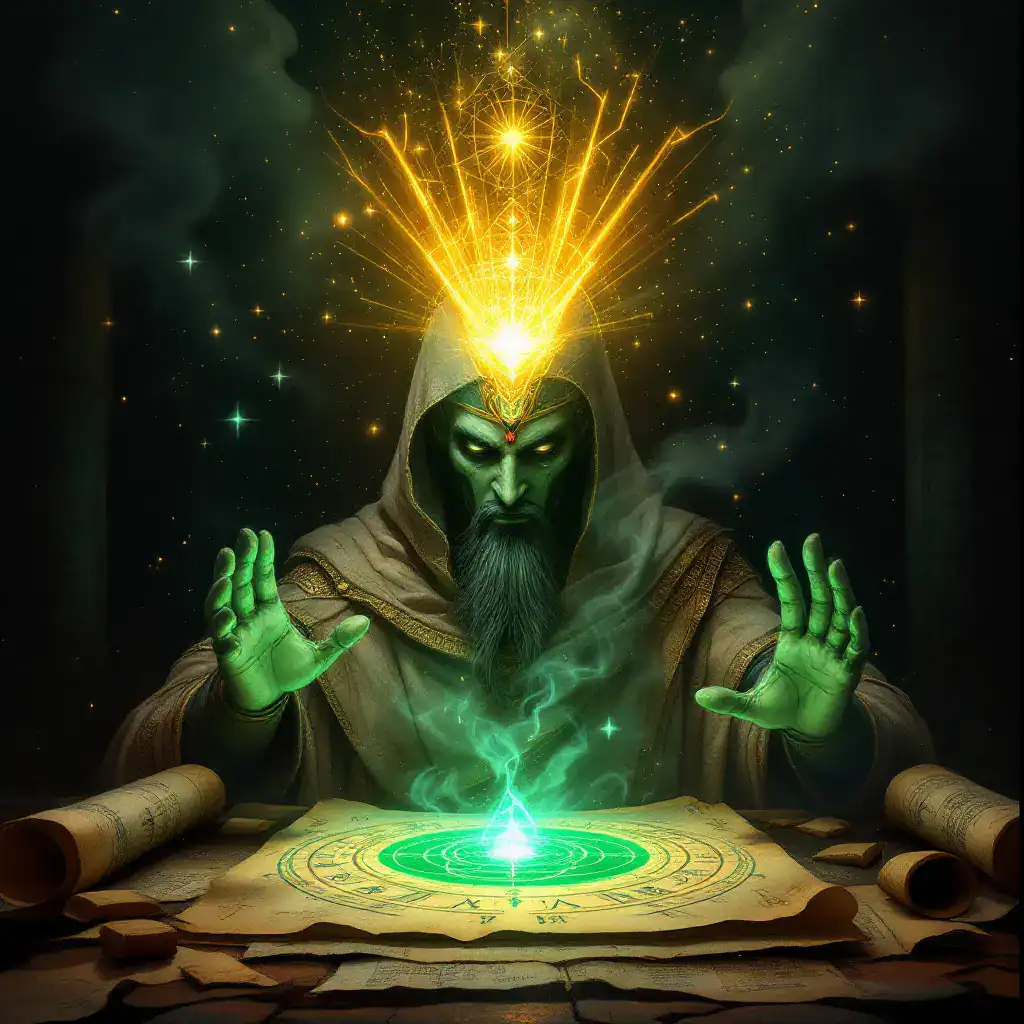
Hermes Trismegistus who was he? The question haunts the margins of accepted history. He appears in ancient texts as a master of alchemy, astrology, and sacred knowledge. His name means “Thrice-Greatest Hermes.” The Greeks called him the author of divine wisdom. The Egyptians knew him as Thoth, the god who taught humanity writing, medicine, and the secrets of the cosmos. But mainstream scholarship treats him as myth, a literary invention with no historical anchor. That dismissal is convenient for institutions built on controlling the narrative of human knowledge.
The figure of Hermes Trismegistus bridges two worlds. He is both the Egyptian deity Thoth and the Greek god Hermes, merged into a single identity during the Hellenistic period when Alexandria became the crossroads of ancient wisdom. This fusion wasn’t random. It reflected a deeper recognition that the knowledge systems of Egypt and Greece pointed to the same source. The name Trismegistus, meaning “thrice-greatest,” suggests mastery across three domains: philosophy, priesthood, and kingship. Others interpret it as mastery of the three parts of wisdom itself: alchemy (the material), astrology (the celestial), and theurgy (the divine). Either way, the title marks him as someone who transcended ordinary human limits.
What makes Hermes Trismegistus so dangerous to institutional narratives is not that he existed, but what he taught. The Corpus Hermeticum, a collection of sacred texts attributed to him and composed between the 1st and 3rd centuries CE, preserves teachings that bypass priests, churches, and external authority entirely. These writings emphasize direct knowledge of the divine, inner transformation, and the principle that humanity carries divinity within. According to Hermetic philosophy, the human being is a microcosm of the universe, capable of accessing the same creative intelligence that structures reality. No intermediary required. No hierarchy necessary. Just knowledge, practice, and the discipline to apply both.
The Egyptian Roots: Thoth, the Record Keeper
Before Hermes Trismegistus carried a Greek name, he was Thoth. In Egyptian mythology, Thoth served as scribe to the gods, inventor of writing, keeper of sacred knowledge, and mediator of cosmic order. He was depicted with the head of an ibis or a baboon, symbols of wisdom and precision. Thoth didn’t just record history. He shaped it. When the Eye of Horus was shattered by Set, it was Thoth who gathered the fragments and restored it. That myth encodes a deeper truth: knowledge can be destroyed, scattered, and deliberately suppressed, but it can also be reassembled by those who understand its structure.
Thoth’s role extended beyond mythology. Egyptian priests attributed their most advanced teachings to him, including the principles of sacred geometry, astronomy, and the inner processes that activate higher consciousness. He was the patron of the mystery schools, the initiatory traditions that taught transformation through direct experience rather than belief. These weren’t public institutions. They were hidden by design, because the knowledge they carried threatened every system built on obedience and external control. The teachings of Thoth survived the fall of Egypt by traveling into Greece, carried by initiates who understood that wisdom doesn’t die when civilizations collapse. It migrates.
The connection between Thoth and Hermes wasn’t a casual syncretism. It reflected a deliberate preservation effort during the Ptolemaic period, when Greek and Egyptian scholars worked side by side in Alexandria. They recognized that the Greek Hermes, messenger of the gods and guide of souls, performed the same function as the Egyptian Thoth. Both were psychopomps, leading consciousness between worlds. Both were associated with language, magic, and hidden knowledge. The fusion of these two figures into Hermes Trismegistus created a vessel capable of carrying Egyptian wisdom into a Greek-speaking world, ensuring its survival as empires rose and fell around it.
The Hermetic Texts and What They Contain
The Corpus Hermeticum consists of 18 treatises, written in the form of dialogues between Hermes Trismegistus and his students. The most famous, the Poimandres, describes a visionary experience in which Hermes encounters the Mind of the universe and receives knowledge of creation, the soul, and the path to divine union. The text doesn’t describe a distant god. It describes a presence within, accessible through inner discipline and the refinement of consciousness. The message is clear: divinity isn’t something you worship from a distance. It’s something you activate from within.
Another key text, the Emerald Tablet, distills Hermetic philosophy into a single principle: “As above, so below.” This isn’t poetry. It’s a structural claim. The universe operates on fractal patterns, with the same laws governing the cosmos, the planet, and the human body. What happens in the stars mirrors what happens in the cell. What unfolds in the heavens unfolds in the heart. Understanding this correspondence allows the practitioner to work with reality rather than against it, aligning personal transformation with universal law. The method for applying this principle across multiple systems, including the biological and the celestial, is detailed in the full framework of Master Thyself.
The Hermetic texts also describe humanity’s dual nature. We are both mortal and divine, trapped in matter yet capable of transcendence. The goal isn’t to escape the body, but to transform it. To awaken the divine spark within and bring it into alignment with the higher intelligence that structures existence. This teaching directly contradicts the doctrine of original sin, the idea that humanity is fundamentally broken and dependent on external salvation. Hermeticism says the opposite: you were never broken. You were asleep. And the tools to wake up are already inside you.
Why the Church Suppressed Hermes Trismegistus
When Christianity consolidated power in the 4th and 5th centuries, Hermetic teachings became a problem. The early Church needed a population that believed salvation came through the institution, not through personal gnosis. Hermetic texts taught the opposite. They said the kingdom is within. They said direct access to God is possible without priests. They said transformation is a process, not a transaction. That kind of teaching doesn’t build empires. It dismantles them.
The suppression wasn’t immediate. Early Christian thinkers like Lactantius and Augustine referenced Hermes Trismegistus with a mixture of respect and suspicion. They acknowledged his wisdom but framed him as a pagan prophet whose insights were incomplete without Christ. By the medieval period, that nuance vanished. Hermetic texts were labeled dangerous, linked to magic and sorcery, and quietly removed from circulation. The knowledge didn’t disappear. It went underground, preserved by alchemists, Gnostic sects, and later by Islamic scholars who translated and protected the texts when Europe descended into the Dark Ages.
The Renaissance brought Hermes Trismegistus back into the light. In 1463, Cosimo de Medici ordered the scholar Marsilio Ficino to stop translating Plato and prioritize the Corpus Hermeticum instead. Ficino’s Latin translation circulated widely, sparking a revival of Hermetic philosophy that influenced figures like Giordano Bruno, who was burned at the stake in 1600 for teachings that included Hermetic cosmology. The Church’s response to Bruno wasn’t about theology. It was about control. Bruno taught that the universe was infinite, that other worlds existed, and that divinity permeated all things. Those ideas didn’t just challenge doctrine. They shattered the boundary between sacred and profane, making every human being a potential vessel of divine intelligence.
By the 17th century, scholars like Isaac Casaubon argued that the Hermetic texts were forgeries, written centuries after Christ rather than in deep antiquity. That claim became the official position, and Hermes Trismegistus was demoted from ancient sage to literary fiction. The timing is worth noticing. Just as Hermetic ideas began spreading beyond elite circles, the texts were declared fake. The content wasn’t disproven. The authorship was attacked. And once the texts lost their claim to antiquity, they lost their authority. This is the same strategy used to suppress the Gnostic gospels, the Book of Enoch, and every other teaching that threatened centralized religious power.
The Chain of Custody: From Egypt to Freemasonry
Hermes Trismegistus didn’t just influence philosophy. He became the symbolic anchor for a chain of initiatory traditions that carried hidden knowledge across millennia. The lineage runs from Egyptian mystery schools through Pythagorean and Platonic academies, into Gnostic and early Christian mysticism, preserved by Islamic scholars during Europe’s Dark Ages, recovered by the Knights Templar, and encoded into Freemasonry. Each link in that chain used different symbols and different language, but the core teaching remained: transformation is an inside job, and the tools to achieve it are written into the body and consciousness itself.
Freemasonry explicitly references Hermes Trismegistus in its rituals and symbolic teachings. The Masonic emphasis on geometry, the temple as a symbol of the self, and the progressive revelation of hidden knowledge all trace back to Hermetic principles. The square and compass aren’t just tools. They’re symbols of the same correspondence Hermes taught: as above, so below. The physical world mirrors the spiritual. The outer work reflects the inner. Masonic lodges didn’t invent this system. They inherited it, carrying forward a tradition that predates Christianity by thousands of years.
The suppression of this lineage wasn’t accidental. When the Knights Templar were arrested in 1307, they were accused of heresy, idol worship, and secret rituals. The charges were fabricated, but the underlying threat was real. The Templars had spent 200 years in the East, absorbing knowledge from Islamic scholars, Sufi mystics, and esoteric traditions that traced back to the same Egyptian source. They brought that knowledge back to Europe encoded in symbols, architecture, and ritual. The Church couldn’t allow it. So they destroyed the Templars, burned their leaders, and drove the tradition underground. But the knowledge survived, because knowledge always does when it’s encoded properly.
For those exploring how ancient civilizations preserved and transmitted forbidden knowledge, the Hermetic lineage offers one of the clearest examples. It wasn’t preserved in libraries or monuments. It was preserved in practices, symbols, and initiatory systems designed to outlast empires. The same pattern appears in every Mystery tradition: Egypt, Greece, Persia, India. Different names, different languages, the same core teaching. And at the center of that teaching, in nearly every case, stands a figure who bridges the human and the divine. In the West, that figure is Hermes Trismegistus.
Was Hermes Trismegistus a Real Person?
The historical question matters less than the structural one. Whether Hermes Trismegistus was a single historical individual, a composite of multiple teachers, or a symbolic representation of an entire initiatory lineage changes nothing about the content of the teachings or their impact on human history. What we know is this: the knowledge attributed to him is real, consistent, and traceable across cultures and centuries. The texts exist. The influence is documented. The suppression is undeniable.
Some researchers argue that Hermes Trismegistus was a title rather than a name, passed down through a succession of Egyptian priests who carried the Thoth lineage. Others suggest he represents the merger of multiple wisdom traditions into a single mythic figure, a way of encoding knowledge that transcended any individual teacher. Both interpretations are plausible. Both preserve the essential point: the teachings work. Whether delivered by one man or transmitted through many, the principles of Hermetic philosophy have proven themselves across millennia. As above, so below. The microcosm mirrors the macrocosm. Inner transformation precedes outer change.
The question of who Hermes Trismegistus was may be unanswerable in historical terms. But the question of what he represents is crystal clear. He represents the moment when hidden knowledge becomes accessible, when the divine stops being a distant abstraction and becomes a lived experience. He represents the refusal to accept ignorance as the natural human condition. And he represents the lineage of teachers, initiates, and practitioners who have carried that refusal forward through every collapse, every suppression, and every attempt to bury the truth.
Hermeticism and the Pineal Gland
The Hermetic texts don’t explicitly name the pineal gland, but they describe the process it governs. The inner eye. The seat of vision. The organ through which the divine light enters consciousness. Later alchemical traditions, drawing directly from Hermetic philosophy, made the connection explicit. The third eye, the philosopher’s stone, the door of Brahman: these are all references to the same biological structure. The pineal gland, shaped like a tiny pinecone and buried deep in the brain, is the physical anchor for the spiritual awakening Hermes described.
The activation of this gland isn’t mystical in the vague sense. It’s biological. The pineal produces melatonin, regulates circadian rhythms, and under specific conditions produces dimethyltryptamine, a compound that alters consciousness in ways modern science is only beginning to map. Ancient traditions didn’t need lab equipment. They had thousands of years of experiential data. They knew how to activate the gland, when to activate it, and what happened when you did. The specifics of that protocol, including ” style=”display:inline-block;background:#0d0b08;color:#c9a84c;padding:4px 14px;margin:0 3px;font-family:’Cinzel’,serif;font-size:0.72em;letter-spacing:0.18em;text-transform:uppercase;font-weight:600;user-select:none;white-space:nowrap;vertical-align:baseline;cursor:pointer;”>REDACTED, READ CHAPTER 21, remain one of the most closely guarded secrets in the Mystery tradition.
Hermetic philosophy frames this activation as the union of opposites. The marriage of sun and moon. The reconciliation of masculine and feminine. The integration of the two hemispheres of the brain. This isn’t poetic language. It’s a description of a neurological event. When the pineal gland activates fully, the experience isn’t just visionary. It’s transformative. Practitioners report expanded perception, dissolution of the ego, and direct contact with what the Hermetic texts call the Nous, the Mind of the All. Whether that contact is with an external intelligence or an unrecognized layer of the self is a question every practitioner must answer for themselves.
The connection between the sacred secretion and inner alchemy runs directly through Hermeticism. The cerebrospinal fluid, the oil that rises through the spine, the biological process that mirrors the alchemical Great Work: these were never separate systems. They were always one teaching, encoded in multiple languages for multiple audiences. Hermes Trismegistus knew this. Thoth knew this. And the initiates who carried the lineage forward knew this. The body is the laboratory. The work is internal. And the result, when the process is completed correctly, is a transformation that rewrites identity from the inside out.
Alchemy, Astrology, and the Hermetic Sciences
Alchemy and astrology are often dismissed as primitive superstitions, pre-scientific guesses that modern knowledge has rendered obsolete. That dismissal is either ignorant or deliberate. Both systems are Hermetic sciences, built on the principle of correspondence. Alchemy isn’t about turning lead into gold in a literal sense. It’s about transforming the base material of human consciousness into something refined, purified, and capable of holding divine light. The stages of the alchemical process, nigredo (blackening), albedo (whitening), citrinitas (yellowing), and rubedo (reddening), map directly onto stages of psychological and spiritual transformation. The laboratory work was real, but it was also symbolic. The outer work trained the practitioner for the inner work.
Astrology operates on the same principle. The stars don’t control your fate. They reflect the cycles and patterns that structure reality at every scale. The same forces that move planets move molecules. The same rhythms that govern seasons govern cells. Astrology isn’t about prediction. It’s about pattern recognition. The practitioner learns to read the sky as a map of timing, resonance, and alignment. When the external conditions match the internal work, transformation accelerates. This is why every ancient tradition tied spiritual practice to celestial cycles. The mechanism behind why lunar and solar timing amplifies specific biological processes is detailed in the study of sacred timing and lunar cycles, but the core insight is Hermetic: the timing matters because the cosmos and the body are built on the same blueprint.
Modern science has begun rediscovering what the Hermeticists encoded. The pineal gland responds to light and regulates hormonal cycles tied to the moon. Geomagnetic fields influence brain activity. Circadian rhythms follow solar patterns. None of this would surprise Hermes Trismegistus. He already knew. The language was different, but the knowledge was the same. What mainstream institutions call superstition often turns out to be advanced pattern recognition disguised in symbolic language. The disguise was necessary. Openly teaching these principles during periods of persecution would have gotten you killed. So the knowledge was hidden in plain sight, encoded in myths, symbols, and alchemical texts that only the initiated could decode.
The Modern Suppression
The suppression of Hermetic knowledge didn’t end with the medieval Church. It continues today, not through burnings and arrests, but through ridicule, dismissal, and institutional gatekeeping. Academic philosophy treats Hermeticism as a historical curiosity, interesting for its influence but not worthy of serious engagement. Mainstream science ignores the experiential claims because they can’t be reduced to quantifiable data. And popular culture reduces Hermes Trismegistus to a footnote in conspiracy theories, lumping him in with aliens, Atlantis, and every other idea that challenges the approved narrative.
This isn’t accidental. Knowledge that empowers the individual is always a threat to systems built on centralized control. Hermetic philosophy says you don’t need a priest, a government, or an expert to access truth. You need discipline, practice, and the willingness to look inward. That message is as dangerous now as it was in the 4th century. Maybe more so, because the mechanisms of control have become more sophisticated. You don’t burn books anymore. You bury them under noise, distraction, and algorithmic suppression. You don’t kill the messenger. You make sure the message never reaches an audience large enough to matter.
But the same pattern that preserved Hermetic knowledge for 2000 years is still running. The chain of custody adapts. Mystery schools become secret societies. Secret societies encode their teachings in architecture and ritual. Architecture and ritual inspire new generations of seekers who recognize the symbols and begin asking questions. The questions lead to texts. The texts lead to practices. The practices lead to transformation. And the cycle repeats. This book is one link in that chain, written for those who are ready to stop asking permission and start doing the work.
What Hermes Trismegistus Teaches Us Today
The teachings attributed to Hermes Trismegistus remain relevant because they address the fundamental structure of reality and consciousness. They don’t require belief in a particular god, adherence to a particular doctrine, or membership in a particular group. They require only this: the recognition that you are more than you appear, that the universe is more coherent than it seems, and that the tools to bridge the gap between what you are and what you could become are already within you.
The principle of correspondence, as above so below, means you don’t need to travel to a monastery or wait for a guru. The work happens where you are, using the body you have, within the life you’re living. The principle of mentalism, that the universe is mental in nature, means your consciousness isn’t a passive observer. It’s an active participant in shaping reality. The principle of vibration, that nothing rests and everything moves, means transformation is always possible. You’re never stuck. You’re always in motion. The only question is whether that motion is conscious or unconscious, directed or reactive.
The synthesis of these principles into a single, coherent practice is what the Mystery schools taught. It’s what the Hermetic lineage preserved. And it’s what institutions of control have tried to suppress for thousands of years. The specifics of how to apply these principles across the biological, psychological, and spiritual dimensions are encoded in Master Thyself by Alex Wolfram, which traces the full chain from ancient Egypt through modern practice. But the entry point is simple. Stop waiting for external validation. Start looking inward. The kingdom Hermes described is already there. You just have to remember how to see it.
Closing Reflection
Hermes Trismegistus who was he? The answer depends on what you’re willing to accept. If you need him to be a single historical figure with a birthdate and a tomb, you’ll be disappointed. The evidence isn’t there. If you can accept that some truths are carried by lineages rather than individuals, that knowledge can be encoded in symbols and transmitted across centuries without a single author, then the question becomes less important than the teaching. Hermes Trismegistus is the name we give to the bridge between worlds, the voice that whispers from the intersection of the human and the divine.
What he taught has survived every attempt to erase it. The texts remain. The practices work. The lineage continues. Whether you call it Hermeticism, alchemy, gnosis, or inner technology, the core claim is the same: you were built for more than survival. You were built for awakening. And the path to that awakening doesn’t run through institutions, intermediaries, or external authorities. It runs through you. The door is inside. Hermes left the key. The only question is whether you’re ready to use it.